
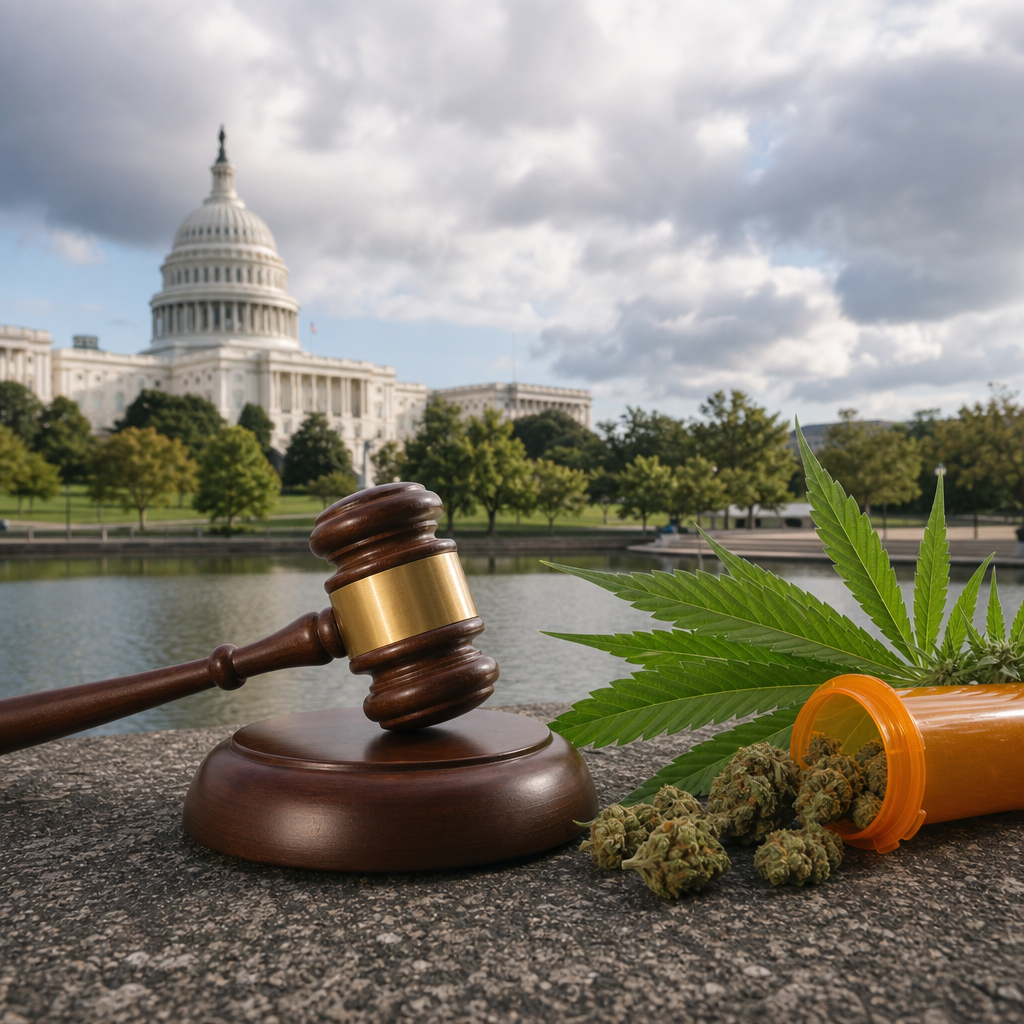
Marijuana federalism describes the uneasy arrangement in which states legalize cannabis for medical or adult use while the federal government still bans it under national law. In AP Government and Politics, this topic matters because it shows federalism in action, not as an abstract diagram but as a live conflict over police power, commerce, taxation, elections, and constitutional limits. I have used marijuana policy in civics instruction because students immediately see the tension: a voter can approve legalization in one state and still live under a federal statute that classifies marijuana as illegal everywhere. That contradiction makes the issue one of the clearest modern case studies of divided sovereignty.
At the federal level, marijuana remains a Schedule I substance under the Controlled Substances Act, meaning Congress has treated it as having high abuse potential and no accepted medical use under federal standards. At the state level, legalization usually means a state removes criminal penalties, creates a licensing system, taxes sales, and regulates cultivation, testing, packaging, and retail distribution. State legalization does not make marijuana legal nationwide. It means the state has chosen not to punish certain conduct under state law and has built rules for a legal state market. The federal ban still exists in the background.
This issue matters beyond drug policy. It reveals how the Supremacy Clause works, what the anti-commandeering doctrine protects, why cooperative federalism sometimes fails, and how administrative discretion shapes real policy. It also affects banking, public employment, firearms possession, immigration status, and higher education research. For students studying AP Government and Politics, marijuana federalism connects constitutional design to headlines, ballot initiatives, agency guidance, and court decisions. Understanding it helps explain not only cannabis policy but also how American government handles conflict when national and state priorities diverge sharply.
The Constitutional Framework Behind Marijuana Federalism
The central constitutional question is simple: how can states legalize something that federal law prohibits? The answer begins with dual sovereignty. States and the federal government are separate governments with separate sources of authority. Congress can criminalize marijuana under its power to regulate interstate commerce, and the Supreme Court confirmed broad federal authority in cases such as Gonzales v. Raich in 2005. In Raich, the Court held that Congress could prohibit even locally cultivated medical marijuana allowed by California law because homegrown cannabis could affect the larger interstate market. That decision did not force states to criminalize marijuana. It confirmed that federal prohibition was constitutionally valid.
The next piece is the anti-commandeering principle. The federal government cannot require state legislatures to enact federal policy or order state officers to enforce federal law. That doctrine, associated with New York v. United States and Printz v. United States, is the reason states may repeal their own marijuana bans. A state is not nullifying federal law when it legalizes cannabis. It is deciding that its own police and prosecutors will not punish certain marijuana activity under state statutes. Federal agents may still enforce federal law, but the federal government must generally use its own personnel and resources.
The Supremacy Clause still matters. If state law directly conflicts with federal law in a way that makes compliance with both impossible, federal law prevails. In marijuana policy, however, most state legalization systems are structured to avoid direct conflict by removing state penalties and creating licensing rules rather than trying to block federal enforcement. That is why modern legalization laws are often described as decriminalization plus regulation. They do not erase federal prohibition. They create a state-level exception to state punishment, leaving the federal-state tension unresolved but manageable in practice.
How State Legalization Actually Works
When a state legalizes marijuana, it usually follows a regulatory model similar to alcohol control, though the details vary widely. Legislatures or voters define possession limits, home cultivation rules, age restrictions, product categories, tax rates, and licensing requirements for growers, processors, testing laboratories, distributors, and retailers. Regulators then write detailed administrative rules for security cameras, seed-to-sale tracking, potency labeling, pesticide testing, child-resistant packaging, and advertising restrictions. In practice, legalization is not a simple declaration that marijuana is allowed. It is a dense administrative system that determines who may participate and under what conditions.
I have seen students assume legalization means a free market. It does not. State cannabis markets are among the most regulated commercial sectors in the country. Colorado and Washington, the first states to launch adult-use markets in 2014, built extensive compliance systems, including inventory tracking and mandatory lab testing. States such as California layered local control on top of statewide licensing, allowing cities and counties to ban or limit cannabis businesses. That local option explains why a substance can be legal under state law yet unavailable in large parts of the state. Federalism operates inside states too, through state-local relationships.
Most legalization laws pursue several goals at once: reducing arrests, displacing illicit markets, protecting public health, and generating tax revenue. Those goals sometimes conflict. High taxes can preserve illicit sales. Strict license caps can keep prices elevated and limit access. Weak enforcement against unlicensed operators can undercut the legal market. Strong enforcement can reproduce some harms of prohibition. Policymakers therefore treat legalization as an ongoing regulatory project, not a single vote. States revise rules constantly as they learn what works and what creates unintended consequences.
| State policy feature | Typical rule | Why it matters |
|---|---|---|
| Minimum age | 21 for adult-use purchases | Aligns cannabis access with alcohol-style age limits and reduces youth access risks |
| Licensing | Separate licenses for cultivation, processing, testing, and retail | Allows oversight and targeted enforcement across the supply chain |
| Seed-to-sale tracking | Digital inventory monitoring using systems such as Metrc | Helps prevent diversion to illicit markets and improves recall capability |
| Local control | Cities or counties may ban or cap businesses | Creates uneven access and shapes where the legal market can operate |
| Excise taxes | Percentage tax at wholesale or retail | Raises revenue but can make legal products less competitive |
| Testing and labeling | Potency, contaminants, and package warnings required | Supports consumer safety and product transparency |
Why Federal Prohibition Still Shapes State Markets
Even where state legalization is well established, federal prohibition affects almost every business decision. The most obvious problem is banking. Because marijuana sales involve activity illegal under federal law, many banks avoid the industry despite guidance from the Financial Crimes Enforcement Network. Businesses often struggle to obtain checking accounts, credit lines, payment processing, and ordinary commercial loans. Cash-heavy operations create security risks, complicate payroll and tax payments, and make compliance more expensive. Some credit unions and state-chartered institutions serve cannabis firms, but access remains uneven and costly.
Tax law is another major pressure point. Section 280E of the Internal Revenue Code prohibits businesses trafficking in Schedule I or II substances from deducting ordinary business expenses. As a result, legal cannabis retailers can face effective tax rates far higher than comparable firms in other industries. They may deduct cost of goods sold, but not many routine operating expenses. I have used simple retail examples with students to show the effect: a company that looks profitable on paper can be squeezed by a tax bill that would be unmanageable in a normal market. That policy alone has shaped consolidation, pricing, and business failure rates.
Federal prohibition also complicates employment, housing, and civil rights questions. Federal workers and military personnel remain subject to federal rules. Public housing residents can face consequences tied to federal standards. Noncitizens may encounter immigration problems because cannabis activity can trigger inadmissibility or other penalties under federal law. Firearms law creates another conflict because unlawful users of controlled substances are restricted under federal statutes, raising questions even for state-legal consumers. These examples show that legalization is not a single legal status. It is a patchwork of permissions and disabilities depending on which government, agency, or benefit system is involved.
Enforcement, Prosecutorial Discretion, and Federal Guidance
If federal law still bans marijuana, why are state-legal markets operating openly? The practical answer is enforcement discretion. The federal government has never had the resources to police every marijuana transaction nationwide, especially after many states replaced prohibition with licensing. During the Obama administration, the Department of Justice issued the Cole Memorandum in 2013, which told federal prosecutors to prioritize issues such as distribution to minors, revenue to criminal enterprises, diversion to other states, violence, and activity on federal property. The memo did not legalize marijuana, but it signaled restrained federal enforcement where states maintained robust regulatory systems.
In 2018, Attorney General Jeff Sessions rescinded the Cole Memorandum, reminding everyone that guidance can change more quickly than statutes. Even so, broad federal crackdowns on state-legal markets did not follow. One reason is political reality. By then, legalization had spread, tax revenues were significant, and public support was high. Another reason is Congress. Since 2014, appropriations riders commonly called the Rohrabacher-Farr and later Rohrabacher-Blumenauer amendment have limited the Department of Justice from using certain funds to interfere with state medical marijuana programs. In United States v. McIntosh, the Ninth Circuit interpreted that rider to restrict prosecutions of people acting in strict compliance with state medical laws.
This pattern teaches an important AP Government lesson: administrative law and budget politics can shape policy as much as headline statutes. Guidance documents, appropriations restrictions, enforcement priorities, and agency staffing all affect what the law means in daily life. The legal baseline remains federal prohibition, but the lived system depends on choices made by prosecutors, regulators, and Congress each budget cycle. That is why marijuana federalism is often stable in practice yet unstable in theory.
Political Development, Ballot Initiatives, and Public Opinion
Marijuana legalization spread through both direct democracy and ordinary legislation. Western states moved first, with California approving medical marijuana in 1996 through Proposition 215. Colorado and Washington then adopted adult-use legalization by ballot initiative in 2012. Later, states including Illinois, New Jersey, New Mexico, New York, Minnesota, and Virginia used legislative pathways for at least part of their reform process. The route matters politically. Ballot initiatives can move faster when legislatures are reluctant, but legislative systems may produce more detailed implementation rules and allow easier revision when the first framework proves imperfect.
Public opinion has shifted dramatically. Gallup polling has shown majority national support for legalization for years, a major change from the late twentieth century. Bipartisan support exists, though the coalition is not identical across parties or regions. Some voters prioritize criminal justice reform, citing racially unequal enforcement of marijuana laws. Others focus on states’ rights, medical autonomy, tax revenue, or skepticism about the drug war. Opponents raise concerns about youth use, impaired driving, commercialization, high-potency products, and normalization. Serious policy analysis acknowledges both sets of arguments because legalization is not cost free.
For a hub page in AP Government and Politics, this topic also links to campaign politics, interest groups, and agenda setting. Industry associations, patient advocates, civil liberties groups, law enforcement organizations, and public health experts all compete to define the issue. Framing matters. When advocates emphasize medical access, reform often gains moderate support. When opponents emphasize corporate concentration or adolescent brain development, they can slow expansion or shape stricter rules. Marijuana policy therefore offers a compact model of how institutions, public opinion, and organized interests interact over time.
What Students Should Watch Next
The next phase of marijuana federalism will likely turn on rescheduling, banking reform, interstate commerce disputes, and equity policy. Rescheduling marijuana to Schedule III, if completed through the federal administrative process, would not by itself create nationwide legalization, but it could change tax treatment by removing the 280E problem and alter research conditions. Banking reform proposals such as the SAFE Banking Act have drawn repeated attention because they would address public safety and financial access without fully ending prohibition. Courts may also confront whether states can exclude out-of-state operators if cannabis remains federally illegal yet state markets become more economically integrated.
Another major issue is social equity. Many states now try to direct licenses, grants, or reinvestment funds toward communities disproportionately harmed by past enforcement. Results have been mixed. Equity applicants often face high capital requirements, local zoning barriers, and delays in licensing. New York, Illinois, and California have all wrestled with the gap between equity goals and market realities. Students should watch how governments design remedies that are legally defensible, administratively workable, and substantial enough to matter. The details reveal whether reform changes opportunity or merely changes who profits.
The larger lesson is enduring. Marijuana federalism shows that American government can sustain long periods of legal contradiction when institutions have overlapping authority and different political incentives. States can innovate, Congress can hesitate, agencies can adapt, and courts can permit the tension to continue. For anyone studying AP Government and Politics, this is more than a cannabis story. It is a practical guide to federalism, separation of powers, public policy, and constitutional conflict. Use this hub as a starting point, then explore the linked subtopics on courts, bureaucracy, civil liberties, elections, and state government to see how one issue illuminates the entire system.
Frequently Asked Questions
1. How can states legalize marijuana if federal law still prohibits it?
States can legalize marijuana within their own borders because of the basic structure of American federalism. Under the Constitution, both the federal government and the states have their own spheres of authority. Congress has the power to regulate interstate commerce and to enact national criminal laws tied to its constitutional powers, while states retain broad “police powers” to regulate health, safety, and morals inside the state. That means a state can choose to repeal its own marijuana prohibitions, stop arresting people under state law, and create a licensing system for growers, sellers, and consumers. At the same time, the federal government can still maintain marijuana as illegal under the Controlled Substances Act.
This is not a contradiction so much as a layered legal system. State legalization does not make marijuana legal under federal law; it means the state has decided not to punish certain conduct under state law. Federal prohibition remains in place, but the federal government does not have the resources to police every marijuana transaction in every legalized state. As a result, what exists in practice is a split system: conduct may be permitted by the state and still forbidden by the federal government.
This arrangement is also shaped by the anti-commandeering principle. The federal government cannot generally force states to criminalize marijuana or require state officers to enforce federal drug laws. So even though federal law remains supreme when it conflicts with state law, states are not obligated to use their own legislatures, police, prosecutors, or courts to carry out the federal ban. That is why states can move ahead with medical or adult-use legalization even while federal prohibition technically remains on the books.
2. Does the Supremacy Clause mean federal marijuana law automatically cancels state legalization?
Not automatically. The Supremacy Clause does make valid federal law “the supreme Law of the Land,” and when a direct conflict exists, federal law prevails. But that does not mean every state marijuana law disappears the moment it differs from federal policy. The key question is what kind of conflict exists. If a state law required people to violate federal law, that would raise a serious preemption problem. But most legalization laws do something different: they remove state penalties and create state regulatory rules. In other words, they do not force the federal government to allow marijuana, and they do not force private individuals to break federal law. They simply reflect the state’s decision not to punish marijuana under state law.
That is why courts have generally allowed states to decriminalize or regulate marijuana even while acknowledging that federal prohibition still exists. The federal government remains free to enforce its own law directly. What states cannot do is block federal agents from enforcing federal statutes or claim that state legalization overrides Congress. But states can decline to mirror federal policy in their own criminal codes.
In practical terms, the Supremacy Clause creates a legal hierarchy, not a requirement that state and federal policy always be identical. Marijuana federalism survives because states are not nullifying federal law; they are choosing their own enforcement priorities and regulatory models within the space left to them. That distinction is essential in AP Government and Politics because it shows how supremacy and state autonomy can coexist in a tense but workable balance.
3. Why doesn’t the federal government simply shut down all state-legal marijuana markets?
In theory, the federal government has broad authority to enforce the Controlled Substances Act against marijuana businesses, even if those businesses are fully licensed under state law. In practice, several limits make a nationwide crackdown difficult. First, federal law enforcement resources are finite. The Drug Enforcement Administration, federal prosecutors, and other agencies cannot realistically replace the entire enforcement apparatus of dozens of states. If a state stops making marijuana possession and sales a state crime, the federal government does not suddenly gain enough personnel to police every dispensary, farm, warehouse, and consumer.
Second, enforcement has long been influenced by politics, appropriations, and administrative priorities. Different presidential administrations have taken different approaches to marijuana enforcement, ranging from relative tolerance of well-regulated state markets to more aggressive rhetoric. Congress has also restricted some enforcement through spending riders, particularly in the medical marijuana context, by limiting the Justice Department’s ability to interfere with certain state medical cannabis programs. Those restrictions are not the same as legalization, but they matter because they shape what federal agencies can realistically do.
Third, federalism itself changes the equation. States control many of the day-to-day systems that make a legal market function, including licensing, inspections, zoning, tax collection, and local business regulation. Once a state builds a regulated framework, it creates political and economic interests that are hard to unwind. Businesses invest, voters adapt, and tax revenues become part of state and local budgets. That does not eliminate federal power, but it raises the political cost of broad enforcement. The result is the uneasy compromise people mean when they talk about marijuana federalism: federal prohibition remains legally real, yet state legalization continues because enforcement is selective, resource-lation are likely to keep colliding until Congress changes federal law or the courts redefine the balance more dramatically.
4. What does marijuana federalism reveal about police power, commerce, taxation, and elections?
Marijuana policy is such a useful civics example because it touches several core AP Government concepts at once. Start with police power. States traditionally regulate public health, safety, and morals, so decisions about whether to criminalize possession, permit medical use, or license dispensaries fall naturally into state policymaking. When a state legalizes marijuana, it is exercising that broad state authority to set criminal justice and health policy for its own residents.
Commerce is the next major issue. The federal government justifies national drug regulation largely through the Commerce Clause, especially because marijuana production and distribution can affect interstate markets. Even marijuana grown and sold entirely within one state can be reached by federal law under existing precedent, because Congress may regulate local activity that, in the aggregate, affects interstate commerce. This is one reason federal prohibition has remained constitutionally durable despite state-level reform.
Taxation adds another layer. States that legalize marijuana often impose excise taxes, licensing fees, and sales taxes, turning a formerly illicit market into a source of public revenue. Those funds may support schools, public health programs, infrastructure, or drug education. At the federal level, however, marijuana businesses face unusual tax burdens because of federal rules such as Internal Revenue Code Section 280E, which has historically prevented businesses trafficking in federally prohibited substances from taking ordinary business deductions. That means a business can be legal under state law and still face punishing federal tax consequences.
Elections are equally important. In many states, marijuana legalization has advanced through ballot initiatives, showing direct democracy at work. Voters can force policymakers to confront an issue that legislatures may avoid. Marijuana policy also illustrates how public opinion can pressure both state and federal institutions over time. Candidates campaign on reform, governors shape enforcement priorities, attorneys general signal legal strategy, and members of Congress respond to changing attitudes among constituents. For students, this makes federalism concrete: marijuana is not just a dispute over one substance, but a case study in how institutions, voters, and constitutional powers interact in real time.
5. What are the biggest legal and practical problems created by the conflict between state legalization and federal prohibition?
The biggest problem is uncertainty. When marijuana is legal under state law but illegal under federal law, individuals, businesses, banks, schools, employers, landlords, and public officials all operate in a gray area. A consumer may buy marijuana lawfully from a licensed dispensary in one state and still violate federal law by possessing it on federal property, carrying it into a national park, or transporting it across state lines. Employees may be protected under some state laws and still face workplace consequences under federal rules or employer drug policies. Students can quickly see that “legal” and “illegal” depend on which government is asking the question.
For businesses, the conflict is especially serious. Banking has long been difficult because federally regulated financial institutions are wary of money-laundering and other federal risks associated with servicing marijuana companies. Many cannabis businesses have therefore operated heavily in cash, which raises security, accounting, and transparency concerns. Interstate commerce is another major issue. Even if two neighboring states both allow marijuana sales, moving cannabis across a state border can trigger federal law because interstate transport remains federally prohibited. This traps the industry inside state lines and creates inefficient, fragmented markets.
There are also broader constitutional and policy tensions. Uneven legalization can create disparities in criminal enforcement, especially when neighboring states take very different approaches. Social equity goals may be difficult to achieve when federal law limits access to capital and normal business services. Research barriers can persist because federal scheduling rules complicate scientific study. Immigration consequences can arise for non-citizens, since conduct allowed under state law may still carry federal immigration risks. Firearm ownership issues can surface as well, because federal law treats unlawful drug users differently even if the relevant drug use is permitted by state law.
Ultimately, the conflict matters because it exposes the limits of partial reform. State legalization has changed daily life for millions of Americans, but it has not fully resolved the underlying legal contradiction. That is why marijuana federalism is such an important teaching example: it demonstrates that federalism is not always neat or stable. Sometimes it produces overlap, friction, compromise, and ongoing institutional conflict. In this case, those pressures continue to shape policy until either federal law