
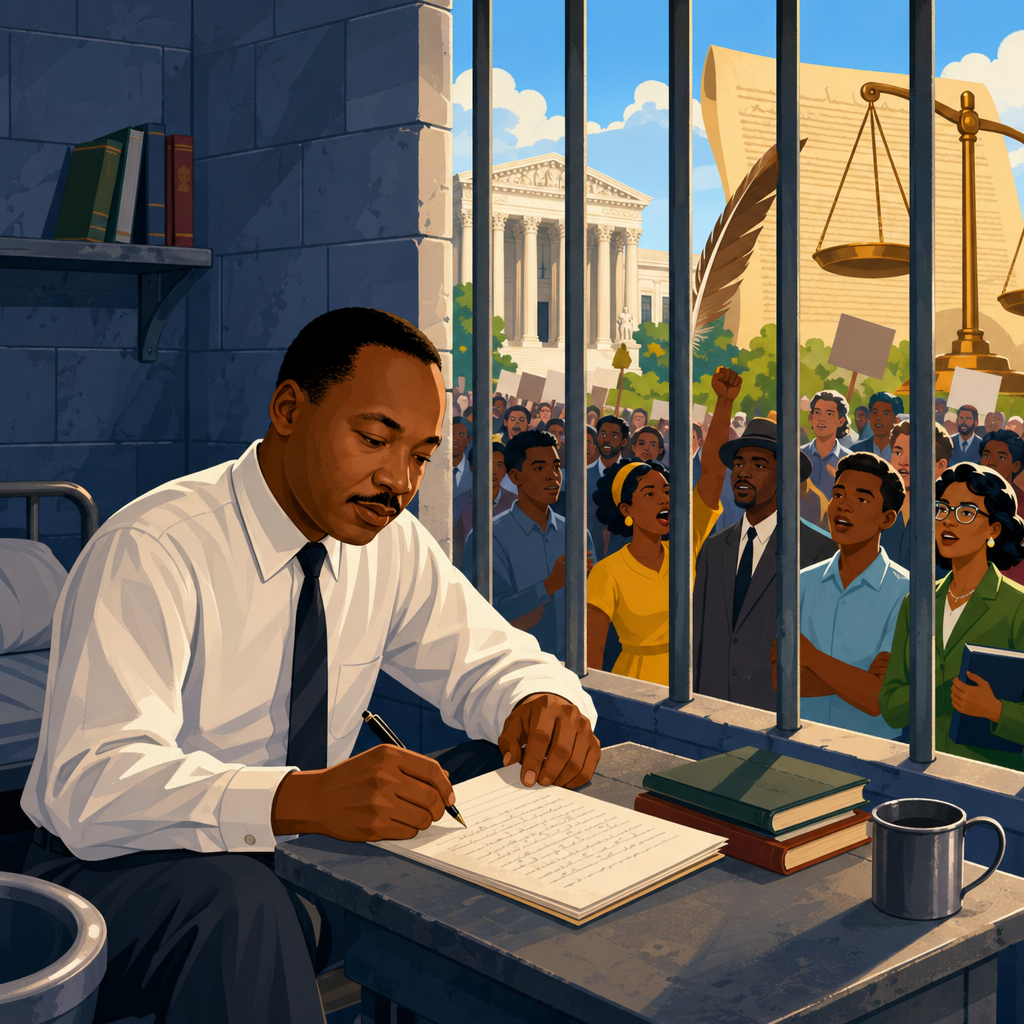
Martin Luther King Jr.’s “Letter from Birmingham Jail” is one of the most important documents in AP Government and Politics because it connects civil disobedience, constitutional interpretation, and democratic change in a single argument. Written in April 1963 after King was arrested during nonviolent protests in Birmingham, Alabama, the letter answered white clergymen who called the demonstrations unwise and untimely. In practice, it became far more than a response to critics. It offered a theory of citizenship, a defense of direct action, and a moral framework for understanding when citizens may challenge law in order to improve constitutional order. For students studying institutions, rights, federalism, and political participation, the letter works as a hub text because it ties together many themes that usually appear in separate units.
Civil disobedience means the open, intentional, nonviolent violation of law to protest injustice and force public attention to a moral or constitutional wrong. It is not the same as random lawbreaking, violence, or revolution. In the tradition King drew from, especially Henry David Thoreau, the Social Gospel, and Mahatma Gandhi, civil disobedience accepts legal penalties to dramatize the difference between legality and justice. Constitutional change, by contrast, refers to changes in how the Constitution is understood, applied, and enforced. Those changes can come formally through amendments, but in American government they often emerge through court decisions, congressional action, executive enforcement, and social movements that reshape public meaning.
That distinction matters. The Constitution does not automatically enforce itself. Rights stated on paper often depend on officials, judges, activists, journalists, and ordinary citizens to make them real. By 1963, the Fourteenth Amendment had existed for nearly a century, yet segregation still dominated public life in much of the South. Brown v. Board of Education had been decided in 1954, but many state and local governments resisted desegregation. King’s letter explains why waiting for institutions alone was not enough. When political channels are blocked, negotiation is refused, and injustice is maintained through law, nonviolent direct action can create the pressure necessary for constitutional promises to become lived reality.
In classrooms, I have found that students understand the letter best when they stop treating it as only a civil rights document and start reading it as a constitutional argument. King distinguishes just laws from unjust laws, invokes natural law and democratic accountability, criticizes procedural delay, and insists that marginalized groups cannot be told to wait indefinitely for rights already guaranteed. Those are foundational questions in American politics. Who decides whether a law is legitimate? When should citizens obey? How do courts, Congress, presidents, states, and movements interact? “Letter from Birmingham Jail” remains central because it answers those questions with unusual clarity while showing how protest can move constitutional development forward.
Historical context: Birmingham, segregation, and the crisis of enforcement
Birmingham was not chosen by accident. In 1963 it was one of the most segregated cities in the United States and had a reputation for racial violence, bombings, and aggressive policing. Local officials, especially Commissioner of Public Safety Eugene “Bull” Connor, defended segregation through arrests, intimidation, and force. The Southern Christian Leadership Conference, working with the Alabama Christian Movement for Human Rights led by Fred Shuttlesworth, targeted Birmingham because local conditions made the gap between American ideals and Southern practices impossible to ignore. Their campaign used marches, sit-ins, boycotts, and strategic arrests to provoke a public confrontation that would attract national attention.
The legal background is essential for AP Government. The post–Civil War amendments had transformed the Constitution by abolishing slavery, defining citizenship, and requiring equal protection and due process. Yet for decades those guarantees were narrowed by courts and undermined by state law. Jim Crow segregation, poll taxes, literacy tests, white primaries, and racially discriminatory policing kept African Americans politically subordinate. Even after Brown rejected segregated public schools, implementation was uneven and slow. Southern officials used “massive resistance,” local ordinances, and procedural delay to preserve segregation. King’s letter was written in this environment of formal rights without consistent enforcement.
The immediate trigger was a public statement by eight white Alabama clergymen who criticized the demonstrations as extremist and premature. They urged Black citizens to pursue their goals through courts and negotiation rather than protest. King answered that negotiation had already been attempted and repeatedly blocked. He outlined the disciplined steps of a nonviolent campaign: collection of facts, negotiation, self-purification, and direct action. That sequence matters because it refutes the claim that civil disobedience is impulsive. In Birmingham, activists first documented injustice, then sought talks, then trained participants to endure abuse without retaliation, and only then acted publicly.
The televised response from authorities changed national politics. Images of children and adults attacked by police dogs and high-pressure fire hoses exposed the brutality behind “law and order” defenses of segregation. This is a classic example of how social movements shape constitutional change indirectly. The protesters did not pass a statute or issue a judicial ruling, but they altered public opinion, increased pressure on federal officials, and helped create momentum for the Civil Rights Act of 1964. In other words, direct action worked as a constitutional catalyst by making continued inaction politically unsustainable.
King’s argument: just laws, unjust laws, and the legitimacy of protest
The most cited section of the letter is King’s distinction between just and unjust laws. A just law, he wrote, squares with moral law and uplifts human personality. An unjust law degrades human personality and is often imposed by a majority on a minority that had no real voice in making it. He gives concrete examples: segregation is unjust because it distorts the soul and damages both the segregated and the segregator; a law can also be unjust in application, such as a facially neutral permitting rule enforced to suppress protest. This distinction remains useful in constitutional analysis because legality alone does not settle legitimacy.
King also rejects the “wait” argument with unusual force. His point is not merely emotional, though he describes the daily humiliations of segregation in vivid detail. He is also making an institutional claim: delay often functions as denial. Courts can move slowly, elected officials can avoid conflict, and moderates can prefer order to justice. In that setting, demands for patience preserve the status quo. Students often notice that this logic still appears in disputes over voting rights, school funding, disability access, and immigration policy. When people hear “not now,” they should ask who benefits from delay and whose rights remain unrealized.
Another major contribution is King’s defense of constructive tension. He argues that nonviolent direct action creates a crisis that forces negotiation. That can sound disruptive, but his point is precise. Tension already existed because injustice already existed; protest simply made it visible. Constitutional democracies frequently change only when hidden conflicts become impossible to ignore. The labor movement, the women’s rights movement, the disability rights movement, and the marriage equality movement all used lawful advocacy plus strategic disruption to make institutions respond. King’s theory explains why peaceful protest is not anti-democratic. It can be a mechanism that reopens blocked democratic channels.
| Concept in the Letter | What King Means | Government and Politics Connection |
|---|---|---|
| Civil disobedience | Open, nonviolent lawbreaking to expose injustice while accepting punishment | Shows how participation can challenge policy outside elections and courts |
| Just vs. unjust law | Legitimacy depends on moral and democratic fairness, not only legal form | Links natural rights ideas to equal protection and due process debates |
| Constructive tension | Peaceful disruption can force negotiation when officials refuse action | Explains agenda setting and movement influence on institutions |
| Critique of moderation | Preference for order can delay justice more than open opposition does | Illustrates limits of incrementalism in constitutional development |
King’s reply to the charge of extremism is equally important. Rather than denying the label, he reframes it by asking what kind of extremist one will be: for hate or for justice, for oppression or for love. This is a strategic rhetorical move, but it is also a constitutional one. Many reforms now treated as mainstream began as positions criticized as radical. Abolition, women’s suffrage, labor protections, and interracial marriage all faced charges of extremism before entering accepted constitutional culture. King understood that constitutional change often begins at the margins and moves inward through persuasion, pressure, and institutional adoption.
How civil disobedience drives constitutional change
The letter helps explain a recurring pattern in American political development: movements identify a gap between constitutional principle and political reality, dramatize that gap through protest, and then push institutions to respond. This pattern does not mean every protest succeeds or that courts simply follow crowds. It means constitutional meaning is shaped through interaction. Congress writes statutes, presidents enforce them, courts interpret them, and movements influence all three by changing public opinion and raising the cost of inaction. In my experience teaching this process, students grasp it fastest when they map Birmingham to later developments: mass protest helped create the conditions for landmark federal legislation.
One clear result was the Civil Rights Act of 1964. The statute prohibited discrimination in public accommodations, employment, and programs receiving federal funds, and it strengthened federal enforcement against segregation. The Voting Rights Act of 1965 followed, attacking literacy tests and authorizing federal oversight of discriminatory election systems. Neither law emerged from King’s letter alone, of course, but the Birmingham campaign was among the events that pushed the Kennedy and Johnson administrations toward stronger action. This is constitutional change in the broader sense: the meaning of equal citizenship became more fully enforced through national legislation grounded in constitutional authority.
Courts also matter here, but King’s letter shows their limits. Brown v. Board announced a principle, yet implementation required political will, executive support, and movement pressure. The Supreme Court can declare rights, but judges lack the capacity to transform society by decree alone. Political scientists sometimes call this the implementation problem. Rights become real when multiple institutions align behind them. The lesson for AP Government is practical: judicial review is powerful, but constitutional change usually depends on a coalition of litigation, public advocacy, administrative enforcement, and electoral pressure.
The letter’s influence extends beyond race. Arguments drawn from King appear in debates about antiwar protest, LGBTQ rights, environmental justice, and disability activism. The sit-ins of the 1960s inspired later forms of nonviolent occupation and public witness. Activists frequently use direct action not because they reject constitutional government but because they want institutions to honor constitutional commitments more consistently. The method has tradeoffs. Public disruption can alienate some audiences, and movements can misjudge timing or tactics. Still, King’s framework endures because it explains when disruption is justified: after facts are gathered, negotiation is attempted, and the normal process remains closed.
Why the letter remains a core text for AP Government and Politics
For AP Government and Politics, this document belongs in the “Misc” hub because it links foundational concepts that students often study separately. It illuminates political participation, the constitutional basis of civil rights, the role of the courts, the importance of federalism, and the influence of public opinion and social movements. It also sharpens comparison. Students can set King against James Madison on factions, against Federalist concerns about disorder, against Supreme Court reasoning in Brown, or against later controversies involving protest permits, public forums, and content-neutral restrictions. Few texts do more to connect theory, institutions, and action.
The letter also teaches an essential democratic lesson: constitutional stability does not require passive obedience. In a healthy republic, dissent can strengthen legitimacy by forcing institutions to confront hypocrisy and extend rights more fully. That is why the document still appears in court opinions, political speeches, and civic education. It offers a standard for evaluating protest that is both demanding and realistic: protest should be public, disciplined, and tied to a clear injustice, yet citizens must not confuse legality with justice or calm with fairness. Read closely, the letter is not an argument against law. It is an argument for a better constitutional order.
The lasting benefit of studying “Letter from Birmingham Jail” is that it teaches how democratic change actually happens. Constitutional principles matter, but they become meaningful only when citizens, movements, and institutions force the nation to live up to them. Birmingham shows that civil disobedience can be lawful in spirit even when illegal in act, especially when it exposes rules designed to preserve inequality. For students building a broad understanding of AP Government and Politics, this text is a hub because it connects rights, institutions, political behavior, and public policy in one unforgettable case. Revisit the letter alongside Brown, the Civil Rights Act, and the Voting Rights Act, and use it as a guide for analyzing how protest reshapes American government.
Frequently Asked Questions
Why is Martin Luther King Jr.’s “Letter from Birmingham Jail” so important in AP Government and Politics?
“Letter from Birmingham Jail” matters so much in AP Government and Politics because it brings together core themes of the course in one powerful document: civil disobedience, constitutional principles, federalism, equal protection, due process, democratic participation, and the relationship between law and justice. Written in April 1963 after King was arrested for participating in nonviolent protests in Birmingham, Alabama, the letter was initially a response to white clergymen who criticized the demonstrations as untimely and disruptive. But its significance quickly expanded beyond that moment. King built a broad argument about why citizens sometimes must challenge existing laws and institutions in order to make constitutional democracy live up to its promises.
For AP Gov students, the letter is especially valuable because it shows that constitutional change does not happen only through courts, legislatures, or presidents. It also happens through organized political action, social movements, public pressure, and moral argument. King explains that rights may be formally guaranteed on paper, yet denied in practice through local customs, discriminatory laws, and government inaction. That idea helps students understand the gap that can exist between constitutional ideals and political reality. The letter therefore serves as a bridge between the Constitution as a legal framework and democracy as an ongoing struggle over inclusion, equality, and legitimacy.
It also gives students a sophisticated view of political participation. Rather than presenting protest as disorder, King frames nonviolent direct action as a democratic tool designed to force negotiation when officials refuse to address injustice. In that sense, the letter teaches that political systems often resist change until citizens create pressure that cannot be ignored. That insight is central to understanding the civil rights movement and, more broadly, the ways constitutional systems evolve over time. In short, the letter is important not only because of what it says about segregation, but because of what it teaches about power, citizenship, and constitutional change in the United States.
How does the letter define civil disobedience, and why does King believe it can be justified?
King’s letter offers one of the clearest defenses of civil disobedience in American political thought. He argues that civil disobedience is not lawlessness for its own sake. Instead, it is the open, nonviolent, and conscientious violation of unjust laws in order to expose injustice and call a community back to higher constitutional and moral principles. This is a crucial distinction. King is not rejecting the idea of law altogether; he is making a careful argument that there is a difference between just laws, which align with human dignity and moral equality, and unjust laws, which degrade people, deny equal treatment, or impose rules on groups that had no meaningful voice in making them.
One of the letter’s most quoted arguments is King’s claim that “an unjust law is no law at all,” a formulation rooted in natural law traditions and Christian theology. He explains that a just law uplifts human personality, while an unjust law distorts it. Segregation, in his view, is unjust because it gives one group a false sense of superiority and another a false sense of inferiority. That moral reasoning also has a constitutional dimension. In practice, segregation violated the equal citizenship promised by the Fourteenth Amendment, even when local officials defended it under the banner of order or tradition.
King also insists that true civil disobedience accepts legal consequences. That point is important because it shows respect for the broader rule of law even while challenging particular laws. By willingly going to jail, protesters dramatize the injustice of the system and reveal the moral seriousness of their cause. In King’s framework, accepting punishment is not surrender; it is a way of highlighting how the legal order itself has become disconnected from justice. This makes civil disobedience both a political tactic and a constitutional argument. It is a way of saying that when ordinary channels are blocked and officials refuse to negotiate, disciplined nonviolent resistance can push the system toward reform.
What is the connection between the letter and constitutional change in the United States?
The letter is deeply connected to constitutional change because it explains how the meaning of constitutional principles can be transformed through political struggle. The Constitution does not interpret or enforce itself. Even when its text promises liberty and equality, those promises often remain limited until citizens, movements, courts, and elected officials contest their meaning in real life. King’s argument shows that constitutional development is not just a matter of Supreme Court decisions; it is also shaped by social action that pressures institutions to respond.
This point is especially clear in the context of the civil rights movement. By 1963, the Supreme Court had already ruled in Brown v. Board of Education that school segregation was unconstitutional, yet racial injustice remained deeply entrenched across the South. Birmingham was a powerful example of how local authorities could resist constitutional change despite federal rulings. King’s letter explains why waiting was not neutral. Delay protected existing power structures and allowed constitutional violations to continue. Nonviolent protest, then, became a mechanism for turning abstract rights into enforceable realities.
The letter also reflects a broader truth about American constitutional history: major expansions of rights often emerge from conflict between citizens and institutions. Movements for abolition, women’s suffrage, labor rights, civil rights, and voting rights all depended on sustained public activism. King understood that constitutional change requires more than legal logic; it requires public urgency. His defense of direct action was designed to create that urgency by exposing injustice so clearly that negotiation and reform could no longer be postponed. In that sense, the letter is not only about Birmingham. It is about how democracy changes when excluded or marginalized groups force the nation to confront the contradiction between its ideals and its practices.
Why does King reject the idea that the protests were “untimely” or that activists should simply wait?
King rejects the call to wait because, in his experience, “wait” almost always meant “never.” One of the most powerful themes in the letter is his critique of moderation that values order over justice. The white clergymen who criticized the Birmingham campaign argued that the protests were unwise and poorly timed, but King responds that African Americans had already waited for generations for basic constitutional and human rights. He lists the daily humiliations of segregation not as abstract grievances, but as lived experiences that show why delay is itself a form of injustice.
His argument is both practical and constitutional. Practically, local leaders had repeatedly failed to negotiate in good faith. Direct action became necessary because normal channels were either closed or ineffective. Constitutionally, continued delay meant continued denial of equal protection, equal citizenship, and freedom from arbitrary discrimination. King understood that people in positions of comfort often ask for patience because they do not bear the costs of the status quo. That is why he draws such a sharp distinction between superficial peace and genuine justice. A society may appear calm on the surface while still enforcing profound injustice underneath.
King’s response also highlights a major lesson about democratic politics: timing is often controlled by those who benefit from inaction. If reformers must wait until opponents are fully comfortable, change may never come. Nonviolent protest interrupts that cycle. It creates constructive tension, not violence, but enough pressure to make negotiation unavoidable. In AP Government terms, this is a lesson about agenda setting and political power. The protests were not untimely; they were timed to confront a system that had long manipulated delay to preserve inequality. King’s insight remains relevant because many movements since then have faced the same criticism—that their demands are valid in theory but inconvenient in the present. His answer is clear: rights delayed are rights denied.
How does “Letter from Birmingham Jail” help explain the relationship between morality, law, and democracy?
The letter is so enduring because it refuses to separate morality, law, and democracy into isolated categories. King argues that a democratic society cannot be judged only by whether it has laws and procedures; it must also be judged by whether those laws are just and whether those procedures genuinely include all citizens. This is a vital insight for students of government. Legal systems can produce unfair outcomes if they reflect unequal power or if officials selectively enforce rights. Democracy is therefore not simply majority rule. It also depends on constitutional commitments, minority rights, and moral accountability.
King’s discussion of just and unjust laws illustrates this relationship clearly. He does not say that personal morality should casually override law whenever someone disagrees with a policy. Instead, he develops a disciplined framework: laws are legitimate when they are rooted in justice, applied equally, and consistent with human dignity; they lose legitimacy when they degrade persons, entrench hierarchy, or are imposed without meaningful democratic reciprocity. This framework helps explain why segregation was not merely a bad policy choice. It was a violation of both moral truth and constitutional principle.
At the same time, King’s argument is profoundly democratic. He is not calling for private withdrawal from public life; he is calling for deeper engagement in it. Through protest, public persuasion, coalition building, and sacrifice, citizens can compel democratic institutions to confront exclusion and reform themselves. That is one reason the letter remains so relevant in discussions of constitutional interpretation and civic action. It teaches that democracy requires more than obedience. It requires citizens who are willing to test whether the nation’s laws truly reflect its highest principles. In that sense, “Letter from Birmingham Jail” is not only a defense of civil disobedience. It is a theory of democratic renewal, showing how moral courage and collective action can