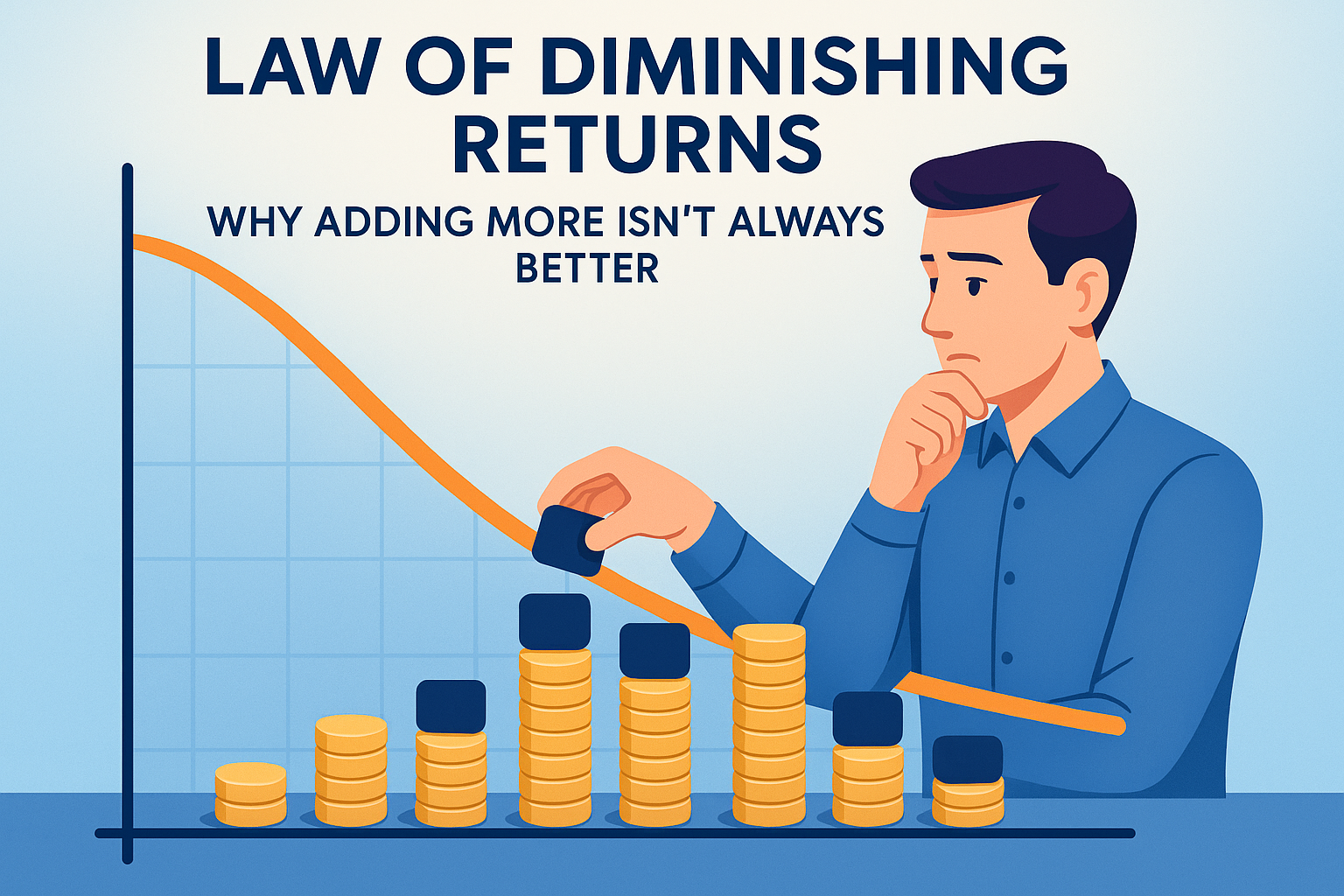
The law of diminishing returns is a fundamental economic principle that states that as you continue to invest resources into a particular endeavor, you will eventually reach a point where the additional input yields progressively smaller increases in output. This principle is crucial for understanding how resources can be managed efficiently. By knowing the limit beyond which extra resources do not contribute proportionally, individuals and businesses can make informed decisions about how to allocate their time, energy, and money effectively.
Understanding why adding more isn’t always better can help you avoid wasted efforts and focus on strategies that offer the most value. The concept of diminishing returns applies to various areas of life, including business, education, diet, exercise, and even social interactions. As such, misjudging or ignoring this principle can lead to overinvestment and suboptimal outcomes. Recognizing when to stop adding resources is a skill that can safeguard against unnecessary expenditures and energy drain, ultimately enhancing productivity and performance.
The Origins of the Law of Diminishing Returns
Originating from classical economics, the law of diminishing returns was first introduced by the early economists David Ricardo and Thomas Malthus in the 19th century. Initially, it was applied to agriculture, suggesting that adding more labor or capital to land without increasing the land size would result in smaller returns on those investments over time. For example, if a farmer continuously increases the number of seeds, fertilizers, or laborers on a fixed area of land, the additional output (in terms of crop yield) will start to decrease after a certain point, even if more resources are added.
In everyday terms, imagine trying to fit more and more workers into a small office space with a limited number of desks and computers. Initially, adding an extra worker might result in increased productivity. However, after a certain point, the lack of space and resources means that additional workers will merely crowd the office and lead to inefficiencies, not additional productivity.
Diminishing Returns in the Business World
In the business realm, the concept of diminishing returns can significantly influence investment decisions. Businesses often scale operations by adding more capital, be it equipment, technology, or human resources, expecting proportional increases in production or sales. However, the marginal productivity of these resources will eventually decline.
Consider a manufacturing plant that produces gadgets. Initially, investing in more machinery and overtime labor increases output significantly. Over time, however, continuing to add more machinery without expanding the plant or improving logistics might not increase output. The increased machinery could lead to bottlenecks, require more maintenance, and introduce inefficiencies.
| Investment | Initial Output Increase | Long-term Output Increase |
|---|---|---|
| New Machinery | High | Low |
| Overtime Labor | Moderate | Negligible |
| Staff Training | Moderate | Consistent |
This table shows how investments have varied effects over time, highlighting that not all investments will yield the same return indefinitely.
Education and Study: The Academic Implication
The law of diminishing returns also manifests in education and study habits. While dedicating more hours to studying generally leads to better results, there is a threshold beyond which additional study doesn’t correspond to a proportionate increase in learning.
For students, studying continuously beyond a certain point can lead to fatigue, reduced concentration, and stress, ultimately hampering effective learning. For instance, if a student studies for four hours daily and then increases it to eight hours in hopes of doubling their knowledge acquisition, they will eventually experience diminishing returns. Cognitive overload, tiredness, and a lack of breaks might impair their ability to retain information.
- Effective Study Time: Enhanced understanding and retention
- Excessive Study: Risk of burnout and minimal additional learning
- Breaks and Varied Techniques: Sustained engagement and comprehension
Physical Fitness and Health
In the domain of health and fitness, the law of diminishing returns is particularly evident. Initially, embarking on a new exercise regimen yields quick results. As the body becomes accustomed to a routine, however, the gains slow down, and pushing harder might not result in the benefits expected.
Consider a person who starts weight training. In the early stages, strength and muscle growth are noticeably rapid. Yet, after a while, the same intensity and volume do not result in significant further improvements. Instead of continuously increasing the workout volume, which may lead to injury or burnout, it’s often more effective to vary the training approach. This includes incorporating different techniques, like adjusting rest periods or focusing on different muscle groups.
Moreover, in dieting, consuming certain nutrients past the recommended amounts does not necessarily convey additional health benefits and might, in some cases, cause harm. For instance, vitamin C is essential, but consuming it in vast doses won’t prevent colds any better than a balanced amount will and may instead lead to side effects like stomach upset.
Social Interactions: More Isn’t Always Merrier
Diminishing returns can also apply to social interactions and relationships. In social settings, increasing the quantity of interaction or the number of social events doesn’t always equate to increased enjoyment or relationship strength.
For example, attending more social gatherings can initially enhance your social network and bring joy. However, prioritizing too many events might lead to social exhaustion, decreased enjoyment, and less meaningful interactions. Similarly, in close relationships, while time spent together is crucial, overly frequent interactions without quality engagement can result in taking the relationship for granted.
Thus, balancing social commitments and focusing on the quality rather than the quantity of interactions often leads to more rewarding relationships and personal well-being. Learning to say “no” to additional social obligations can be just as important for maintaining healthy interactions and personal mental health.
Summary: Navigating Diminishing Returns
The law of diminishing returns teaches us that more isn’t always better, whether in economics, business, education, health, or personal relationships. By understanding this principle, we can become more adept at allocating resources efficiently and optimizing our efforts in various aspects of life. Investing time in planning and strategizing can be more beneficial than blindly adding resources, which may lead to inefficiencies and wasted effort.
To effectively navigate diminishing returns, consider evaluating your current approaches and identifying points of diminishing effective returns. This process may involve setting limits, strategically diversifying efforts, and focusing on areas that continue to offer sustainable benefits. Whether you’re managing a business, learning a new skill, or enhancing relationships, knowing when to push forward and when to reassess is crucial for sustained progress and satisfaction.
So next time you’re tempted to just keep adding more of something, pause to consider: are you really getting the most out of it? Knowing what really contributes to your goals and acting accordingly can make all the difference.
Frequently Asked Questions
1. What exactly is the law of diminishing returns?
The law of diminishing returns, also known as the principle of diminishing marginal returns, is an economic theory that explains a critical concept about investment and productivity. It states that while initially adding more resources, such as labor, time, or capital, to a particular endeavor can increase output, there comes a point where the rate of increase begins to slow. This means that each additional unit of input results in a progressively smaller increase in output. Imagine you’re baking cookies, and you keep adding more and more chocolate chips. Initially, the cookies become more delicious. However, if you continue to add beyond a certain threshold, the extra chips do little to enhance taste, and might even ruin the texture, making it harder to eat. That’s diminishing returns in action. Understanding this concept helps businesses and individuals allocate resources effectively, avoid waste, and optimize output.
2. Why does the law of diminishing returns matter in business?
The law of diminishing returns is fundamental for business because it helps companies realize that more isn’t always better. In practical terms, adding more workers to a project or increasing investment in a particular sector does not necessarily result in proportionate declines in output or profitability. For instance, consider a factory assembly line. If too many workers are added to complete a single sequence of production, they may get in each other’s way, causing inefficiencies rather than heightened productivity. In scenarios like this, the added labor costs outweigh the incremental benefits of increased output, and profits may decrease. By appreciating this principle, businesses can plan strategically to determine the optimal allocation of resources, set realistic growth expectations, and avoid unnecessary investments that don’t yield returns.
3. Can you provide an example of diminishing returns in everyday life?
Absolutely! Let’s take the example of studying. When you first start preparing for an exam, a few hours of studying can significantly boost your knowledge and improve your performance. However, as you continue to study longer hours, the benefits gradually decrease. That is, the additional knowledge gained diminishes with each extra hour. Eventually, you might even become too tired or stressed out, disrupting your ability to retain information or think clearly. At this point, the additional study time offers little to no benefit, demonstrating diminishing returns. Recognizing this point helps students learn more efficiently by balancing study time with breaks and relaxation for maximum retention and effectiveness.
4. How can businesses utilize the understanding of diminishing returns to enhance productivity?
For businesses, recognizing when diminishing returns occur allows them to optimize processes and maximize efficiency. By analyzing data and observing workflow patterns, companies can identify when additional investments—be it in labor, materials, or technology—might start to offer reduced benefits. Businesses can then adjust their strategies, such as optimizing team sizes, recalibrating supply chains, or investing in employee training to enhance skillsets. It can also mean innovating processes to ensure they are operating at peak efficiency. For example, a tech company could determine after a certain number of server upgrades, the cost outweighs the speed and capabilities gained, and they might then choose to invest in software optimization instead. This ensures a balanced approach, integrating costs and benefits, leading to smarter expenditure and optimal utilization of resources.
5. What are the potential risks of ignoring the law of diminishing returns?
Disregarding the law of diminishing returns can lead to several risks, impacting both operational efficiency and financial stability. Companies that fail to recognize the point at which additional inputs yield less output may find themselves overstaffed or overcapitalized without proportional returns. This inefficiency could lead to increased costs and decreased profitability. Ignoring diminishing returns can also mislead firms into pursuing aggressive growth strategies that stretch resources too thin, potentially resulting in lowered product quality, longer lead times, frustrated employees, or negative customer experiences. Furthermore, in a personal or academic context, it could manifest as burnout or resource wastage, reducing overall effectiveness. Recognizing and acting upon this principle enables entities to strategically allocate resources, pursue sustainable growth, and maintain a competitive edge in their respective fields.