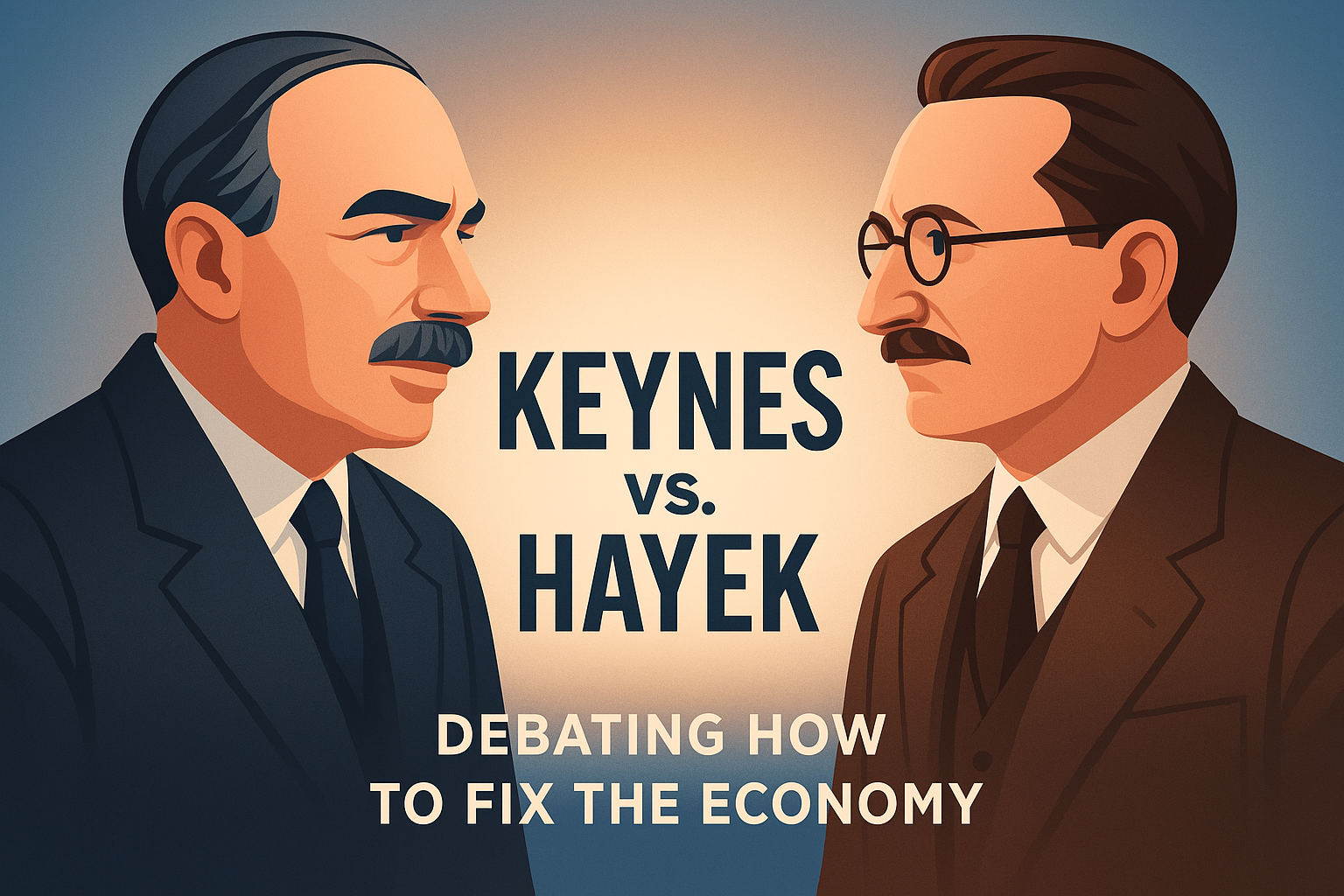
The tumultuous waves of economic fluctuations have long spurred debates among economists, policymakers, and scholars. Two of the most influential figures in the field, John Maynard Keynes and Friedrich Hayek, have emerged as titans representing contrasting views on how best to address economic challenges. Understanding their theories is not just an academic exercise; it directly impacts decisions on economic policy, influencing everything from government spending to regulatory frameworks. This debate is crucial because it shapes how we approach economic recovery, maintain stability, and improve living standards across the globe. As we journey through this intellectual battleground, we will explore key terms, dissect their ideas, and unravel why this debate continues to matter in today’s economic discourse.
Keynesian Economics: Activism in Fiscal Policy
Keynesian economics, named after British economist John Maynard Keynes, is a school of thought that advocates for active government intervention in the economy. According to Keynes, during economic downturns, private sectors may not have the ability or incentive to boost spending to spur growth. Hence, it’s the responsibility of the government to stimulate demand through fiscal policies such as public works and social safety nets.
Keynes believed that during recessions, consumer demand declines, leading to lower output and higher unemployment. To counter this, Keynesians argue for increased government spending to create jobs and demand. A real-world example of Keynesian policy in action was the New Deal implemented by President Franklin D. Roosevelt in response to the Great Depression. The series of programs and projects aimed to revitalize the U.S. economy by providing employment and directly injecting money into various sectors.
The Keynesian approach is praised for its ability to quickly address unemployment and aim for full employment. Through acute fiscal measures, policymakers can tackle economic slumps and, theoretically, balance the books during periods of growth by increasing taxes or cutting spending. However, critics argue that excessive government intervention can lead to inefficient allocation of resources and increase national debt.
Hayek’s Advocacy for Free Markets and Price Signals
Contrasting sharply with Keynes, Austrian economist Friedrich Hayek championed the free market as the best mechanism for economic stabilization. Hayek argued that any government intervention distorts the natural signals provided by the market, primarily through prices. According to Hayek, prices reflect the true state of supply and demand, dictating how resources should be allocated.
Hayek believed that individual entrepreneurs and businesses are better positioned to make decisions that will benefit the economy as a whole. He emphasized the importance of allowing market forces to operate without obstruction, viewing government intervention as a path to inefficiency and potential authoritarianism. A notable example of Hayek’s philosophy can be seen in the economic policies of the Thatcher administration in the UK during the 1980s. By reducing government involvement and focusing on deregulation, privatization, and tax cuts, the aim was to harness the power of the free market to stimulate growth.
While Hayek’s theories have been applauded for promoting innovation and efficiency, detractors point out the potential for increased inequality and economic volatility. The lack of a governmental safety net could lead to harsh outcomes for the most vulnerable in society, who may not benefit equally from the unbridled market forces.
Comparative Analysis of Keynes and Hayek
To better understand the divergent views of Keynes and Hayek, it’s critical to compare their core principles and their implications on public policy.
- Role of Government: Keynesians advocate for active government intervention, while Hayekians favor minimal interference, advocating for market-driven solutions.
- Economic Stability: Keynesians prioritize stabilizing output and employment through fiscal measures, whereas Hayekians emphasize the self-regulating nature of markets, which theoretically leads to long-term stability through competition.
- Inflation and Deflation: Keynesians are less concerned with inflation in the short term if it means lowering unemployment, while Hayekians caution that ignoring inflation can destabilize economies, leading to bubbles and crashes.
- Savings and Investment: Keynes believed savings might be insufficient to generate full employment without intervention, whereas Hayek asserted that saving is vital for investing in future growth.
This comparative analysis provides a framework for policymakers, enabling them to choose strategies that fit their economic and political contexts. Balancing these philosophies requires careful analysis and sometimes, compromise.
The Modern Context: Blending Theories for Optimal Policy
The modern economic landscape has seen a blend of Keynesian and Hayekian theories, often dictated by prevailing circumstances and societal needs. In practice, many countries adopt a hybrid approach, utilizing fiscal stimulus during intense downturns alongside structural reforms that encourage market efficiency and competition.
One illustrative example is the response to the 2008 global financial crisis. Many governments, notably the United States, initiated massive fiscal policies reminiscent of Keynesian thought to stimulate demand and stabilize banks. Concurrently, reforms to enhance financial regulations and oversight were enacted to align with Hayek’s advocacy for long-term market health and prevent future collapses.
The interplay between stimulus and regulation is vital in navigating complex economic landscapes. Policymakers must remain nimble, able to switch gears based on economic indicators, societal needs, and the global environment.
Visualization: Comparing Core Concepts
| Concept | Keynes | Hayek |
|---|---|---|
| Government Role | Active Intervention | Minimal Intervention |
| Market Dynamics | Stabalizing through fiscal tools | Relying on free market rules |
| Economic Policy | Demand-driven | Supply-driven |
| Public Spending | Increases during downturns | Strictly limited |
Real-World Policy Implications: Choices and Outcomes
The adoption of either Keynesian or Hayekian principles can significantly impact societal welfare, growth trajectories, and international competitiveness. In nations where Keynesian policies are predominant, there is often a stronger focus on social welfare programs and public infrastructure projects. For example, Scandinavian countries like Sweden have successfully merged elements of Keynesian social programs with market-friendly policies, achieving both high living standards and economic innovation.
Conversely, in economies where Hayekian policies are more prominent, such as in parts of Asia, there is an emphasis on deregulation and business incentives. Countries like Singapore exemplify the Hayekian model, where minimal state intervention has fostered rapid economic growth and a robust international trading position.
Ultimately, the challenge for policymakers is to discern the right mix of Keynesian and Hayekian elements. Flexibility in policy adoption can help nations adapt to changing economic conditions, considering factors like globalization, technological advancement, and shifting demographics.
Summary: Key Insights and Paths Forward
The ongoing debate between Keynesians and Hayekians is not merely an academic exercise but a vital one with direct consequences on economic stability, growth, and societal well-being. By understanding the core tenets of each philosophy—Keynes’ emphasis on government intervention and Hayek’s advocacy for market freedom—policymakers can tailor strategies that best suit their economic environments.
Key takeaways include the realization that no single approach fits all scenarios. Blending elements from both schools of thought may provide more comprehensive solutions, leveraging government resources when necessary, while also fostering an entrepreneurial spirit and market-driven growth.
For individuals, understanding these economic principles can empower informed decisions about political candidates, investment strategies, and career choices. Recognizing that economies are dynamic systems subject to external shocks and internal shifts can foster a more adaptable attitude towards change.
As we move forward, continuing this dialogue and revisiting these economic models remains essential. Policymakers, educators, and citizens should strive to remain informed and engaged, advocating for policies that enhance prosperity while maintaining resilience against inevitable economic shifts.
In conclusion, let us utilize the insights from this rich debate to foster a more prosperous and equitable global economy, where knowledge and collaboration pave the way to the future.
Frequently Asked Questions
1. What are the main differences between Keynesian and Hayekian economic theories?
Both John Maynard Keynes and Friedrich Hayek have significantly contributed to the field of economics, shaping the ways we think about economic policy, but they have fundamentally different views on how economies function and how they should be managed. Keynesian economics, derived from the works of John Maynard Keynes, emphasizes the role of government intervention in stabilizing the economy. Keynes argued that private-sector decisions sometimes lead to inefficient macroeconomic outcomes such as recessions. During these times, he believed it was essential for the government to step in, often through fiscal policy like government spending, to stimulate demand and pull the economy out of recession. Essentially, Keynesians advocate for active policy responses by the public sector in the form of monetary and fiscal policy actions to ensure economic stability and growth.
Hayek, on the other hand, was a staunch advocate of free-market capitalism. He believed that the market is the best mechanism for allocating resources and that government intervention, especially in the form of central planning, distorts the information conveyed by prices, which are crucial for making efficient economic decisions. Hayek posited that too much government involvement could lead to economic inefficiencies and ultimately impede individual freedoms. He argued for limited government intervention, stressing that economies are too complex for central planning to effectively manage. Thus, while Keynesians see economic slumps as issues that can be corrected with proactive governmental policies, Hayekians emphasize the self-correcting nature of free markets, cautioning against over-reliance on government intervention.
2. How did Keynesian and Hayekian theories influence real-world economic policies?
The influence of Keynesian and Hayekian theories on real-world policies is profound and has been evident through various economic eras. During the Great Depression of the 1930s, Keynes’s ideas gained significant traction. His emphasis on the importance of demand and government intervention led to massive public works programs and fiscal stimuli designed to reduce unemployment and spur growth. This approach saw its height during the mid-20th century, when many western governments implemented Keynesian policies to smooth out the volatile cycles of boom and bust.
Conversely, Hayek’s ideas became more prominent in the latter half of the 20th century, particularly during the 1970s and 1980s with the rise of monetarism championed by economists like Milton Friedman and political figures such as Margaret Thatcher and Ronald Reagan. Their policies reflected Hayekian principles—they emphasized tax cuts, regulatory rollbacks, and controlling inflation through monetary policy rather than fiscal stimulus which was seen as potentially inflationary and less effective.
While both theories have experienced periods of dominance in shaping economic policy, many modern economies use a mix of both schools of thought, applying different elements as suit the particular economic context they are in—a testament to the lasting significance of both Keynes and Hayek’s contributions.
3. How do Keynes and Hayek contribute to current debates on government spending?
The debate over government spending is still very much influenced by the clash between Keynesian and Hayekian thought. During economic recessions, Keynesians typically advocate for increased government spending to boost aggregate demand, arguing that it helps mitigate downturns and accelerate recovery. In contrast, Hayekians warn against the potential long-term consequences of sustained high government spending, such as fiscal deficits and inflation, and their possible effect on individual freedom and market-driven resource allocation.
Today, policymakers face these differing perspectives, especially during times of economic crisis like the 2008 financial crisis or the economic disruptions caused by the COVID-19 pandemic. Keynesians often argue for stimulus packages and increased public sector investments to support employment and economic output, while critics, inspired by Hayekian ideals, caution against accruing crippling levels of government debt and distorting market signals with excessive intervention.
Ultimately, the debate isn’t just theoretical; it directly impacts how governments craft fiscal policies to address the vital issues of unemployment, inflation, and economic recovery. This ongoing discourse shapes the ideologies of political parties and influences legislative priorities around the globe.
4. What do Keynes and Hayek say about monetary policies, and how relevant are their views today?
Keynes and Hayek also had differing views on monetary policy. Keynes recognized the role of monetary policy in managing economic conditions but placed more emphasis on fiscal policy as a tool for managing economic fluctuations. He believed that during periods of low interest rates, monetary policy could become ineffective (a situation known as the liquidity trap). Thus, when faced with severe economic downturns, Keynesians tend to prioritize fiscal policy interventions over monetary ones.
Hayek, however, viewed monetary policy as crucial, but with a focus on its stability rather than its flexibility. He believed that central banks should adhere to sound money principles, maintaining stable currencies to facilitate market operations without interference that could cause economic disturbances or inflation. Hayek cautioned against the manipulation of interest rates and other monetary tools, which he argued could lead to distortions in investment and savings.
In the 21st century, monetary policy remains a critical tool for managing economies, especially in the face of global economic challenges. Central banks worldwide, from the Federal Reserve to the European Central Bank, often employ a mix of Keynesian and Hayekian insights by adjusting interest rates, engaging in quantitative easing, and considering fiscal policy implications. The conversation about the best ways to utilize monetary policy continues as policymakers strive for stability, growth, and minimal inflation.
5. Are Keynes’s and Hayek’s theories mutually exclusive, or can they be integrated?
While Keynes’s and Hayek’s theories offer differing perspectives, there is a growing view among economists and policymakers that integrating the two approaches can create a more balanced economic framework. In essence, these theories are not necessarily mutually exclusive, and many modern policy decisions combine elements of both. For example, a government might adopt a Keynesian approach during a deep recession by increasing spending or cutting taxes to boost demand while also adopting Hayekian policies to promote free markets, individual enterprise, and innovation during times of economic stability.
This pragmatic approach acknowledges that while government intervention can be necessary to address economic slumps and prevent severe social and economic disruptions, the fundamentals of a market-driven economy are crucial for sustainable long-term growth. Integrating these theories allows policymakers to be flexible, adjusting their strategies based on current economic conditions while maintaining a balance between control and freedom, intervention and non-intervention, short-term needs and long-term objectives. In practice, this means employing Keynesian tools primarily during economic downturns and turning towards Hayekian principles when aiming for robust, sustainable economic health during growth periods.