
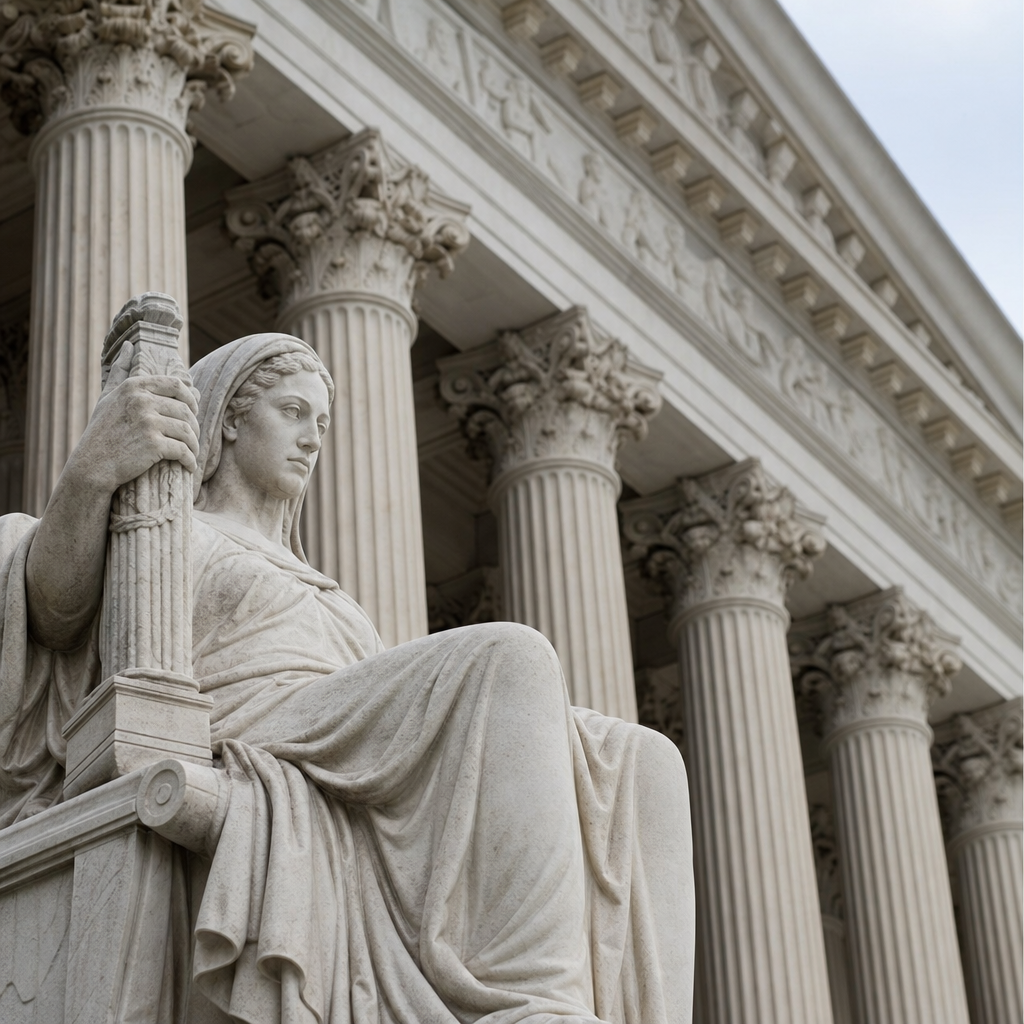
Judicial review is often taught as if it began in 1803 with Marbury v. Madison, but the idea existed well before Chief Justice John Marshall wrote his famous opinion. In plain terms, judicial review is the authority of courts to examine laws or government actions and refuse to enforce them when they conflict with a higher law, usually a constitution. That definition matters for AP Government and Politics because it separates the underlying principle from the case that made it famous. Marbury did not invent the concept out of nothing; it crystallized, defended, and publicized a practice that had already appeared in colonial arguments, state court decisions, constitutional debates, and early federal litigation.
I have found that students understand this topic best when they stop asking, “Who created judicial review?” and start asking, “How did Americans come to accept that courts could compare ordinary law to fundamental law?” Once framed that way, the story becomes clearer. British constitutionalism, colonial resistance to Parliament, written state constitutions after independence, and the framers’ commitment to limited government all pushed American lawyers toward the conclusion that judges had a duty to prefer constitutional rules over conflicting statutes. By 1787, this was not a fringe theory. It was debated, refined, and in some places already practiced.
This article serves as a hub for the “Misc” corner of AP Government and Politics because judicial review before Marbury touches several core themes at once: constitutional interpretation, separation of powers, federalism, the role of courts, and the difference between legal myth and historical development. It also connects naturally to related topics such as the Federalist Papers, the Supremacy Clause, state constitutions, early Supreme Court cases, and how precedent gains authority. If you are building a broader understanding of AP Government, this question is useful precisely because it forces you to see institutions as products of argument and practice, not single moments.
The short answer is yes: the idea already existed. The more complete answer is that it existed in multiple forms, with important limits. Before 1803, Americans had already argued that written constitutions bound legislatures, several state courts had invalidated statutes, delegates at the Constitutional Convention discussed judges checking unconstitutional laws, and Federalist supporters publicly defended the doctrine during ratification. What Marbury added was a durable national statement from the Supreme Court, tied to the new federal Constitution, delivered in language that later generations could quote. Understanding that distinction is essential to understanding both constitutional law and American political development.
What Judicial Review Meant Before 1803
Before Marbury, judicial review did not always look like the modern practice students see today. There was no long chain of Supreme Court precedent, no settled hierarchy of constitutional doctrines, and no universally accepted assumption that every court would strike down unconstitutional laws in the same way. Still, the core logic was familiar. A constitution was understood as fundamental law, created by the people. A statute was ordinary law, created by the legislature. If the two conflicted, judges applying law in actual cases had to decide which rule governed. Many American lawyers concluded that the higher law had to prevail.
This reasoning depended heavily on written constitutions. In Britain, Parliament was traditionally considered supreme, and courts could not invalidate acts of Parliament simply because they conflicted with a single written constitutional text. In the United States after independence, many states adopted written constitutions that expressly limited governmental power. That changed the legal landscape. Once limits were written down, judges had something concrete to compare against statutes. In practice, that made judicial review less a claim to judicial supremacy than a claim of judicial duty: when deciding a case, courts had to apply the superior rule.
It is also important to distinguish judicial review from broader ideas of constitutional interpretation. Legislators, executives, and citizens all interpret constitutions. Presidents veto bills they think unconstitutional. Legislatures debate constitutional limits. But judicial review refers specifically to what courts do in cases before them. That narrower meaning matters because critics then, as now, worried that allowing judges to invalidate statutes would make unelected officials too powerful. Supporters responded that courts were not superior to the legislature; the constitution was superior to both.
Colonial Roots and Revolutionary Constitutionalism
The intellectual roots of judicial review reach back into the colonial era. Colonial lawyers were already accustomed to arguing that some enactments were invalid because they violated higher legal principles, charters, or the rights of Englishmen. One often-cited source is Dr. Bonham’s Case from 1610, in which Sir Edward Coke suggested that common law could control acts of Parliament in certain circumstances. Historians rightly debate how far Coke actually meant that principle to go, and Britain never embraced American-style judicial review. Even so, Coke’s language circulated widely in the colonies and helped shape a legal culture comfortable with the idea that governmental acts could be measured against higher norms.
The imperial crisis of the 1760s and 1770s deepened that habit of mind. American colonists argued that Parliament had exceeded legitimate authority through measures such as the Stamp Act and Townshend duties. Although these disputes were political as much as legal, they trained American leaders to think in layered forms of authority: local assemblies, colonial charters, imperial institutions, and inherited rights. By the time independence arrived, many Americans already believed that government was limited by foundational rules. That belief did not automatically create judicial review, but it prepared the ground for it.
After independence, revolutionary constitutionalism transformed the theory into a more usable legal doctrine. State constitutions were written, adopted in the name of the people, and treated as superior to ordinary legislation. This was a major innovation. If a legislature was merely one created body among others, then it could not be the final judge of its own powers. In my experience, this is the conceptual turning point students need most: judicial review becomes easier to understand once you see that legislatures in the new republic were agents of the people, not sovereign bodies in the British sense.
State Court Precedents Before Marbury
Long before the U.S. Supreme Court decided Marbury, state courts had already acted on the principle of judicial review. The most famous example is Trevett v. Weeden in Rhode Island in 1786. The dispute involved a state law requiring acceptance of paper money, and the court reportedly refused to enforce the statute because it violated constitutional protections, including the right to jury trial. Records are incomplete, so historians disagree about the exact reasoning and scope of the decision. Even with that caution, the case shows that judges in the 1780s were willing to treat constitutions as enforceable limits on legislatures.
Another major case is Bayard v. Singleton decided in North Carolina in 1787. There, the court invalidated part of a statute because it denied a jury trial guaranteed by the state constitution. This decision is especially important because its reasoning was explicit. The judges stated that the constitution was a fundamental law binding the legislature and that acts inconsistent with it could not stand. For AP Government purposes, Bayard is one of the clearest examples that the doctrine existed in practice before Marbury.
Virginia also contributed through cases and judicial commentary, even if not every episode produced a clean modern-style invalidation. In Commonwealth v. Caton in 1782, judges suggested that if the legislature violated the constitution, courts could intervene. St. George Tucker, one of the leading legal commentators of the early republic, later defended judicial review in his 1803 edition of Blackstone’s Commentaries. By then he was describing something already familiar in American legal thought. The pattern across states was uneven, but the cumulative evidence is strong: before 1803, judicial review was not hypothetical.
| Case | Year | Jurisdiction | Why It Matters |
|---|---|---|---|
| Commonwealth v. Caton | 1782 | Virginia | Judges indicated courts could resist unconstitutional legislative action. |
| Trevett v. Weeden | 1786 | Rhode Island | Often cited as an early refusal to enforce a statute conflicting with constitutional protections. |
| Bayard v. Singleton | 1787 | North Carolina | Clear statement that a state court could invalidate a law violating the state constitution. |
| Hylton v. United States | 1796 | U.S. Supreme Court | Showed the federal Court would assess constitutionality, even though it upheld the statute. |
The Constitutional Convention and Ratification Debate
The framers did not write the words “judicial review” into Article III, but the Philadelphia Convention and ratification debates show they expected courts to play that role. Delegates repeatedly discussed ways to restrain unconstitutional legislation. Some favored a proposed council of revision made up of judges and the executive to review bills before they became law. That proposal failed, but its failure did not mean judges were excluded from constitutional review. In fact, several delegates argued that judges would still be able to strike down unconstitutional laws in actual cases after enactment.
Alexander Hamilton gave the clearest public defense in Federalist No. 78. He wrote that the interpretation of laws is the proper province of the courts and that a constitution must be regarded as fundamental law. Therefore, when a statute conflicts with the constitution, judges should prefer the constitution. Hamilton was careful in presenting this as a limit on all branches, not a claim that judges were politically supreme. Courts had “judgment,” not “force” or “will.” That framing remains central to how American constitutional law justifies judicial review.
Other ratification-era voices reinforced the point. James Madison and James Wilson both spoke as if courts would guard constitutional boundaries. Anti-Federalists, notably Brutus, criticized the federal judiciary partly because they understood it would claim substantial power in constitutional interpretation. Their objections are historically revealing. People do not usually warn against a power no one expects to exist. The ratification debate therefore supplies strong evidence that judicial review was publicly understood before 1803, even if people disagreed over whether it was desirable or how broad it would become.
Early Federal Practice Before Marbury
The federal judiciary also moved toward judicial review before Marbury. The clearest example is Hylton v. United States in 1796, which tested the constitutionality of a federal carriage tax under the Constitution’s rules on direct taxation. The Supreme Court ultimately upheld the law, but that outcome should not obscure the key point: the justices openly considered whether Congress had violated the Constitution. A court does not need to strike down a statute to exercise judicial review. The act of measuring a law against the Constitution is itself the practice.
Lower federal courts did something similar in the 1790s. Judges discussed constitutional limits in circuit decisions and in grand jury charges. Justice Samuel Chase and other early jurists spoke in terms suggesting that unconstitutional statutes could not bind courts. At the same time, there was still uncertainty about institutional boundaries. The justices refused to give President Washington advisory opinions in 1793, reinforcing the idea that federal courts act through cases, not abstract consultations. That distinction helped define the American model: judicial review would be tied to concrete disputes, not general political supervision.
By the time Marbury arrived, then, the legal materials were already on the table. Written constitutions, state precedents, Convention debates, ratification essays, and early federal cases all pointed in the same direction. Marshall’s achievement was not creation ex nihilo. It was strategic consolidation. He used a politically sensitive case to declare a principle that many lawyers already accepted, while also asserting the Supreme Court’s role in saying what the law is when legal texts conflict.
What Marbury Changed and What It Did Not
Marbury v. Madison matters because it gave the doctrine a canonical statement at the national level. Marshall argued that the Constitution is superior law, that judges are bound to apply law in cases before them, and that a statute repugnant to the Constitution is void. He then held that part of the Judiciary Act of 1789 unconstitutionally expanded the Supreme Court’s original jurisdiction. This was the first time the Supreme Court invalidated an act of Congress. That fact made the case symbolically powerful and easy to teach as a beginning.
But treating Marbury as the origin of judicial review is historically misleading. It hides the state-level experiments that made the doctrine plausible, ignores ratification-era evidence, and understates how ordinary the underlying logic already was to many founding-era lawyers. The better interpretation is that Marbury nationalized and memorialized a preexisting idea. It did not settle every future controversy. Later battles over slavery, Reconstruction, economic regulation, civil rights, and executive power show that the scope of judicial review remained contested. Even now, Americans disagree over how deferential courts should be. Still, the pre-1803 record proves the idea did not suddenly appear with Marshall’s pen.
For AP Government and Politics, the key takeaway is simple. If you are asked whether judicial review existed before Marbury, the historically accurate answer is yes, in concept and in practice. Use the strongest evidence: written constitutions as higher law, Bayard v. Singleton, discussion at the Constitutional Convention, Federalist No. 78, and Hylton v. United States. Then add the critical nuance: Marbury made the doctrine authoritative for the U.S. Supreme Court and embedded it in American constitutional memory. That distinction will make your analysis more precise and more persuasive. To deepen this “Misc” hub, connect this article with your study of federalism, the framers, landmark cases, and constitutional interpretation.
Frequently Asked Questions
Did judicial review actually exist before Marbury v. Madison in 1803?
Yes. The core idea behind judicial review existed before Marbury v. Madison, even though that case is the one most often associated with it in U.S. history courses. In simple terms, judicial review means that courts can compare a law or government action against a higher legal authority, usually a constitution, and decline to enforce the lower rule if the two conflict. That concept did not suddenly appear in 1803. It had roots in earlier legal traditions, colonial practice, Revolutionary-era political thought, and state court decisions in the years after independence.
Before the Constitution was adopted, Americans were already familiar with the idea that written charters, fundamental law, and limits on government power mattered. Colonial lawyers and political thinkers drew from English constitutional ideas, including the belief that government was not supposed to act arbitrarily. After independence, state constitutions became especially important because they were written documents that explicitly set boundaries on legislative power. Once legislatures were understood to be creatures of a constitution rather than the highest source of authority themselves, it became more plausible for judges to say, “This statute cannot stand if it violates the constitution.”
So the best way to understand the history is this: Marbury did not invent judicial review from nothing. Instead, it gave a clear, powerful, and nationally influential statement of a principle that already had intellectual and legal support. For AP Government and Politics, that distinction is essential. The principle existed earlier; Marbury v. Madison made the principle famous at the national level and tied it firmly to the Supreme Court.
If the idea already existed, why is Marbury v. Madison taught as such an important turning point?
Marbury v. Madison is so important because it was the Supreme Court’s most famous and durable statement of judicial review under the U.S. Constitution. Chief Justice John Marshall’s opinion did not merely hint that courts could disregard unconstitutional laws. It laid out a direct argument for why judges must do so when faced with a conflict between ordinary legislation and the Constitution. That made the doctrine more visible, more authoritative, and more central to the structure of the national government.
The case also mattered because it came from the Supreme Court of the United States, not a state court. Earlier examples existed, but they were more scattered and less universally remembered. Marshall’s opinion placed the doctrine inside a major constitutional controversy involving executive power, congressional legislation, and the Court’s own role. Because the case became a landmark in federal constitutional law, it naturally overshadowed earlier precedents and discussions.
Another reason Marbury looms so large is that it is easy to teach as a foundational story. Students can see a dramatic moment in which the Court claims the authority to interpret the Constitution and reject a conflicting act of Congress. That makes for a memorable civics lesson. But historically, it is more accurate to say that Marbury confirmed, articulated, and institutionalized judicial review rather than creating the basic idea for the first time. In other words, the case was a turning point in visibility and authority, not necessarily the origin of the concept itself.
What are some examples of judicial review before Marbury?
There were several important examples before 1803 that show judges and legal thinkers were already working with the basic logic of judicial review. One often-cited example is Bayard v. Singleton (North Carolina, 1787), in which a state court refused to enforce a legislative act that it found inconsistent with the state constitution. That case is frequently discussed because it shows a court explicitly treating the constitution as superior to ordinary legislation and acting on that principle.
Another major example is Commonwealth v. Caton (Virginia, 1782), sometimes called the “Case of the Prisoners.” In that dispute, judges suggested that if the legislature violated the constitution, courts had a duty to respond. Even when the exact holding is debated by scholars, the case clearly reflects the idea that judges could assess legislative acts against constitutional limits. That matters because it demonstrates the doctrine was being seriously considered by leading legal figures before Marbury.
Legal and political commentary from the founding era also points in the same direction. Alexander Hamilton in Federalist No. 78 argued that courts should treat the Constitution as fundamental law and prefer it to conflicting statutes. His argument was not presented as a shocking innovation; it was framed as a logical consequence of having a written constitution. In addition, some delegates at the Constitutional Convention and ratifying conventions discussed judicial review as an expected feature of constitutional government. Taken together, these examples show that the doctrine was already present in state practice, constitutional theory, and public debate before Marshall’s opinion gave it its most famous expression.
How did written constitutions help create the idea of judicial review?
Written constitutions were crucial because they changed the legal hierarchy. If a constitution is simply a political tradition or unwritten custom, it can be harder to identify a precise legal rule that overrides a statute. But when a constitution is written down as a binding, superior law, judges can compare the text of a statute to the text of the constitution and ask whether the two are compatible. That makes judicial review far more concrete and legally manageable.
In the American system after independence, state constitutions and later the U.S. Constitution were understood as acts of the people establishing government and limiting its powers. Legislatures were powerful, but they were not supreme in the same way Parliament was often described in Britain. Instead, legislatures operated under constitutional limits. Once that premise is accepted, the logic of judicial review becomes much stronger: if the legislature passes a law beyond its constitutional authority, and if a court must decide a case involving that law, the court must decide which rule governs. Under this reasoning, the constitution must prevail because it is the higher law.
This is why the distinction between parliamentary supremacy and constitutional supremacy is so important. In a system of parliamentary supremacy, the legislature’s enactments are generally final. In a system of constitutional supremacy, the constitution stands above ordinary laws. Judicial review fits naturally into the second model because courts are asked to interpret and apply law in actual disputes. If two legal rules conflict, judges must choose. American written constitutions made it possible to argue that the judges’ duty was not to obey the legislature blindly, but to uphold the superior law that created and limited the legislature in the first place.
What is the most important takeaway for AP Government students studying judicial review before Marbury?
The key takeaway is that students should separate the idea of judicial review from the landmark case most commonly associated with it. Judicial review, as a principle, existed before 1803. It drew support from founding-era constitutional theory, early state court decisions, and the broader belief that constitutions are higher law. Marbury v. Madison did not invent the doctrine from nothing; it gave the doctrine its most famous and authoritative statement in federal constitutional law.
That distinction helps students avoid a common oversimplification. If a teacher or textbook says “judicial review began with Marbury,” that usually means Marbury is the foundational Supreme Court case recognizing and explaining the power at the national level. But if the question is historical, the fuller answer is that the concept had earlier roots. Understanding this difference shows stronger analytical thinking and a better grasp of constitutional development.
For exam purposes, it is still essential to know that Marbury v. Madison established the Supreme Court’s power to declare acts of Congress unconstitutional. But for deeper historical understanding, students should remember that Marshall’s opinion rested on ideas that were already circulating in American law and politics. The most accurate summary is: judicial review existed as a developing principle before 1803, and Marbury transformed it into a defining feature of the Supreme Court’s role in the American constitutional system.