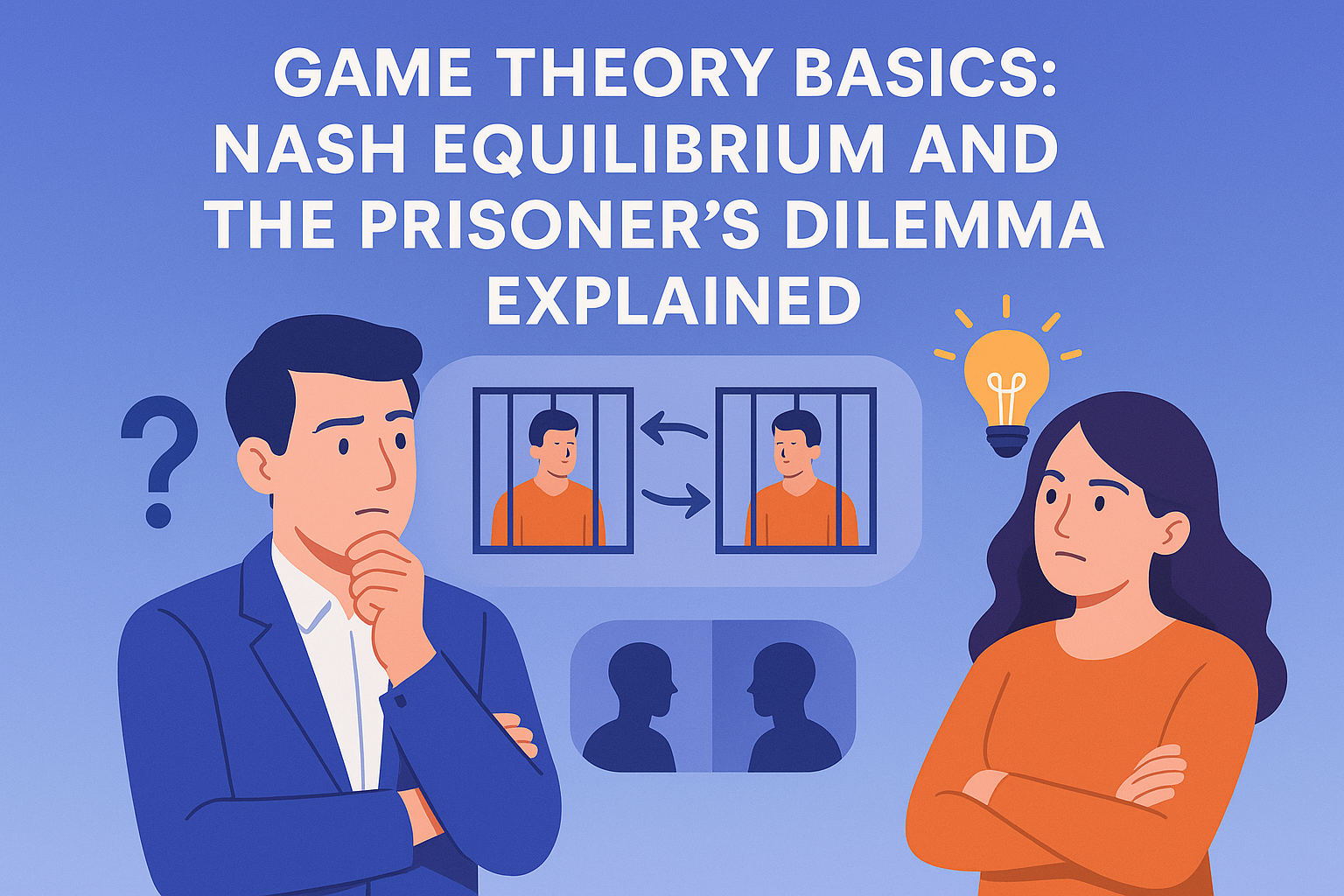
Game theory is a fundamental concept in economics, political science, and decision-making fields. It is a mathematical framework used to analyze situations where players make strategic decisions, considering the potential choices and payoffs of others. As a study of strategic interaction, game theory provides insights into competitive and cooperative behaviors among individuals or groups.
In the realm of game theory, two key concepts often emerge as particularly crucial: the Nash Equilibrium and the Prisoner’s Dilemma. Understanding these concepts is essential to those seeking to predict, interpret, or influence decision-making in environments characterized by conflict, cooperation, or competition. The importance of game theory extends beyond academic exercise—it has practical implications for negotiating deals, optimizing business strategies, and even understanding societal dilemmas. Through clarity on these concepts, stakeholders can make more informed, strategic choices that lead to better outcomes in various fields, including economics, diplomacy, and organizational leadership.
In this article, we delve into the world of game theory by exploring its basics. We will introduce key terms, define the Nash Equilibrium, and unravel the complexities of the Prisoner’s Dilemma. These fundamental ideas are the building blocks for formulating strategies that anticipate and account for others’ actions, making them indispensable in today’s interconnected world.
Understanding Nash Equilibrium
John Nash, an influential figure in the development of game theory, introduced the concept of Nash Equilibrium in 1950. Named after him, the Nash Equilibrium is a situation in non-cooperative games where no player can benefit by unilaterally changing their strategy if the other players’ strategies remain unchanged. Simply put, it is the point at which players settle into a strategy from which they see no gain from deviating, given the decisions of others.
Consider it like a game of chess where each player anticipates the moves of their opponent. Once the game reaches a Nash Equilibrium, neither player can benefit from changing their move, assuming the other player’s strategy stays constant. This balance of strategies results in a mutual best response, providing each player the maximum potential payoff given the actions of others.
The Nash Equilibrium has profound implications across various domains. For example, in the competitive world of business, companies achieve a Nash Equilibrium when they find that any change to their current strategy would not increase profits, given their competitors’ strategies. The Nash Equilibrium helps players understand and anticipate the actions of others in strategic settings.
The Real-World Application: Auction Games
One real-world application of Nash Equilibrium can be observed in auction games, particularly in the field of online advertising. Advertisers compete in auctions to bid for ad placements, with each aiming to maximize visibility while minimizing costs. In a Nash Equilibrium, each advertiser determines their bid based on the anticipated bids of others, reaching a strategic balance where altering the bid doesn’t result in a better outcome.
Consider, for example, a second-price sealed-bid auction, commonly used by search engines for ad placement. In this setting, advertisers submit bids without knowing what their competitors are bidding. The highest bidder wins, but the price paid is the second-highest bid. Each advertiser finds that if their bid reflects their true valuation, it maximizes their expected payoff regardless of others’ strategies. This equilibrium compels bidders to strategize and choose bids that best respond to the expected actions of others.
The Prisoner’s Dilemma Explained
The Prisoner’s Dilemma is a canonical example of game theory illustrating why individually rational decisions can lead to a worse collective outcome. The dilemma presents a scenario where two individuals, acting in their self-interest without collaboration, result in suboptimal results compared to if they had cooperated.
Imagine two partners in crime, arrested and isolated in separate cells. Prosecutors offer each prisoner a bargain: confess and testify against the other, receive a reduced sentence, while the other gets a harsh punishment. If both confess, they get moderate sentences. However, if both stay silent, they each get minimal punishment due to lack of evidence. The challenge arises because each prisoner must decide without knowing the other’s choice.
The Nash Equilibrium in this dilemma arises when both prisoners opt to confess, as each views confessing as the best strategy to minimize potential losses regardless of the other’s choice. Despite a better mutual outcome if neither confesses, the individual strategy leads to both confessing due to mistrust and lack of coordinated strategy, highlighting the inherent conflict between individual logic and collective good.
Real-World Example: The Tragedy of the Commons
A pertinent real-world application of the Prisoner’s Dilemma is seen in environmental issues like the Tragedy of the Commons. This scenario describes a situation where individuals, acting independently according to their self-interest, deplete or spoil shared resources, resulting in adverse outcomes for the group.
Consider fishermen exploiting a common fishing area. Each fisherman aims to maximize their catch, assuming it brings them more gain irrespective of others’ actions. However, if everyone overfishes, the resource becomes depleted, harming everyone involved, including those engaged in excessive fishing. This mirrors the logic of the Prisoner’s Dilemma, where the pursuit of personal gain can contribute to a collective detriment without cooperative restraint.
- Overfishing: Each fisherman benefits individually by maximizing their catch but risks resource depletion.
- Cooperation: If fishermen cooperated to regulate fishing, stock could be sustainable, benefiting all.
- Realization: Without coordination, individuals adhere to self-interest, leading to undesirable outcomes similar to the Prisoner’s Dilemma.
Solving the Dilemma Through Cooperation
Emerging from scenarios like the Prisoner’s Dilemma and Tragedy of the Commons are insights into the importance of cooperation and communication in strategic interactions. Cooperation can be leveraged as a tool to improve outcomes where individual goals and collective welfare align poorly.
Mechanisms such as binding agreements, third-party enforcement, or shared governance models can incentivize participants to collaborate rather than defect. In international diplomacy, treaties and bilateral agreements embody such principles, aligning participants toward mutually beneficial outcomes and mitigating self-interested tendencies.
Cooperative strategies compel players to shift perspectives from immediate individual gains to long-term collective benefits, encouraging strategies based on trust and collaboration. These mechanisms redefine the strategic landscape, transforming competitive dilemmas into zones where improved agreements and collaborative outcomes are possible.
Conclusion: Applying Game Theory Strategies
In summary, game theory provides frameworks and insights essential for understanding strategic interactions in complex environments. Concepts like Nash Equilibrium and the Prisoner’s Dilemma delineate how strategic decisions can impact not only individual outcomes but also influence collective scenarios across varied domains.
Recognizing the dynamics of game theory enables stakeholders to formulate more effective strategies, predict others’ actions, and design mechanisms fostering cooperation over competition. Whether applied in business, diplomacy, or social policy, these principles encourage decision-making that better aligns individual actions with broader objectives.
The next step is to deepen your grasp of game theory by exploring various scenarios in your field, identifying strategic equilibria, and envisioning cooperative possibilities. Understanding these nuances can unveil pathways to more strategic choices, fostering enhanced negotiation skills and improved outcomes.
Ultimately, embracing game theory as a tool for strategic insight, analysis, and decision-making can be transformative, empowering individuals and organizations to navigate the complexities of today’s interdependent world with greater foresight and cooperation.
Frequently Asked Questions
1. What is the Nash Equilibrium in game theory?
Nash Equilibrium, named after the mathematician John Nash, is a fundamental concept in game theory. It represents a state of strategic interaction where no player can benefit by changing their strategy while the other players keep theirs unchanged. In simpler terms, when a game reaches a Nash Equilibrium, each player’s strategy is optimal given the strategies of all other players. This implies that none of the players has anything to gain by solely altering their current strategy. The Nash Equilibrium can occur in various types of games, whether they are zero-sum, cooperative, or non-cooperative. It’s a point where players are in a state of balance, meaning they have made the best possible decisions, taking into account the decisions of others. Recognizing this equilibrium allows us to predict outcomes in strategic situations, like economic competition or political conflicts, providing a solution concept for both players’ optimal responses.
2. How does the Nash Equilibrium apply to real-world situations?
The Nash Equilibrium has versatile implications in real-world scenarios. For instance, consider the competitive pricing strategies of businesses in an oligopoly—a market structure where a few firms dominate. Here, each firm must consider its competitors’ pricing before setting its own prices to maximize profit. If all firms reach a Nash Equilibrium, none has an incentive to change their pricing strategy unilaterally because it wouldn’t result in a more favorable outcome given the market’s competitive responses. This equilibrium perspective also extends to fields like politics, where candidates must choose policies based not just on preferences but also on electoral strategies of opponents. Similarly, in traffic systems, drivers make route choices based on how others are likely to drive, akin to reaching a Nash Equilibrium of travel routes to minimize commute times, demonstrating its influential role in shaping decisions that individuals and firms make under uncertainty and interdependence.
3. What is the Prisoner’s Dilemma, and why is it important in game theory?
The Prisoner’s Dilemma is a classic example used in game theory to demonstrate the complexities of decision-making in cooperative contexts. In this scenario, two criminal suspects are arrested and interrogated separately. They face choices: confess and implicate the other or remain silent. If both confess, they receive moderately severe sentences. If one confesses while the other remains silent, the confessor is freed while the silent one gets an extended sentence. If both remain silent, they serve minimal sentences. Here, the dilemma arises because individual rational choices lead both to confess, resulting in a worse collective outcome than if they had cooperated by staying silent. The Prisoner’s Dilemma is crucial because it encapsulates the problem of trust and cooperation: self-interested decisions often result in worse payoffs, challenging players to consider mutual benefits versus individual gains. Its significance is profound in understanding negotiations, business strategies, and even international relations, highlighting the often paradoxical outcomes of strategic situations where non-cooperation seems favorable yet is suboptimal.
4. How does game theory help in understanding strategic behavior?
Game theory offers a structured methodology to analyze strategic interactions, providing a robust framework to understand and predict how rational individuals or groups make decisions. It enables us to model situations where outcomes depend not just on one’s actions but also on others’ decisions. By examining the payoffs associated with different strategies, game theory illuminates how players might behave, revealing equilibrium outcomes, strategic dominance, and potential for cooperation or conflict. This insight is instrumental in various fields; economists utilize it to dissect market behaviors and business negotiations, political scientists apply it to electoral strategies and policy-making, and psychologists incorporate it to study decision-making processes. By simulating these strategic encounters, game theory equips stakeholders with tools to devise optimal strategies, anticipate rivals’ moves, and improve negotiation outcomes, making it indispensable for anyone involved in strategic decision-making and complex interactions across sectors.
5. What are some limitations of the Nash Equilibrium and the Prisoner’s Dilemma in practical applications?
While both the Nash Equilibrium and the Prisoner’s Dilemma provide valuable insights into strategic interactions, they have notable constraints. For the Nash Equilibrium, one limitation is its assumption that all players are rational and have complete knowledge of each other’s strategies, which isn’t always realistic in complex real-world scenarios. Moreover, some games may have multiple equilibria, making it challenging to predict which will ultimately occur. On the other hand, the Prisoner’s Dilemma, while powerful in illustrating cooperation challenges, often simplifies interactions with its binary choice structure. It assumes that players cannot communicate or collaborate, which might not reflect the nuances of actual negotiation environments where dialogue and repeated interactions can lead to trust and cooperation. Both concepts may also struggle with dynamic environments where strategies evolve over time. Despite these limitations, they remain fundamental in strategical analysis, often serving as starting points for more complex models that account for real-world irregularities and multi-faceted decision-making processes.