
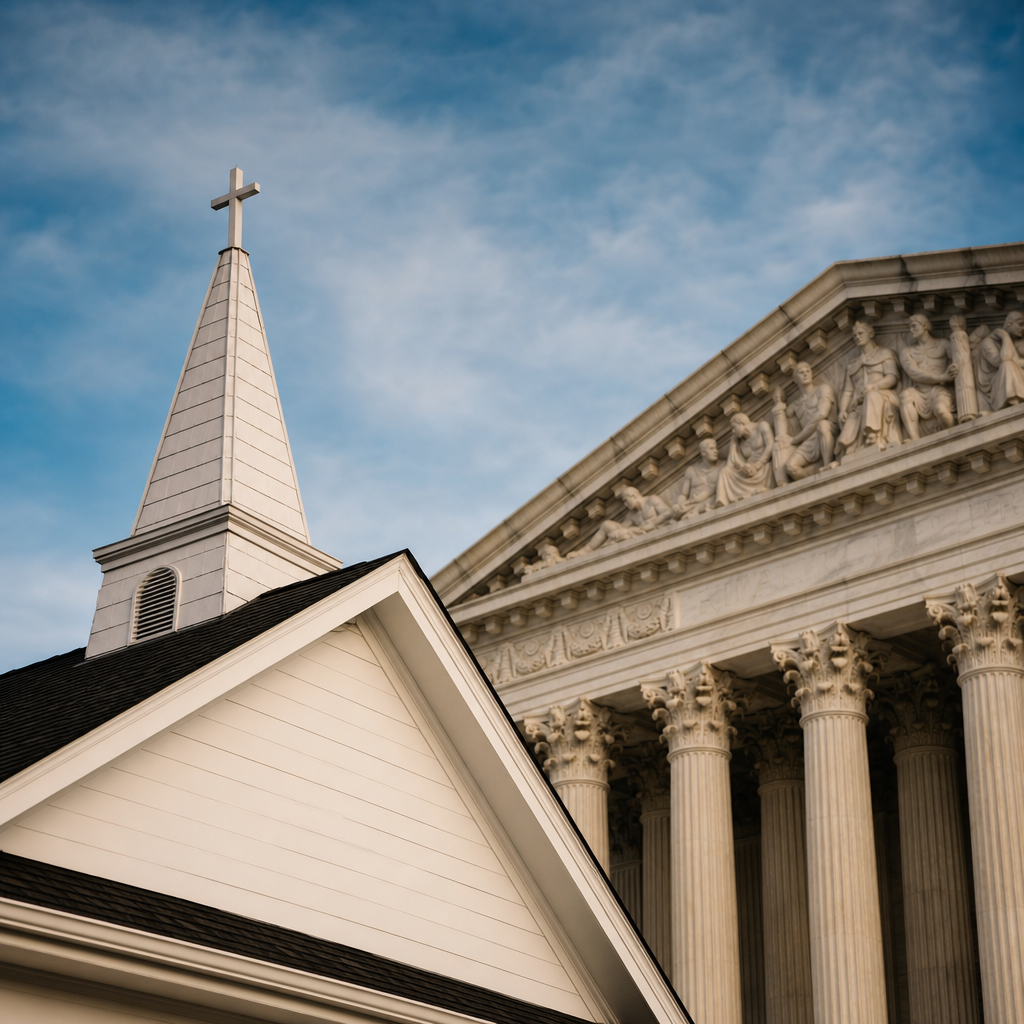
The First Amendment begins American religious liberty with two closely linked commands: government may not prohibit the free exercise of religion, and it may not establish religion. Together, the Free Exercise Clause and the Establishment Clause form the constitutional framework for church-state relations in the United States. For AP Government and Politics students, understanding how these two religion clauses compare is essential because many landmark Supreme Court cases, public policy disputes, and exam questions turn on the distinction between protecting private belief and limiting government endorsement. This hub article explains the meaning, history, doctrine, and major cases behind both clauses so readers can connect the broad principles to the details that appear across the wider religion and civil liberties unit.
The Free Exercise Clause protects individuals and groups in practicing religion without unjustified government interference. In plain terms, government cannot punish religious belief, target religious practices because they are religious, or deny equal access to benefits simply because a person or institution is faith-based. The Establishment Clause works in the other direction. It restrains government itself by barring laws or policies that create an official religion, favor one faith over another, coerce religious participation, or excessively entangle public authority with religious institutions. One clause safeguards religious activity from state suppression; the other guards the political system from state-sponsored religion.
That distinction sounds simple, but in practice the two clauses often overlap and sometimes pull in opposite directions. A public school district that allows student prayer might be defended as protecting free exercise, yet challenged as government endorsement of religion. A state that excludes a church-run school from a generally available benefit program might claim it is avoiding establishment concerns, while the school argues that exclusion burdens free exercise. I have worked through these tensions with students by framing the central question this way: when religion appears in public life, is government protecting private liberty, or is it using public power to advance religion? Most litigation under the religion clauses asks some version of that question.
The clauses also matter beyond the classroom because they shape conflicts over education, public funding, health regulations, conscientious objection, symbols on public land, and the rights of religious minorities. Supreme Court doctrine has changed significantly over time, especially in recent decades, so old rules do not always match current case law. AP students need both the foundational concepts and the doctrinal trends. This article serves as a hub for the miscellaneous religion-clause issues that connect church and state, helping readers compare the two clauses directly while building a roadmap for deeper study of cases, tests, standards, and recurring controversies.
What the Free Exercise Clause protects
The Free Exercise Clause appears in the First Amendment and has been applied to the states through the Fourteenth Amendment. Its core rule is that government may not penalize belief, and it may not single out religious conduct for disfavored treatment. The strongest protection arises when a law targets religion directly. In Church of the Lukumi Babalu Aye v. City of Hialeah (1993), the Court struck down city ordinances aimed at Santeria animal sacrifice. The laws looked neutral on paper in places, but the Court found their design and operation targeted a specific faith. That is a classic free exercise violation: government hostility to religion.
Free exercise doctrine became harder after Employment Division v. Smith (1990). In that case, the Court held that neutral laws of general applicability usually do not violate the Free Exercise Clause even if they incidentally burden religion. Oregon denied unemployment benefits to workers fired for using peyote in a religious ritual, and the Court upheld that result. The decision sharply limited constitutionally required religious exemptions from ordinary laws. Congress responded with the Religious Freedom Restoration Act, known as RFRA, which restored a tougher standard for federal action: government must show a compelling interest and use the least restrictive means when substantially burdening religion. That standard applies federally, while many states use similar protections through state law or state constitutions.
Recent Supreme Court decisions have strengthened free exercise claims when government excludes religious people or institutions from public programs. In Trinity Lutheran v. Comer (2017), Missouri could not deny a church preschool access to a public playground resurfacing grant solely because it was religious. In Espinoza v. Montana Department of Revenue (2020), once a state created scholarship aid for private schools, it could not bar religious schools from participating because of their religious status. In Carson v. Makin (2022), Maine’s exclusion of religious schools from tuition assistance also failed. These cases establish an important comparison point: avoiding establishment problems does not authorize government discrimination against religion where public benefits are otherwise broadly available.
What the Establishment Clause forbids
The Establishment Clause bars government from setting up an official church, preferring one religion over another, or using public authority to pressure religious observance. Historically, the framers reacted against European establishments and colonial patterns in which tax funds, legal privileges, or civil penalties supported favored churches. In modern law, establishment questions most often involve public schools, legislative prayer, government displays, and public funding that may assist religious institutions. The basic concern is not private faith in public life; it is state action that endorses, coerces, or institutionalizes religion.
For decades, courts often used the Lemon v. Kurtzman (1971) test, which asked whether a law had a secular purpose, a primary effect that neither advanced nor inhibited religion, and avoided excessive government entanglement with religion. AP students still need to know Lemon because it shaped establishment analysis for years and appears in textbooks, but the Court has moved away from relying on it as a controlling formula. Recent cases emphasize history and tradition instead. In Kennedy v. Bremerton School District (2022), the Court stated that establishment questions should be interpreted by reference to historical practices and understandings rather than the old Lemon framework.
Even with doctrinal shifts, some bright lines remain. School-sponsored prayer is unconstitutional. In Engel v. Vitale (1962), the Court invalidated an official state-composed school prayer, even though participation was technically voluntary. In Lee v. Weisman (1992), clergy-led prayer at public school graduation was unconstitutional because of subtle coercion. Students are especially vulnerable in school settings, where social pressure and government supervision matter. By contrast, not every interaction between government and religion violates the clause. In Marsh v. Chambers (1983), legislative prayer was upheld based on historical tradition, and in Town of Greece v. Galloway (2014), sectarian prayers before town meetings were allowed where the practice fit a long historical pattern and did not coerce participation.
How the two clauses differ and where they collide
The cleanest way to compare the clauses is by asking who is being restrained. The Free Exercise Clause restrains government from burdening religious believers. The Establishment Clause restrains government from using state power to support religion. One is primarily a liberty guarantee; the other is primarily a structural limit on public authority. Yet they are interpreted together because the Constitution does not want either religious suppression or religious establishment. That means judges often look for a workable balance rather than an absolute rule.
| Question | Free Exercise Clause | Establishment Clause |
|---|---|---|
| Main purpose | Protect religious belief and practice from government interference | Prevent government endorsement, support, or coercion in religion |
| Typical claimant | Individual, church, school, or religious nonprofit | Student, taxpayer, resident, parent, or civic group challenging state action |
| Classic violation | Law targeting a faith or excluding religion from a public benefit | Official school prayer or state preference for one religion |
| Key concern | Discrimination against religion | Government sponsorship of religion |
| Modern trend | Broader protection against unequal treatment | More reliance on history and coercion than Lemon |
Collisions occur when the government claims it must distance itself from religion to avoid establishment, while religious claimants argue that the distancing itself is discriminatory. That tension was visible in cases about aid to religious schools. It also appears in public employee speech and equal access disputes. In Kennedy v. Bremerton, a football coach’s postgame prayer was treated as private religious expression, not impermissible state establishment. The Court concluded the school district violated free exercise and free speech by disciplining him. The case illustrates a major modern principle: the Establishment Clause is not a license for the government to suppress private religious expression whenever religion is visible on public property.
Still, the clauses do set limits on each other. If a public school principal organizes classroom prayer, the district cannot defend that as free exercise because the actor is using official authority. Likewise, a prison or military system may have to accommodate religious practice under free exercise principles even in a heavily regulated setting, but not in ways that undermine security or convert the institution into a sponsor of religion. Constitutional law here is fact-sensitive. The identity of the speaker, the presence of coercion, the neutrality of the rule, and the historical treatment of similar practices all shape the outcome.
Landmark Supreme Court cases AP students should know
Several decisions appear repeatedly in AP Government and Politics because they define the major doctrines. Reynolds v. United States (1879) drew an early distinction between belief and action, allowing regulation of polygamy despite religious objections. The case is old, but it shows that free exercise has never meant automatic exemption from all laws. Cantwell v. Connecticut (1940) incorporated the Free Exercise Clause against the states and protected Jehovah’s Witnesses from a licensing system that burdened religious solicitation. Everson v. Board of Education (1947) incorporated the Establishment Clause and famously described a “wall of separation,” while still upholding bus reimbursement to parents of parochial school students.
School religion cases are central. Engel prohibited official school prayer, and Abington School District v. Schempp (1963) barred school-sponsored Bible reading. Wisconsin v. Yoder (1972) recognized a free exercise exemption for Amish families from compulsory schooling beyond eighth grade, though later doctrine limited how broadly Yoder could be read. Lemon provided the long-dominant establishment test. Smith narrowed constitutionally required free exercise exemptions. Lukumi showed that targeted laws against religion remain unconstitutional. More recently, Trinity Lutheran, Espinoza, Carson, and Kennedy reveal the Court’s current direction: stronger protection against unequal treatment of religion and less reliance on separationist rules that exclude religion from public life simply because it is religious.
For exam preparation, students should connect each case to a rule, not just memorize names. Engel means government-composed school prayer is unconstitutional. Lemon means there used to be a three-part establishment test. Smith means neutral, generally applicable laws usually survive free exercise challenges. Lukumi means laws targeting religion fail. Trinity Lutheran and Espinoza mean states cannot discriminate against religious status in public benefit programs. If students pair the facts, holding, and doctrine, they can answer multiple-choice, FRQ, and argument questions with much more confidence.
How to analyze religion clause questions on exams and in current events
When a religion clause issue appears in AP Government and Politics, start by identifying the government action. If the state is restricting a religious practice, denying a benefit, or singling out a faith, think Free Exercise Clause first. Ask whether the rule is neutral and generally applicable, whether it targets religion, and whether a statute such as RFRA could apply in a federal context. If the state is organizing prayer, funding religious activity in a way that looks like sponsorship, or pressuring participation in worship, think Establishment Clause first. Ask whether there is official endorsement, coercion, unequal preference, or a strong historical tradition supporting the practice.
Current events often involve both clauses at once. Consider school vouchers, charter school debates, conscience objections in health care, religious displays during holidays, and disputes over student clubs. The best analysis avoids slogans. “Separation of church and state” is useful shorthand, but it is not the full constitutional test. The real inquiry is more precise: is the government being neutral toward religion, or is it discriminating for or against religion? I tell students to focus on who is speaking, who is funding, who is coerced, and whether the program is open on equal terms. Those four questions usually reveal which clause matters most and why.
Free Exercise Clause and Establishment Clause disputes remain some of the most important civil liberties issues in American government because they define the boundary between public power and private faith. The Free Exercise Clause protects people and institutions from government hostility and unequal treatment. The Establishment Clause prevents government from turning religious belief into official policy, public pressure, or state-backed orthodoxy. Understanding the difference helps students decode Supreme Court opinions, public school controversies, and policy debates about funding, speech, and accommodation.
The key takeaway is that the clauses are complementary, not contradictory. American constitutional law seeks both religious liberty and governmental neutrality. Modern cases show a Court more willing to protect religious participation in public programs, while still rejecting genuine government coercion or sponsorship in matters of faith. For AP Government and Politics, master the definitions, the major cases, and the recurring fact patterns. Then use this hub as a starting point for deeper study of school prayer, religious exemptions, public funding, incorporation, and civil liberties generally. Review the cases linked to each doctrine, practice applying the rules to new facts, and you will be prepared for both the exam and the broader constitutional conversation.
Frequently Asked Questions
1. What is the difference between the Free Exercise Clause and the Establishment Clause?
The Free Exercise Clause and the Establishment Clause are the two religion clauses in the First Amendment, and each serves a different constitutional purpose. The Free Exercise Clause protects people’s ability to hold religious beliefs and practice their faith without unnecessary government interference. In simple terms, it is about religious liberty for individuals and groups. The Establishment Clause, by contrast, limits the government itself. It prevents government from officially supporting, endorsing, funding, favoring, or creating religion. In other words, it is about keeping the state from becoming entangled with religion in ways that threaten neutrality.
Although they are distinct, the two clauses work together. The Free Exercise Clause guards against government hostility toward religion, while the Establishment Clause guards against government promotion of religion. That is why many church-state controversies involve both clauses at once. For example, a public school policy that appears to encourage prayer might raise Establishment Clause concerns because the state seems to endorse religion, but a rule that unfairly punishes a student for private religious expression might raise Free Exercise concerns because the state is burdening religious practice. For AP Government and Politics students, the key comparison is this: one clause protects religious practice from government suppression, and the other protects society from government-sponsored religion.
2. Why did the Framers include both religion clauses in the First Amendment?
The Framers included both clauses because they had seen the dangers of religious oppression and state-sponsored religion. Many early Americans were deeply familiar with European history, where governments often established official churches, compelled religious conformity, taxed citizens to support religion, and punished dissenters. The Founders wanted to avoid those abuses. At the same time, they did not want the new national government interfering with people’s ability to worship freely. Including both clauses reflected a dual commitment: religion should be protected from government control, and government should be restrained from using religion as a tool of power.
This two-part design also reflects an important constitutional balance. If the Constitution protected only free exercise, government might still favor one religion over another, creating indirect pressure on citizens to conform. If it prohibited establishment but did not protect free exercise, government might remain neutral on paper while still burdening or suppressing religious believers in practice. By including both protections, the First Amendment creates a broader framework for religious liberty. The result is not hostility to religion, but neutrality and freedom. That principle has shaped debates over school prayer, religious displays, public funding, exemptions from general laws, and the rights of religious minorities throughout American history.
3. How has the Supreme Court interpreted the Free Exercise Clause and the Establishment Clause over time?
The Supreme Court’s interpretation of the religion clauses has changed significantly over time, which is one reason the topic is so important in AP Government and Politics. In Free Exercise cases, the Court has generally recognized that religious belief receives absolute protection, but religiously motivated conduct can be regulated in some circumstances. A major case is Employment Division v. Smith (1990), in which the Court held that neutral, generally applicable laws usually do not violate the Free Exercise Clause just because they incidentally burden religious practice. That decision narrowed free exercise protections in some respects, though later cases and statutes, such as the Religious Freedom Restoration Act, continued to shape the legal landscape.
In Establishment Clause cases, the Court has often focused on whether government action appears to endorse religion or create excessive entanglement between church and state. A well-known example is Lemon v. Kurtzman (1971), which produced the Lemon test. Under that framework, government action had to have a secular purpose, could not have the primary effect of advancing or inhibiting religion, and could not foster excessive government entanglement with religion. Over time, however, the Court has moved away from relying solely on the Lemon test and has increasingly emphasized historical practice, coercion, and neutrality.
Recent decisions show that the Court now tends to be more protective of religious expression in public life than it was in some earlier eras. Cases involving school choice, public benefits for religious institutions, and religious expression by public employees illustrate this shift. Still, the Court continues to reject direct government coercion in matters of faith. The broad trend is that modern doctrine often tries to prevent discrimination against religion without allowing actual establishment. That tension is at the heart of many current controversies and is exactly why comparing the two clauses is so useful.
4. What are some landmark Supreme Court cases students should know for comparing the two religion clauses?
Several landmark cases are especially helpful because they show how the clauses operate differently. For the Establishment Clause, Engel v. Vitale (1962) is a foundational case. The Court ruled that state-sponsored prayer in public schools was unconstitutional, even if the prayer was non-denominational and students were not forced to participate. That case is important because it shows that government cannot compose or promote religious exercises. Another major case is Lemon v. Kurtzman (1971), which addressed government aid to religious schools and created the influential Lemon test.
For the Free Exercise Clause, Wisconsin v. Yoder (1972) is a classic example. The Court held that Amish families could not be compelled to send their children to school past the eighth grade when doing so violated their religious beliefs. The case shows the Court sometimes granting exemptions when government rules place a serious burden on religious practice. Employment Division v. Smith (1990) is also essential because it limited the circumstances in which religious believers can claim exemptions from neutral laws of general applicability.
Some cases connect both clauses more directly. In Everson v. Board of Education (1947), the Court used the Establishment Clause against the states through incorporation and famously discussed the “wall of separation” between church and state. In more recent years, cases such as Trinity Lutheran Church v. Comer (2017) and Carson v. Makin (2022) addressed public benefits and suggested that excluding religious institutions from generally available programs may raise Free Exercise problems. These cases are valuable for comparison because they show that the same government action can be challenged either as impermissible support of religion or as unconstitutional discrimination against religion, depending on the context.
5. Why do the Free Exercise Clause and the Establishment Clause sometimes come into conflict in public policy disputes?
The two clauses can appear to conflict because protecting religious freedom sometimes requires allowing religious expression in public settings, while preventing establishment sometimes requires limiting government involvement with religion. This creates difficult constitutional questions. For example, if a school allows student religious clubs to meet after class on the same terms as other clubs, that may satisfy the Free Exercise Clause and principles of neutrality. But if school officials organize or pressure students into prayer, that raises Establishment Clause concerns because the government is no longer neutral and may be endorsing religion. The constitutional line often depends on who is acting, whether participation is voluntary, and whether the state is merely accommodating religion or actively promoting it.
Public funding disputes also highlight the tension. If the government includes religious schools in a neutral aid program, some critics argue that public money is supporting religion, which sounds like an Establishment Clause issue. But if the government excludes religious schools solely because they are religious, supporters of inclusion argue that this is discriminatory and violates the Free Exercise Clause. The Supreme Court has increasingly framed these disputes around equal treatment and neutrality rather than strict separation in every circumstance.
For students, the best way to understand this tension is to remember that the Constitution does not require government hostility toward religion, nor does it allow government favoritism toward religion. The challenge is finding the constitutional middle ground. Courts ask whether the state is coercing religious activity, endorsing religion, penalizing religious practice, or instead treating religious and nonreligious people equally under neutral rules. That ongoing balancing act explains why the religion clauses remain some of the most debated and significant parts of the First Amendment.