
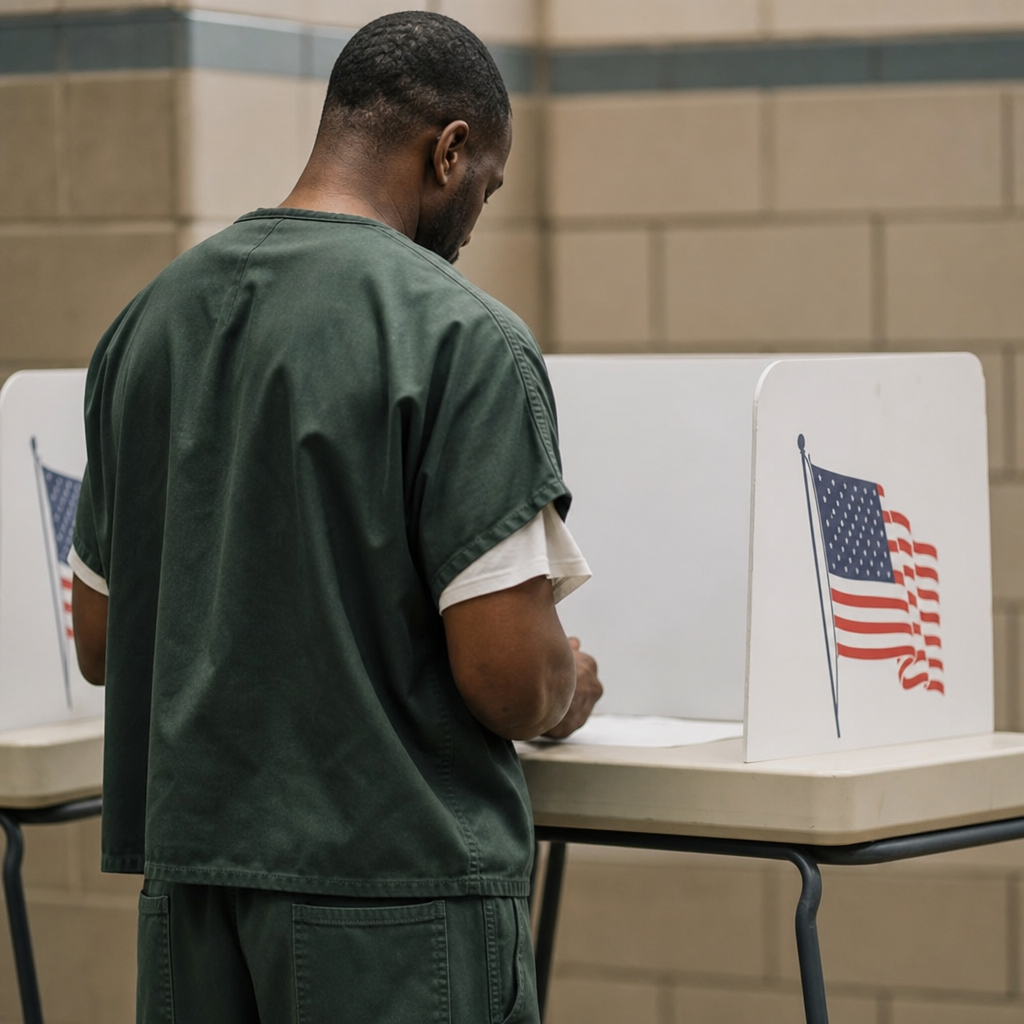
Felon disenfranchisement is the policy of restricting voting rights after a criminal conviction, and it remains one of the most consequential intersections of criminal justice and democratic participation in the United States. In AP Government and Politics, the topic matters because it connects federalism, civil rights, elections, representation, and the ongoing debate over who belongs in the political community. I have worked with students and civic education materials on this issue, and the first challenge is always vocabulary: a felony is generally a serious criminal offense, disenfranchisement means losing the right to vote, and restoration refers to the process by which voting eligibility returns. Those simple definitions open a complicated policy landscape because there is no single national rule. Instead, states decide whether people lose voting rights while incarcerated, during parole or probation, for life, or not at all. That variation makes felon disenfranchisement a major case study in how American government distributes power and produces unequal outcomes.
The issue also matters because it affects real elections and real communities. According to The Sentencing Project, millions of Americans have been disenfranchised at various points because of felony convictions, with racial disparities that are impossible to ignore. Black Americans are disproportionately represented in the criminal legal system, so restrictions on voting after conviction have an outsized political effect on Black communities. Supporters of disenfranchisement often argue that serious lawbreaking should suspend certain civic privileges, at least temporarily. Opponents argue that voting is a fundamental democratic right, that people who live under laws should have a voice in choosing lawmakers, and that restoring rights supports reintegration rather than exclusion. For students, journalists, and voters, understanding this debate requires more than memorizing state rules. It requires tracing the history, constitutional framework, administrative barriers, and reform movements that shape who can vote after a criminal conviction.
Historical Origins and Constitutional Foundations
Felon disenfranchisement in the United States has deep historical roots, but its current form is largely a product of state law layered onto constitutional ambiguity. In earlier legal traditions, including English common law, conviction for serious crimes could trigger civil death, meaning a person lost multiple civic and legal rights. American states inherited and adapted that idea. During the nineteenth century, many states adopted explicit provisions barring people convicted of certain crimes from voting. After the Civil War, these rules took on sharper political significance. Southern states rewrote constitutions and election laws in ways that combined criminal disenfranchisement with poll taxes, literacy tests, and selective law enforcement to weaken Black political power after emancipation.
The most important constitutional text in this debate is Section 2 of the Fourteenth Amendment, which reduces representation for states that deny voting rights to adult male citizens, except for participation in rebellion or other crime. That phrase has long been read by courts as recognizing some state authority to disenfranchise people based on criminal convictions. The Supreme Court’s 1974 decision in Richardson v. Ramirez is central here. The Court held that California could deny voting rights to people with felony convictions because the Fourteenth Amendment’s text created an exception tied to crime. That decision did not require disenfranchisement, but it made clear that the Constitution permits states to impose it in many circumstances.
At the same time, there are constitutional limits. In Hunter v. Underwood in 1985, the Supreme Court struck down an Alabama provision because it was enacted with racially discriminatory intent. That case matters because it shows felon disenfranchisement laws are not automatically valid if they are rooted in discrimination. Students should remember the distinction: the Constitution allows states to disenfranchise for crime, but laws adopted or enforced in racially discriminatory ways can still violate equal protection. That tension between state authority and civil rights enforcement is one reason this topic belongs at the center of AP Government and Politics rather than on the margins.
How State Laws Differ After Conviction
The most direct answer to the question “Can a person vote after a felony conviction?” is that it depends on the state and the person’s current status. Some states never take away voting rights except during actual incarceration. In Maine and Vermont, even people in prison can vote, usually by absentee ballot. Many states suspend voting rights only while a person is incarcerated for a felony, then restore them automatically upon release. Others require completion of parole and probation as well. A smaller group imposes additional barriers such as fines, fees, waiting periods, gubernatorial clemency, or case-by-case review. In a few places, certain convictions can still trigger long-term or effectively permanent disenfranchisement unless rights are affirmatively restored.
In practice, those categories create enormous differences in political participation. A person convicted of the same offense may remain eligible to vote in one state, lose the vote for several years in another, and face complicated restoration procedures in a third. Election administrators, probation officers, advocacy groups, and courts all influence how understandable these rules are. I have seen students assume that “once you finish your sentence you can vote again everywhere,” but that is inaccurate. In some states, legal financial obligations become part of the restoration question, which means unpaid court debt can delay or complicate eligibility. That has generated serious controversy because wealth can shape how quickly rights are restored.
| State approach | When voting rights are lost | When rights return | Example states |
|---|---|---|---|
| No disenfranchisement | Never lost, including during incarceration | Always retained | Maine, Vermont |
| Lost only during incarceration | While in prison for a felony | Automatically upon release | Colorado, California |
| Lost through parole or probation | During incarceration and community supervision | After full sentence completion | Texas, Georgia |
| Restoration with added conditions | Varies by offense and sentence status | After applications, payment, or clemency in some cases | Florida, Kentucky |
This state-by-state variation is a classic example of federalism. States administer elections, define most crimes, and control restoration procedures, so policies reflect local political cultures as much as constitutional doctrine. For a hub article under AP Government and Politics, that is the key organizing principle: felon disenfranchisement is not one policy but a patchwork system that reveals how decentralized election law can shape citizenship in unequal ways.
Race, Representation, and Democratic Legitimacy
Any serious discussion of felon disenfranchisement must confront race. The racial impact is not accidental background context; it is part of the subject’s core meaning in American politics. The Sentencing Project and other researchers have shown that Black adults are disenfranchised at rates far above the national average because of disparities in arrest patterns, charging, sentencing, and supervision. In several states, one in every ten or more Black adults has been disenfranchised at various times in recent decades. Those figures alter not only individual rights but also collective representation, especially in local elections where margins are small and community voice matters most.
The democratic legitimacy issue is straightforward. When large groups of residents are excluded from voting because of criminal convictions, elected officials can govern communities without being fully accountable to them. That problem extends beyond the individual who committed the offense. Families, neighborhoods, and advocacy networks lose political influence when exclusion is concentrated geographically and racially. Researchers have also linked civic participation to lower recidivism and stronger reintegration, although causation is complex. What is clear is that voting can serve as a marker of belonging. Denying it signals that punishment continues beyond incarceration and supervision, sometimes indefinitely.
Supporters of stricter laws counter that voting reflects a social contract and that serious violations of law can justifiably suspend participation in self-government. That argument carries weight for some voters, particularly when framed around accountability and respect for the rule of law. Yet the weakness in that position is inconsistency. The United States does not usually strip constitutional rights permanently because of a completed sentence, and it allows people with convictions to work, pay taxes, raise families, and in many cases serve their communities. Once someone is back in society, the claim that they should remain governed without representation becomes harder to defend on democratic grounds.
Administration, Restoration, and Barriers in Practice
Legal eligibility is only part of the story. Administrative design determines whether restored rights are meaningful or merely theoretical. The best systems use automatic restoration, clear public guidance, coordinated voter file updates, and direct notice to people leaving prison or supervision. The worst systems depend on opaque paperwork, inconsistent agency records, and officials who are unsure about the law. I have reviewed state guidance documents that are written so technically that even trained educators have to parse them line by line. If election officials, judges, and probation departments interpret rules differently, eligible citizens may stay away from the polls out of fear of making a mistake.
Florida offers a revealing example. In 2018, voters approved Amendment 4, which restored voting rights to many people with felony convictions after completion of all terms of sentence, excluding certain serious offenses. The measure was widely viewed as a major expansion of the franchise. But implementation quickly became contested because the phrase “all terms of sentence” was interpreted to include some fines, fees, and restitution. That meant many people could not easily determine whether they were eligible. Critics called it a pay-to-vote system, while supporters argued that a sentence is not complete until all legally imposed obligations are satisfied. The dispute demonstrated how statutory interpretation and recordkeeping can narrow a reform that appears broad on paper.
Practical barriers also include misinformation, mobility, and fear of prosecution. Some eligible voters wrongly believe they are still barred. Others move between states and assume old rules still apply. Highly publicized cases involving alleged unlawful voting can intensify caution, especially among formerly incarcerated people who have strong incentives to avoid any contact with the legal system. Effective policy therefore requires more than changing eligibility rules. It requires accurate databases, plain-language notices, training for front-line officials, and accessible restoration pathways. In public administration terms, implementation is the policy.
Current Reform Debates and What Students Should Watch
Modern reform efforts generally fall into three categories. First, some advocates seek automatic restoration upon release from prison, arguing that community reentry should include immediate political reintegration. Second, others push for restoration after completion of parole and probation, which preserves a punishment period while still rejecting permanent exclusion. Third, a smaller but growing movement supports universal voting rights, including for people who are incarcerated, on the theory that citizenship does not disappear at the prison gate. Each approach reflects a different understanding of punishment, rights, and membership in a democracy.
Recent years have shown that reform can come through ballot initiatives, legislation, executive action, and litigation. Governors in states such as Kentucky and Virginia have used executive authority to restore rights to large numbers of residents, though those decisions can be limited or reversed by future administrations. Legislatures have revised rules in states including Colorado and Nevada. Courts continue to address disputes over discriminatory intent, administrative burdens, and the meaning of sentence completion. For AP Government and Politics students, the lesson is to watch institutions, not just ideas. The same goal, expanded voting rights, can rise or stall depending on whether the key actor is a governor, legislature, state court, or voters acting through referendum.
This subtopic also connects to broader hub questions in AP Government and Politics: How does federalism create unequal access to rights? How do social movements turn moral claims into legal change? How do administrative details affect constitutional values? How do race and criminal justice shape representation? If you are building out related articles, useful companion pages would cover the Fourteenth Amendment, voting rights federalism, ballot initiatives, mass incarceration, equal protection doctrine, and election administration. Felon disenfranchisement sits at the crossroads of all of them, which is why it functions well as a hub topic rather than a narrow side issue.
Felon disenfranchisement is ultimately a debate about democracy itself: whether voting is a privilege that can be broadly withdrawn after criminal conviction or a core right that should return quickly, or never be lost at all. The strongest takeaway is that there is no single American rule. State laws differ dramatically, constitutional doctrine permits substantial variation, and administrative choices often decide whether formal rights can actually be used. History shows that these policies have often been entangled with racial exclusion. Current reform efforts show they can also change quickly when public pressure, litigation, and political leadership align.
For students and readers using this page as a hub, start with three questions. What does your state require after conviction: incarceration, parole, probation, payment, or an application? Who has the power to change that rule: voters, legislators, governors, or courts? And what does that answer reveal about citizenship in the American system? Those questions will guide deeper study across AP Government and Politics and keep the issue grounded in institutions rather than slogans. If you want to understand voting rights after criminal conviction, compare state rules, read the major cases, and follow current restoration debates closely.
Frequently Asked Questions
What is felon disenfranchisement, and why is it such an important topic in American government?
Felon disenfranchisement refers to laws and policies that limit or remove a person’s right to vote after a criminal conviction, most commonly after a felony conviction. In the United States, this issue is especially important because voting is one of the core rights of citizenship and democratic participation. When the government restricts access to the ballot, it raises major questions about representation, political equality, punishment, rehabilitation, and who is considered part of the political community.
In AP Government and Politics, felon disenfranchisement matters because it sits at the crossroads of several foundational concepts. It is directly tied to federalism because states, not the federal government, generally control voter qualifications and restoration rules. It is also connected to civil rights because these laws can have broad effects on marginalized communities and have long been criticized for producing unequal political outcomes. In addition, the topic helps students understand how elections work, how public policy shapes participation, and how legal rules can influence democratic legitimacy.
The issue is consequential not only in theory but in practice. Millions of Americans have been affected by felony disenfranchisement laws at some point, and the exact impact depends heavily on where a person lives. Some states automatically restore voting rights after incarceration, while others impose waiting periods, parole or probation requirements, or additional administrative steps. A few states have historically maintained far more restrictive systems. That variation makes felon disenfranchisement a powerful example of how American democracy can look very different across state lines.
Do people with felony convictions lose the right to vote everywhere in the United States?
No. One of the most important things to understand is that there is no single national rule for voting rights after a felony conviction. Instead, each state sets its own policies, subject to constitutional limits and court decisions. That means a person with a felony conviction may be eligible to vote in one state but ineligible in another, even if their criminal history is similar. This state-by-state variation is a textbook example of federalism in action.
In some states, people never lose the right to vote, even while incarcerated for a felony conviction. In many others, voting rights are restored automatically once a person completes incarceration. Some states require completion of the full sentence, including parole and probation, before rights return. Others may require payment of certain fines, fees, or restitution, though those requirements have been highly controversial and legally contested. In the most restrictive systems, restoration may require an application, a pardon, or a discretionary decision by government officials.
This complexity can create confusion, which becomes a major practical barrier to participation. Many people do not know whether they are eligible, and election officials, advocacy groups, and educators often stress the importance of checking current state law before registering. The larger lesson is that voting rights after conviction are not governed by a uniform national standard. Instead, they reflect different state-level choices about punishment, reintegration, and democratic inclusion.
Why are felon disenfranchisement laws controversial?
Felon disenfranchisement is controversial because it forces Americans to confront competing ideas about justice and democracy. Supporters of these laws often argue that serious criminal conduct can justify the temporary or permanent loss of certain civic privileges, including voting. From this perspective, disenfranchisement is seen as part of the consequences of violating the law and social contract. Some defenders also argue that states should retain the power to determine voter qualifications and the conditions under which rights are restored.
Critics, however, argue that disenfranchisement undermines democratic principles by excluding citizens from political participation, often long after they have served their time. They contend that voting should not be treated as a privilege that can be broadly revoked, especially because political participation can support reintegration into society. Many also point out that these laws have had disproportionate effects on racial minorities and communities already overrepresented in the criminal justice system. As a result, critics often frame the issue not just as a question of criminal punishment, but as a civil rights and equality issue.
The controversy also extends to how restoration rules work in practice. Even when rights are technically restored, complicated paperwork, unclear rules, and differing interpretations can discourage eligible voters from participating. That means the debate is not only about whether people should regain the franchise, but also about how accessible and transparent the restoration process should be. In this way, felon disenfranchisement remains a live political and constitutional issue because it affects both the meaning of citizenship and the functioning of representative government.
How does felon disenfranchisement connect to civil rights and racial inequality?
Felon disenfranchisement is closely linked to civil rights discussions because its effects have not been evenly distributed across the population. Due to long-standing disparities in policing, prosecution, sentencing, and incarceration, some racial and ethnic groups are more likely to be affected by criminal justice penalties, including voting restrictions tied to felony convictions. As a result, disenfranchisement laws can reduce political participation in communities that are already facing structural inequalities.
Historically, scholars and advocates have noted that some disenfranchisement policies expanded during periods when states were also using other legal tools to suppress political participation, particularly in the South after Reconstruction. That history matters because it shapes how the laws are interpreted today. Even where current laws are written in race-neutral terms, their real-world impact can still raise serious concerns about equal representation and the fairness of the democratic process.
In AP Government and Politics, this issue helps illustrate how formal equality and actual political power are not always the same thing. A law may appear neutral on paper while still producing unequal outcomes in practice. That is why debates over felon disenfranchisement often involve constitutional principles, voting rights policy, and broader questions about racial justice. For students and readers trying to understand American democracy, this topic shows how civil rights issues can operate through institutions, election rules, and public policy, not just through explicit discrimination.
What should students understand about voting rights restoration after a criminal conviction?
Students should understand that rights restoration is not a simple yes-or-no question. Instead, it is a legal and political process that varies widely from state to state and can change over time through legislation, ballot initiatives, executive action, and court rulings. In some places, restoration is automatic once a sentence is completed. In others, individuals must take additional steps such as re-registering to vote, obtaining documentation, or applying for official restoration. Because the rules can be updated, anyone directly affected should always verify their status under current state law.
It is also important to see restoration as more than a technical administrative matter. At its core, restoration reflects competing beliefs about what should happen after punishment ends. One view holds that once people have completed their sentence, they should fully reenter civic life, including participation in elections. Another view supports continued restrictions under certain conditions. The policy choices states make reveal broader ideas about rehabilitation, public trust, and democratic belonging.
For AP Government and Politics, the key takeaway is that felon disenfranchisement and voting rights restoration provide a concrete way to study federalism, political participation, civil rights, and public policy all at once. They show that democracy is shaped not only by big constitutional principles, but also by detailed state rules that determine who can cast a ballot. Understanding this issue helps students think more critically about representation, equality, and the real-world barriers that can affect participation in American elections.