
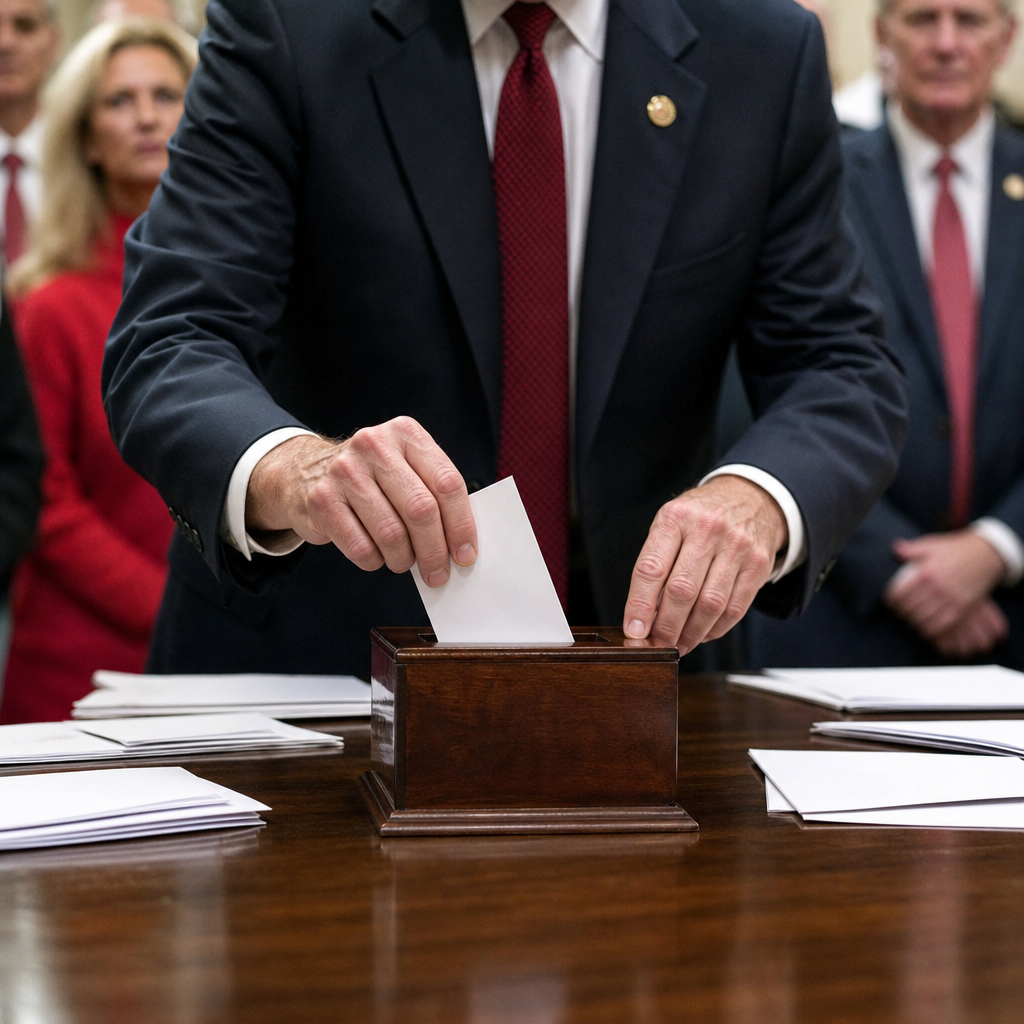
Faithless electors are members of the Electoral College who do not vote for the presidential or vice presidential candidate they were expected to support, and that small procedural deviation raises a big constitutional question about whether the system is mostly symbolic or a genuine point of risk. In AP Government and Politics, this topic sits in the miscellaneous category because it links constitutional design, federalism, parties, elections, judicial interpretation, and democratic legitimacy in one unusually compact issue. A faithless elector may cast a vote for a different candidate, abstain, or submit an invalid ballot, depending on state law and meeting procedures. The phrase matters because the United States does not technically elect a president by direct popular vote; voters choose slates of electors, and those electors formally cast the decisive ballots. That structure means even a rare act of defection can attract national attention, especially in close elections. Students often ask the central question directly: can faithless electors change the outcome of a presidential election? The practical answer is yes in theory, but historically it has almost never happened on a scale large enough to alter the winner. The legal answer is more nuanced, because state laws, party pledges, replacement procedures, and Supreme Court precedent now sharply limit the room for surprise. I have taught and reviewed this issue with students preparing for unit tests and free-response questions, and the confusion usually comes from mixing constitutional text with modern party practice. Understanding the gap between the original design and current political reality is the key to mastering the topic.
What Faithless Electors Are and Why They Exist
The Electoral College was created in Article II of the Constitution and later modified by the Twelfth Amendment, which separated presidential and vice presidential balloting. The Framers did not design electors as mere clerks. At the founding, electors were expected to exercise judgment, filter public passions, and help select nationally acceptable leaders. That original expectation explains why the Constitution itself does not explicitly require electors to vote for the winner of their state’s popular vote. Over time, however, political parties transformed the office. By the early nineteenth century, electors were chosen precisely because they were loyal party agents, not independent deliberators. In modern practice, almost every elector is selected by a party for reliability, activism, and loyalty.
That historical evolution matters because it explains why faithless electors are legally interesting but politically unusual. A faithless elector is not just breaking with a candidate; that person is breaking with the state voters who selected the party slate and with the party organization that trusted the elector. In many states, electors sign pledges, and in some states those pledges are backed by penalties or immediate removal. Even where legal enforcement used to be uncertain, party screening made large-scale defections highly improbable. The result is a constitutional remnant from an earlier design living inside a modern mass-party democracy.
How the Electoral College Process Creates the Possibility of Defection
The process works in several stages. On Election Day, voters generally choose a party slate of electors pledged to a presidential ticket. After states certify results, the winning slate in each state meets in December to cast electoral votes. Those votes are sent to Congress, which counts them in January. Because the electors, not the November voters, cast the formal constitutional ballots, there is a narrow opening for an elector to defect. If an elector votes for someone else, refuses to vote, or casts a procedurally invalid ballot, that is the point at which faithlessness occurs.
The risk is greatest in an extremely close election where only one or a few electoral votes separate victory from defeat. If a candidate has a comfortable Electoral College margin, a stray defection is politically embarrassing but not outcome-determinative. If the margin is razor thin, every elector matters. That is why discussion of faithless electors spikes after close races such as 2000, 2016, and hypothetical 269-269 tie scenarios. The mechanics also matter for AP Government because they connect to contingent elections. If no candidate wins a majority of electoral votes, the House of Representatives chooses the president, voting by state delegation, while the Senate chooses the vice president. A cluster of defections could therefore shift the decision from electors to Congress.
Historical Record: Rare, but Not Imaginary
Faithless electors are rare, but they are not a myth. Across U.S. history, more than 150 electoral votes have been cast contrary to expectation, though many came from unusual circumstances such as candidate death rather than deliberate rebellion. The election of 2016 is the modern benchmark because it produced the largest number of faithless electors in more than a century. Seven electoral votes were ultimately cast for someone other than the pledged candidates after several additional attempted defections were blocked or replaced under state rules. Electors voted for figures including Colin Powell, John Kasich, Ron Paul, Bernie Sanders, and Faith Spotted Eagle. Those votes did not change the winner, but they reminded the public that the Electoral College still contains human discretion unless law removes it.
Other examples are useful for context. In 1836, Virginia electors refused to vote for Democratic vice presidential nominee Richard Mentor Johnson, denying him an Electoral College majority and sending the vice presidential election to the Senate. That remains the strongest historical example of elector defection having a real institutional consequence. In 1976, a Washington elector pledged to Gerald Ford voted for Ronald Reagan instead. In 1988, a West Virginia Democratic elector cast a vice presidential vote for Lloyd Bentsen and a presidential vote for Michael Dukakis as a symbolic protest. These cases show that defections can be ideological, strategic, or expressive rather than purely accidental.
What the Supreme Court Decided
The most important modern legal development came in 2020, when the Supreme Court decided Chiafalo v. Washington and a companion case, Colorado Department of State v. Baca. The Court unanimously held that states may enforce elector pledges and penalize or replace faithless electors. Justice Elena Kagan’s opinion emphasized long national practice and the constitutional space states possess in appointing electors. In practical terms, the ruling means states are not required to tolerate elector independence. They can bind electors to the state’s popular vote outcome.
For students, the takeaway is straightforward: the Constitution does not force states to allow free-agent electors, and the Supreme Court has approved state laws that prevent or punish faithlessness. That decision significantly reduced the odds that a coordinated elector revolt could succeed in states with binding statutes. It did not create a uniform national rule, because election administration still rests largely with the states, but it removed the biggest legal uncertainty. Before 2020, some scholars argued electors had a constitutionally protected discretion once appointed. After Chiafalo, that argument carries far less practical force.
State Laws and the Real Distribution of Risk
Whether faithless electors are a real risk now depends mainly on state law and electoral margins. Many states and the District of Columbia require electors to vote for their pledged candidates, and several authorize immediate replacement if an elector defects or attempts to defect. A smaller number impose fines or other sanctions. A handful historically had weaker rules or no explicit binding law, though party selection still served as a deterrent. This patchwork means the national risk is uneven rather than universal.
| Factor | Effect on Risk | Why It Matters |
|---|---|---|
| State binding law | Reduces risk sharply | Electors can be forced to follow the popular vote winner |
| Replacement procedures | Reduces risk most | An attempted defector can be removed before the vote counts |
| Close Electoral College margin | Raises risk | One or two votes can matter if the race is tight |
| Party vetting of electors | Reduces risk | Parties choose loyal activists, donors, and officials |
| Protest movements among electors | Raises risk modestly | Organized campaigns can encourage symbolic defections |
In practice, replacement procedures are especially important. A state that simply fines a faithless elector after the fact still allows the unexpected vote to be cast. A state that nullifies the vote and substitutes another elector largely eliminates outcome risk. When I explain this to students, I frame it as the difference between punishment and prevention. Prevention matters far more than punishment in constitutional design. If the goal is ensuring the certified state winner receives the electoral votes, immediate replacement is the strongest safeguard.
Could Faithless Electors Actually Change a Presidential Election?
Yes, but only under narrow conditions. First, the election must be close enough that a small number of electoral votes can flip the result or deny a majority. Second, the relevant electors must come from states without effective binding and replacement rules, or the legal challenge must somehow fail in real time. Third, the defectors must be willing to withstand intense public scrutiny, party backlash, and possible legal consequences. Those conditions can exist simultaneously, but they rarely do.
The strongest modern concern is not a random lone elector but coordinated defections during a contested election. Imagine a candidate winning 270 electoral votes exactly, with one elector in a state lacking replacement power. A single defection could reduce that candidate to 269, potentially sending the election to the House if no other candidate reaches a majority. That scenario is constitutionally possible. It is also improbable because parties choose electors specifically to avoid it, and contested states increasingly have legal guardrails. The bigger democratic issue may be legitimacy rather than outcome. Even failed elector revolts can fuel public distrust by suggesting that a tiny group of insiders could override millions of voters.
Why This Topic Matters in AP Government and Politics
Faithless electors appear minor until you map the concept onto core course themes. They reveal how formal constitutional institutions interact with informal norms, especially party loyalty. They illustrate federalism because states control many rules governing elector appointment and enforcement. They show how the judiciary shapes election administration through constitutional interpretation. They also invite evaluation of democratic ideals: should presidential selection reflect direct voter preference, state-based allocation, or constitutional mediation through electors?
For exam purposes, this topic can support multiple argument lines. In a concept application, it can demonstrate the tension between original constitutional design and modern political practice. In a comparison question, it can contrast the Electoral College with direct popular election. In an argumentative essay, it can provide evidence about whether U.S. elections are majoritarian or filtered through institutions. Strong answers define the term, note that faithless electors are rare, and explain that Supreme Court precedent now allows states to bind or replace them. That combination shows both factual knowledge and institutional reasoning.
Common Misconceptions and Better Ways to Explain Them
The first misconception is that faithless electors are common enough to make every election unstable. They are not. The historical record shows occasional defections, usually symbolic, and almost never decisive. The second misconception is that electors can freely ignore voters everywhere. They cannot. State law now matters enormously, and many states tightly control elector behavior. The third misconception is that the popular vote automatically determines the presidency. It does not, which is why this issue exists at all. The Constitution makes electoral votes, not national popular votes, the formal basis of presidential selection.
A better explanation is this: faithless electors are a low-frequency but high-visibility feature of the Electoral College. They matter because they expose the distance between democratic expectations and constitutional machinery. If you want a plain-language analogy, think of them as a rarely used emergency exit in an old building plan. Most of the time nobody touches it, newer safety rules have narrowed access, and the building functions normally. But the exit still tells you something important about how the structure was originally designed and where vulnerabilities remain.
Faithless electors are best understood as a rare event with limited but real constitutional significance. They have appeared throughout U.S. history, sometimes as protest, sometimes because of unusual circumstances, and once in 1836 with a meaningful effect on the vice presidency. Yet modern elections are far less vulnerable than the constitutional text alone might suggest. Party vetting, state pledge laws, replacement procedures, and the Supreme Court’s 2020 decisions have turned elector discretion from a major theoretical debate into a narrower practical concern. That does not mean the issue is irrelevant. It remains a sharp case study in how American institutions evolve without fully shedding their original design.
For AP Government and Politics, this hub topic helps connect election mechanics, constitutional interpretation, federalism, parties, and democratic legitimacy. If you remember one core point, make it this: faithless electors almost never decide elections, but they still matter because they reveal who really holds power at the final stage of presidential selection and how law can constrain that power. Use this page as your starting point for related topics such as the Electoral College, contingent elections, the Twelfth Amendment, campaign strategy, and election reform debates. Review those connected issues next, and you will understand not just whether faithless electors are a real risk, but why the question keeps returning in every close presidential race.
Frequently Asked Questions
What is a faithless elector, and why does the issue matter if it happens so rarely?
A faithless elector is a member of the Electoral College who casts a vote for president or vice president in a way that differs from the candidate they were expected or pledged to support. In most elections, electors follow the outcome of their state and vote as anticipated, which is why the topic can seem minor at first glance. But even rare instances matter because the Electoral College is part of the formal constitutional process for choosing the president. That means a single unexpected vote is not just a quirky footnote. It raises larger questions about whether electors are supposed to exercise independent judgment, whether states can control them, and how much room exists for individual discretion inside a system most voters assume is automatic.
The issue also matters because close elections magnify small procedural irregularities. If the electoral vote margin is narrow, even one or two defections could affect the final outcome or at least throw the result into confusion. Beyond the numbers, faithless electors can undermine public confidence because they create the impression that a handful of individuals might override the expectations of millions of voters. In AP Government and Politics, that is exactly why the topic is so important: it connects constitutional structure, the mechanics of elections, state authority, party loyalty, and democratic legitimacy in one unusually revealing example.
How common are faithless electors in U.S. history, and have they ever changed the outcome of a presidential election?
Faithless electors are historically uncommon, which is why many scholars describe them as a rare event rather than a routine feature of presidential elections. Across American history, there have been scattered cases in which electors voted for someone other than their party’s nominee or otherwise failed to vote as expected. Some of those votes were symbolic protests, some were reactions to a candidate’s death or political controversy, and others reflected personal preference. Even so, the vast majority of electors in every election have voted as pledged.
Most importantly, faithless electors have not changed the final winner of a presidential election. That fact helps explain why the issue is often treated as more of a constitutional and theoretical concern than an immediate crisis. Still, “has not happened yet” is not the same as “cannot happen.” In a closely divided election, the possibility becomes more serious. The risk is not just that a faithless elector could change who reaches the required electoral majority, but also that defections could force the election into a contingent process in the House of Representatives under the Twelfth Amendment. So while history suggests the danger is limited, the structure of the system means the possibility cannot be dismissed entirely.
Can states legally require electors to vote for the candidate who won their state?
Yes, states can generally require electors to vote for the candidate they are pledged to support, and this became much clearer after the Supreme Court addressed the issue directly. In 2020, the Court held that states have the authority to enforce elector pledges and punish or replace electors who try to vote faithlessly. That decision reinforced the modern understanding that electors are not free agents in most circumstances, but participants in a state-regulated process designed to reflect the voters’ choice.
This matters because it shifts the Electoral College away from the older idea that electors might deliberate independently and toward the contemporary reality that they function largely as party-selected instruments of the popular vote in their states. At the same time, the fact that states have this authority does not mean every state uses identical rules. Election administration in the United States is deeply shaped by federalism, so states can differ in how they bind electors, what penalties they impose, and whether they replace an elector immediately if that person attempts to defect. For AP Government students, this is a great example of how constitutional silence, state power, and judicial interpretation interact to define the actual workings of American government.
Why does the Constitution leave room for debate about whether electors are symbolic or independent decision-makers?
The debate exists because the Constitution created the Electoral College but did not spell out every detail about how electors must behave once chosen. In the founding era, some framers imagined electors as individuals who would exercise judgment in selecting qualified national leaders. Over time, however, the rise of political parties transformed the system. Electors stopped acting like independent deliberators and became party loyalists selected precisely because they were expected to support a specific ticket. The constitutional text remained relatively spare, but the political system built around it evolved dramatically.
That gap between original design and modern practice is what makes faithless electors such a fascinating constitutional problem. On paper, the Electoral College can look like a body with discretion. In practice, it usually operates as a ceremonial checkpoint ratifying results already determined by state elections. Faithless electors expose the tension between those two understandings. If electors are purely symbolic, then any independent action seems illegitimate. If they retain some constitutional discretion, then attempts to bind them raise different questions about state control and institutional purpose. This tension is one reason the topic appears in so many AP Government themes at once: constitutional design, political parties, federalism, elections, and the courts all shape the answer.
Are faithless electors a real threat to democratic legitimacy, or mostly a technical issue exaggerated by speculation?
The best answer is that faithless electors are both limited in practice and significant in principle. In practical terms, they are usually a small-scale issue. They happen infrequently, they almost never affect the electoral count in a meaningful way, and many states now have laws that reduce the chance of a successful defection. From that perspective, it is fair to say the threat is often exaggerated when compared with larger electoral issues such as voter turnout, districting, ballot access, or election administration.
But in principle, faithless electors matter a great deal because democratic legitimacy depends not only on outcomes, but also on public trust in the rules. Americans generally believe that when they vote for president, they are effectively choosing among presidential candidates directly, even though constitutionally they are voting within an Electoral College framework. If an elector were to break that expectation in a pivotal election, the backlash could be enormous. The controversy would not just be legal. It would be political, civic, and moral, because it would raise the question of whether the system honors the will of the voters or allows an obscure procedural actor to disrupt it.
So the most accurate conclusion is that faithless electors are a rare event but a real risk in the sense that they reveal a structural vulnerability. They are unlikely to overturn an election under normal circumstances, especially after modern state laws and Supreme Court guidance. Yet the controversy remains highly relevant because it shows how even a seldom-used constitutional mechanism can affect perceptions of fairness, representation, and legitimacy. That is exactly why the subject continues to matter in both scholarship and AP Government classrooms.