
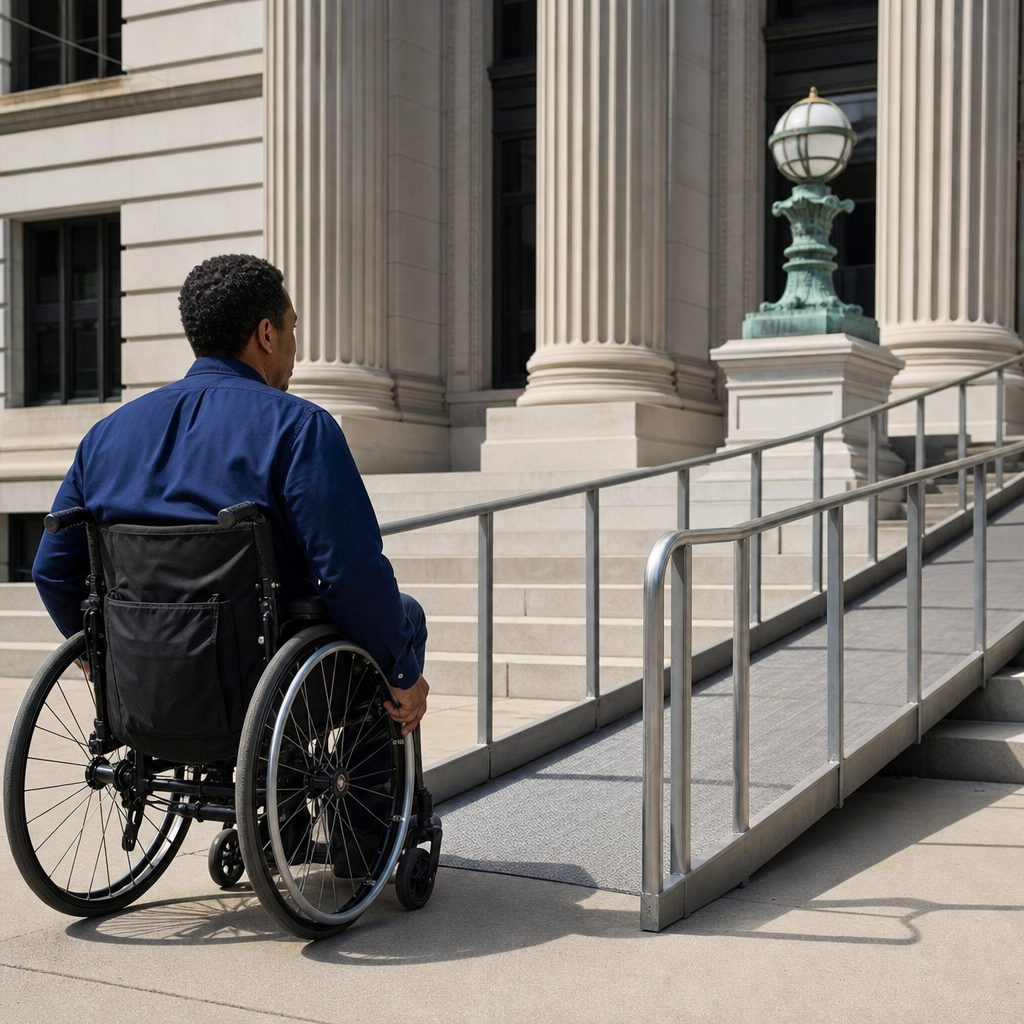
Disability rights in public life shape whether citizens can enter a courthouse, ride a bus, attend a town hall, apply for a permit online, or vote with privacy and independence. In the United States, the core legal framework is the Americans with Disabilities Act, usually called the ADA, alongside Section 504 of the Rehabilitation Act, the Individuals with Disabilities Education Act in school settings, and constitutional principles of equal protection and due process. In practice, ADA access means more than ramps and reserved parking. It includes effective communication for people who are deaf, blind, or have speech disabilities; program access in government services; reasonable policy modifications; digital accessibility; and transportation systems that function for real people, not just on paper.
This topic matters in public life because government is not optional. A restaurant can lose a customer; a motor vehicle office, polling place, police department, public university, or city council cannot be avoided so easily. When access fails, the result is exclusion from democracy itself. I have seen the difference in municipal settings where a single inaccessible PDF blocked benefits applications, and where a simple fix, such as an accessible web form or live captioning at meetings, opened participation immediately. Disability rights law exists to prevent that exclusion and to require public entities to plan for inclusion rather than react after complaints. For students of AP Government and Politics, this area is a practical lens on federalism, civil rights enforcement, administrative rulemaking, local governance, and the daily meaning of equal citizenship.
Understanding the hub of disability rights in public life starts with a few key terms. A public entity under Title II of the ADA includes state and local governments and their departments, agencies, and instrumentalities. Public accommodations under Title III are different; they are mostly private businesses open to the public. Accessibility refers to whether a facility, service, communication channel, or policy can be used by people with disabilities. Reasonable modification means changing a rule or practice when necessary to avoid discrimination, unless doing so would fundamentally alter the program. Effective communication means providing auxiliary aids and services, such as interpreters, captioning, large print, Braille, or accessible documents, so communication is as clear for disabled people as for others.
Because this article is a hub for the broader subtopic, it covers the main pillars: physical access, digital access, transportation, voting, policing and emergency response, education and public meetings, enforcement, and the recurring limits and tradeoffs governments face. Each area connects to a basic obligation: government programs, when viewed in their entirety, must be accessible. That legal standard sounds abstract, but it drives concrete decisions about curb cuts, elevator maintenance, website redesigns, procurement rules, training, and budget priorities. Once you understand how those obligations work, the rest of the disability rights landscape becomes much easier to analyze.
The Legal Foundation: What Governments Must Do
Title II of the ADA is the centerpiece for public life because it applies directly to state and local government operations. It prohibits disability discrimination in services, programs, and activities, whether they occur in a building, on a bus route, in a licensing process, or on a website. Section 504 adds similar duties for entities receiving federal financial assistance, which includes most public schools, transit systems, health agencies, and universities. The Department of Justice enforces many Title II obligations, while the Department of Transportation, Department of Education, and other agencies enforce sector-specific rules.
A central concept is program access. Older government buildings do not always need every doorway and counter rebuilt immediately, but the program as a whole must be accessible. That can mean relocating a hearing to an accessible courtroom, installing a lift, offering services on an accessible floor, or renovating over time according to a transition plan. New construction and alterations face stricter standards and generally must comply with the 2010 ADA Standards for Accessible Design. In my experience reviewing public facilities, the biggest compliance failures are not obscure design details. They are basic maintenance and planning problems: blocked routes, heavy doors, broken lifts, missing signage, inaccessible restrooms, and no process for accommodating requests.
Governments also must make reasonable modifications to policies and practices. A city hall that bans all animals must still allow service animals. A recreation program may need to adjust registration procedures for people using assistive technology. A police department may need to alter standard communication practices when interacting with a person who is deaf or autistic. The obligation is not limitless. Agencies can deny changes that would fundamentally alter a program or impose undue financial and administrative burdens, but they must be able to justify that decision with evidence, not convenience. That distinction matters in litigation and in everyday administration.
Physical Access in Streets, Buildings, and Facilities
Physical accessibility is the most visible part of disability rights in public life, and it reaches far beyond wheelchair ramps. Sidewalks, curb ramps, crosswalk signals, parking, building entrances, service counters, restrooms, courtrooms, parks, playgrounds, and emergency shelters all affect whether disabled residents can use public services. The Supreme Court’s decision in Tennessee v. Lane underscored the constitutional significance of courthouse access, recognizing that inaccessible judicial facilities can deny fundamental rights. That case remains one of the clearest examples of why access to government facilities is not a minor convenience issue.
Sidewalks are especially important because they connect every other service. If a resident cannot navigate the route from transit to city hall or from a parking area to a polling place, nominal building access is meaningless. Federal enforcement actions have repeatedly focused on curb ramps, detectable warnings, excessive slopes, and barriers created during street resurfacing projects. Under ADA rules, when a jurisdiction alters a roadway, it generally must install or upgrade curb ramps at affected intersections. Many cities now use self-evaluation reports and transition plans to map these deficiencies block by block, then prioritize fixes based on complaint data, pedestrian demand, and proximity to schools, transit, and government offices.
Public facilities also need operational accessibility, not just compliant blueprints. An elevator that is frequently out of service can create the same exclusion as having no elevator at all. A secure entry checkpoint with no reachable tray or no staff procedure for mobility devices can stop visitors at the door. Parks departments often overlook accessible routes to bleachers, picnic tables, fishing piers, or playground surfacing. The lesson from real compliance work is simple: access depends on maintenance, staff training, and procurement as much as on architecture.
Digital Accessibility, Communication, and Public Information
Government increasingly operates through websites, apps, online forms, remote hearings, and digital records, which makes digital accessibility a civil rights issue, not merely an IT preference. If a tax payment portal cannot be used with a screen reader, or a public meeting livestream has no captions, disabled residents are locked out of core civic functions. The Department of Justice has made clear that Title II applies to web content and mobile applications. The most widely used technical benchmark is WCAG 2.1 Level AA, which addresses text alternatives, keyboard navigation, color contrast, form labels, error identification, and captions.
Effective communication rules also require agencies to choose aids and services that actually work for the person and context involved. For a routine interaction, exchanging notes may be enough. For a court proceeding, disciplinary hearing, medical consultation in a public hospital, or police interrogation, a qualified sign language interpreter may be necessary. Video remote interpreting can be useful, but only when bandwidth, camera placement, and staff competency are adequate. I have seen agencies treat any technology purchase as compliance, then discover the interpreter video freezes or the PDF remains unreadable by assistive software. Accessibility fails when procurement is disconnected from actual user testing.
| Public function | Common barrier | Accessible practice |
|---|---|---|
| Online benefits application | Unlabeled form fields and image-only PDFs | Screen-reader compatible web forms with labeled inputs |
| City council livestream | No captions or transcript | Real-time captioning and archived transcript |
| Emergency alert | Audio-only announcement | Text, visual, audio, and multilingual alert formats |
| Public records request | Scanned documents unreadable to assistive tech | Tagged PDFs or accessible HTML documents |
Digital access is often the fastest way for governments to improve participation because fixes can scale quickly. An accessible content management system, a procurement checklist, routine captioning, and staff training can prevent hundreds of barriers before they occur. But digital access also requires governance. Someone must own standards, test systems, monitor vendors, and respond to complaints.
Transportation, Voting, and Participation in Democracy
Public transit is a gateway right because it determines whether people can reach work, school, health care, and government services. Under ADA transportation rules, fixed-route bus systems must provide accessible vehicles, stop announcements, maintenance of lifts and ramps, and complementary paratransit for eligible riders who cannot use the regular system. In practice, recurring problems include missed paratransit pickups, long reservation windows, inaccessible bus stops, and poor driver training. The legal standard is not perfection, but service must be comparable enough that disabled riders can use public transportation with dignity and reliability.
Voting is another core area where government obligations are especially visible. The Help America Vote Act requires at least one accessible voting system in each polling place for federal elections, enabling private and independent voting. The ADA and Section 504 add broader obligations involving polling place routes, parking, entrances, check-in tables, signage, and communication assistance. When counties place voting in churches, schools, or community centers with steps, narrow doors, or inaccessible restrooms, they often need temporary solutions or alternative sites. Election officials who audit polling places early, train poll workers, and offer accessible absentee options reduce both legal risk and voter exclusion.
Public participation includes more than casting a ballot. Town halls, zoning hearings, school board meetings, jury service, and permit hearings all require access. A hearing scheduled in an inaccessible room, with no captioning and no remote participation option, effectively narrows who can influence policy. That is why disability rights in government settings are inseparable from democratic legitimacy. If only the nondisabled can readily attend, speak, and monitor officials, public accountability is weakened.
Policing, Emergency Response, Education, and Enforcement
Police and emergency services present some of the most difficult and consequential disability rights issues. Officers must adapt communication and tactics when interacting with people who are deaf, blind, have intellectual disabilities, autism, mental illness, or medical conditions that affect behavior. Misreading disability as defiance can escalate encounters rapidly. Best practice now includes crisis intervention training, dispatch flags, de-escalation protocols, plain-language commands, and access to interpreters or communication boards. Emergency management agencies likewise must ensure shelters, evacuation plans, transportation assistance, and public warnings are accessible before disasters occur, not after litigation exposes failures.
Public education occupies a related but distinct space. K–12 schools and public universities are governed by disability rights rules that overlap but are not identical. IDEA focuses on special education entitlements for eligible students, while Section 504 and the ADA address nondiscrimination and access more broadly. In higher education, common issues include testing accommodations, captioned course media, accessible learning platforms, housing modifications, and equal access to labs, athletics, and campus events. Government obligations here matter politically because education systems are among the largest and most visible public institutions most citizens encounter.
Enforcement happens through administrative complaints, negotiated settlements, private lawsuits, and internal compliance systems. The Department of Justice often resolves matters through settlement agreements requiring timelines, training, policy revision, consultant review, and reporting. Strong governments do not wait for a complaint. They conduct self-evaluations, maintain ADA coordinators and grievance procedures, publish accommodation processes, update transition plans, and include accessibility in capital planning and technology procurement. The biggest lesson from years of public-sector compliance work is that accessibility succeeds when treated as routine governance rather than a special exception.
Disability rights in public life are a measure of whether government serves the whole public. The ADA and related laws require more than symbolic inclusion. They require buildings people can enter, websites they can use, transportation they can rely on, meetings they can follow, and public systems that adapt when standard procedures exclude. For AP Government and Politics, this subtopic connects civil rights doctrine, federal enforcement, local administration, elections, public budgeting, and democratic participation in a single framework.
The key takeaway is straightforward: access is not a side issue within government obligations; it is part of lawful and legitimate governance. Physical barriers, inaccessible documents, failed communication, and rigid policies each deny equal participation in different ways. Governments that plan early, train staff, consult disabled residents, and build accessibility into procurement and operations usually spend less, face fewer complaints, and deliver better public service. Governments that postpone action create avoidable exclusion and legal risk.
Use this hub as the starting point for deeper study of voting access, disability rights case law, public school obligations, transit compliance, digital accessibility standards, and policing reforms. If you are analyzing a policy, a court case, or a local government practice, ask one practical question first: can disabled people use this service fully, safely, and with dignity? That question will lead you to the real constitutional, administrative, and civic stakes.
Frequently Asked Questions
What does the ADA require from state and local governments in public life?
The Americans with Disabilities Act requires state and local governments to make public programs, services, and activities accessible to people with disabilities. In most discussions about government obligations, this falls under Title II of the ADA. The basic rule is broad: if a public entity offers something to the public, qualified individuals with disabilities must have an equal opportunity to benefit from it. That includes courthouses, jails, sidewalks, voting locations, parks, buses, public meetings, police services, licensing offices, websites, and many other parts of civic life.
Accessibility under the ADA is not limited to ramps and parking spaces, though physical access remains central. Governments also have to address communication access, policy barriers, and digital access. For example, a city may need to provide sign language interpreters for a public hearing, allow reasonable modifications to a policy that would otherwise exclude a person with a disability, maintain accessible pedestrian routes, or ensure an online permit application system works with screen readers and keyboard navigation. The law looks at whether people with disabilities can participate in a way that is meaningful, integrated, and comparable to others.
Governments are also expected to avoid eligibility rules or administrative practices that unnecessarily screen out people with disabilities. In addition, they must provide effective communication and make reasonable modifications unless doing so would fundamentally alter the program or create an undue financial and administrative burden. Even then, a public entity generally must look for another effective way to provide access. The practical takeaway is that ADA compliance is an ongoing governmental duty, not a one-time construction project. It requires planning, maintenance, training, and responsiveness whenever barriers prevent equal participation in public life.
How is ADA access different from Section 504 of the Rehabilitation Act, and why do both matter?
The ADA and Section 504 are closely related, and in many situations they work together. Section 504 of the Rehabilitation Act applies to programs or activities receiving federal financial assistance, and it also applies to certain federal executive agencies. The ADA, by contrast, reaches broadly across public entities and many private entities whether or not they receive federal funding. For state and local governments, both laws often apply at the same time, especially because so many public programs receive federal money in some form.
In day-to-day terms, both laws prohibit disability discrimination and require access, but Section 504 has special importance because it has long served as a foundation for disability rights enforcement in education, transportation, healthcare, housing-related programs, and other federally assisted services. Agencies that distribute federal funds can investigate complaints and require corrective action under Section 504. That means a school district, transit provider, public hospital, or local government department may face obligations under both statutes at once, along with agency-specific regulations.
Why does this overlap matter? Because it gives disabled individuals multiple legal pathways and reinforces the principle that public systems cannot exclude people with disabilities from civic life. If a county courthouse is inaccessible, if a federally funded transit system fails to provide usable service, or if a government website blocks access to benefit applications, both the ADA and Section 504 may be relevant. The standards are often interpreted in harmony, but the funding connection under Section 504 can affect enforcement options, oversight, and compliance strategies. For the public, the main point is simple: government access is not optional, and these laws together form a strong framework for demanding equal participation.
What counts as accessible communication and digital access when dealing with government services?
Accessible communication means a government must communicate with people with disabilities as effectively as it communicates with others. This is a core ADA requirement, and it applies across a wide range of interactions: court proceedings, police interviews, school meetings, public hearings, emergency alerts, permit applications, tax notices, transportation announcements, and voting materials. The right solution depends on the person and the context. For someone who is deaf or hard of hearing, effective communication might require a qualified sign language interpreter, real-time captioning, assistive listening systems, or accurate captions on video content. For someone who is blind or has low vision, it may involve screen-reader-compatible documents, Braille, large print, accessible PDFs, or verbal assistance that preserves privacy and independence.
Digital access has become one of the most important disability rights issues in public life because so much government interaction now happens online. If a resident cannot use a city website to pay taxes, request records, apply for housing assistance, register for recreation programs, or review election information, that person is effectively shut out of public services. An accessible government website or mobile platform should generally support keyboard-only navigation, proper heading structure, form labels, color contrast, alt text for meaningful images, error identification, captioned multimedia, and compatibility with screen readers and other assistive technology.
Governments cannot simply assume that a phone number or in-person office is an adequate substitute for a broken online system, especially when the online option offers convenience, privacy, speed, or availability outside business hours. The law focuses on equal access in practice, not just theoretical availability. Effective communication and digital accessibility therefore require more than technical fixes; they require policies, procurement standards, staff training, testing, and prompt remediation when barriers are reported. In modern public life, inaccessible technology can be as exclusionary as a staircase with no ramp.
Do governments have to change their policies or practices for people with disabilities?
Yes. One of the ADA’s most important requirements is the duty to make reasonable modifications to policies, practices, and procedures when necessary to avoid discrimination on the basis of disability. This matters because exclusion often happens through rules rather than architecture. A building may be physically open, but a rigid policy can still prevent meaningful participation.
Examples are everywhere. A city hall may need to allow a person with a disability to submit paperwork in an alternative format, a public meeting may need extra time or a modified speaking process, a transit agency may need to adjust how it handles stop announcements or boarding assistance, and a courthouse may need to accommodate a litigant whose disability affects scheduling or communication. A no-animals rule may have to be modified for service animals. A requirement that all business be conducted only through a touchscreen kiosk may need to be adjusted if that system is inaccessible. The key question is whether the modification is reasonable and necessary to provide equal access.
There are limits. A government does not have to make a change that would fundamentally alter the nature of the service, program, or activity, and it does not have to accept a modification that would create a direct threat or an undue financial and administrative burden. But those exceptions are not blanket excuses. Public entities are expected to make individualized assessments, rely on actual facts rather than assumptions, and consider alternative modifications if the first requested option is not feasible. The law is designed to prevent bureaucratic rigidity from becoming a form of disability discrimination, which is why thoughtful policy modification is such a central part of government obligations.
What can a person do if a courthouse, transit system, voting site, or government website is not accessible?
If a public service is inaccessible, the first practical step is often to document the barrier clearly. That can include dates, locations, screenshots, photos, names of offices contacted, and a description of how the barrier affected access. Specific facts matter. For example, it is helpful to note whether a courthouse entrance had no usable ramp, whether a bus lift repeatedly failed, whether a polling place lacked an accessible path of travel, or whether an online form could not be completed using a screen reader or keyboard. Documentation can make it easier to request a fix and, if needed, pursue a formal complaint.
Many accessibility problems can and should be raised directly with the responsible government agency. State and local governments often have ADA coordinators, grievance procedures, election officials, transit complaint systems, or public accommodations offices. A person can request a reasonable modification, auxiliary aid, accessible format, or corrective action. In some cases, especially where time matters, such as an upcoming hearing or election, immediate contact with the agency can help secure a prompt solution. Advocacy organizations and legal aid groups may also be able to assist.
When informal efforts do not work, formal enforcement options may be available. Depending on the facts, a complaint may be filed with the U.S. Department of Justice, a federal funding agency under Section 504, a state civil rights body, or a court. Voting access may implicate additional federal protections. Public school issues may involve the Individuals with Disabilities Education Act as well as the ADA and Section 504. The larger legal principle is that disability access is not a courtesy; it is a civil right. When governments fail to provide accessible buildings, transportation, meetings, websites, or voting systems, affected individuals are not asking for special treatment. They are demanding equal citizenship, privacy, independence, and full participation in public life.