
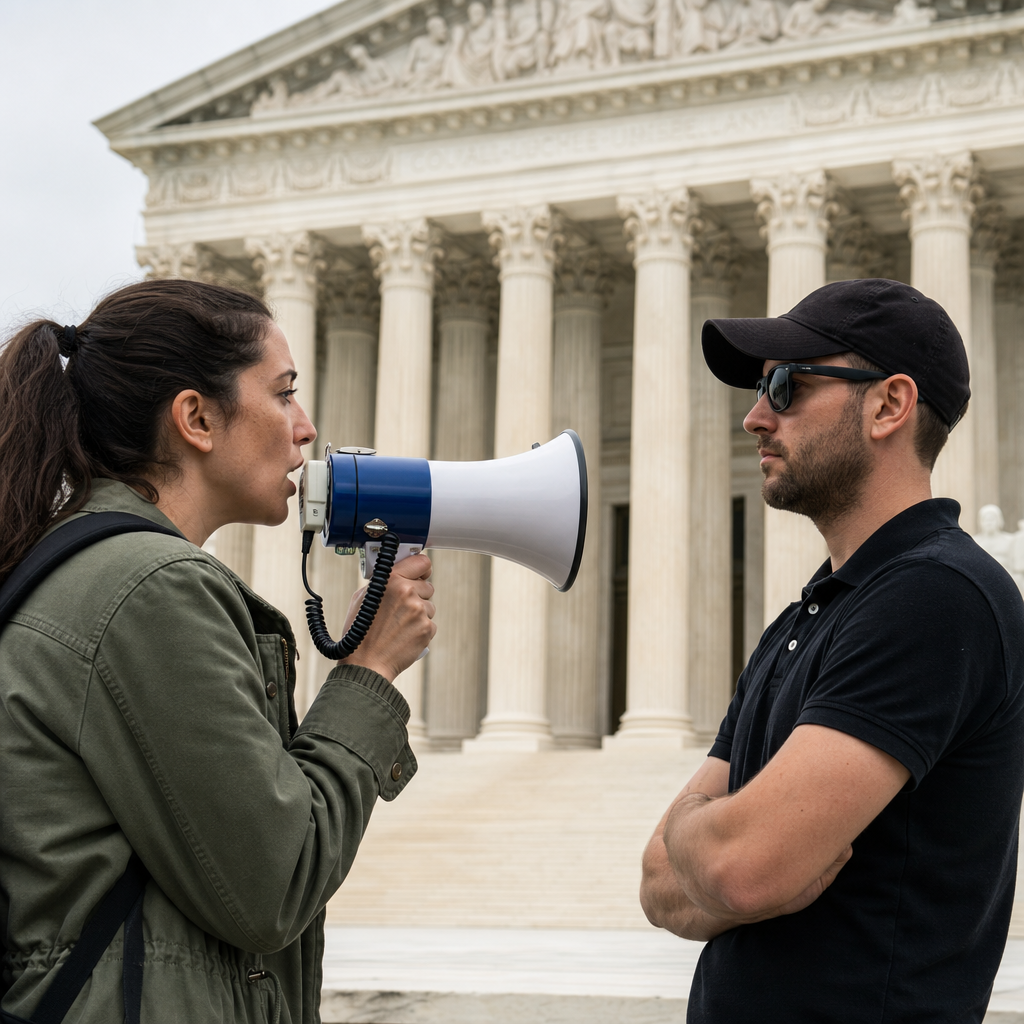
Content-based vs content-neutral speech regulation is one of the most important distinctions in AP Government and Politics because it determines how courts evaluate laws that affect expression, protest, media, and public debate. In constitutional law, a content-based regulation targets speech because of the topic discussed, the idea expressed, or the message conveyed. A content-neutral regulation, by contrast, applies without regard to the message and usually governs the time, place, or manner of expression. I have taught this distinction by starting with a simple test: if officials must examine what was said to decide whether the law applies, the regulation is probably content based. If the rule applies no matter what the speaker says, it is more likely content neutral.
This difference matters because the First Amendment does not treat all regulations equally. Courts generally subject content-based laws to strict scrutiny, the toughest constitutional standard, requiring a compelling government interest and narrow tailoring. Content-neutral laws usually receive intermediate scrutiny, which asks whether the government has an important interest unrelated to suppressing expression and has left open ample alternative channels for communication. For students, this framework links many recurring AP Government topics, including free exercise and establishment comparisons, civil liberties balancing, prior restraint, symbolic speech, student speech, campaign speech, and protest regulation. It also helps explain why some laws are struck down immediately while others survive.
As a hub topic, this subject connects the major speech cases that AP courses revisit repeatedly. Knowing the doctrine lets students compare cases instead of memorizing them in isolation. It clarifies why flag burning is protected in one case, why permit systems can be constitutional in another, and why zoning, parade routes, noise limits, and buffer zones often trigger disputes over whether the state is regulating harmful effects or disfavored ideas. Once students can identify the difference between content-based and content-neutral speech regulation, they can analyze almost any First Amendment question with greater precision and confidence on tests, essays, and class discussion.
What content-based speech regulation means
A content-based speech regulation is a law or policy that restricts expression because of the subject matter, viewpoint, or communicative impact of the speech. The clearest examples are statutes that ban criticism of government, prohibit advocacy on a controversial issue, or punish speech that expresses one side of a debate but not the other. Courts are especially suspicious of viewpoint discrimination, the most disfavored form of speech regulation, because government may not favor one opinion over its rival. In practice, if a city allows praise of the police but bans anti-police messages, that rule is unconstitutional almost automatically because it depends entirely on what the speaker says.
The Supreme Court has repeatedly emphasized this principle. In Police Department of Chicago v. Mosley the Court invalidated a law that barred picketing near schools except labor picketing. The defect was not simply unequal treatment; it was that the government selected permitted speech based on subject matter. In Reed v. Town of Gilbert, the Court sharpened the rule by holding that a sign code was content based when different rules applied to political signs, ideological signs, and directional signs. Officials had to read the sign to classify it, and that was enough to trigger strict scrutiny. For AP Government students, Reed is a modern anchor case because it shows how even technical local ordinances can become major First Amendment problems.
Strict scrutiny is difficult to satisfy. Government must identify a compelling interest, such as national security in rare circumstances, and must prove the law is narrowly tailored to achieve that interest using the least speech-restrictive means. Most content-based laws fail. That does not mean every speech-related law is invalid, because some categories of low-value or historically unprotected speech, such as true threats, incitement under the Brandenburg standard, obscenity under the Miller test, and defamation under established rules, can be regulated. Still, within protected speech, content-based distinctions are presumptively unconstitutional. That presumption reflects a core constitutional judgment: the state should not decide which ideas citizens may hear, endorse, or reject.
What content-neutral speech regulation means
A content-neutral speech regulation controls the circumstances of expression rather than the message itself. These laws often govern time, place, and manner. Common examples include permit requirements for parades, limits on amplified sound after certain hours, restrictions on blocking building entrances, or rules on the size and placement of signs for safety reasons. The key question is whether the regulation applies regardless of viewpoint or topic. If a city limits all rally sound trucks to a certain decibel level after 10 p.m., it is usually regulating noise and neighborhood disruption, not suppressing a particular idea.
Courts generally apply intermediate scrutiny to these laws. The government must show that the regulation furthers a significant interest, is narrowly tailored, and leaves open ample alternative channels for communication. This test appears often in public forum analysis, where sidewalks, parks, and streets are treated as traditional public forums with strong speech protection. Even there, the state may impose reasonable content-neutral rules to maintain order, protect safety, and manage competing uses of public space. I often tell students that content neutrality does not mean automatic constitutionality; permit systems can still fail if officials have too much discretion, fees are arbitrary, or alternatives for communication are unrealistic.
The Supreme Court’s decision in Ward v. Rock Against Racism is a standard example. New York City required performers in Central Park to use city-provided sound equipment and technicians to control excessive noise. The Court upheld the rule because it targeted volume, not message, and served a substantial interest in protecting nearby residents and preserving park use. By contrast, if the city had allowed loud patriotic concerts but restricted loud antiwar concerts, the regulation would have been content based. This contrast is exactly why AP Government students should analyze not only what the government claims its purpose is, but also how the law operates in practice.
How courts tell the difference
The most reliable way to distinguish the two categories is to ask three direct questions. First, does enforcement require an official to read, listen to, or interpret the message to know whether the law applies? Second, does the rule single out a subject matter, speaker category, or viewpoint? Third, is the government truly addressing secondary effects such as traffic, crowd control, property access, or noise, rather than disagreement with the expression itself? These questions do not solve every case, but they organize the analysis far better than relying on labels used by legislators or local officials.
Context also matters. A facially neutral law can be unconstitutional if it is adopted or enforced for discriminatory reasons. Likewise, a law that appears to mention a topic may still fit within a recognized category of unprotected speech if it targets threats, fraud, or criminal solicitation. Students should also separate content neutrality from forum type. Speech rights differ in traditional public forums, designated public forums, limited public forums, and nonpublic forums. A school board meeting, military base, classroom, airport terminal, or courthouse can involve different standards. The same restriction may be valid in one setting and invalid in another because forum doctrine changes the baseline level of access.
| Question | If Yes | Likely Result |
|---|---|---|
| Must officials examine the message to enforce the rule? | The rule depends on subject matter or viewpoint | Content based; strict scrutiny usually applies |
| Does the rule regulate noise, location, duration, or crowd movement regardless of message? | The government is managing effects of speech | Content neutral; intermediate scrutiny usually applies |
| Does the rule give officials broad discretion to approve or deny speech permits? | Risk of censorship is high | May fail even if framed as content neutral |
This framework is useful because exam questions often hide the issue inside realistic facts. A buffer zone outside a clinic, for example, may be defended as content neutral if it applies to all speakers and aims to prevent congestion or harassment. But if the rule only bars anti-abortion counseling while allowing supportive messages, it becomes content based. Similarly, sign ordinances, campus protest rules, and social media policies often turn on whether the government is regulating disruption or selecting messages. Once students identify who is speaking, where they are speaking, and whether officials must inspect the content, the constitutional analysis becomes much more manageable.
Major cases AP Government students should know
Several Supreme Court cases serve as landmarks for this topic. Texas v. Johnson held that flag burning as political protest is protected symbolic speech. The state’s interest was tied to the communicative impact of the act, making the regulation content based. Tinker v. Des Moines protected student armbands absent substantial disruption, showing that even in schools the government cannot suppress expression merely because it dislikes the message. Morse v. Frederick, however, allowed schools greater control over speech reasonably viewed as promoting illegal drug use, illustrating that context and institutional setting matter.
For public forums, Cox v. New Hampshire recognized permit requirements for parades, while Ward v. Rock Against Racism upheld a content-neutral sound regulation. McCullen v. Coakley struck down Massachusetts buffer zones around abortion clinics, not because the law was content based, but because it burdened substantially more speech than necessary. That case is especially helpful for students because it proves content neutrality does not end the inquiry. A law can be content neutral and still unconstitutional if it is not narrowly tailored. Meanwhile, Reed v. Town of Gilbert remains central for sign regulations and any rule that categorizes speech by topic.
Another case worth connecting is R.A.V. v. City of St. Paul, which invalidated a bias-motivated expression ordinance because it singled out particular disfavored subjects even within a category of otherwise regulable speech. Together, these cases show a pattern I have seen students grasp quickly once the doctrine is organized properly: the Court is most hostile to laws choosing winners and losers in the marketplace of ideas, more tolerant of regulations addressing practical harms, and highly attentive to whether less restrictive alternatives were available.
Why the distinction matters beyond exams
This doctrine matters in everyday politics because public officials constantly regulate expression in contested spaces. City councils write protest ordinances, school districts adopt student conduct codes, universities govern demonstrations, and state legislatures address online conduct, campaign signage, and access to public property. The difference between content-based and content-neutral speech regulation often determines whether a policy protects public order lawfully or becomes censorship. During election seasons, for example, restrictions on sign placement near polling places may be upheld if they address congestion and safety uniformly, but rules singling out partisan signs are far more vulnerable.
The distinction also shapes current debates about platform governance and digital communication, even though private companies are not generally bound by the First Amendment in the same way governments are. When states attempt to compel or forbid content moderation by platforms, courts still ask whether the law targets ideas, editorial choices, or operational conduct. The underlying constitutional instinct remains consistent: government may address genuine harms, but it cannot manipulate public discourse by privileging favored messages and burdening disfavored ones.
For AP Government and Politics, this hub concept ties together civil liberties doctrine, judicial review, federalism disputes, and the ongoing tension between liberty and order. If you can identify whether a rule is content based or content neutral, you can predict the level of scrutiny, frame a stronger Supreme Court comparison, and explain outcomes with clarity. Review the major cases, practice the three-question test, and use this page as your starting point for deeper study across the broader speech and rights unit.
Frequently Asked Questions
What is the difference between content-based and content-neutral speech regulation?
The difference comes down to why the government is regulating speech. A content-based regulation applies to speech because of what the speaker says, the idea being communicated, or the subject matter of the message. If a law treats speech differently depending on whether it discusses politics, religion, public policy, or any other topic, it is usually considered content-based. Courts are highly suspicious of these laws because they raise the risk that the government is favoring some viewpoints or suppressing disfavored ideas.
A content-neutral regulation, by contrast, does not depend on the message itself. Instead, it regulates the circumstances of expression, such as when, where, or how speech occurs. These are often called time, place, and manner restrictions. For example, a city may require permits for large parades, limit the use of amplified sound late at night, or impose crowd-control rules for demonstrations, as long as those rules apply regardless of the cause or viewpoint being expressed. This distinction is central in AP Government and constitutional law because once a regulation is classified as content-based or content-neutral, that classification largely determines the level of judicial scrutiny the court will apply.
Why are content-based speech regulations usually more difficult for the government to defend in court?
Content-based regulations are usually reviewed under strict scrutiny, the most demanding standard of judicial review. Under strict scrutiny, the government must prove that the law serves a compelling governmental interest and is narrowly tailored to achieve that interest using the least restrictive means available. In practice, this is very hard to satisfy. Courts assume that the free exchange of ideas is a foundational constitutional value, so laws targeting speech based on its subject matter or message are treated with deep skepticism.
The reason for this skepticism is not just technical doctrine; it reflects a broader concern about censorship and government abuse. If officials can regulate expression because they disagree with the message or believe a topic is too controversial, then political criticism, minority viewpoints, and unpopular opinions become vulnerable. That is exactly what the First Amendment is designed to prevent. Even when the government claims a worthy goal, courts ask whether the law is actually focused on a truly compelling interest and whether it unnecessarily burdens protected speech. In many cases, content-based laws fail because they sweep too broadly, discriminate among speakers, or could have been replaced by a less speech-restrictive alternative.
What are common examples of content-neutral speech regulations?
Common examples include permit requirements for marches and rallies, noise ordinances that limit amplified sound during certain hours, restrictions on the placement of signs in public spaces, and rules governing the location of demonstrations near government buildings, schools, or private residences. These regulations are generally considered content-neutral if they apply equally regardless of the message being delivered. A parade supporting environmental reform and a parade opposing tax increases would both be subject to the same permit process if the regulation is truly neutral.
Courts typically evaluate these laws under intermediate scrutiny or a specialized time, place, and manner framework. To survive, the regulation usually must serve a significant governmental interest, be narrowly tailored, and leave open ample alternative channels for communication. For instance, the government may regulate street closures to preserve traffic flow and public safety, but it cannot use that authority as a disguised way to silence certain causes. In other words, content-neutral regulations are permissible not because speech is unimportant, but because orderly administration of public spaces can coexist with free expression if the rules are evenhanded and not aimed at suppressing ideas.
How do courts determine whether a law is actually content-based, even if the government says it is neutral?
Courts look beyond labels and examine how the law operates in practice. A regulation may appear neutral on its face but still be content-based if enforcing it requires officials to examine the message of the speech. For example, if a rule allows one kind of sign but bans another based on what each sign says, that is strong evidence of content discrimination. Similarly, if a law singles out speech about political campaigns, religion, labor disputes, or another subject, courts will likely classify it as content-based even if the government describes the law as administrative or procedural.
Courts also consider legislative purpose and practical effect. If the real reason for the law is hostility toward a viewpoint or discomfort with a particular topic, that matters. A regulation can be unconstitutional not only because of its wording but because of the way it is designed or enforced. This is why courts are attentive to selective enforcement, exemptions, and hidden distinctions. In AP Government terms, the key question is whether the government is regulating speech because of disagreement with the message or simply managing the conditions under which expression occurs. That inquiry helps courts protect free speech rights while still allowing legitimate regulation of public order and safety.
Why is the content-based versus content-neutral distinction so important in AP Government and Politics?
This distinction matters because it helps explain how the First Amendment works in real cases involving protest, campaign speech, student expression, public demonstrations, media regulation, and government control of public spaces. Students often encounter court cases in which a law does not ban speech outright but still affects how speech happens. The content-based versus content-neutral framework gives a clear way to analyze those cases: first identify whether the law targets the message, then determine which level of scrutiny applies, and finally assess whether the government’s justification is strong enough.
It is also important because the distinction captures a basic constitutional principle: government generally has more authority to regulate the mechanics of expression than the ideas being expressed. That principle shapes major First Amendment doctrine and shows up across many areas of public life. When students understand this framework, they are better able to analyze whether a restriction on protest is a valid crowd-management rule or an attempt to silence dissent. In short, the distinction is essential because it connects abstract constitutional principles to practical questions about democracy, political participation, and the protection of unpopular or controversial speech.