
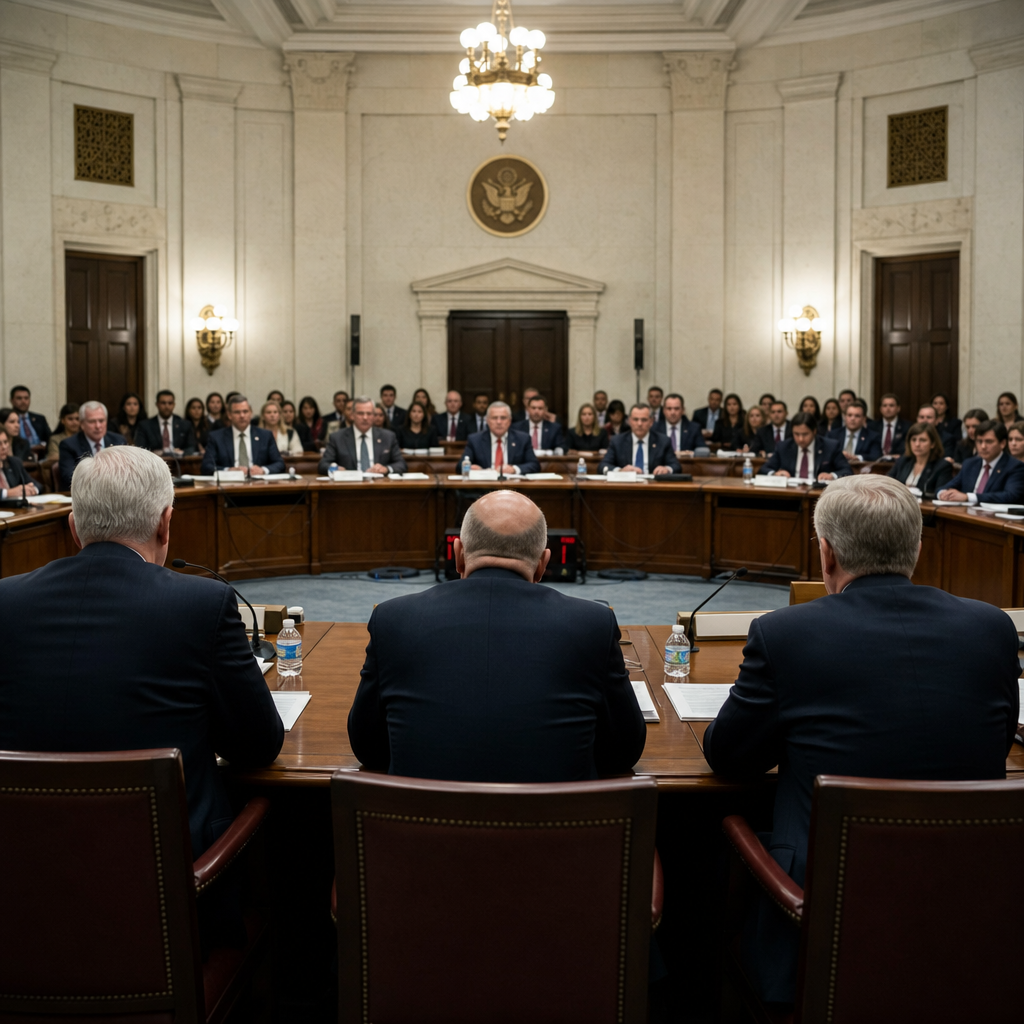
Congressional delegation to agencies is the process by which Congress gives executive branch bodies the authority to make detailed rules, enforce statutes, and apply broad legislative goals to real-world problems. In AP Government and Politics, delegation matters because it explains how a constitutional system built on separated powers actually functions in a modern administrative state. Congress writes laws, but agencies such as the Environmental Protection Agency, Securities and Exchange Commission, Food and Drug Administration, and Federal Communications Commission turn those laws into operating standards that affect air quality, financial disclosures, drug approvals, broadband access, and thousands of other daily realities.
Students often ask a basic question: why would lawmakers hand off power if Article I gives legislative power to Congress? The short answer is capacity. Congress is a political institution designed for representation, bargaining, and broad policy direction, not for drafting every emissions threshold, workplace safety protocol, banking capital ratio, or pharmaceutical labeling rule. Delegation lets elected officials set goals and boundaries while relying on specialists to manage complexity. That arrangement has existed since the early republic, but it became central in the twentieth century as industrialization, consumer markets, environmental hazards, and national security demands required continuous oversight that Congress alone could not provide.
Understanding delegation also helps explain debates over bureaucracy, presidential control, judicial review, and democratic accountability. Agencies are not free-floating governments unto themselves. They are created by statute, funded by Congress, overseen through hearings and investigations, constrained by the Administrative Procedure Act, and reviewed by courts. Yet they still exercise significant discretion, which creates an enduring constitutional tension: Americans want expert, flexible governance, but they also want decisions tied to elected representatives. That tension is the core of this topic and the reason it appears across AP Government and Politics questions, class discussions, and foundational Supreme Court cases.
In my experience teaching and writing about institutions, students grasp delegation best when they see it as a practical bargain. Congress retains major policy choices, agencies handle implementation details, presidents influence administration, and courts police legal limits. The system works imperfectly but persistently because lawmakers face incentives to claim credit for goals, avoid blame for technical tradeoffs, and respond to problems faster than the full legislative process usually allows. Once that logic is clear, the rest of the subject becomes easier: why Congress delegates, how agencies use discretion, what checks exist, and why the controversy never disappears.
Why Congress Delegates Authority
Congress delegates authority primarily because modern governance is too complex, technical, and fast-moving to manage through fully specific statutes. A law can announce that air pollution should be reduced to protect public health, but legislators usually cannot agree on or maintain expertise about acceptable particulate levels, measurement methods, monitoring schedules, exemptions, enforcement formulas, and scientific updates. Agencies can. They employ economists, scientists, lawyers, engineers, accountants, and policy analysts who can translate broad statutory commands into actionable regulations.
Delegation also solves a time problem. Congress meets in sessions, works through committees, and operates under intense partisan and electoral pressure. Agencies work continuously. When a new banking risk emerges, a disease outbreak accelerates, or a dangerous product enters the market, agencies can investigate, issue guidance, propose rules, and enforce standards far more rapidly than Congress can pass a new law. This continuing capacity is one reason Congress often writes framework statutes rather than exhaustive codes.
Political incentives matter too. Lawmakers often prefer to legislate in broad values-rich language because broad language is easier to pass. “Clean air,” “safe workplaces,” “fair securities markets,” and “effective communications networks” attract wider coalitions than pages of technical details that produce obvious winners and losers. Delegation lets members support popular goals while leaving difficult calibration to administrators. Critics call this blame shifting; defenders call it necessary institutional design. Both views capture part of the truth.
Another reason is geographic representation. Members of Congress represent districts and states with diverse interests. A national rulemaking process allows those varied concerns to be aired through notice-and-comment procedures, advisory committees, data collection, and enforcement discretion. Agencies can gather information from affected industries, consumer groups, state governments, and scientific experts in ways Congress often cannot sustain at scale.
How Delegation Works in Practice
Delegation begins with an enabling act, the statute that creates an agency or assigns it authority. That law defines the agency’s mission, jurisdiction, powers, funding structure, and often the standards it must pursue. Congress might instruct an agency to regulate in the “public interest,” set rules that are “necessary and appropriate,” or protect health with an “adequate margin of safety.” Those phrases are intentionally broad enough to permit adaptation, but specific enough to give a legal basis for action.
Once Congress delegates, the agency uses several tools. Rulemaking creates binding regulations. Adjudication resolves disputes or applies standards in individual cases. Investigations gather evidence. Licensing and permitting systems control entry into regulated activities. Guidance documents interpret obligations, though they usually do not carry the same legal force as formal rules. Enforcement actions, including fines or injunction requests, push compliance. Each tool flows from statutory authority and must fit procedural requirements.
The Administrative Procedure Act of 1946 is essential here. It standardizes how many agencies propose rules, accept public comments, justify final decisions, and create records that courts can review. If students want one concept that ties bureaucracy to constitutional limits, this is it. Agencies are powerful, but they are expected to explain themselves, follow procedures, and remain within the bounds Congress set.
A useful way to understand delegated power is to distinguish between ends and means. Congress usually sets the ends: safer food, cleaner water, more transparent securities markets, accessible disability rights enforcement. Agencies choose means within statutory limits: inspection schedules, disclosure forms, testing standards, emission caps, recordkeeping requirements, and penalty structures. In practice, fights arise because means can shape ends. A strict implementation choice may transform an industry just as much as a dramatic new law.
| Agency | Delegated mission | Common tools | Plain-language example |
|---|---|---|---|
| EPA | Protect environmental and public health under statutes such as the Clean Air Act | Rulemaking, permits, inspections, enforcement | Sets emissions standards for pollutants and penalizes violators |
| FDA | Ensure safety and effectiveness of food, drugs, and medical devices | Testing review, approvals, recalls, labeling rules | Determines whether a new drug can be marketed |
| SEC | Promote fair and transparent securities markets | Disclosure rules, investigations, civil penalties | Requires publicly traded companies to report material financial information |
| FCC | Regulate interstate communications by radio, television, wire, satellite, and cable | Licensing, spectrum allocation, rulemaking | Assigns broadcast spectrum and sets communications standards |
Constitutional Foundations and Limits
The Constitution does not mention most modern agencies, but it establishes the structure within which they operate. Congress creates agencies through law. The president executes the law and often appoints agency leaders, subject in many cases to Senate confirmation. Courts review agency actions when challenged. This arrangement means delegation is not a surrender of all legislative power; it is a structured transfer of implementation authority inside the constitutional framework.
The major legal limit is the nondelegation doctrine, the principle that Congress cannot transfer its core legislative power without an intelligible principle to guide the agency. In practice, the Supreme Court has rarely struck down statutes on this basis. The Court upheld broad delegations for decades so long as Congress supplied a general policy and a standard. Cases such as J.W. Hampton, Jr. & Co. v. United States helped define that approach. Only in exceptional periods has the Court invalidated delegations as too vague.
Recent jurisprudence has added new constraints through doctrines that demand clearer congressional authorization on questions of major economic and political significance. When agencies claim broad authority from old or ambiguous statutes, courts may insist that Congress speak more clearly. That trend reflects concern about administrative overreach and has become especially visible in disputes involving environmental regulation, workplace rules, and student debt policy. For AP Government purposes, the takeaway is simple: delegation is common and constitutional, but not unlimited.
There are also structural differences between executive agencies and independent regulatory commissions. Executive agencies, such as the Department of Justice, are generally more directly controlled by the president. Independent commissions, such as the SEC or FCC, often have multi-member leadership, staggered terms, and some protection from at-will removal. Congress uses these designs when it wants expertise and some insulation from day-to-day politics, though presidents still influence appointments, budgets, and policy direction.
Benefits of Delegation for Governing
Delegation improves government performance when problems require specialized knowledge, continuity, and adaptability. I have seen students understand this instantly when comparing Congress to a hospital board. A board sets mission and approves broad policy; it does not personally establish every dosage protocol or sterilization standard. Similarly, Congress can declare that financial markets must be transparent, but regulators must define reporting rules as trading technologies evolve.
Flexibility is a major advantage. A statute can remain in place for decades while agencies update technical standards through rulemaking. The Clean Air Act, for example, has endured through changing scientific understanding of pollutants and changing industrial practices. Without delegation, Congress would need to revise statutes constantly just to keep up with chemistry, engineering, medicine, data security, or telecommunications.
Delegation can also improve national uniformity. If every issue had to be resolved by piecemeal legislation or entirely by states, businesses and citizens could face a patchwork of conflicting standards. Federal agencies create common baselines for securities disclosures, food labeling, aircraft safety, labor relations, and environmental permits. Uniformity reduces uncertainty, though it can also spark federalism disputes when states prefer stricter or looser rules.
Finally, agencies create administrative records. They collect comments, publish studies, assess costs and benefits, and explain decisions. Those records can make policy more evidence-based than purely rhetorical legislative debate. This does not mean agencies are neutral machines; they respond to politics and priorities. But delegation can channel policy disputes into procedures that demand data, reasons, and responsiveness.
Criticisms, Risks, and Democratic Accountability
The strongest criticism of delegation is democratic distance. Agency officials are usually not elected, yet they make decisions with real economic and social consequences. A regulation can close a factory, change hospital billing, alter internet access rules, or reshape energy markets. Critics argue that when Congress writes vague statutes and leaves major value choices to administrators, voters lose a clear line of accountability.
There is also the risk of agency capture, the condition in which a regulator becomes too aligned with the industry it oversees. Capture can happen through revolving-door employment, information dependence, lobbying pressure, or subtle cultural identification with regulated firms. The Interstate Commerce Commission became a classic historical warning for this problem. Modern agencies try to reduce capture through ethics rules, transparency requirements, inspector general oversight, and judicial review, but the risk never disappears.
Another concern is bureaucratic drift. Congress may delegate with one policy vision in mind, only to see agencies interpret statutes differently under a new president or changing leadership. Because agencies exercise discretion, the same law can produce different regulatory approaches across administrations. That can be useful when conditions change, but it can also create instability for businesses, states, and citizens trying to plan ahead.
Complex procedures present another tradeoff. Notice-and-comment rulemaking, cost-benefit analysis, interagency review, and litigation are meant to improve quality and legality. They can also slow action dramatically. During emergencies, delay can be costly. During ordinary periods, delay can frustrate both regulated parties seeking clarity and advocacy groups seeking stronger protections.
How Congress, Presidents, and Courts Check Agencies
Delegation does not end congressional involvement. Congress uses oversight hearings, confirmation battles, appropriations, statutory amendments, reporting requirements, sunset provisions, and investigations to monitor agencies. Committees can pressure administrators publicly, demand documents, and threaten budget reductions. In practice, appropriations are often among the most powerful tools because agencies cannot function without sustained funding.
Presidents shape delegated authority through appointments, executive orders, Office of Management and Budget review, and broader administrative priorities. A president who favors deregulation may appoint leaders committed to narrower enforcement and more industry flexibility. A president who favors aggressive public health or environmental action may interpret the same statutory authority more expansively. This is why agency politics often shift after elections even when Congress does not enact new statutes.
Courts serve as legal referees. They review whether an agency exceeded statutory authority, failed to follow required procedures, acted arbitrarily, or violated constitutional limits. Judicial review can block overreach, but it can also narrow agencies’ room to adapt. For students, the key point is that the administrative state is not uncontrolled. It operates within a web of legal, fiscal, and political constraints, even if those constraints do not always produce clear or timely outcomes.
This topic links to many other AP Government areas. Delegation connects to federal bureaucracy, required Supreme Court cases, separation of powers, checks and balances, issue networks, iron triangles, and public policy implementation. It also serves as a hub for miscellaneous institutional questions because so many modern controversies, from climate policy to consumer finance, ultimately turn on what Congress delegated and how agencies interpret that grant of power.
Congressional delegation to agencies persists because it solves a genuine governing problem: elected lawmakers cannot personally administer a complex national economy and society. By delegating, Congress sets broad policy, agencies supply expertise and continuity, presidents steer priorities, and courts enforce legal boundaries. That arrangement brings clear benefits, including technical competence, flexibility, uniform standards, and faster responses than legislation alone can usually provide.
At the same time, delegation always raises hard questions about accountability, overreach, capture, and constitutional limits. Those concerns are not side issues; they are the reason the subject remains central to AP Government and Politics. To understand American government as it actually works, students must look beyond the text of statutes and examine the institutions that implement them. If you are building out this subtopic, use this hub as your starting point and then explore agency oversight, rulemaking, independent commissions, and landmark delegation cases in detail.
Frequently Asked Questions
What does congressional delegation to agencies mean?
Congressional delegation to agencies means Congress passes a law that sets broad goals or standards, then gives an executive branch agency the authority to work out the details. In practice, lawmakers often do not write every specific rule directly into a statute. Instead, they create a framework and authorize agencies to define technical terms, issue regulations, investigate violations, and enforce the law. This is why agencies such as the Environmental Protection Agency, Securities and Exchange Commission, and Food and Drug Administration play such a large role in public policy.
In AP Government and Politics, delegation helps explain how the federal government actually operates in a modern society. The Constitution gives legislative power to Congress, but the complexity of environmental protection, securities markets, health standards, labor rules, and telecommunications makes it difficult for Congress to legislate every detail on its own. Delegation allows agencies to translate broad statutory language into practical rules that can be applied in real-world situations. Congress still creates the original legal authority, but agencies carry out much of the day-to-day governing.
Why does Congress hand off power to federal agencies?
Congress delegates power because modern policymaking is too complex, technical, and fast-moving for legislators to manage entirely through detailed statutes. Members of Congress are elected generalists. They vote on taxes, defense, education, healthcare, banking, environmental policy, and much more. Agencies, by contrast, are designed to specialize. They employ scientists, economists, lawyers, engineers, and policy experts who can develop highly specific rules that respond to changing conditions. Delegation therefore helps make government more functional and more informed.
There are also political reasons Congress delegates. Lawmakers often prefer to claim credit for solving a problem while avoiding responsibility for controversial details. For example, Congress may pass a law requiring cleaner air or safer financial markets, but leave the exact standards and enforcement methods to an agency. That gives legislators flexibility. If the policy works, they can say they acted. If a particular rule becomes unpopular, they may criticize the agency rather than the statute itself. Delegation can therefore be both a practical necessity and a strategic political choice.
Does delegation violate the constitutional principle of separation of powers?
Delegation creates tension with separation of powers, but it is generally considered constitutional as long as Congress provides an intelligible principle, meaning a clear enough standard to guide agency action. The Constitution vests legislative power in Congress, so critics argue that giving agencies rulemaking authority allows executive branch bodies to exercise powers that look legislative. That concern is real and has been debated for generations. However, the Supreme Court has usually allowed delegation when Congress sets the overall policy and limits within which the agency must operate.
In other words, agencies are not supposed to make law from nothing. They act under authority granted by statutes enacted by Congress. Congress decides the mission, the agency implements it, and courts can review whether the agency stayed within its legal boundaries. This arrangement reflects the reality of the modern administrative state: separated powers still exist, but they often interact through delegated authority, oversight, and judicial review rather than through perfectly neat institutional lines. For AP Government, that makes delegation an important example of how constitutional principles are adapted to practical governance.
How do federal agencies use delegated power once Congress passes a law?
Once Congress delegates authority, an agency typically uses that power in several ways. First, it may engage in rulemaking by issuing regulations that clarify how the statute will be applied. These rules can define standards, set deadlines, establish compliance procedures, and explain what conduct is prohibited or required. Second, the agency may enforce the law by monitoring behavior, conducting inspections, investigating violations, and imposing penalties. Third, many agencies also perform adjudication, meaning they resolve disputes or make decisions in individual cases through administrative hearings and formal procedures.
This combination of rulemaking, enforcement, and adjudication is one reason agencies are so influential. A statute might be only a few pages long, but the regulations and enforcement decisions that follow can shape entire industries and affect millions of people. Agencies do not operate without limits, though. They must follow statutory authority, comply with procedural rules, and remain subject to congressional oversight, presidential influence, and court review. So while delegation gives agencies substantial power, that power exists within a broader constitutional and political system of checks.
How does Congress keep control over agencies after delegating authority?
Congress does not simply hand over power and walk away. It retains multiple tools for controlling agencies after delegation. The most important is legislation itself: Congress can amend a statute, narrow an agency’s authority, expand it, or eliminate programs altogether. Congress also controls agency budgets through the appropriations process, which gives lawmakers leverage over how aggressively an agency can act. In addition, congressional committees hold oversight hearings, demand testimony, request reports, and investigate whether agencies are carrying out the law as intended.
Congress also influences agencies through appointments, confirmations, and ongoing political pressure. Although the president usually nominates agency leaders, the Senate often confirms them, and lawmakers can shape agency behavior through public criticism, constituent demands, and informal communication. Courts provide another important check by reviewing whether agencies exceeded statutory authority or acted in an arbitrary way. Taken together, these mechanisms show that delegation does not mean abdication. Congress may pass off the details of policymaking, but it still has significant ways to supervise, correct, and constrain the agencies that carry out federal law.