
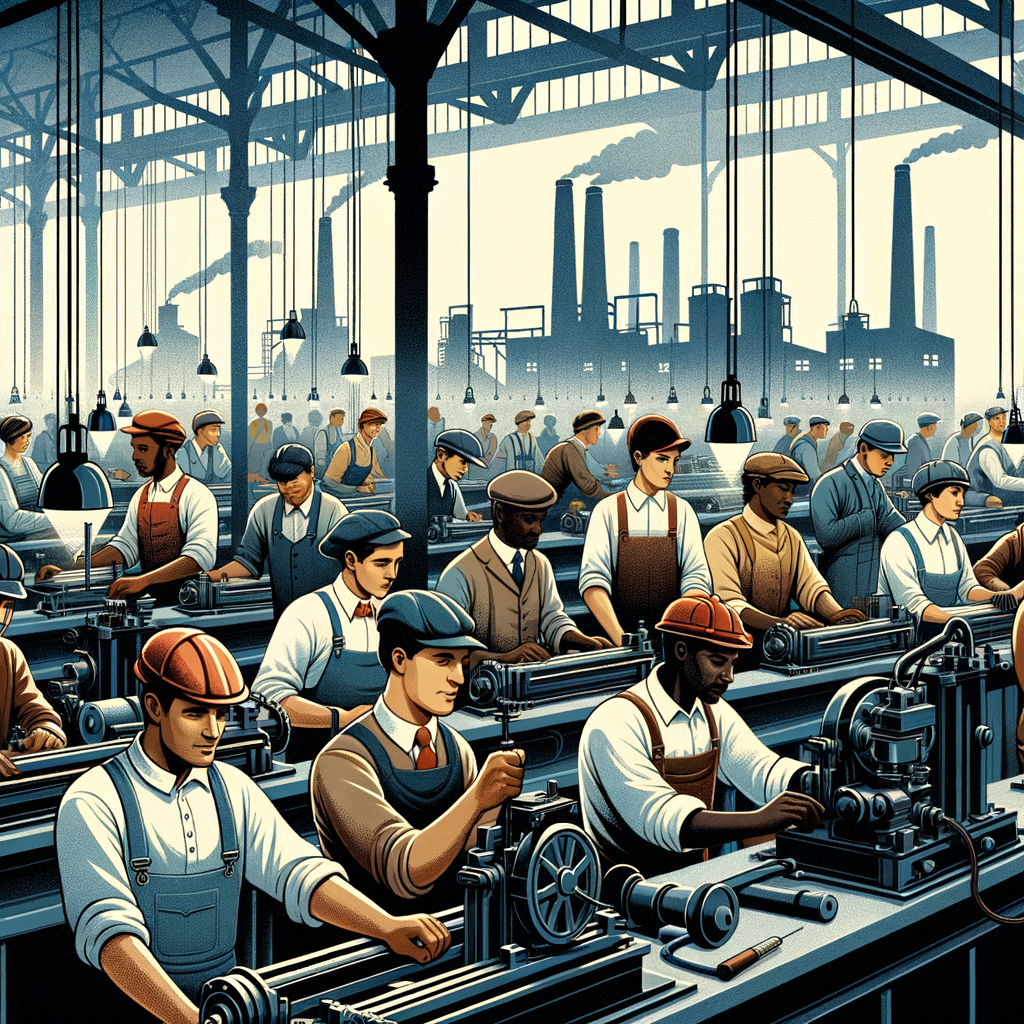
A Professor’s Position: What was the effect of the industrial revolution on factory workers?
The industrial revolution and the great economic success that accompanied it had a wide variety of victims. As we have previously discussed the American public, through the efforts of trusts, became a victim of the elimination of competition. The consumer was not the only victim however. The American worker was also victimized.
As America industrialized two things happened:
(A) There was a shift from rural (country) regions to urban regions. This population shift is known as urbanization. The reasons for urbanization should be obvious…that was where the work was! Urban centers were traditionally founded near waterways, this provided them with easy sources of labor (immigrants) and shipping.
(B) Factories began to replace small “cottage” industries. As the population grew so did wants and needs. Manufacturers realized that
bulk production was cheaper, more efficient and provided the quantity
of items needed. As a result more and more factories sprang up.

Factory work is very different from other types of labor. The introduction of the factory system had a profound effect on social relationships and living conditions. In earlier times workers and employees had close relationships. By contrast, the factory owners were considered to have discharged their obligations to employees with the payment of wages; thus, most owners took an impersonal attitude toward those who worked in their factories. This was in part because no particular strength or skill was required to operate many
of the new factory machines. The owners of the early factories often were more interested in hiring a worker cheaply than in any other qualification. Thus they employed many women and children, who could be hired for lower wages than men. These low-paid employees had to work for as long as 16 hours a day; they were subjected to pressure, and even physical punishment, in an effort to make them speed up production. Since neither the machines nor the methods of work were designed for safety, many fatal and maiming accidents resulted.

Factory owners, especially those involved in the steel industry and in the coal mine industry, often would build company towns. Workers were given cheap rent in these towns to go along with there low wages. In essence the worker was trapped. They company town afforded him a place to live and without the job he couldn’t leave.

Those in the garment industry worked in sweatshops. Sweatshops were poorly ventilated and lit rooms where seamstresses sat side by side doing piece work (specializing on one piece of the work thus never making a finished product.) The cloth would be piled high, workers were not allowed to talk. Often sweatshop employees where forced to work late into the night so that the job was completed or they wouldn’t get paid.
One of the most influential events in labor history was a direct result of sweatshop conditions. The Triangle Shirt Factory Fire killed 114 workers because the fabric could fire and tore through the building. There were no fire escapes and the doors opened out into the hall. The doors where blocked locking the workers in. As result stricter building codes and fire regulations where passed.

after the fire

Coal miners also faced difficult work conditions. Mine owners often hired children whose small hands could fit into narrow openings to scrape coal from the mine walls. Working 16 hour days with poor ventilation and frequent cave ins these children might be paid a dollar a day.
It was only a matter of time before these conditions would force change. The question was when. With America embracing a laissez faire philosophy few in government favored interfering on behalf of the worker, of whom many where immigrants. The ideals of social Darwinism and rugged individualism created the mentality that if the workers where to improve their lot in life then they would have to do it themselves, and it wasn’t easy!
Frequently Asked Questions
1. How did the Industrial Revolution affect working conditions for American factory workers?
The Industrial Revolution dramatically changed the working conditions for factory workers in America. As factories became the cornerstone of economic production, workers found themselves in environments that were often unsafe and unsanitary. The pursuit of efficiency led to long working hours, frequently exceeding 12-14 hours a day, often under harsh conditions. Many factories lacked proper ventilation, were poorly lit, and had inadequate heating or cooling. Safety measures were minimal, leading to a high incidence of occupational injuries. Child labor was also prevalent, as the demand for labor exceeded the available adult workforce. These factors combined to create a challenging and often oppressive work environment for factory employees during the Industrial Revolution.
2. What impact did the Industrial Revolution have on job opportunities for factory workers?
While the Industrial Revolution degraded working conditions, it also significantly increased job opportunities for factory workers. The shift from agrarian societies to industrialized ones created a growing demand for labor in factories, which spurred urban migration as people sought employment in industrial hubs. This boom in factory jobs offered individuals, including immigrants, women, and children, new employment opportunities. However, this influx of labor led to intense competition for jobs, often resulting in low wages and limited job security. Despite the difficulties, the demand for labor facilitated significant social shifts, as previously isolated rural populations adapted to urbanized, industrialized lifestyles.
3. How did the Industrial Revolution influence the wages of American factory workers?
The Industrial Revolution had a complex impact on wages for American factory workers. Initially, the high demand for labor often resulted in relatively low wages due to the abundant workforce willing to accept any form of employment. Employers, focused on maximizing profit, were able to suppress wages further by employing underpaid women and children. However, over time, the situation began to change as workers organized themselves into unions to demand better pay and working conditions. These movements eventually led to incremental wage increases and improved economic conditions for many workers. However, these improvements were gradual and uneven across different sectors and regions.
4. What role did unions play in improving the lives of factory workers during the Industrial Revolution?
Unions played a crucial role in improving the lives of factory workers during and after the Industrial Revolution. As workers endured poor working conditions and low wages, the formation of labor unions became a vital strategy for advocating change. Unions leveraged collective bargaining to negotiate better wages, implement wage standards, and seek safer working conditions. Over time, unions orchestrated strikes and protests, drawing public attention to the plight of factory workers and pressuring employers and legislators to enact labor reforms. These movements were instrumental in the establishment of labor laws, the reduction of work hours, the introduction of overtime pay, and the prohibition of child labor, which progressively enhanced workers' quality of life.
5. How did technological advancements during the Industrial Revolution affect factory work?
Technological advancements during the Industrial Revolution significantly reshaped factory work in multiple ways. The introduction of machinery such as the spinning jenny, power looms, and steam engines radically transformed production processes, increasing efficiency and output. These advancements allowed factories to produce goods on a scale previously unimaginable, paving the way for the mass production era. However, this shift also led to job displacement as machines began to perform tasks that were once done by hand. While technology made certain tasks easier and reduced the need for physical labor, it simultaneously reduced the demand for skilled labor, as machines could perform the duties previously requiring artisanal expertise. Over time, the adoption of technology spurred new kinds of jobs and industries, highlighting a need for an evolving workforce adept at new skills to align with technological progress.