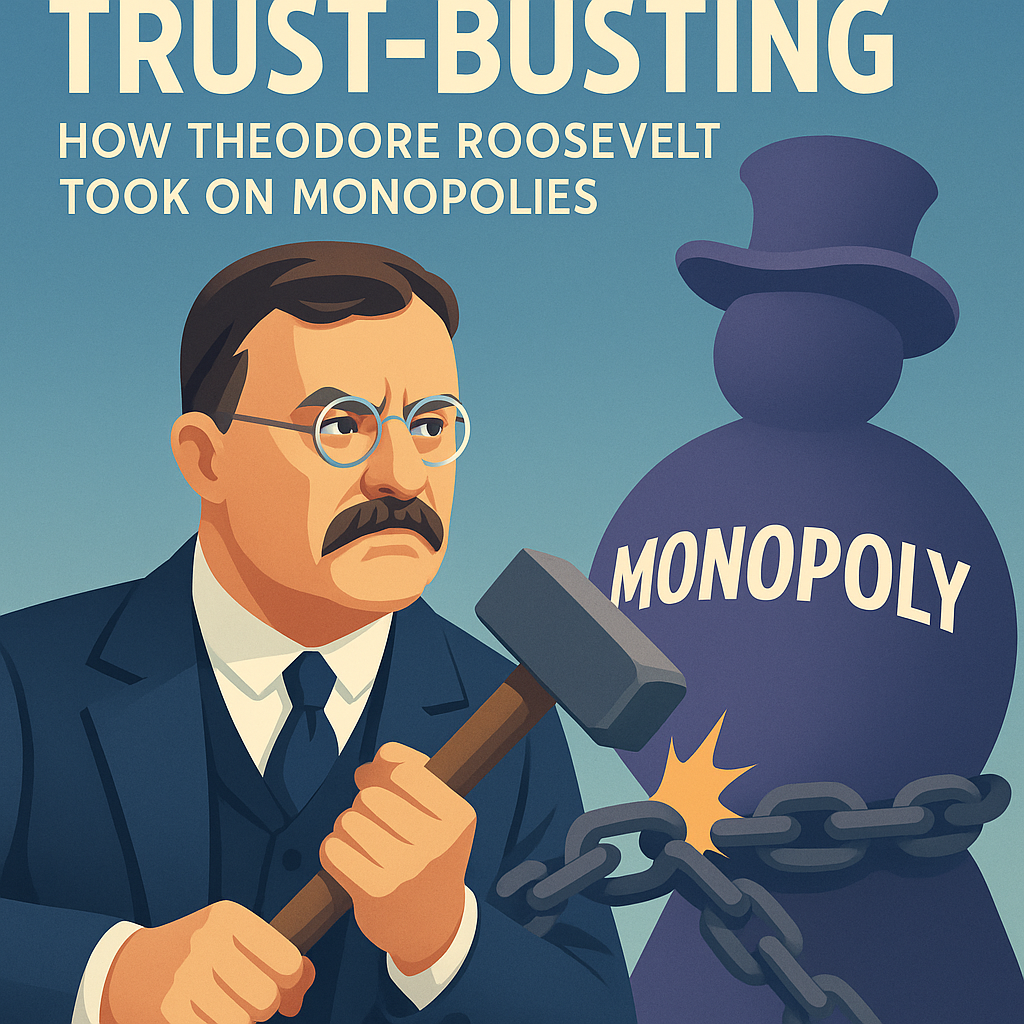
Introduction to Trust-Busting and Its Relevance
The turn of the 20th century brought significant industrial growth in the United States. With it came the rise of powerful conglomerates and monopolies that dominated entire industries. Known as “trusts” in that era, these entities wielded incredible power, often dictating prices and squeezing out competition. This market manipulation affected consumers and small businesses, leading to widespread calls for reform. Trust-busting refers to government efforts aimed at breaking up these monopolies to ensure fair competition.
Theodore Roosevelt, the 26th president of the United States, emerged as a prominent figure in this fight against monopolies. Known for his energetic approach to the presidency, Roosevelt believed that no private entity should hold too much power over the American economy. His commitment to regulating big businesses reshaped the economic landscape, championing the cause of consumer protection and setting precedents that echo even today. In this exploration of Roosevelt’s legacy, we delve into the mechanisms of trust-busting, its historical significance, and the impact it has had on modern economic policies. Understanding Roosevelt’s actions against trusts is crucial for comprehending how government intervention can strike a balance between regulation and free enterprise.
The Rise of Monopolies: Understanding the Problem
The late 19th century was marked by rapid industrialization and urbanization in the United States. Technological advancements and the expansion of the railroad system facilitated a boom in industrial output, leading to the formation of large corporations and monopolies. Trusts were legal arrangements that allowed multiple companies to be controlled by a single board, granting them excessive market power.
- Rockefeller’s Standard Oil Company controlled approximately 90% of U.S. refineries and pipelines.
- Andrew Carnegie’s steel company held a near-monopoly in U.S. steel production.
- The American Tobacco Company dominated cigarette manufacturing, controlling the majority of the supply chain.
These trusts eliminated competition through methods such as predatory pricing and exclusive agreements, resulting in poor consumer conditions. Prices skyrocketed as these entities prioritized profit margins over public interest. After a series of economic depressions in the late 1800s, antitrust sentiments grew, and public outcry demanded government intervention.
The Sherman Antitrust Act: Laying the Foundation
Before Theodore Roosevelt’s presidency, the U.S. Congress passed the Sherman Antitrust Act in 1890. It aimed to curb concentrations of power that restrained trade and reduced economic competition. Named after Senator John Sherman, the act declared illegal all combinations “in restraint of trade or commerce among the several States, or with foreign nations.”
While the act was a step in the right direction, its vague wording made enforcement challenging. Courts often ruled in favor of the trusts due to a lack of judicial clarity, rendering the Sherman Act relatively ineffective initially. The Progressive Era, however, saw a resurgence in its application, especially under Roosevelt’s leadership. He believed in using this legislation to ensure fairer competition and curb the excesses of capitalist greed.
Theodore Roosevelt’s Approach to Trust-Busting
Theodore Roosevelt became president in 1901 following the assassination of President William McKinley. Embracing the role of a vigorous reformer, Roosevelt distinguished himself with his “Square Deal,” an approach built on control of corporations, consumer protection, and conservation of natural resources. Central to controlling corporations was his commitment to breaking apart monopolistic trusts that hindered fair market practices.
Roosevelt’s administration took legal action against several major corporations. One of the most famous cases was against the Northern Securities Company, a conglomerate that controlled several significant railroads in the northwestern United States. By asserting that this merger restrained trade, Roosevelt successfully dissolved the company in 1904. This victory was pivotal and sent a clear message about his administration’s trust-busting intentions.
| Trust | Industry | Roosevelt’s Action |
|---|---|---|
| Northern Securities Company | Railroads | Dissolved in 1904 |
| Standard Oil | Oil | Broken apart under Taft in 1911, influenced by Roosevelt’s actions |
| American Tobacco Company | Tobacco | Dissolved in 1911 |
While Theodore Roosevelt is often dubbed a “trust buster,” his administration recognized the necessity of big businesses in certain sectors. Instead of breaking up all trusts, Roosevelt distinguished between “good” and “bad” trusts, maintaining those he deemed beneficial but regulating them to operate in the public’s interest.
Impact of Trust-Busting on the Economy and Society
Roosevelt’s determined stance against monopolies yielded both immediate and long-term effects on the U.S. economy and society. By dissolving trusts like the Northern Securities Company, he encouraged more competition, which, in turn, lowered prices and improved consumer choices. The drive to ensure fair practices inspired subsequent administrations, leading to a more comprehensive application of antitrust laws.
Moreover, Roosevelt’s actions highlighted the power and responsibility of the federal government in regulating major economic sectors. This newfound governmental assertiveness prevented private monopolies from gaining uncontestable power, setting the stage for future reforms. His legacy expanded beyond dismantling monopolies, influencing consumer protection laws such as the Pure Food and Drug Act and the Meat Inspection Act, ensuring that businesses operated transparently and ethically.
The Modern-Day Legacy of Roosevelt’s Trust-Busting
The principles of trust-busting resonate strongly in today’s discussions around big tech companies, healthcare conglomerates, and financial institutions. Modern antitrust debates revolve around how to balance innovation with fair competition, similar to concerns in the early 1900s.
Roosevelt’s antitrust philosophy reminds us of the importance of government oversight in protecting the public from poverty-inducing practices of powerful corporations. His era serves as a case study for evaluating current economic giants and asks whether the rise of tech monopolies warrants Roosevelt-style interventions.
In present times, antitrust laws are still being enforced, with cases brought against companies like Google and Facebook asserting that their market dominance harms consumer welfare. The relevance of Roosevelt’s actions is apparent as regulators strive to adapt antitrust enforcement to the digital age, ensuring that the values of fair competition and consumer protection remain paramount.
Conclusion
Theodore Roosevelt’s role in pioneering antitrust actions positioned him as a formidable figure in U.S. history, underpinning the importance of government intervention in market economies. His trust-busting efforts dismantled monopolies, inspiring a regulatory framework designed to foster competition and uphold public welfare. Through decisive actions, Roosevelt carved a path for future policies and economic paradigms, showcasing a balance between fostering industry growth and curbing the potential abuses of corporate power.
Today’s economic environment, rife with growing tech monopolies, demands vigilance and adaptation of these long-standing principles. Roosevelt’s legacy reflects a fundamental belief that economic fairness and equity are cornerstones of a prosperous society. The challenge presented to modern policymakers lies in sculpting an atmosphere that encourages innovation while safeguarding consumer interests—an embodiment of Roosevelt’s enduring influence.
By exploring Roosevelt’s triumphs against monopolies, citizens and policymakers alike can acknowledge the significance of balanced regulation in a thriving democracy. Understanding this history unveils opportunities for action and improvement, prompting modern society to reconsider current regulatory practices. As we move forward, let Roosevelt’s trust-busting ethos inspire a new era of informed, deliberate decision-making to benefit society in all facets.
Frequently Asked Questions
What is trust-busting, and why was it important in the early 20th century?
Trust-busting refers to the government’s actions to break up monopolies and restore competition in the marketplace. In the early 20th century, the United States experienced a dramatic rise in powerful industrial conglomerates, known as “trusts.” These monopolies dominated entire sectors, dictating prices and eliminating smaller competitors. With vast control over industries, they reduced consumer choice and set exorbitant prices. Roosevelt’s trust-busting was pivotal because it aimed to dismantle these monopolies, ensuring fair competition and protecting consumers. Roosevelt, often called a “trust buster,” played a crucial role in this movement by actively seeking legal action against monopolies and consolidating efforts to regulate larger corporate influences.
How did Theodore Roosevelt approach the problem of monopolies?
Theodore Roosevelt approached the problem of monopolies with vigor and determination. Recognized for his commitment to progressive reforms, he leveraged the Sherman Antitrust Act, a legislative measure dating back to 1890 designed to combat anticompetitive practices. However, before Roosevelt’s presidency, the act was applied inconsistently. Roosevelt breathed new life into the antitrust sentiment, transforming it into a formidable mechanism for change. He launched numerous legal battles against the trusts, beginning with high-profile cases like the Northern Securities Company, a massive railroad monopoly. His administration sought to delineate between ‘good’ trusts, which were fair and efficient, and ‘bad’ trusts, which were detrimental to the public interest. Roosevelt aimed not to dismantle all big businesses but to regulate them to promote integrity and ensure they contributed positively to economic growth. His efforts highlighted the importance of government intervention in maintaining economic balance.
What were some of the key successes of Roosevelt’s trust-busting efforts?
Roosevelt’s trust-busting efforts saw several key successes, marking a turning point in the federal government’s role in economic regulation. One notable victory was the Supreme Court’s ruling against the Northern Securities Company in 1904, which signaled the administration’s commitment to enforcing antitrust laws. This case dismantled a major railroad monopoly, signaling to other magnates that anti-competitive practices would no longer be tolerated. Roosevelt also targeted the Beef Trust, known for manipulating meat prices, and the Standard Oil Company, a behemoth in the oil industry later broken into multiple entities. These actions ushered in a new era where the federal government actively curbed the excesses of powerful corporations, effectively preventing them from using their market power unfairly. These efforts resonated with the public, who had grown weary of corporate exploitation, and redefined the reach and impact of federal oversight.
How did trust-busting affect the American economy and society?
The impact of trust-busting on the American economy and society was profound and multifaceted. Economically, it invigorated competition, leading to more consumer choices and better prices. By curbing the monopolistic hold of trusts, new businesses found room to enter the market, fostering innovation and economic diversity. Trust-busting practices also laid the groundwork for future economic regulations, establishing a precedent for government intervention to prevent exploitative corporate practices. Socially, it instilled public confidence in governmental bodies acting as protectors of consumer rights and equitable markets. The notion that corporations were beholden not just to their bottom lines, but also to ethical standards of business conduct, began to take root. Moreover, Roosevelt’s actions helped cultivate a culture that valued fairness and monitored corporate behavior, ensuring businesses contributed to societal wellbeing rather than merely their own profits.
What were the limitations or criticisms of Roosevelt’s trust-busting policies?
While Roosevelt’s trust-busting policies were groundbreaking, they were not without limitations or criticisms. Firstly, the task of distinguishing between ‘good’ and ‘bad’ trusts was inherently subjective, leading to debates over whether some corporations targeted were more beneficial than harmful. Critics argued that Roosevelt’s aggressive tactics could stifle business innovation by creating an environment of uncertainty among entrepreneurs. Furthermore, despite several high-profile cases, an expansive number of trusts still operated relatively unchecked, suggesting that while symbolic, trust-busting was not wholly comprehensive in execution. Additionally, the legal battles were lengthy and resource-intensive, sometimes leading to settlement instead of outright dissolution. Another criticism was on the political front; some perceived the trust-busting as more of a political maneuver for popularity rather than genuine economic reform, as Roosevelt picked cases that would rally the public’s support. Despite these criticisms, Roosevelt’s efforts fundamentally altered the landscape of corporate regulation, and laid the groundwork for future legislation, such as the Clayton Antitrust Act, aimed at curbing monopolistic practices more effectively.