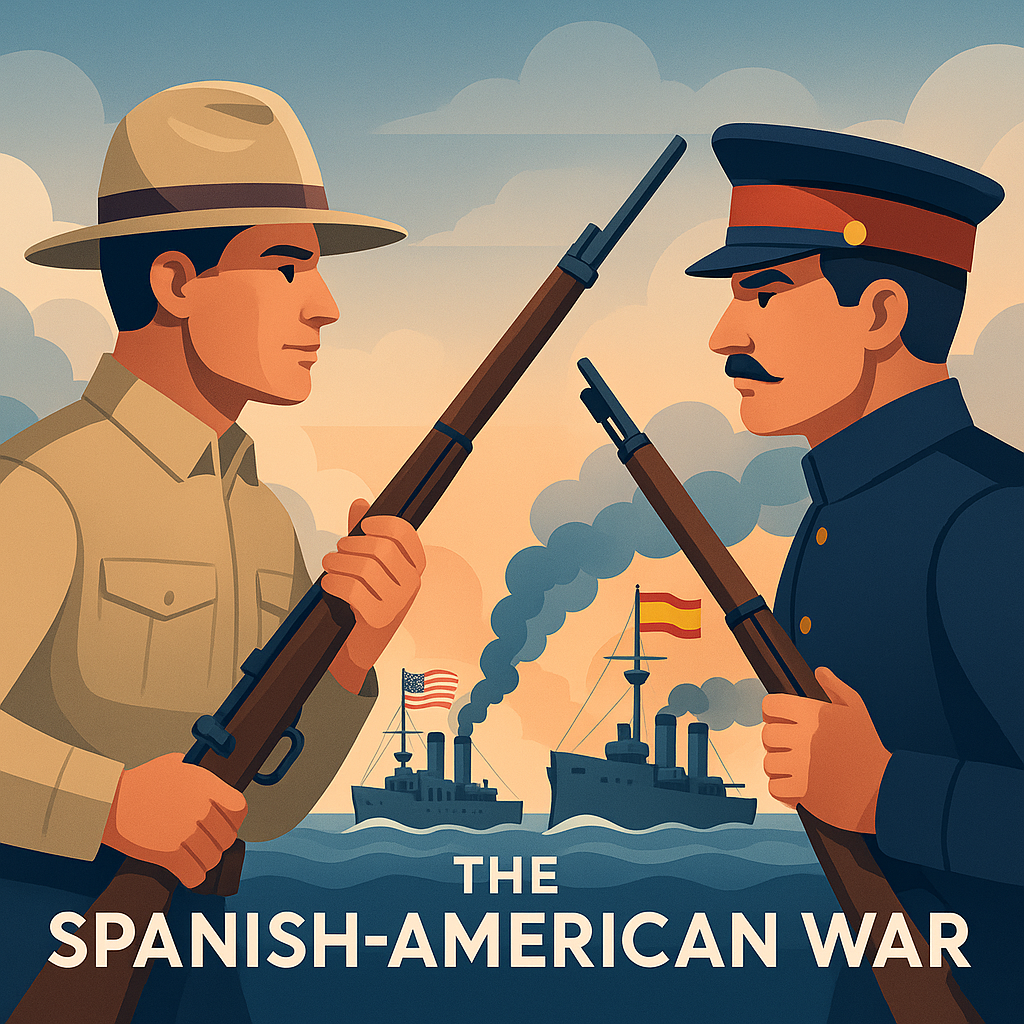
The Spanish-American War, a brief yet pivotal conflict that erupted in 1898, marked a significant turning point in the histories of both Spain and the United States. Engendered by a series of complex events and multifaceted issues, this war heralded the emergence of the United States as a global power, fundamentally altering the trajectory of colonialism and imperialism worldwide. Understanding this war involves delving into its causes, tracing its course, and grasping the multifarious consequences that ensued. Recognizing the importance of this conflict helps illuminate how colonial power dynamics shifted, the impact on national identities, and the foundations of modern international relations. Given its lasting influence, the Spanish-American War remains a critical topic of study for historians, students, and anyone interested in the shadows cast by past events on our modern world.
Causes of the Spanish-American War
The Spanish-American War was precipitated by a variety of factors, chief among them the Cuban struggle for independence from Spain, the explosion of the USS Maine, and heightened media sensationalism—often referred to as “yellow journalism.” The Cuban struggle, part of a wider pattern of independence movements in the late 19th century, reflected both local desires for autonomy and broader anti-imperialist sentiments. The brutal measures employed by Spain to quell the insurgency in Cuba led to humanitarian concerns, particularly in the United States, where the plight of the Cuban people gained considerable public sympathy.
An explosive incident that dramatically intensified tensions was the destruction of the USS Maine in Havana Harbor on February 15, 1898. While the cause of the explosion was never definitively determined, American newspapers quickly blamed Spanish forces, exploiting the event to galvanize public support for military intervention. This was fueled by the era’s prevalent yellow journalism, wherein sensationalized stories dominated the press, inflaming public opinion and pushing the United States closer to war. These intertwining causes exemplified how geopolitical, humanitarian, and media influences can collectively spiral into conflict.
Course of the Spanish-American War
Once the United States declared war on April 25, 1898, the conflict unfolded rapidly across several theaters, including the Caribbean and the Pacific. Primarily fought at sea and land campaigns in Cuba, Puerto Rico, and the Philippines, the war featured notable battles such as the Battle of Manila Bay and the Battle of San Juan Hill.
| Theater of War | Key Engagement | Outcome |
|---|---|---|
| Pacific (Philippines) | Battle of Manila Bay | American Victory |
| Caribbean (Cuba) | Battle of San Juan Hill | American Victory |
| Caribbean (Puerto Rico) | Puerto Rico Campaign | American Victory |
The U.S. Navy played a crucial role, decisively defeating the Spanish Pacific squadron at Manila Bay, effectively ending Spanish colonial rule in the Philippines. In Cuba, American forces, alongside Cuban insurgents, engaged Spanish troops in a series of land battles, culminating in the renowned charge of the Rough Riders up San Juan Hill, led by future President Theodore Roosevelt. The conflict concluded with the capture of Puerto Rico and the eventual signing of the Treaty of Paris on December 10, 1898. This treaty stipulated the relinquishment of Spanish sovereignty over Cuba, cession of Puerto Rico, Guam, and the Philippines to the United States, and a payment of $20 million to Spain as compensation for the latter’s losses.
Consequences of the Spanish-American War
The implications of the Spanish-American War were both immediate and far-reaching, reshaping both global geopolitics and influencing internal dynamics within the involved nations. For the United States, victory signified its burgeoning status as a global power with territorial possessions extending into the Caribbean and the Pacific. This shift was seen by many as a transition from a continental power to an imperial force, engaging in foreign territories beyond its prior scope.
As the U.S. emerged as a colonial power, it faced new challenges, including the governance of distant territories and ethical questions surrounding imperialism and self-determination. The annexation of the Philippines, for example, led to the Philippine-American War, a protracted and bloody conflict, as Filipinos who had welcomed U.S. forces as liberators anticipated independence from colonial rule rather than a change in colonizers.
In Spain, the loss embittered a nation already grappling with internal strife and economic stagnation. The war precipitated a crisis that shook the foundations of Spanish society, leading to calls for regeneration and reform from various political factions aimed at restoring national pride and improving socio-economic conditions. Ultimately, the war’s aftermath contributed to the rise of a robust nationalist sentiment throughout Spain, influencing its future direction in the 20th century.
Imperial Ambitions and the Global Order
In a broader context, the Spanish-American War holds a critical place in the history of colonial and imperial endeavors, illustrating the complexities and consequences of expansionist policies. The turn of the 20th century was characterized by Western powers competing fiercely for global dominance, with imperial pursuits reshaping the world map. The acquisition of Spanish territories marked a significant escalation in the American geopolitical strategy and its new involvement in Asia-Pacific affairs laid the groundwork for future conflicts and alliances.
Additionally, this war prompted a re-evaluation of military tactics and technological advancements, emphasizing the importance of naval power. The success of the U.S. Fleet in the Spanish-American War underscored the strategic advantage of sea dominance, prompting nations worldwide to modernize their naval forces. These changes were indicative of the global progression towards modern warfare that defined the subsequent world conflicts.
Historical Reflections and Modern Learning
The enduring lessons from the Spanish-American War remain relevant today, offering crucial insights into the consequences of geopolitical maneuvers, the ethical responsibilities of emerging powers, and the persistent narrative of national sovereignty and autonomy. Reflecting on this war encourages critical evaluation of modern military interventions and the balance of power politics that continue to govern international relations.
For historians and global leaders alike, the Spanish-American War stands as a testament to the ripple effects of warfare—how a brief conflict can catalyze significant cultural, political, and technological shifts. It fosters an awareness of the legacy of imperial actions and the nuanced interplays of power that continue to shape global dynamics in the present day.
Conclusion: Understanding the Spanish-American War
The Spanish-American War, a seemingly short-lived conflict, ushered in an era of profound transformation, with enduring impacts on international relations, military strategy, and colonial history. By interrogating the causes, unfolding the narrative of the war, and examining its longstanding repercussions, we uncover a multifaceted story of ambition, identity, and power. Recognizing its influence not only aids our comprehension of past geopolitical shifts but also aids in understanding today’s global intertwined limits and potentials. As we continue to navigate a complex world landscape, the lessons from this war serve as a potent reminder of the paths to peace, the consequences of aggression, and the eternal quest for freedom that punctuates human history. I invite you to delve deeper into the past, explore further academic works, and engage with the historical tapestry that defines our current realities.
Frequently Asked Questions
1. What were the main causes of the Spanish-American War?
The Spanish-American War was fueled by a combination of factors that culminated in armed conflict. The root causes included a mix of imperial ambitions, humanitarian concerns, and economic interests. Firstly, the United States had long-standing interests in Cuba, which was one of Spain’s last remaining colonies in the Americas. The Cuban struggle for independence from Spain captured American sympathy, particularly because oppressive Spanish rule and humanitarian concerns over the treatment of Cubans were highlighted by American media. So-called “yellow journalism” played a significant role, with sensationalized news reports by publishers like William Randolph Hearst and Joseph Pulitzer stoking public outrage against Spain. Economic interests also figured prominently, as American businesses had investments in Cuban sugar plantations, and instability in the region threatened these economic activities. Lastly, the mysterious explosion of the USS Maine in Havana harbor in February 1898 served as a direct catalyst, inflaming American public opinion against Spain and pushing the US government towards war.
2. How did the course of the war unfold?
The Spanish-American War was relatively brief, lasting from April to August 1898, but it saw significant military engagements both in the Caribbean and the Pacific. The war began with a US naval blockade of Cuba and quickly escalated with the destruction of the Spanish fleet in the Battle of Manila Bay by Commodore George Dewey. This victory signaled the downfall of Spanish naval power in the Pacific and marked the Philippines as another front in the war. Meanwhile, in the Caribbean, American forces, including the famed Rough Riders led by Theodore Roosevelt, launched land assaults, most notably the charge up San Juan Hill. The US goal was to force Spain into relinquishing its control over Cuba, but victory in Cuba was complemented by surprising successes elsewhere. The effectiveness of American naval forces and the relative weakness of Spanish defense hastened the war’s conclusion with the Treaty of Paris, where Spain ceded vital territories including Puerto Rico, Guam, and the Philippines to the United States.
3. What were the immediate consequences of the Spanish-American War for the United States?
The immediate aftermath of the Spanish-American War significantly expanded American territory and influence. By acquiring Puerto Rico, Guam, and the Philippines, the United States began its trajectory as an imperial power for the first time in its history. The war marked a decisive departure from the previously dominant doctrine of isolationism, positioning the US as a key player on the global stage. The war also catalyzed internal debates on imperialism and the nation’s roles and responsibilities towards its new territories. It sparked a heated discourse over the ethical and political implications of American expansionism and the governance of overseas lands, a debate that would impact US policy for decades. In addition, the war acted as a springboard for individuals such as Theodore Roosevelt, whose exploits catapulted him to national fame, eventually leading him to the presidency.
4. How did the Spanish-American War affect Spain and its empire?
For Spain, the Spanish-American War marked the end of its colonial empire in the Americas and Southeast Asia, signaling a profound transformation in its global standing. With the loss of Cuba, Puerto Rico, Guam, and the Philippines, Spain experienced what was known as the “Disaster of 1898,” which induced a period of soul-searching, termed the “Generation of ’98” in Spanish intellectual circles. This reflection inspired cultural and political shifts within Spain and prompted a national effort to modernize and reform in the early 20th century. Although Spain retained its sovereignty, the loss of its colonies diminished its role as a world power and reshaped its foreign policy approach for years to come. The economic and moral blow of the war also exacerbated internal tensions that would later contribute to civil unrest and political changes within Spain.
5. How did the Spanish-American War influence global colonialism and imperialism?
The Spanish-American War had a far-reaching impact on the global landscape of colonialism and imperialism. As the United States emerged from the war with overseas territories, traditional European powers were forced to recognize the US as a new competitor in imperial endeavors. This shift contributed to reshaping alliances and power balances at the dawn of the 20th century. American control over the newly-acquired territories also had ramifications for local populations, leading to resistance movements and questions of self-governance and independence, particularly in the Philippines, where conflict and insurrection against American rule would continue. Moreover, Japan and other rising powers took note of the shift in imperial tides, reflecting how the war highlighted the changing dynamics of global influence. In essence, the Spanish-American War signaled not just a changing of the guard in colonial authority but also stoked broader discussions on the ethics of imperialism and the rights of subjugated peoples.