
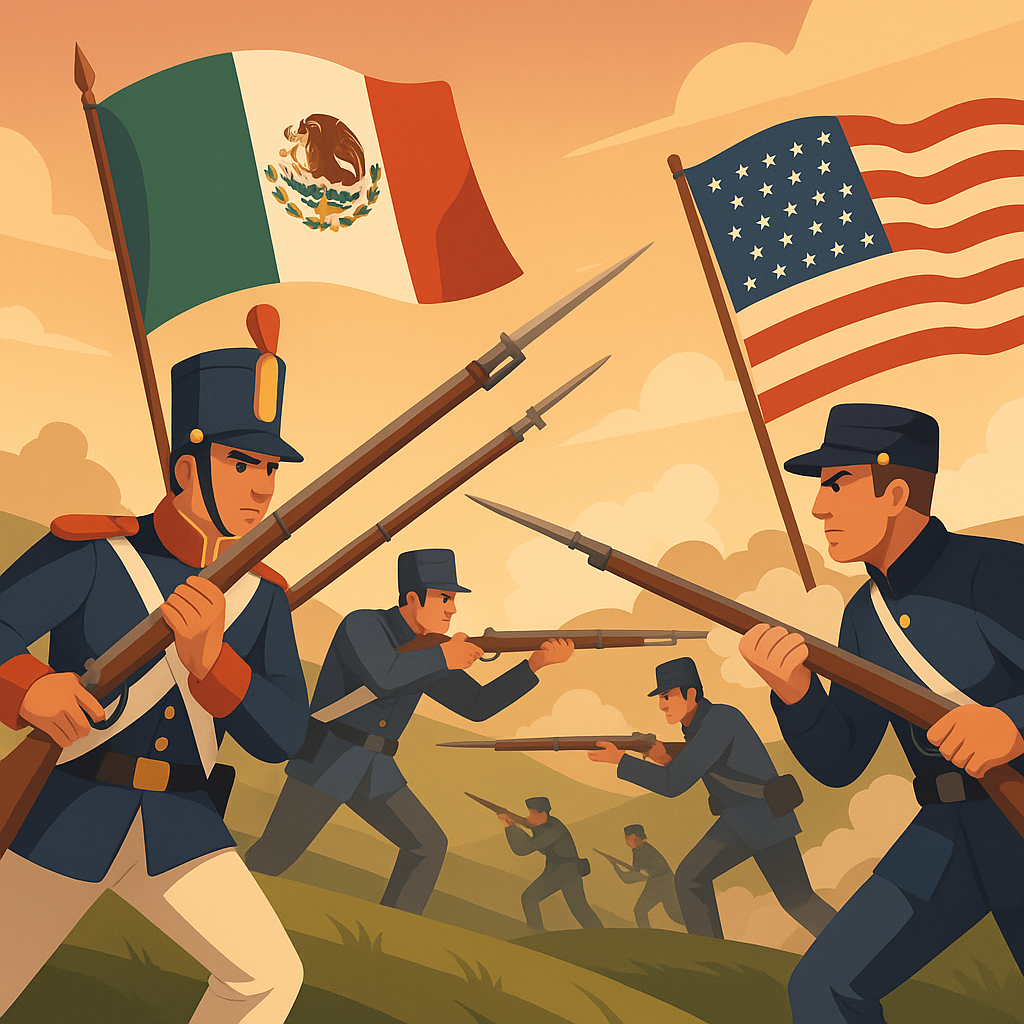
The Mexican-American War was a pivotal conflict that resulted in the United States acquiring vast territories in the American Southwest. This war, fought between 1846 and 1848, saw the U.S. pitted against Mexico and had significant ramifications for both countries. At its core, the war was instigated by territorial disputes and the doctrine of Manifest Destiny, the belief that the U.S. was destined to expand across the continent. Understanding this conflict is crucial because it reshaped the geographical and political landscape of North America, laying the foundation for modern U.S.-Mexico relations and significantly influencing the cultural and demographic makeup of what would become some of the most populous states in the U.S.
The key terms associated with the Mexican-American War include “Annexation,” referring to the formal act of acquiring territory, often by force or diplomacy; “Manifest Destiny,” the 19th-century doctrine advocating U.S. territorial expansion; and the “Treaty of Guadalupe Hidalgo,” the agreement that officially ended the war. By examining these concepts and the war’s motivations, strategies, and consequences, one can comprehend the long-lasting impact this conflict had on both nations and their citizens.
Annexation of Texas and Its Consequences
The annexation of Texas was one of the most significant events leading up to the Mexican-American War. Originally part of Mexico, Texas declared its independence in 1836 after a series of conflicts and skirmishes. This move was not well-received by Mexico, which still considered Texas as part of its territory. Despite this, the Republic of Texas voted to join the United States, and the U.S. Congress approved the annexation in 1845, effectively annexing Texas as the 28th state.
This decision heightened tensions between the U.S. and Mexico. The Mexican government perceived this as an act of aggression, while the U.S. saw it as an opportunity to expand its territory in line with Manifest Destiny. The annexation also raised questions about the expansion of slavery in the U.S., as Texas was a slave-holding region. These factors combined to create a volatile atmosphere that would soon lead to war.
The Causes of the Mexican-American War
Understanding the causes of the Mexican-American War requires an examination of several intertwined factors. Firstly, the doctrine of Manifest Destiny played a profound role, as many Americans believed it was their divine right to expand across the continent, from the Atlantic to the Pacific. This expansionist ideology found strong support among American politicians and the public.
Additionally, there were unresolved border disputes between Texas and Mexico. While Texas claimed the Rio Grande as its southern boundary, Mexico insisted on the Nueces River as the border. Diplomatic efforts to resolve this dispute failed, leading to military confrontations. When Mexican troops crossed the Rio Grande and clashed with American forces in April 1846, President James K. Polk used it as a pretext to declare war, asserting that American blood had been shed on American soil.
Key Battles and Military Strategies
The Mexican-American War featured several key battles and involved complex military strategies. Both sides aimed to secure vital territories and routes to gain an advantage. Among the notable battles was the Battle of Palo Alto, where American forces, led by General Zachary Taylor, defeated the Mexican army. This battle set the tone for subsequent U.S. victories.
Another crucial engagement was the Battle of Buena Vista, in which Taylor’s forces successfully repelled a larger Mexican army commanded by General Santa Anna. Furthermore, Generals Winfield Scott and Stephen Kearny led campaigns capturing important Mexican cities, including Monterrey, San Francisco, and eventually Mexico City in September 1847. These victories were achieved through superior tactics, resources, and the mobilization of American soldiers and volunteers.
The Treaty of Guadalupe Hidalgo
The war officially ended with the signing of the Treaty of Guadalupe Hidalgo on February 2, 1848. This treaty had profound implications for both nations. Under its terms, Mexico ceded approximately 55% of its pre-war territory to the United States, including present-day California, Nevada, Utah, Arizona, New Mexico, Colorado, and Wyoming. In return, the U.S. paid Mexico $15 million and assumed $3.25 million in claims held by American citizens against the Mexican government.
The treaty marked a drastic loss of territory for Mexico but was seen as a victory for American expansionism. It also laid the groundwork for future relations between the two countries. The acquisition of these vast lands accelerated the westward movement of settlers, facilitated the California Gold Rush, and opened new opportunities and challenges for the United States.
The Aftermath and Long-Term Consequences
The Mexican-American War had lasting repercussions that extended far beyond the territorial gains of the United States. For Mexico, the loss of nearly half of its landmass was a devastating blow that weakened the nation’s economy and political structure. Meanwhile, in the U.S., the new territories sparked debates over the expansion of slavery, which would eventually contribute to the American Civil War.
Apart from the political landscape, the war also had a significant impact on the cultural and demographic fabric of the newly acquired regions. Diverse communities, comprising Native Americans, Mexicans, and incoming settlers, coexisted, creating a unique blend of cultures and traditions that continue to shape the Southwest today. The war also left a legacy of tension and distrust between the U.S. and Mexico, particularly regarding border issues and migration, which still influences bilateral relations.
| Event | Date | Outcome |
|---|---|---|
| Annexation of Texas | December 29, 1845 | Texas becomes 28th U.S. state |
| Battle of Palo Alto | May 8, 1846 | U.S. victory |
| Battle of Buena Vista | February 22-23, 1847 | U.S. victory |
| Fall of Mexico City | September 14, 1847 | U.S. occupation |
| Treaty of Guadalupe Hidalgo | February 2, 1848 | End of war; U.S. gains territory |
Conclusion: The Legacy of the Mexican-American War
The Mexican-American War was a defining chapter in the history of both nations, leaving an indelible mark on their respective futures. By gaining control of the Southwest, the United States dramatically expanded its territory, which offered newfound resources, economic opportunities, and geopolitical influence. However, this expansion came at a high cost, as it fueled tensions over slavery and set the stage for subsequent conflict within the U.S.
For modern readers, understanding the Mexican-American War provides valuable insights into the roots of contemporary issues, including border immigration and cultural integration. As a critical episode in the history of American expansionism, the war highlights the complex interplay between national ambition, territorial disputes, and cultural consequences.
As a next step, contemporary audiences can engage with this information by exploring the rich cultural tapestry of the Southwestern United States, recognizing the intertwined heritage of its communities, or delving deeper into how historical conflicts shape current international relations. By embracing the diverse history brought about by such conflicts, we can work towards building more inclusive societies that acknowledge and honor all parts of our shared past.
Frequently Asked Questions
1. What were the main causes of the Mexican-American War?
The Mexican-American War was triggered by several critical factors, with Manifest Destiny playing a predominant role. Manifest Destiny was the 19th-century doctrine that encouraged the belief that the United States was fated to expand across the North American continent. This ideology fueled the desire for territorial expansion, driving settlers, politicians, and businessmen. Another root cause was the ongoing boundary dispute over Texas. After Texas gained independence from Mexico in 1836, it wanted to join the U.S., which Mexico did not recognize. The U.S. annexed Texas in 1845, causing tensions with Mexico. Additionally, President James K. Polk was a staunch expansionist who wanted to acquire California and New Mexico. His administration’s aggressive push for land negotiations with Mexico, and subsequent skirmishes like the Thornton Affair, acted as a catalyst for the conflict. Ultimately, it was this confluence of U.S. expansionist ambition, boundary disputes, and flashpoints of violence that ignited the war.
2. How did the U.S. manage to win the Mexican-American War?
The United States’ victory in the Mexican-American War was the result of several factors, including strategic military decisions, logistical advantages, and the quality of American leadership. The U.S. military was better equipped and organized than Mexican forces. Key figures like General Winfield Scott and General Zachary Taylor employed successful strategies that capitalized on mobility and surprise, as seen in the battles of Palo Alto and Buena Vista. Additionally, the U.S. had superior artillery and a modern navy that allowed successful blockades and amphibious landings. Moreover, internal political instability in Mexico and low morale among the Mexican troops degraded their ability to maintain a coordinated defense. American soldiers also benefited from a surge of nationalism as support for Manifest Destiny steered public sentiment. Combined with President Polk’s strategic diplomacy to navigate international pressures, the U.S. was able to systematically secure victories, culminating in the capture of Mexico City in 1847, forcing Mexico to negotiate peace.
3. What territories did the United States gain as a result of the Mexican-American War?
The conclusion of the Mexican-American War was formalized with the Treaty of Guadalupe Hidalgo in 1848. This treaty resulted in a significant territorial acquisition for the United States, known as the Mexican Cession. The U.S. gained over 525,000 square miles of land, which includes present-day California, Nevada, and Utah, as well as portions of Arizona, Colorado, New Mexico, and Wyoming. This represented a substantial increase in U.S. territory and was instrumental in paving the way for expansion across the continent. Additionally, the treaty established the Rio Grande as the boundary for Texas, resolving one of the major disputes that had led to the conflict. This extensive land acquisition not only provided significant resources and facilitated westward expansion but also exacerbated tensions over slavery in the newly acquired territories, contributing to the civil schisms that would later culminate in the American Civil War.
4. How did the Mexican-American War impact U.S.-Mexico relations?
The Mexican-American War had a long-lasting impact on diplomatic relations between the United States and Mexico. For Mexico, the war was a national tragedy, resulting in the loss of nearly half its territory and bitter memories. This created a profound sense of mistrust and resentment towards the United States. The war highlighted Mexico’s political fragmentation and social tensions which continued to influence its internal affairs for decades. On the American side, the victory and subsequent territorial gains were seen as a validation of Manifest Destiny and increased U.S. dominance on the continent. Over time, relations improved through economic cooperation and diplomacy, but the war’s legacy lingered as an element of Mexican nationalism and a reminder of the asymmetric power dynamic. In contemporary discussions and cultural narratives, the war is remembered in Mexico with a sense of historical grievance, whereas in the U.S., it is often less emphasized but recognized as a major event in the country’s expansionist history.
5. What were the consequences of the Mexican-American War for the U.S. domestically?
Domestically, the Mexican-American War had profound and far-reaching consequences for the United States. The acquisition of vast new territories reignited the contentious debate over the expansion of slavery, contributing to the sectional strife that eventually led to the American Civil War. The Wilmot Proviso, although never passed, highlighted northern efforts to prohibit slavery in the newly acquired territories, creating political friction with the southern states. This partitioned public opinion and escalated tensions between abolitionist and pro-slavery factions. Furthermore, the war acted as a catalyst for military reform and modernization, as the U.S. learned valuable lessons in logistics, leadership, and strategy, shaping future military engagements. Politically, the war elevated figures such as Zachary Taylor to national prominence, eventually leading to Taylor’s election as the 12th President of the United States. Economically, the new territories offered abundant resources and space for settlement, fueling further growth and migration westward, thus playing a vital role in America’s economic expansion during the mid-19th century.