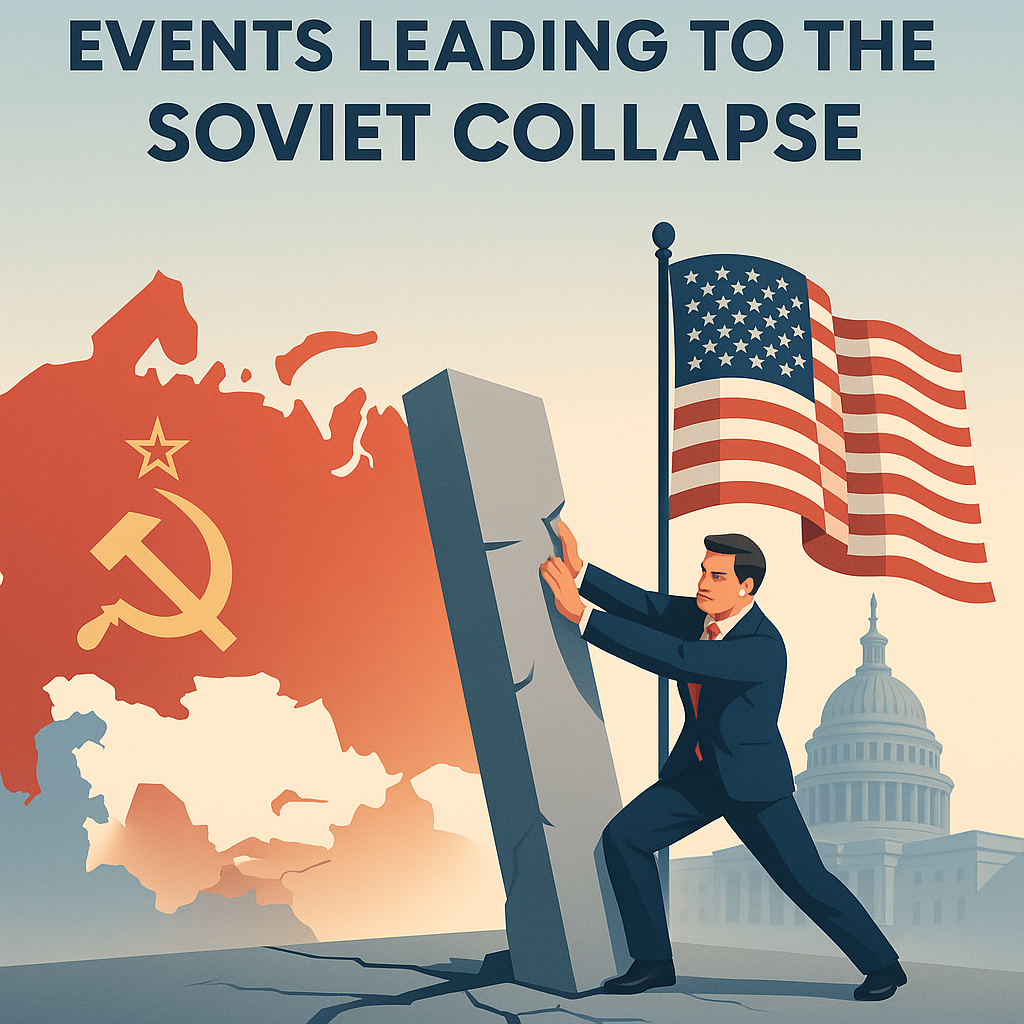
The Cold War was a significant historical period marked by political tension and military rivalry between the United States and the Soviet Union. This global standoff lasted from the end of World War II in 1945 until the dissolution of the Soviet Union in 1991. The term “Cold War” denotes the absence of large-scale fighting directly between the two superpowers, though they engaged in various forms of proxy wars and espionage. The conflict was driven by ideological differences, with the US promoting capitalism and democracy, while the Soviet Union championed communism. Understanding the events leading to the Soviet collapse is crucial because it reshaped global political dynamics and ended a period of intense geopolitical tension.
The significance of this era lies in its profound impact on international relations. The Cold War influenced global military strategies, led to the formation of military alliances such as NATO and the Warsaw Pact, and significantly impacted economic policies worldwide. As the Cold War waned, a new era of globalization and cooperation among former adversaries began, altering the course of history. By exploring the factors that led to the end of the Cold War and the collapse of the Soviet Union, we gain valuable insights into the dynamics of geopolitical power shifts and the importance of diplomacy and negotiation in preventing conflict.
Economic Strain: The Cost of the Arms Race
The arms race between the United States and the Soviet Union was one of the most visible aspects of the Cold War. Both nations invested enormous resources into developing nuclear weapons and maintaining vast military forces. This arms buildup placed a severe economic burden on the Soviet Union. The Soviet economy, plagued by inefficiencies and a lack of innovation, struggled with the high costs of sustaining a massive military.
The Soviet Union dedicated a substantial portion of its GDP to defense spending, diverting crucial resources from other sectors. This focus on military capability came at the expense of consumer goods and technological advancement, resulting in widespread shortages and a stagnating economy. While the United States faced economic challenges of its own, its economic diversity and resilience provided a buffer that the Soviet system lacked. Over time, the economic pressure exacerbated internal weaknesses within the Soviet Union.
Gorbachev’s Reforms: Glasnost and Perestroika
Mikhail Gorbachev became the leader of the Soviet Union in 1985, introducing a series of reforms aimed at revitalizing the Soviet system. Glasnost, meaning “openness,” allowed for more transparency and freedom of information within the Soviet Union. Perestroika, or “restructuring,” sought to reform the stagnant Soviet economy by introducing elements of market economics.
Gorbachev’s initiatives were designed to modernize the Soviet Union and make it more competitive on the global stage. However, they had unintended consequences. Glasnost empowered citizens to express dissatisfaction with government policies, leading to increased demands for political freedom and autonomy among Soviet republics. Perestroika, while introducing some market elements, struggled to overcome the deep-rooted inefficiencies of the Soviet economic system.
Political Upheaval: The Rise of Nationalism
As Gorbachev’s reforms unfolded, nationalist movements gained momentum within the Soviet republics. Long-suppressed ethnic tensions resurfaced as republics like Estonia, Latvia, and Lithuania began to assert their autonomy. The Baltic states, in particular, pursued independence, challenging the unity of the Soviet Union.
The rise of nationalism posed a significant problem for the Soviet leadership, which relied on a centralized and unified state. The craving for self-determination among various republics highlighted the deep-seated issues within the Soviet Union’s structure. The failed coup attempt in 1991 by hardline members of the Communist Party further fueled nationalist sentiments, accelerating the push for independence among several Soviet republics.
International Context: The Role of the United States and Europe
The international context during the late Cold War period significantly influenced the eventual collapse of the Soviet Union. The United States, under President Ronald Reagan, adopted a more confrontational stance towards the Soviet Union, ramping up military spending and rhetoric. This pressure further strained the Soviet economy already buckling under the weight of its military expenditures.
Simultaneously, European countries, particularly those in Eastern Europe, began to push for independence and reform. The solidarity movement in Poland and the fall of the Berlin Wall in 1989 served as catalysts, demonstrating that change was possible. The Soviet Union, unable to contain this wave of reform and unable to maintain its influence over Eastern Europe, faced a rapidly shifting geopolitical landscape.
| Event | Year | Impact |
|---|---|---|
| Glasnost and Perestroika Initiated | 1985 | Introduced political openness and economic restructuring |
| Fall of the Berlin Wall | 1989 | Symbolized the end of Soviet influence in Eastern Europe |
| Dissolution of the Soviet Union | 1991 | Officially marked the end of the Soviet era |
The Final Stages: The August Coup and the Soviet Dissolution
The final chapter in the collapse of the Soviet Union unfolded dramatically. In August 1991, a group of hardline Soviet officials, opposed to Gorbachev’s reforms, attempted a coup to seize control of the government. The coup failed due to lack of support from the military and decisive action by Boris Yeltsin, the President of the Russian Soviet Federative Socialist Republic.
Following the coup’s failure, republics quickly realized the weakened grip of the Soviet central government. By December 1991, the Soviet Union dissolved, leading to the independence of its constituent republics. Boris Yeltsin played a pivotal role in this transition, pushing for reforms and fostering democratic governance within the Russian Federation.
Summary: The Lessons of Soviet Collapse
The collapse of the Soviet Union resulted from a confluence of internal weaknesses and external pressures. Economic strain from the arms race, coupled with failed reforms and rising nationalism, laid the groundwork for its disintegration. The international climate, influenced by US pressure and European reform movements, further accelerated the Soviet Union’s demise.
Understanding these events offers critical lessons for modern geopolitics. The importance of economic resilience, political openness, and addressing nationalist sentiments cannot be overstated. The Soviet collapse illustrates the need for adaptable governance structures that can respond to technological, economic, and social changes. For today’s world, fostering international cooperation based on mutual respect and diplomatic dialogue is crucial to prevent conflict and promote stability.
As individuals, embracing openness and adaptability in our personal and professional lives is essential. Learning from history, we must advocate for transparent and accountable governance. Studying the end of the Cold War reminds us that seemingly unyielding political structures can change, often suddenly, highlighting the need for proactive engagement in shaping our futures. Explore more about modern-day geopolitics, historical lessons, and ways to foster positive change in your community and beyond.
Frequently Asked Questions
1. What were the main factors that led to the end of the Cold War?
The end of the Cold War was influenced by a myriad of complex factors that unfolded over several decades. Key among these was the economic stagnation that plagued the Soviet Union in the 1980s. The centrally planned economy struggled to compete with the more dynamic and flexible market economies of the West, particularly that of the United States. Additionally, the arduous burden of military spending strained the Soviet economy, as they attempted to keep up with the United States’ superior and rapidly advancing military technology.
A significant political factor was the ascension of Mikhail Gorbachev to power in 1985. He introduced major reforms through ‘Perestroika’ (restructuring) and ‘Glasnost’ (openness), aimed at revitalizing the Soviet system by injecting a degree of economic freedom and openness. These policies inadvertently loosened the Communist Party’s grip and escalated the momentum toward greater political freedoms, which led to increased public demand for democratization and independence among Soviet satellite states.
International pressure and diplomatic strategies, such as the rigorous arms control negotiations spearheaded by US President Ronald Reagan in tandem with Gorbachev, also provided a framework for reducing nuclear arsenals and fostering a cooperative spirit, which ameliorated tensions. The fall of the Berlin Wall in 1989 symbolized the crumbling divide between East and West Europe and heralded the formal dissolution of the Soviet Union in 1991, officially ending the Cold War.
2. How did the policies of Mikhail Gorbachev influence the collapse of the Soviet Union?
Mikhail Gorbachev’s policies were a pivotal force in the dismantling of the rigid Soviet structure. His initiatives, ‘Perestroika’ and ‘Glasnost’, were primarily aimed at solving the economic crisis but ended up being transformative in various unexpected ways. ‘Perestroika’ sought to decentralize economic control and introduce market-like reforms within the Soviet system. However, these reforms were met with resistance, and the misalignment created more economic chaos rather than revitalization, leading to a shortage of goods and a sharp decline in the standard of living.
‘Glasnost’ opened up the political landscape by promoting transparency and freedom of information, allowing citizens to express criticism toward the government without fear of repression. This led to a significant rise in national movements within republics seeking sovereignty and eventually demanding independence from Soviet control.
While Gorbachev’s intentions were to preserve socialism by making it more efficient and responsive, the gradual relaxing of authority hastened its disintegration. The absence of oppressive force allowed revolutionary ideologies to flourish, weakening the central government’s power and accelerating the dissolution of the Soviet Union.
3. What role did the United States play in the Soviet Union’s collapse?
The United States played a crucial indirect role in the collapse of the Soviet Union, particularly under the leadership of President Ronald Reagan, who escalated an arms race that put immense pressure on the Soviet military-industrial complex. The strategic defense initiative, famously dubbed ‘Star Wars’, along with significant military expenditures, forced the Soviet Union to spend an unsustainable portion of its GDP on defense.
Apart from military strategy, U.S. diplomacy also shifted in a manner that exacerbated internal Soviet weaknesses. Through persistent efforts in arms control talks and fostering international economic sanctions, the U.S. increased the isolation of the Soviet economy while simultaneously supporting dissident movements in Eastern Europe, thus challenging their sphere of influence.
Furthermore, American cultural and ideological influence played a subtle yet powerful role, as the Western portrayal of capitalist prosperity and personal freedoms provided a stark contrast to the reality of Soviet life, fueling internal dissatisfaction. Through media and the advancement of communication technologies, ideals of democracy and consumerism seeped into the Soviet Union, undermining Communist ideology and sparking aspirations for reform.
4. How did the changes in Eastern Europe contribute to the end of the Cold War?
Changes in Eastern Europe were vital catalysts for the conclusion of the Cold War as they undermined the integrity and unity of the Eastern Bloc, which had been a cornerstone of Soviet control. The fall of communist regimes in Eastern Europe in 1989, following a wave of revolutions, demonstrated an irreversible trend away from Soviet-style socialism, largely spurred by Soviet non-intervention in these uprisings.
Countries like Poland and Hungary led the charge with Solidarity and other independent movements pressuring their governments for democratic reforms. Similarly, East Germans amassed pressure at the Berlin Wall, culminating in its fall on November 9, 1989, a symbolic defeat for Soviet-dominated communism. These upheavals were precipitated by Gorbachev’s decision not to use force to uphold pro-Soviet regimes, unlike his predecessors who suppressed such movements in the past with military intervention.
The collective moves by these countries towards democratization and independence set off a domino effect that reverberated throughout the Eastern Bloc, leading to the erosion of Soviet power and influence in Eastern Europe, thereby paving the way for the conclusion of the Cold War.
5. Was there any single event that marked the definitive end of the Cold War?
While there is no single event that definitively marked the end of the Cold War, the dissolution of the Soviet Union in December 1991 stands as the ultimate conclusion to the era. This pivotal moment signaled the disbanding of the Soviet state and its transformation into a series of independent nations, marking the definitive collapse of communist rule in true Soviet form.
The signing of the Belavezha Accords on December 8, 1991, by leaders of Russia, Ukraine, and Belarus declared the Soviet Union effectively dissolved. Shortly thereafter, Mikhail Gorbachev resigned on December 25, 1991, and the Soviet flag was lowered for the final time over the Kremlin, symbolizing the cessation of the Cold War’s bipolar superpower competition.
These events followed a tumultuous period of transitions, including the fall of the Berlin Wall in 1989 and a series of failed coups against Gorbachev, which eradicated the remnants of centralized Soviet control. Collectively, these occurrences punctuated the end of the systemic, ideological, and geopolitical conflict that defined the Cold War period.