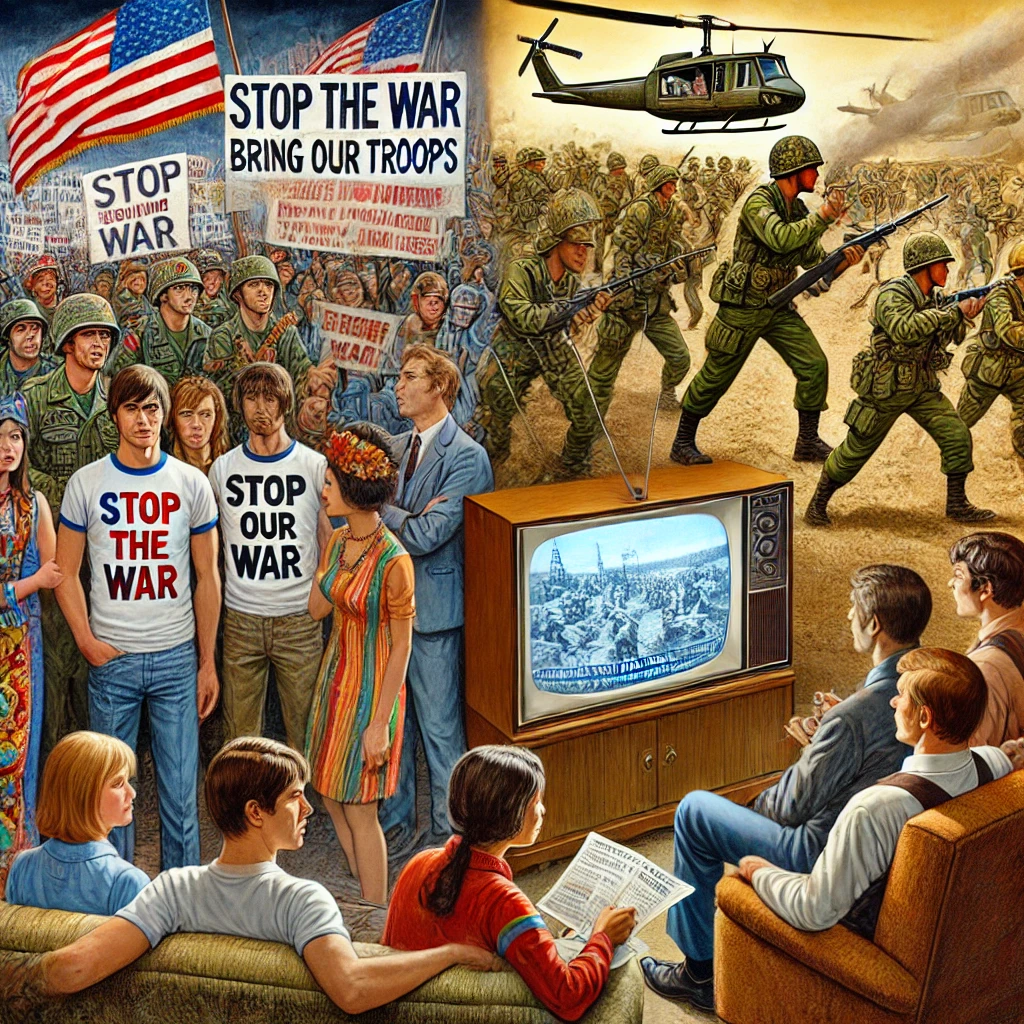
The Vietnam War was unlike any conflict Americans had ever experienced. It wasn’t fought on American soil, and it wasn’t just a distant struggle that people read about occasionally. Night after night, television networks brought the front lines into living rooms across the United States. This constant exposure to the brutal realities of war transformed what had often been blind trust in government and military decisions into a contentious national debate. While some Americans believed in their nation’s mission against the spread of communism, others questioned whether the U.S. should be involved at all. Over time, as death tolls rose and victories remained elusive, Americans found themselves increasingly divided. In this article, we’ll explore the political, social, and cultural factors that drove this division and how the Vietnam War reshaped American public opinion in ways that continue to resonate today.
The Historical Context: Fear of Communism and the Cold War
After World War II, the United States emerged as a global superpower, locked in an ideological struggle with the Soviet Union. The “Cold War” defined foreign policy for decades, creating an atmosphere of suspicion and fear. In the minds of many policymakers, preventing the spread of communism was critical to protecting American values and global stability. When communist forces gained ground in Southeast Asia, Washington viewed it as a test of American resolve. Vietnam—initially a French colonial territory seeking independence—became a focal point of the U.S. effort to contain communism.
At first, the American public largely accepted this rationale. Most people didn’t want to see another world war, and the image of the “domino theory”—the idea that if one country fell to communism, nearby nations would follow—was frightening enough to justify a growing U.S. presence. But as the years wore on, the reasons for American involvement began to feel less convincing to a significant portion of the population. Skepticism grew as the conflict dragged out and victory seemed nowhere in sight.
Early Support for Intervention
In the early stages, most Americans backed their government. The United States had a long history of rallying around the flag, and there was a general trust that elected leaders and military experts knew what they were doing. President Lyndon B. Johnson’s administration portrayed the conflict as a noble fight against tyranny. At first, the media mostly echoed the official line. Few Americans questioned the morality or strategy of involvement—at least not publicly. This is not to say there was zero dissent, but during the early and mid-1960s, it did not dominate the national conversation.
At the time, many believed that American wealth, technology, and military might could achieve a quick victory. The idea was that a show of force would deter further communist expansion. Newspapers and television reports, early on, tended to highlight U.S. and South Vietnamese victories, while downplaying setbacks. This presentation helped maintain initial support. However, as U.S. troop numbers escalated into the hundreds of thousands and casualties rose, the carefully managed public image of the war began to crack.
The Media’s Crucial Role
Technology—and the media’s reach—played a pivotal role in dividing public opinion over the Vietnam War. For the first time, television cameras brought graphic images of wounded soldiers, terrified civilians, and burned villages into American homes. Reporters in the field had greater freedom to record events than in previous conflicts, and the brutal honesty of their footage contradicted the more optimistic narratives offered by political leaders.
Americans saw soldiers fighting in jungles they could barely name. They witnessed children scarred by napalm and heard soldiers express confusion and doubt about their mission. These images stood in stark contrast to the comforting rhetoric from Washington, creating a profound dissonance. As investigative journalists dug deeper, stories emerged that challenged official claims. Incidents like the My Lai massacre, where hundreds of Vietnamese civilians were killed by U.S. troops, brought the moral complexity and horror of the war into sharp focus.
Suddenly, citizens were forced to question their assumptions. If this was truly a battle for freedom, why did it look so grim and senseless? If the United States was the good guy, why were there so many innocents caught in the crossfire? These questions weren’t easily answered, and they added fuel to the growing fire of dissent.
Hawks vs. Doves: The Emerging Divide
As doubts grew, Americans began to separate into two main camps: “hawks” and “doves.” Hawks believed the war was a necessary struggle against a dangerous enemy. They saw it as the responsibility of the United States to stop the spread of communism and preserve freedom. Even if the war was tough, hawks argued that the nation had to stand firm. To them, pulling out would be a sign of weakness, and the long-term consequences would be far worse.
Doves, on the other hand, questioned the entire premise of the war. They saw the conflict not as a heroic struggle, but as a brutal misadventure driven by misguided fears and unrealistic goals. Doves argued that the Vietnamese people should be allowed to determine their own destiny, free from American interference. They pointed out that the conflict was costing the U.S. dearly, not just in terms of lives lost, but also in money, moral standing, and social cohesion at home.
These opposing views surfaced in town halls, college campuses, and dinner table conversations. Families found themselves split. In some homes, parents supported the war while their children marched against it. In others, friends stopped talking to each other because they couldn’t find common ground. Politicians faced angry crowds on the campaign trail, and the press struggled to portray the complexity of public sentiment. The Vietnam War revealed deep ideological fissures within the American psyche that had been buried beneath the surface of post-World War II optimism.
The Draft and the Question of Fairness
One of the most hotly debated aspects of the war was the draft. Military service in Vietnam was not always voluntary. Young men, many of them not old enough to vote at the start of the conflict, were being called to serve in a distant land for a cause they often didn’t fully understand. College students could obtain deferments, and those with connections or resources found ways to avoid the draft. As a result, poorer Americans and minorities were more likely to be sent into combat. This highlighted glaring inequalities and fueled resentment.
It became harder to argue that the war was noble when the burden did not seem fairly shared. Communities that lost several young men came to question the government’s policy. Mothers and fathers demanded to know why their sons had to sacrifice their lives for something that looked increasingly like a stalemate. The draft transformed what might have remained a distant foreign policy issue into a deeply personal crisis for many American families. That personal stake made public opinion even more volatile and passionately divided.
The Antiwar Movement
By the late 1960s, the antiwar movement had grown into a powerful force. Students, religious groups, civil rights activists, and even some veterans joined large-scale protests. They marched on Washington, carried signs calling for peace, burned draft cards, and chanted slogans denouncing the war. The antiwar movement’s presence was felt in nearly every major American city, especially on college campuses.
This movement drew strength from a changing cultural landscape. The 1960s were a time of social upheaval. The civil rights struggle had already exposed the nation’s systemic injustices. Now, the Vietnam War gave Americans another reason to doubt their leaders. If the government was wrong about segregation and racial justice, why not about Vietnam too?
Musicians also played a key role, writing protest songs that captured the mood of disillusionment and frustration. Artists like Bob Dylan and Joan Baez gave voice to the antiwar sentiment, and their messages resonated with young people who felt that the older generation had led the country into a moral quagmire. The antiwar movement was no fringe group. Its critiques echoed through every level of society, challenging not just the war, but the entire direction of the nation’s foreign policy and moral compass.
Shifting Political Tides
Politicians could not ignore the division in public opinion. As casualties mounted and victory remained elusive, elected leaders began to feel the pressure. President Johnson, who had escalated U.S. involvement, saw his popularity plummet. He famously announced he would not seek reelection in 1968, citing the war and the unrest it caused.
Richard Nixon campaigned on a promise of “peace with honor,” claiming he had a plan to end the war. While Nixon eventually oversaw the withdrawal of U.S. troops, the conflict dragged on for years, and the bombings of neighboring countries like Cambodia deepened moral concerns. The shifting tides of public opinion played a significant role in these political maneuvers. Leaders who failed to address the growing skepticism risked losing support.
By the early 1970s, “Vietnamization”—the idea of gradually handing over the fight to the South Vietnamese—became the official policy, partly to calm the domestic storm. Even so, the nation’s trust in its political class and its institutions had been severely damaged. The war raised big questions: Could Americans believe their presidents? Could they trust the military brass? Were the intelligence reports reliable? These doubts did not vanish when the fighting stopped. They lingered, influencing future foreign policy and shaping the way Americans viewed their government for decades.
The Role of Veterans in Shaping Opinion
American soldiers returning from Vietnam faced a complicated homecoming. Unlike veterans of World War II who were greeted as heroes, Vietnam veterans often encountered indifference or outright hostility. They returned to a country that was divided about the war they had fought in. Some Americans blamed them for the atrocities that occurred. Others pitied them as victims of misguided policies.
These veterans brought back firsthand accounts that challenged simplistic narratives. Some became outspoken critics of the war, joining antiwar groups like Vietnam Veterans Against the War. Their voices carried immense credibility. After all, they were there; they knew the situation on the ground. Their testimonies further eroded support and fed the public’s growing skepticism about how the conflict was managed.
At the same time, many veterans felt betrayed and misunderstood. They had risked their lives for what they believed was their country’s mission, only to be met with protests and blame. The fractured reception of veterans highlighted just how deeply the war had cut into the national fabric, turning even the question of how to treat returning soldiers into a source of tension.
Cultural Shifts and the Long-Term Impact
The Vietnam War era was about far more than just foreign policy. It coincided with a period of massive cultural change in the United States. Traditional values were being questioned, new forms of music and art were emerging, and social norms were in flux. The war both influenced and was influenced by these cultural currents. The lines between the war debate and broader social movements—women’s liberation, environmentalism, racial equality—became blurred.
As public confidence in government declined, so did the willingness to support open-ended military commitments around the world. The Vietnam experience became a cautionary tale. Future interventions, such as those in the Middle East, would always be compared to Vietnam. The phrase “another Vietnam” became shorthand for any prolonged, unwinnable, and controversial conflict.
On a psychological level, the war’s division left a mark on how Americans viewed dissent and patriotism. No longer was it a given that supporting the government’s foreign policy was a patriotic duty. Criticism could now be framed as an act of responsible citizenship. Public opinion, fractured during Vietnam, never fully returned to the trusting consensus of the post-World War II era. Instead, skepticism and questioning became the norm.
Lessons Learned: Public Opinion as a Check on Policy
The Vietnam War demonstrated the immense power of public opinion to influence policy—even if belatedly. At the start, the public went along with the government’s narrative. But as evidence mounted that things were not going well, the tide turned. Widespread protests, media scrutiny, and organized dissent created enormous pressure on policymakers. Eventually, that pressure contributed to ending America’s direct military involvement.
This shift had lasting implications. Elected leaders recognized that they had to sell their policies to a now more skeptical and informed public. The government realized it needed greater transparency, or at least the appearance of it, if it wanted to maintain public support. The media learned lessons, too. After Vietnam, journalists approached official statements with more caution, aware of how propaganda and selective reporting could influence perceptions.
Conclusion: A Nation Forever Changed
The Vietnam War stands as a landmark in American history, not just for its geopolitical significance, but for how it split the country’s public opinion right down the middle. The conflict emerged from Cold War fears of communism and initially enjoyed a measure of support. But as the fighting dragged on, the images turned brutal and contradictory, the draft sparked outrage, and Americans began to question the entire enterprise. Hawks insisted on fighting for honor and containment. Doves argued that the war was immoral and unwinnable. Out of this clash came a lasting skepticism toward government, a more vocal and organized form of dissent, and a cultural shift that would shape the American mindset for decades.
In the end, the Vietnam War forced Americans to look hard at their national identity, their values, and the role they wanted their country to play in the world. It taught a generation that patriotism could include disagreement, that trusting leaders blindly could lead to tragedy, and that citizens had both the right and the responsibility to hold their government accountable. These lessons have influenced how Americans think about war and peace to this day, making the Vietnam War’s division of public opinion one of the most profound legacies of the 20th century.
Frequently Asked Questions
1. Why did the Vietnam War cause such a deep division among Americans?
The Vietnam War ignited intense debate across the nation primarily because it was the first time that modern media delivered the realities of war directly into American homes on a nightly basis. This exposure showed the American public, not only the war’s brutality but also the ambiguities of its purpose, and this transparency transformed the public’s perception. Initially, many Americans supported the government’s intervention with the belief in stopping the spread of communism as part of the domino theory. However, as the war dragged on with increasing loss of life and resources, without clear progress or victory insight, support waned. People started questioning the wisdom and ethics of the war, especially as it became apparent that military and government leaders were being less than forthright. The draft, which disproportionately affected lower-income and minority communities, further fueled dissent. The growing anti-war movement was empowered by these factors, creating a rift between those who believed in supporting their country no matter what and those who believed the conflict was unjust and unnecessary.
2. How did television influence American public opinion about the Vietnam War?
Television had an unprecedented role in shaping American public opinion during the Vietnam War, providing graphic and immediate depictions of the conflict. For the first time, the violence and chaos of war were available for anyone with a television set to see. Nightly news broadcasts featured footage of battles, wounded soldiers, and the aftermath of attacks, bringing the war’s brutal realities into stark relief. This accessibility altered the public’s perception drastically; people could no longer view the war as an abstract or faraway conflict. The horrors faced by soldiers, combined with images of Vietnamese civilian casualties, led many Americans to question the war’s morality and the government’s handling of the situation. Such raw portrayals often clashed with official reports, breeding a sense of distrust and sparking a broader anti-war movement that questioned not only the Vietnam strategy but also larger policies related to U.S. foreign intervention.
3. What role did the anti-war movement play in dividing American opinions on the Vietnam War?
The anti-war movement played a crucial role in dividing American opinions. Comprising mainly students, intellectuals, and civil rights activists, the movement grew rapidly as the war escalated. It organized large demonstrations, teach-ins, and marches that drew national attention. Persistent coverage by the media highlighted the movement’s size and scope, showcasing the passion and urgency of its participants. Public figures, including prominent musicians and celebrities, joined the cause, lending their voices to the chorus demanding an end to the conflict. This activism prompted discussions about patriotism, duty, and dissent, fundamentally challenging traditional norms. For some Americans, these protests were seen as unpatriotic and disrespectful to those serving. For others, they embodied a necessary stand against an unjust war. These conflicting viewpoints fueled intense debates within families, communities, and the corridors of power, making the Vietnam War as much a battle at home as abroad.
4. How did the draft system contribute to the division of opinion on the Vietnam War?
The draft system was a significant factor in widening the divide over the Vietnam War. It was perceived as inequitable, as deferment options—particularly for college students and those with medical exemptions—meant that minorities and lower-income young men were disproportionately conscripted. The draft brought the conflict into the hearts of American towns and cities, making the war personal and immediate for those affected. As family and friends were sent to fight, many began questioning the value and purpose of their sacrifice. Draft cards were burned in protest, and some fled to countries like Canada to avoid conscription. These actions exemplified a growing dissatisfaction and resistance against what was seen as both a morally questionable war and an unjust system of selecting individuals to fight it. This criticism of the draft system contributed to a larger questioning of U.S. military policy and fueled the anti-war sentiment that further deepened the national divide.
5. How did political leadership during the Vietnam War contribute to the division among Americans?
Political leadership during the Vietnam War significantly influenced the division among Americans. Presidents Lyndon B. Johnson and Richard Nixon both made controversial decisions that heightened tensions and mistrust. Johnson escalated U.S. involvement dramatically without a formal declaration of war, which many viewed as executive overreach. The credibility gap grew as discrepancies emerged between what the government reported and what was witnessed by troops and television viewers. Nixon’s policy of Vietnamization, coupled with covert operations and the expansion of the war into neighboring countries like Cambodia, further compounded these issues. Furthermore, incidents such as the leaking of the Pentagon Papers exposed long-standing governmental deception and mismanagement, undermining public confidence. These acts fostered widespread skepticism and criticism of political leaders and their decisions, deepening ideological divides and propelling the anti-war and civil rights movements that sought to hold these leaders accountable.