
The Persian Gulf War of 1991 stands out as a defining moment in modern American history, marking a transition in U.S. foreign policy and military strategy after the Cold War. Also referred to as Operation Desert Storm, this conflict played a critical role in revealing the United States’ capabilities as a global superpower. Its outcome redefined how the international community perceived American leadership, both militarily and diplomatically. As we explore how the Persian Gulf War reflected America’s standing on the world stage, we’ll walk through the events that led to the war, the strategies and technologies employed, and the broader consequences that reshaped global politics well into the 21st century.
Setting the Stage: A Post-Cold War Environment
At the close of the 1980s, the United States found itself in a rapidly changing global environment. The Cold War—a period characterized by tension between the U.S. and the Soviet Union—was winding down, and the Soviet Union was on the brink of collapse. For decades, the United States had approached international conflicts primarily through the lens of this rivalry. However, with the Soviet Union no longer the formidable adversary it once was, the U.S. government had to reconsider its role in international affairs.
Against this backdrop, the Middle East became an increasingly pivotal region for American foreign policy. The U.S. had longstanding ties to Middle Eastern countries, motivated primarily by access to oil resources, strategic alliances, and concerns over stability in a region frequently marred by conflict. For instance, the United States had supported Iraq during the Iran-Iraq War in the 1980s, providing intelligence and economic assistance. However, relationships in the Middle East were fluid, and alliances could shift rapidly.
By the time Saddam Hussein, Iraq’s leader, ordered the invasion of Kuwait in August 1990, the United States was emerging as the world’s dominant power, with a modern, well-equipped military and a widespread diplomatic network. Many in the U.S. leadership saw this crisis not just as a threat to Kuwait, but as a challenge to international law and a direct test of American resolve in the post-Cold War era. The question was no longer just how to counter the Soviet Union, but rather, how to preserve and promote a world order consistent with U.S. values and economic interests. This was the environment in which the United States prepared to engage in the Persian Gulf War—and in doing so, reveal its global superpower status.
The Road to Conflict: Iraq’s Invasion of Kuwait
When Saddam Hussein’s forces invaded Kuwait on August 2, 1990, the shock reverberated worldwide. Kuwait was a small, oil-rich neighbor that Hussein had long claimed was historically part of Iraq. He accused Kuwait of exceeding OPEC oil production quotas and effectively driving down oil prices, harming Iraq’s economy. The invasion was swift and brutal. Within days, Iraqi troops controlled the streets of Kuwait City, and the country was formally annexed as Iraq’s “19th province.”
For the United States, Iraq’s move threatened not only the sovereignty of Kuwait but also the security of Saudi Arabia, another key American ally. Saudi Arabia possessed a critical portion of the world’s oil reserves, and any threat to that supply was considered a direct threat to global economic stability. Moreover, the invasion raised urgent questions about whether the international community would tolerate such an act of aggression in an era that many hoped would be defined by international cooperation rather than superpower rivalry.
President George H. W. Bush quickly condemned Iraq’s actions, framing the crisis as a matter of global significance. With memories of the appeasement policies that failed to prevent World War II in mind, the administration believed that giving in to Saddam Hussein could set a dangerous precedent. Bush famously declared that the invasion “will not stand,” sending a clear message that the United States was prepared to lead a global response.
Building a Coalition: The Diplomatic Front
Perhaps the most telling aspect of America’s superpower status during the Persian Gulf War was its ability to build and lead a broad international coalition. President Bush and his Secretary of State, James Baker, embarked on an extensive diplomatic campaign to rally support for a unified response against Iraq. The United Nations Security Council condemned the invasion and passed a series of resolutions calling for Iraq to withdraw from Kuwait. These resolutions, culminating in Resolution 678, set a deadline for Iraq’s retreat and authorized “all necessary means” to enforce compliance if that deadline was ignored.
The coalition that emerged included countries from across the globe: NATO allies such as the United Kingdom and France, regional powers like Egypt and Saudi Arabia, and even nations that had historically been at odds with the United States, including the Soviet Union. This remarkable unity underscored America’s ability to galvanize international support around a shared objective. The success of this diplomatic effort highlighted the U.S. government’s ability to navigate complex geopolitical environments and leverage its economic, political, and cultural influence to forge temporary, yet formidable, alliances.
In many ways, this represented a transformation of the U.S. role in world affairs. During the Cold War, American alliances were often formed in direct opposition to Soviet expansionism. But with the Soviet threat receding, the U.S. took the lead in responding to regional conflicts that threatened global economic or political stability. This new context demanded that the United States exercise both “hard power” (military capabilities) and “soft power” (diplomatic and cultural influence). The Gulf War coalition was a significant test of that balancing act, and it propelled the U.S. further into its role as the post-Cold War era’s dominant superpower.
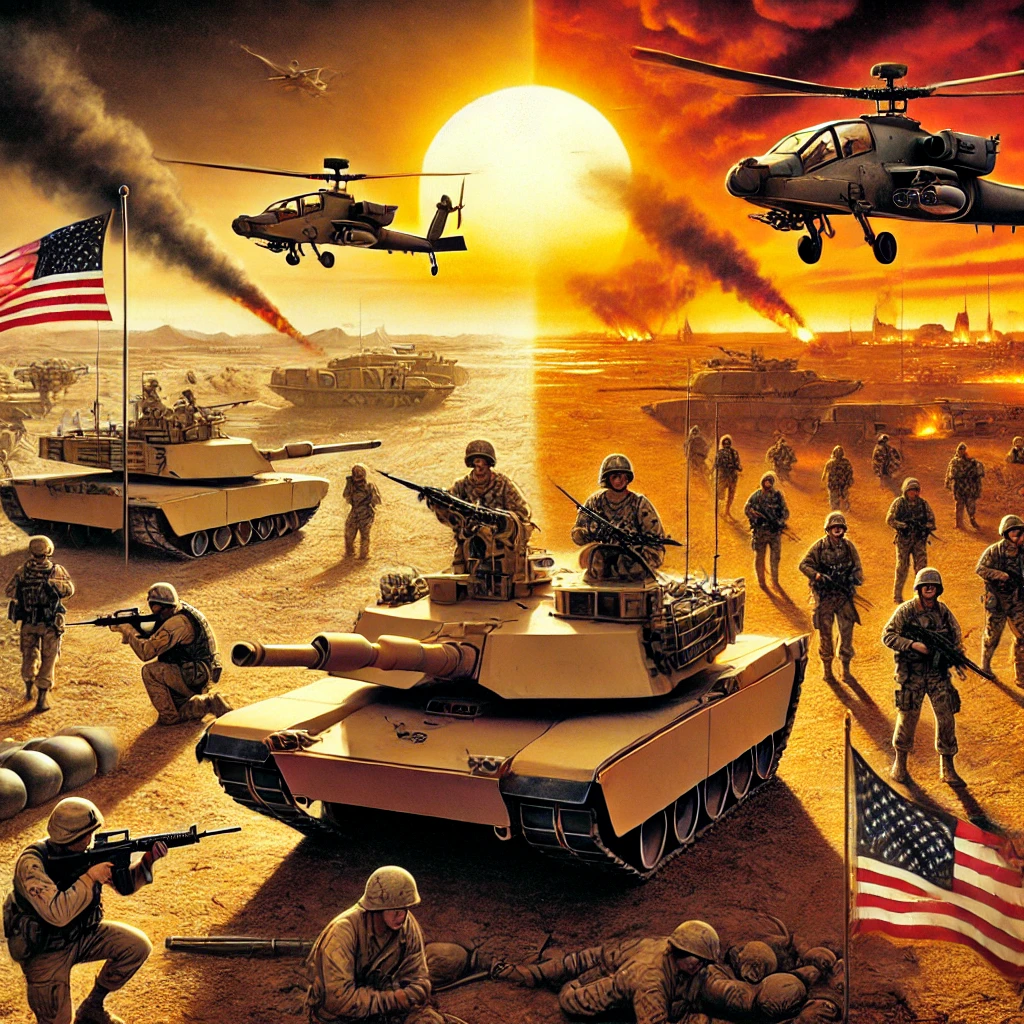
Operation Desert Shield and Operation Desert Storm
In preparation for potential military engagement, the United States launched Operation Desert Shield in August 1990. This operation aimed to protect Saudi Arabia from any Iraqi advances and create a strategic foothold in the region. Hundreds of thousands of U.S. troops—along with forces from other coalition countries—assembled in Saudi Arabia, building up a considerable military presence. The sheer speed and scale of this deployment showcased American logistical capacity: the U.S. military transported personnel, equipment, and supplies halfway around the world in a matter of months.
As the January 15, 1991, deadline for Iraqi withdrawal passed without compliance, the coalition initiated Operation Desert Storm on January 17. This was a massive air campaign designed to cripple Iraq’s command-and-control infrastructure, its communication networks, and its essential services. The coalition’s advanced technology was on full display: precision-guided munitions, stealth aircraft, and satellite-based intelligence played a pivotal role in ensuring accuracy and minimizing coalition casualties.
After several weeks of relentless aerial bombardment, coalition forces launched a swift ground offensive on February 24, 1991. In just four days, Iraq’s military was overwhelmed, and Kuwait was liberated. Although the fighting was intense in certain areas, the coalition’s superior equipment and training proved decisive. The conflict officially ended on February 28, 1991, when President Bush declared a cease-fire. Saddam Hussein remained in power in Iraq, but his forces were severely weakened, and his claim over Kuwait was completely dislodged.
Military Might on Display
One of the most striking ways the Persian Gulf War reflected America’s superpower status was the overwhelming military might demonstrated during the conflict. The technological edge displayed by the U.S. and its allies in Desert Storm was unlike anything the world had seen up to that point. Among the high-profile military technologies showcased were:
- Stealth aircraft: The F-117 Nighthawk, known colloquially as the “stealth fighter,” could elude radar detection and deliver precision strikes with minimal risk of being targeted.
- Precision-guided munitions: Commonly referred to as “smart bombs,” these weapons relied on laser or GPS guidance to strike targets with remarkable accuracy, reducing collateral damage.
- Patriot missile defense system: Designed to intercept incoming Iraqi Scud missiles, the Patriot system highlighted advancements in defensive capabilities against ballistic threats.
- Satellite-based intelligence and communications: The war demonstrated the power of space technology in real-time troop movements, surveillance, and data transfer.
American media outlets broadcast these technological feats around the clock, capturing the dramatic “night vision” footage of bombs dropping on targets in Baghdad. This media coverage not only informed the public but also acted as a global advertisement of U.S. military superiority. It showed the world that the U.S. was willing and able to project power far beyond its own borders, thereby reinforcing its position as the dominant military force in the post-Cold War era.
Public Opinion and the Media’s Role
The Persian Gulf War was also notable for how media coverage shaped public perception of both the conflict and the United States’ global leadership. For the first time, news networks like CNN provided 24-hour broadcasts from the war zone, offering live updates on troop movements and bombings. Many Americans watched the war unfold in real time—something that was unprecedented in the history of warfare.
Initially, public opinion favored intervention. Americans saw Saddam Hussein as the clear aggressor, and the Bush administration made effective use of messaging that emphasized defending freedom, protecting allies, and deterring future aggressions. Press briefings featured sophisticated charts and videos detailing coalition successes, and these visuals solidified the narrative of a high-tech, near-flawless military campaign.
However, the immediacy of the coverage also brought ethical questions to the forefront. Some critics argued that the media created a “sanitized” view of the war, focusing on precision strikes and minimized U.S. casualties while downplaying the destruction in Iraq and civilian casualties. Although these concerns surfaced, they did little to dampen the patriotic fervor in the United States. The quick and decisive victory, coupled with low American casualty figures, helped cement the impression that the war was a resounding success, validating America’s leadership on the global stage.
Aftermath and Shaping a New World Order
The liberation of Kuwait had immediate consequences for regional and international politics. Economically, Kuwait’s oil fields, some of which had been set ablaze by retreating Iraqi forces, were eventually restored, stabilizing the global oil market. Militarily, the United States maintained a presence in the Gulf region to deter future threats, setting up bases in Saudi Arabia and other allied nations. This extended military footprint became both a symbol of American protection and a point of contention for local populations who resented foreign troops on their soil.
Politically, the victory in the Gulf War positioned the United States at the forefront of shaping a “New World Order”—a term often used by President Bush. This concept implied that the U.S. and its allies would enforce international norms and counter aggression through collective action. The war also revitalized the United Nations as a forum for international diplomacy, at least temporarily, demonstrating that collective security could be achieved when major world powers cooperated.
Yet the Gulf War left some unresolved issues. Saddam Hussein remained in power, defying sanctions and inspections aimed at dismantling Iraq’s weapons programs. These tensions would later contribute to the rationale behind the 2003 invasion of Iraq under President George W. Bush. Moreover, the stationing of American troops in Saudi Arabia became one of the grievances voiced by extremist groups like al-Qaeda, playing a role in the complex web of factors that led to the September 11 attacks.
Controversies and Criticisms
Despite the widespread support for the Gulf War at the time, critics have since raised questions about the conflict’s humanitarian impact and long-term repercussions. One concern revolved around the coalition’s decision not to push on to Baghdad and remove Saddam Hussein from power in 1991. Some argued this allowed a dangerous regime to survive and reassert control. Others, however, felt that regime change was beyond the scope of the United Nations mandate and would have caused an extended occupation, creating an even bigger crisis in the region.
Additionally, the U.S.-led sanctions on Iraq after the war were a source of global debate. Critics claimed these sanctions harmed Iraqi civilians more than the governing regime, restricting access to food, medical supplies, and other critical resources. The Iraqi leadership capitalized on these sanctions for propaganda, blaming the United States for the suffering of innocent people. This narrative, whether fully accurate or not, eroded America’s moral standing among some international communities.
Another point of contention was the environmental damage caused by the conflict. The burning of Kuwait’s oil fields by retreating Iraqi forces led to massive pollution, with thick black smoke in the atmosphere and extensive oil spills in the Persian Gulf. Environmental advocates claimed that while Saddam Hussein was to blame, the United States and coalition forces could have done more to mitigate the ecological catastrophe.
These controversies suggest that while the Persian Gulf War showcased America’s power, it also highlighted the complexities of global leadership. Balancing military objectives with humanitarian and environmental considerations became a significant challenge in the following decades. Still, the war’s immediate success amplified perceptions of the United States as the world’s preeminent military and diplomatic force.
Reflection of American Superpower Status
Ultimately, the Persian Gulf War revealed multiple dimensions of U.S. power that cemented its role as a global superpower in the modern era:
- Diplomatic Leadership: The ability to assemble an international coalition on such a large scale demonstrated the respect and influence the United States commanded. This diplomatic coordination went far beyond Cold War alignments, showing that the U.S. could unite diverse nations around a common cause.
- Military Dominance: The advanced technology, speed of deployment, and effectiveness of coalition forces underscored America’s superior military capabilities. The war’s swift conclusion and minimal casualties on the coalition side became proof of the U.S. military’s overwhelming might.
- Media Influence: The continuous news coverage allowed the U.S. to shape global narratives about the war, reinforcing its image as a champion of liberation while minimizing domestic dissent. This level of information control and public relations was pivotal in maintaining broad-based support for the conflict.
- Economic and Strategic Interests: Securing vital oil supplies and preserving regional stability were key American objectives. The outcome protected global economic interests, reinforcing the idea that the U.S. would act decisively to safeguard international trade routes and resources.
- Post-Cold War Outlook: With the Soviet Union in decline, the U.S. filled the power vacuum on the world stage. The Gulf War served as a proving ground for a new era in which American political, economic, and military influence would shape global events—even if it also brought new challenges and responsibilities.
In many ways, the war acted as a curtain-raiser for how the U.S. would conduct foreign policy in the years to come. From humanitarian interventions in the Balkans to ongoing conflicts in the Middle East, American strategies often relied on coalition-building, advanced military technologies, and swift interventions. While these actions were not without controversy, they illustrated the central role the United States played as a protector of global interests and a promoter (or imposer, depending on one’s viewpoint) of a particular world order.
Lasting Impact and Lessons Learned
The lasting impact of the Persian Gulf War continues to shape discussions about U.S. foreign policy. Here are some key takeaways that remain relevant:
- Intervention Threshold: The war set a precedent for when and how the U.S. might intervene internationally, emphasizing a clear objective—expelling an aggressor from a sovereign nation—and strong diplomatic backing.
- Technological Edge: By showcasing advanced weaponry and strategic planning, the U.S. raised the bar for modern warfare. This prompted other nations to invest in or acquire similar technologies, leading to an arms race in precision-guided munitions and defense systems.
- Media Strategy: The “CNN effect” highlighted the power of real-time reporting in shaping public opinion and government policy. Governments learned the importance of controlling the narrative and providing compelling visuals during conflict.
- Coalition Warfare: The success of a broad coalition under U.S. leadership affirmed that collective military action could be both efficient and politically advantageous. However, it also underscored the diplomatic labor required to maintain unity among diverse allies.
- Regional Consequences: The U.S. presence in the Middle East grew significantly after the war, fueling debates about the American role in regional politics. This foreshadowed further interventions and military build-ups in the years ahead.
From a broader perspective, the Gulf War was an inflection point that displayed how the U.S. would manage global conflicts in a unipolar world. Though the Soviet Union’s collapse removed the binary tension of the Cold War, it also made the United States the primary steward of international security, whether welcomed or criticized by the global community. This elevated responsibility brought both prestige and pressure, influencing decisions on international interventions for decades to come.
Conclusion
In answering the question, “How did the Persian Gulf War reflect America’s role as a global superpower?”, we see that the conflict offered a vivid demonstration of U.S. military and diplomatic dominance in a world transitioning away from Cold War bipolarity. Through swift and overwhelming force, adept coalition-building, and pervasive media influence, the United States affirmed its position as the primary architect of global order. While the war achieved its immediate objectives—liberating Kuwait and containing Saddam Hussein’s ambitions—it also set into motion a new set of challenges and debates about the scope of American power, ethical responsibilities, and the complexities of long-term engagement in the Middle East.
Above all, the Persian Gulf War showcased America’s readiness to act decisively when it perceived a threat to international stability and its own national interests. The lessons gleaned from this conflict continue to inform U.S. policy, public sentiment, and global perceptions of American leadership. Despite controversies and unintended consequences, the war remains a cornerstone in understanding modern American history and the nation’s evolution as the world’s preeminent superpower in the final decade of the 20th century and beyond.
Frequently Asked Questions
1. How did the Persian Gulf War mark a transition in U.S. foreign policy post-Cold War?
The end of the Cold War ushered in a significant shift in global politics. The Persian Gulf War was the first major international conflict after this period, forcing the U.S. to re-evaluate its foreign policy strategy. Prior to the Gulf War, American foreign policy was heavily focused on containing the spread of communism. With the Soviet Union’s collapse, there was a pivot towards addressing regional conflicts and promoting stability in key areas of strategic interest, notably the Middle East. During the Persian Gulf War, the U.S. showcased a new form of interventionism, centered around coalition building, rapid deployment, and the use of advanced technology, shifting the focus from large-scale conventional warfare to precision strikes and quick conflict resolution. This new approach emphasized American commitment to ensuring global order and stability, reinforcing its role as a global superpower.
2. How did Operation Desert Storm enhance the U.S.’s global military standing?
Operation Desert Storm profoundly impacted the global perception of U.S. military might. The operation was characterized by the effective use of high-tech weaponry, satellite communication, and real-time intelligence, emphasizing speed and precision over sheer force. The wide-scale deployment of stealth aircraft, smart bombs, and the logistical prowess demonstrated in supporting a massive coalition of forces painted a picture of overwhelming superiority. The conflict, broadcast on live television, presented the world with a new era of military capability. The United States emerged as the definitive leader, capable not just of assembling forces efficiently but of executing strategies with minimal casualties. This exhibition of prowess confirmed its role as the dominant military power, illustrating America’s capacity to lead decisive military interventions when global stability was threatened.
3. What was the significance of coalition-building during the Persian Gulf War?
Coalition-building during the Persian Gulf War was a landmark in international diplomacy and military cooperation. Unlike earlier conflicts where the U.S. might have acted more unilaterally, this war involved a broad alliance of over 35 nations, unified under the goal of expelling Iraqi forces from Kuwait. Orchestrating such a diverse group required deft diplomatic engagement, showcasing the U.S.’s ability to rally international support for its initiatives. This coalition not only shared the military burden but also lent legitimacy to the U.S.-led efforts, bolstering America’s image as a leader capable of orchestrating multilateral efforts. Through this alliance, the U.S. demonstrated that it could effectively lead when mutual international interests were at stake, while also reinforcing global diplomatic ties that would prove vital in future endeavors.
4. How did the Gulf War change the perception of American leadership globally?
The Persian Gulf War dramatically reshaped global perceptions of American leadership. Traditionally, global giants like the Soviet Union shared the stage; however, its disintegration left a vacuum that the U.S. quickly filled. Through decisive action and visible successes, the Gulf War painted America as a power that could act as a global peacekeeper. Furthermore, the media coverage of the war, especially CNN’s live broadcasts, brought the conflict into living rooms worldwide and showcased the operational transparency and determination of the U.S. government. The rapid success against Iraq, a regionally formidable power, reinforced the idea that U.S. leadership was critical for maintaining global security and managing international conflicts. This perception solidified former skeptics’ views and enhanced existing alliances, thus embedding the concept of the United States as the preeminent global superpower for decades to come.
5. What role did advanced technology play in the Persian Gulf War and its implications for future U.S. military strategy?
Advanced technology was pivotal in the Persian Gulf War, heralding a new era in military operations. The conflict witnessed the inaugural large-scale use of stealth technology in the form of the F-117 Nighthawk aircraft, which could avoid radar detection, providing a tactical edge. Precision-guided munitions allowed for targeted strikes that minimized collateral damage and underscored the efficacy of technology in modern warfare. Moreover, the implementation of GPS systems and satellite communications enhanced navigation and real-time intelligence, allowing for greater operational coordination and efficiency. These advancements underscored the advantages of technological superiority, leading to a paradigm shift in U.S. military strategy by placing greater emphasis on research and development for future conflicts. Following the Persian Gulf War, the U.S. military committed to maintaining its technological edge, influencing defense policies and military budgets to prioritize innovation and modernization.