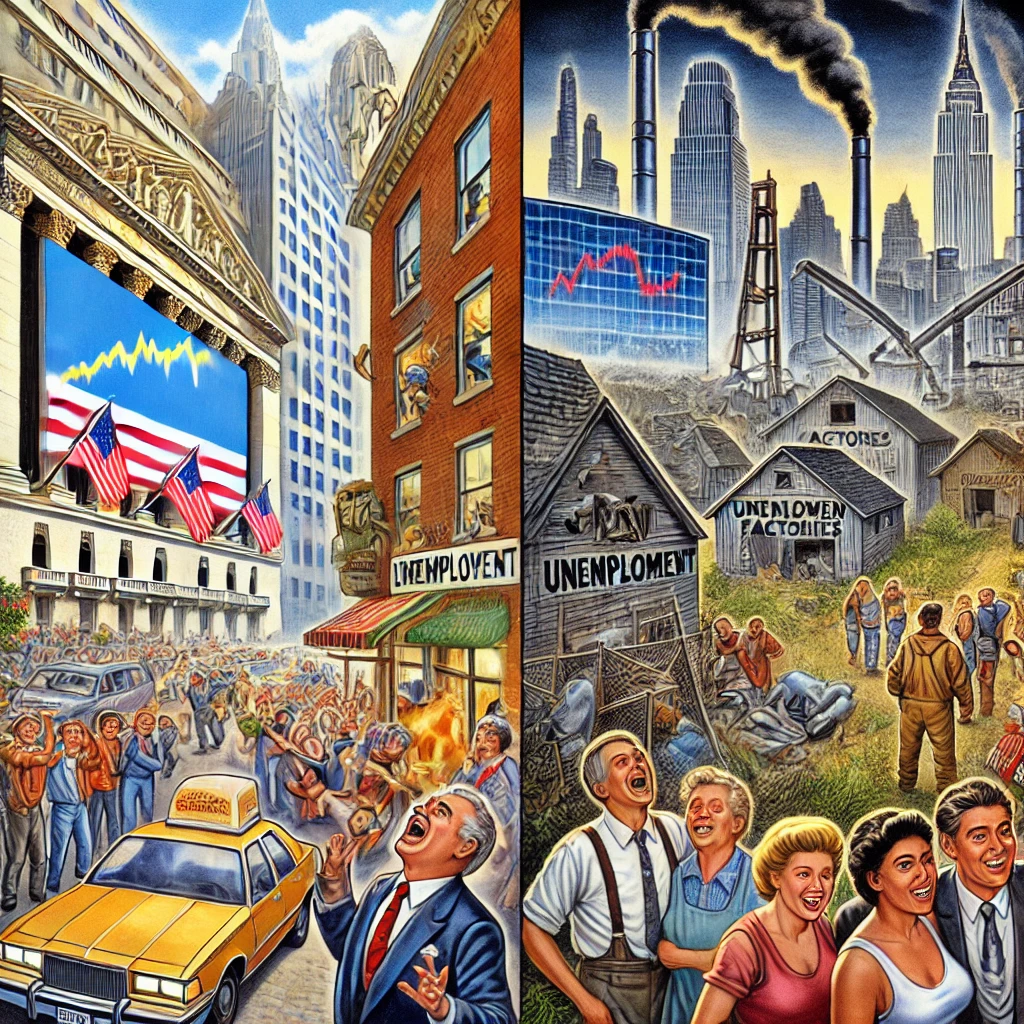
When Ronald Reagan stepped into the Oval Office in 1981, the United States faced a challenging economic landscape. High inflation, escalating unemployment, and lingering effects from the energy crises of the 1970s weighed heavily on Americans. At the same time, tensions with the Soviet Union and the global strain of the Cold War influenced every policy decision. In this environment, Reagan introduced a set of economic policies that later became known as “Reaganomics.” These policies were built on promises of lowering taxes, cutting regulations, and reducing government spending to unleash the powers of the private sector.
But how exactly did Reaganomics transform the U.S. economy? While some credit these policies with jump-starting growth and bringing inflation under control, others argue they worsened income inequality and ballooned the federal deficit. Understanding the real impact of Reaganomics means placing it in its historical context, considering its mixed results, and examining the lasting influence it has had on how Americans think about government, markets, and fairness.
The Economic and Political Climate Before Reaganomics
To understand the significance of Reaganomics, it’s essential to consider what came before it. The U.S. economy in the late 1970s was stuck in a period sometimes called “stagflation,” characterized by slow economic growth, high inflation, and rising unemployment. Traditional Keynesian policies, which had guided economic thinking since World War II, seemed less effective. Americans faced gasoline shortages, rising interest rates, and a general sense that the federal government wasn’t living up to its post-war economic promise.
On top of this, the country was still feeling the ripple effects of the Vietnam War’s expenses and the trauma of the Watergate scandal, which had shaken trust in government leadership. The Soviet Union remained a formidable rival, and massive defense expenditures weighed on the national budget. Many Americans looked for a different path forward, someone who could restore a sense of optimism and power to the American economy.
Ronald Reagan, a former governor of California and a former Hollywood actor, emerged as that figure. He campaigned on the idea that government had grown too large, too intrusive, and too expensive. He promised to reduce the burden of taxes and regulations, arguing that doing so would allow businesses and individuals to thrive. This approach challenged the decades-long reliance on government intervention and placed greater faith in private enterprise as a driver of prosperity.
Core Principles of Reaganomics
Reaganomics rested on four primary pillars: tax cuts, deregulation, reduced government spending growth, and a tight monetary policy to control inflation. The philosophical foundation of these policies drew from supply-side economics, which suggested that lowering barriers to production—like high taxes and regulations—would encourage businesses to invest more, create jobs, and ultimately boost tax revenue through increased economic activity.
- Tax Cuts: Perhaps the most famous element of Reaganomics was the substantial reduction in federal income tax rates. The 1981 Economic Recovery Tax Act slashed the top marginal tax rate from 70% to 50% and made significant cuts across the board. The idea was that if people kept more of their money, they would spend, invest, and save more, thus stimulating the economy from the ground up. Businesses, freed from heavy tax burdens, would be more willing to expand and innovate.
- Deregulation: Reagan aimed to remove what he saw as excessive government rules that stifled productivity and entrepreneurship. From the energy sector to telecommunications, the Reagan administration rolled back layers of regulation. By freeing businesses from what they considered unnecessary restrictions, the hope was that they would respond with more growth, efficiency, and improved services.
- Controlling Government Spending (in Some Areas): While Reagan was often associated with cutting government spending, in practice, total federal spending did not dramatically decrease. Defense spending, for example, soared as Reagan pushed for a military build-up against the Soviet Union. However, the administration did attempt to slow the growth of non-military spending in areas like social welfare programs. This created debate, as critics argued that cuts in social programs hurt vulnerable communities.
- Tight Monetary Policy: Although the Federal Reserve is independent from the White House, Reagan’s presidency coincided with Chairman Paul Volcker’s commitment to controlling inflation. High interest rates initially caused pain, particularly in the housing market, but eventually helped bring inflation under control. Lower inflation was seen as essential for long-term economic stability and growth.
The Immediate Effects: Growth and Stability
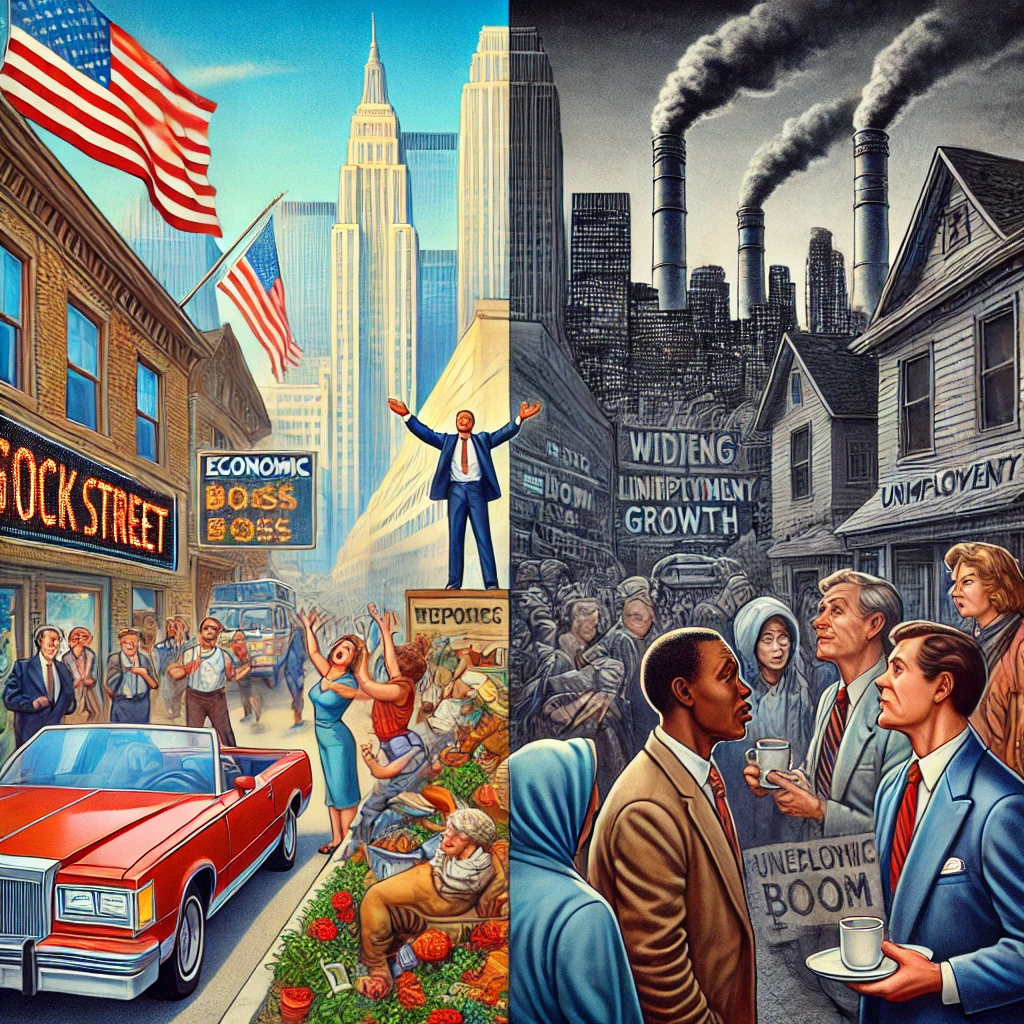
One of the key questions about Reaganomics is whether it delivered on its promise of reviving the U.S. economy. In the short term, the economy did rebound. By the mid-1980s, the U.S. saw a burst of economic growth. Unemployment, which had been over 10% in 1982, declined significantly as job opportunities expanded. The stock market soared, reflecting renewed investor confidence. Consumer confidence also improved, and many Americans felt that the economic malaise of the 1970s was finally ending.
Inflation, once a major drag on the economy, was brought under control. By the mid-1980s, inflation fell to more manageable levels, contributing to a period of relative price stability. This helped households and businesses plan for the future without fear that their dollars would rapidly erode in value.
Many supporters of Reaganomics point to these trends as proof that supply-side policies worked. They argue that by giving people more control over their finances and reducing unnecessary government interference, the Reagan era created an environment ripe for innovation and growth.
Critiques and Controversies: Inequality and Deficits
However, not everyone saw these changes as wholly positive. Critics of Reaganomics argue that while wealth and prosperity did rise, they did not do so evenly. Income inequality in the United States grew during the 1980s. The richest households generally benefitted the most from tax cuts, while wage growth for middle- and lower-income Americans lagged behind. This shift contributed to a widening gap between the top earners and the rest of the country.
At the same time, the federal deficit and national debt grew significantly during Reagan’s two terms. Tax cuts reduced federal revenue as a share of GDP, and although economic growth provided some offset, it wasn’t enough to pay for the administration’s ambitious defense spending. Critics contend that this left the U.S. with long-term financial burdens. Once the idea of a balanced budget had bipartisan appeal, but after the 1980s, large deficits became more normalized.
Another controversy centers on the social safety net. Cutting or slowing growth in social spending meant that low-income communities, people of color, and other vulnerable groups often felt the squeeze. Reagan’s approach forced many Americans to rely more on private charity and local communities. Some argue this was a return to individual responsibility, while others see it as government abandonment of its duty to care for citizens who struggle.
The Role of Deregulation in Changing the Economic Landscape
Deregulation under Reagan had far-reaching impacts. The airline and trucking industries, for instance, had begun the process of deregulation under President Carter, but Reagan’s administration continued pushing in that direction. Proponents argued that deregulation lowered consumer prices and spurred competition. Airline tickets became cheaper, and more Americans could afford to fly. Similarly, trucking costs fell, and the movement of goods became more efficient.
On the other hand, critics point out that deregulation sometimes led to negative outcomes. In the financial sector, deregulation is often cited as setting the stage for future crises. For example, the savings and loan crisis of the late 1980s was partly attributed to the relaxation of rules meant to keep financial institutions stable. Without strong oversight, risky lending soared, and taxpayers eventually had to bail out these institutions, costing billions of dollars. The legacy of financial deregulation would echo for decades, influencing the debates leading up to the 2008 financial crisis.
Defense Spending and the Cold War Context
It’s impossible to separate Reaganomics from the Cold War environment in which it was implemented. Reagan believed that a stronger military would not only deter Soviet aggression but could hasten the end of the Cold War. He increased defense spending dramatically, pouring money into new weapons systems and technological advancements. The defense sector boomed, creating jobs and stimulating certain regions of the country. Some economists argue that this defense buildup had a stimulative effect on the economy, though it also contributed to those rising deficits.
Ultimately, the Soviet Union collapsed at the start of the 1990s. While historians debate how much Reagan’s military buildup directly influenced that outcome, his defenders argue that the economic cost imposed on the Soviets by trying to keep up with U.S. defense spending was a key factor. The end of the Cold War opened new markets and arguably lowered global tension, potentially benefiting the U.S. economy in the long run.
The Lasting Impact on Policy Debates
Reaganomics didn’t just change the economy during the 1980s; it transformed how Americans talk about the economy. The ideas that taxes should generally be lower, that government regulation should be viewed with skepticism, and that private industry drives prosperity became cornerstones of American political discourse. Subsequent presidents, both Republican and Democrat, operated to some degree within the framework Reagan helped establish.
For instance, Bill Clinton’s administration in the 1990s did not fully reverse Reagan-era tax cuts or regulations. Instead, Clinton embraced free trade agreements and maintained a generally pro-business environment. While the federal budget temporarily returned to a surplus in the late 1990s, this was due more to a booming tech-driven economy and moderate spending cuts than a wholesale rejection of Reagan’s economic philosophy.
George W. Bush’s presidency further emphasized tax cuts and limited government. Later, even Barack Obama, who championed more government intervention during the financial crisis, did not return marginal tax rates to pre-Reagan levels. The shadow of Reaganomics looms large over every economic debate, framing arguments about whether cutting taxes will spur growth and how much the government should intervene in markets.
Long-Term Outcomes: What Do the Numbers Say?
Assessing the long-term results of Reaganomics is no simple task. On the one hand, the U.S. economy remained innovative and resilient in the decades after Reagan left office. The 1990s tech boom, the rise of Silicon Valley, and America’s status as a global economic leader can be partially credited to an environment that favored entrepreneurship. Many conservatives and libertarians point to the Reagan era as proof that lower taxes and lighter regulations encourage a spirit of enterprise that benefits everyone in the long run.
On the other hand, the income inequality that started expanding in the 1980s has persisted and even intensified. While Reaganomics did not singlehandedly cause inequality—it’s influenced by a globalized economy, technological changes, and many other factors—it set a tone for policies that often favored the wealthy and corporations. This has led to ongoing debates about whether the government should step in more aggressively to reduce inequality, raise minimum wages, or ensure affordable healthcare and education.
Furthermore, the deficits run up in the 1980s paved the way for an era in which massive government debt is a given rather than an emergency. While Reaganomics supporters counter that deficits can be managed through spending restraint and growth, critics worry that the precedent set in the 1980s contributed to a culture of debt. The cost of servicing this debt, both then and now, can limit the government’s ability to respond to new challenges—be they economic downturns, pandemics, or climate-related disasters.
The Legacy for American Workers
For the American working class, Reaganomics had mixed results. The booming economy of the mid-1980s did create jobs, but those jobs did not always come with the robust benefits and wages seen in earlier decades. Manufacturing jobs, which once supported middle-class families, continued to decline in the face of global competition and automation. The Reagan administration’s anti-union stance, symbolized by the firing of striking air traffic controllers early in his presidency, weakened organized labor’s influence. With unions losing power, wages for average workers stagnated over time, even as productivity increased.
This shift in the labor market and wage dynamics still shapes today’s policy debates. Should the federal government do more to support labor unions and ensure that workers share in the fruits of economic growth? Or should it continue to trust market forces to set wages and working conditions? Reaganomics, by firmly taking the side of less regulation and more employer freedom, set the standard for how these questions are often answered.
Reaganomics in Popular Memory
For many Americans, Reagan’s presidency is remembered as a time of renewed patriotism, optimism, and strength. His cheerful demeanor and confident speeches conveyed a sense of national purpose. The economic growth of the mid-1980s is often cited as a validation of his policies. Ask a supporter of Reaganomics, and they’ll likely emphasize the end of high inflation, the job creation, and the renewed respect for private enterprise.
Opponents, however, remember the decade differently. For them, the era was one where the rich got richer while the poor struggled to keep up, where important social programs were cut back, and where the seeds of future financial problems were sown. They argue that the gains of the 1980s were unevenly distributed and that the U.S. has been dealing with the consequences ever since.
Conclusion: A Lasting Debate
How did Reaganomics transform the U.S. economy? In many ways, it remade the nation’s economic landscape and political vocabulary. It moved the country toward lower taxes, less regulation, and a heightened belief in the power of private enterprise. It brought stability after the turmoil of the 1970s, providing a foundation for decades of innovation and growth.
Yet, Reaganomics also contributed to rising inequality, the normalization of budget deficits, and a more contentious political environment over the proper role of government. Even today, policy discussions about tax reform, social welfare, and financial regulation unfold in the long shadow of the Reagan years.
The legacy of Reaganomics reminds us that economic policies can have far-reaching effects that shape not only pocketbooks but also the national character. By understanding its promises, successes, and shortcomings, we gain a clearer picture of the trade-offs involved in choosing one economic path over another. The debate over Reaganomics is not just about the past; it’s about the future direction of the American economy and the society we hope to build.
Frequently Asked Questions
1. What exactly is Reaganomics and what were its core principles?
Reaganomics refers to the economic policies implemented by President Ronald Reagan during his time in office from 1981 to 1989. The term combines Reagan’s name with “economics” and encapsulates a specific vision of economic management that included several key principles:
Firstly, Reaganomics focused heavily on tax cuts as a means to spur economic growth. The administration believed that by reducing taxes, individuals and businesses would have more disposable income to spend and invest, thereby stimulating economic activity. This approach aimed at giving power to the market forces through what is often called “supply-side economics” or colloquially known as “trickle-down economics.”
Secondly, deregulation was a cornerstone of the policy. The idea was to remove government controls and reduce federal oversight across various industries, which was expected to encourage business innovation and efficiency. In Reagan’s view, excessive regulation stifled business operations and restricted economic growth.
Thirdly, there was a strong emphasis on controlling inflation by tightening the control of the money supply. The Federal Reserve played a significant role during this period to manage inflation, which was considered a major barrier to economic stability.
Lastly, Reaganomics included a reduction in government spending on social programs while increasing military spending. This shift aimed to reallocate resources to strengthen the U.S. military while insisting that a robust defense was vital, especially given the Cold War context.
2. How did Reaganomics impact the U.S. economy?
The impact of Reaganomics on the U.S. economy is a widely discussed and debated topic. During Reagan’s presidency, the American economy experienced substantial changes, and several metrics illustrate the outcomes:
One noticeable effect was the reduction in inflation. When Reagan took office, inflation was a persistent issue, but by the end of his term, it had decreased significantly. The tight monetary policy of the Federal Reserve, alongside Reagan’s economic strategies, helped achieve this reduction.
Economic growth saw an upward trend during this period. The U.S. GDP grew steadily, recovering from the recessions of the late 1970s through to the early 1980s. Supporters of Reaganomics argue that these principles directly contributed to a more robust economic landscape.
However, the policies also led to an increase in national debt. While Reagan prioritized cutting taxes and government spending, the focus on increased military expenditure, coupled with tax cuts that reduced federal revenue, contributed to a growing budget deficit.
Additionally, critics highlight growing income inequality as a significant side effect of Reaganomics. The emphasis on tax cuts, particularly for the wealthier segments of society, is said to have contributed to uneven wealth distribution.
3. Did Reaganomics have any long-term effects on the U.S. economy?
The long-term effects of Reaganomics are still evident in aspects of the U.S. economic structure and policy debates. Let’s delve into some of these lasting impacts:
One of the most significant long-term legacies of Reaganomics is the tax structure. The focus on lowering taxes, especially for high-income individuals and corporations, laid the groundwork for future tax reform and policy that echoed similar principles. Debates surrounding tax cuts versus the need for increased government revenue often refer back to the era of Reaganomics.
Another influence is seen in deregulation. The precedent of reducing government intervention in business operations continued beyond Reagan’s presidency, shaping economic policy under subsequent administrations. This cultural shift towards a less regulated market economy has become a staple in the American economic philosophy.
The debt legacy left by increased military spending and reduced tax revenue also persists. Conversations about fiscal responsibility and the federal deficit often trace their roots back to changes initiated during Reagan’s reign.
Moreover, the discussions around income inequality have roots in the disparity that grew during this time. The distribution of wealth and conversations about economic justice have been critical points of debate in understanding the socio-economic fabric of the United States today.
4. How did Reaganomics affect international economies?
Reaganomics didn’t just impact the United States; its ripple effects were felt globally, influencing economic policies in several nations across the world:
Firstly, the strong U.S. dollar during the Reagan years exerted significant influence on international trade. The appreciation of the dollar made American goods more expensive abroad, impacting trade balances. Some countries found their markets flooded with American imports, which affected local industries, while others struggled to sell goods in the U.S. due to increased costs.
Reaganomics also propagated the idea of free markets and deregulation to other economies, notably those undergoing reform. For instance, countries in Latin America and Eastern Europe, transitioning from state-controlled systems to market economies, often looked to the U.S. for models and guidance on how to liberalize their economies.
Additionally, the emphasis on military spending elevated the arms race financially. Countries aligned with both the U.S. and the Soviet bloc increased their military expenditures, affecting their socioeconomic priorities and economic structures.
Lastly, Reaganomics helped spread neoliberal economic policies globally, as financial institutions like the International Monetary Fund and the World Bank began advocating for similar policies in their conditional loans to developing nations. This interventionist approach reinforced a global shift towards market-driven economic strategies.
5. How does Reaganomics compare to economic strategies of other U.S. presidents?
To thoroughly understand Reaganomics, it’s insightful to compare it to the economic strategies of other U.S. presidents, both before and after Reagan:
Prior to Reagan, during the presidency of Franklin Delano Roosevelt, the U.S. was guided by the Keynesian economic model, which promoted active government intervention in the economy, especially through public works programs to stimulate demand. This was in stark contrast to the laissez-faire principles of Reaganomics where less government involvement was a goal.
Years after Reagan, presidents have taken varied approaches, often dictated by the economic context of their times. For instance, during Bill Clinton’s presidency, there was a focus on balancing the federal budget alongside moderate deregulation. Clinton’s tenure saw budget surpluses, which contrasted with the deficits that characterized Reagan’s era.
George W. Bush’s economic policies also reflected Reaganomic ideals through tax cuts and an emphasis on individual wealth creation, although with a notable expansion in federal spending, particularly in military and security sectors.
Under Barack Obama, in the wake of the 2008 financial crisis, there was a move towards more direct government intervention and stimulus to stabilize the economy, differing from Reagan’s supply-side principles. This reflects a frequent oscillation in U.S. economic policy, moving from market liberation to guided intervention, depending heavily on prevailing economic needs.
Throughout these comparisons, Reaganomics remains a touchstone for understanding America’s economic policy debates, particularly around taxation, government spending, and the role of regulation. Each administration’s approach reflects the continuity and evolution of these discussions over decades.