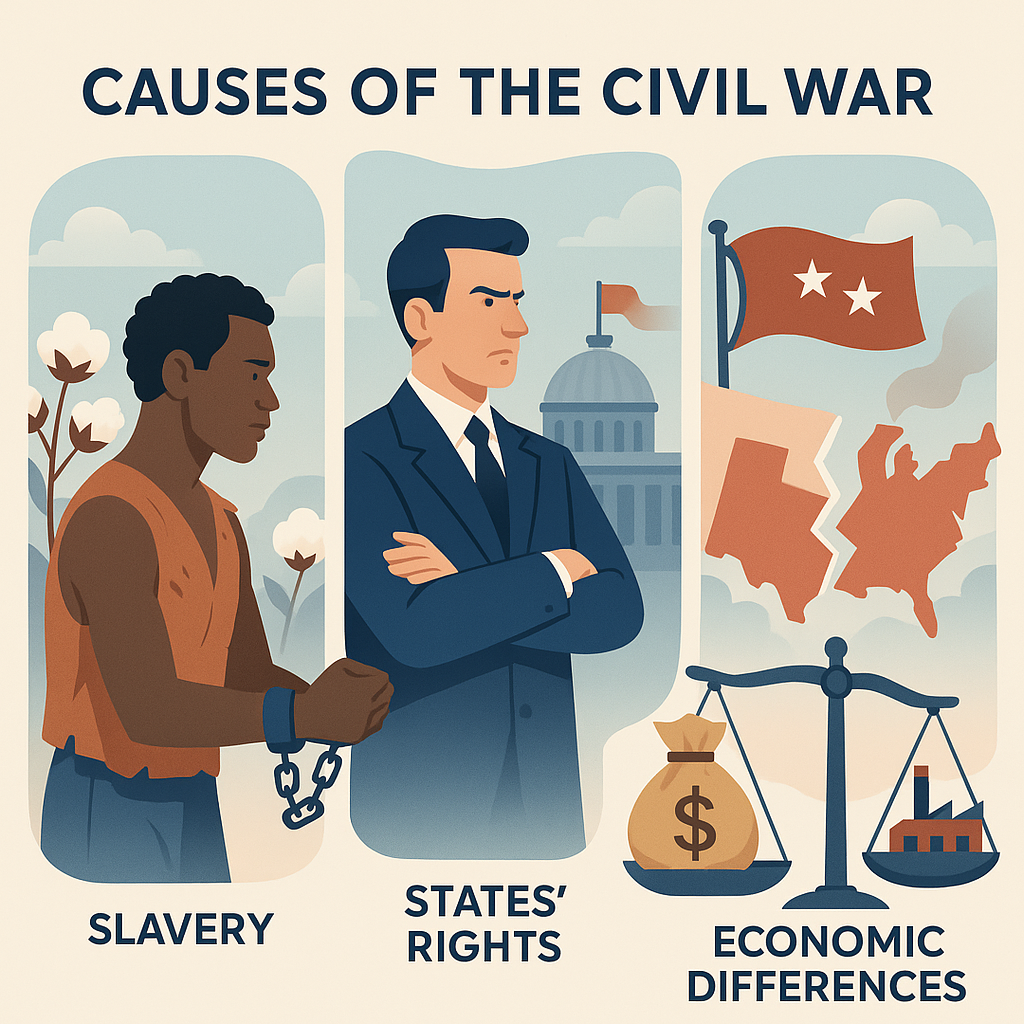
The Civil War, a pivotal moment in American history, fundamentally reshaped the nation. Understanding its causes is essential to comprehending the complex interplay of political, economic, and social factors that culminated in a brutal conflict and long-lasting implications. At the heart of the Civil War’s origins were deep-seated tensions driven by sectionalism, a concept indicating the division between distinct regions with competing interests. These tensions were exacerbated by issues related to states’ rights, economic disparities, and most critically, the contentious institution of slavery. Addressing the causes of the Civil War requires unpacking each of these components, illustrating how they interwove to form the crisis of secession and conflict.
By delving into the causes of the Civil War, one gains insight into the drastic divisions that defined a nation on the brink. Recognizing the factors that led to the war aids in understanding the conflicts and challenges that continue to impact American society today, including issues of race, federal versus state authority, and economic inequity. This exploration of the Civil War’s causes is integral for those seeking to grasp how historical events have shaped current national issues, ensuring that the lessons of the past guide future progress.
Sectionalism and Economic Disparities
At the heart of sectionalism were profound economic differences between the North and the South. The North’s economy was rapidly industrializing, characterized by urban growth and the rise of factories. In contrast, the South remained predominantly agrarian, with large plantations reliant on slave labor. This economic dichotomy fueled mutual distrust and competition, as each region sought policies favorable to its own growth at the expense of the other. A prominent example of these economic tensions was the tariff policy. The North, with its burgeoning industries, favored high tariffs to protect domestic manufacturing from foreign competition. Conversely, the South, which relied heavily on exporting cotton, opposed tariffs that could provoke retaliatory measures from other nations.
This rift was highlighted by the Tariff of 1828, dubbed the “Tariff of Abominations” by Southern detractors. It epitomized how differing regional economic priorities could spur significant political conflict. Southern states, particularly South Carolina, were infuriated, arguing that such tariffs disproportionately benefited the North while harming the Southern economy. This dispute over economic policy underscored the broader sectional divisions that would later manifest more violently.
The Slavery Debate
Slavery was undeniably the most contentious and explosive issue that drove the sectional divide. The Southern economy’s reliance on slave labor meant that any threat to slavery was perceived as a threat to the South’s way of life. The moral and ethical debates over slavery were further intensified by the abolitionist movement in the North, which sought to end slavery in the United States.
One notable example of how the slavery issue fractured national politics was the Missouri Compromise of 1820. When Missouri applied for statehood as a slave state, it threatened to disrupt the delicate balance between slave and free states. The compromise allowed Missouri to enter as a slave state while Maine entered as a free state, maintaining the balance but also sowing seeds of discord. Over the following decades, numerous political battles erupted as the nation expanded westward, each new territory sparking heated debates over whether it would permit slavery.
States’ Rights and Federal Power
The balance of power between state and federal authorities was a pivotal factor in the lead-up to the Civil War. Many Southern leaders championed the doctrine of states’ rights, arguing that states had the authority to nullify federal laws deemed unconstitutional and ultimately to secede from the Union if their rights were violated. This belief was deeply rooted in the events following the ratification of the Constitution and was central to the South’s resistance to perceived Northern overreach.
Perhaps the most illustrative example of this tension occurred during the Nullification Crisis of the early 1830s. South Carolina, in opposition to high federal tariffs, declared the tariffs null and void within state borders, challenging federal authority. President Andrew Jackson’s firm response, asserting the supremacy of federal law and threatening military action, set a precedent for future conflicts. Despite temporary resolutions, the Nullification Crisis elucidated the stark divide over states’ rights and foreshadowed the South’s eventual move toward secession.
The Rising Political Partisanship
As sectional tensions escalated, so too did political partisanship, intensifying the debate over the future of slavery and state sovereignty. The creation of the Republican Party in the 1850s, with an explicit platform against the expansion of slavery, signaled a shift in national politics. The party’s rise threatened Southern interests and contributed significantly to regional animosities.
The election of Abraham Lincoln in 1860, a Republican staunchly opposed to the spread of slavery, was a decisive turning point. Though he assured the South of his intention not to abolish slavery where it already existed, the fear of its eventual end led to immediate calls for secession. Lincoln’s election is often cited as the immediate catalyst for the Civil War, underscoring the extent to which partisanship and sectional loyalties had polarized the nation.
The Road to Secession
The final years leading up to the Civil War were marked by escalating tensions and an increasing inability to find common ground. As each sectional dispute further strained the Union, secession became a more attractive option for Southern leaders who felt their way of life was under existential threat.
The secession of Southern states began with South Carolina in December 1860 and swiftly expanded. By February 1861, six more states had seceded, forming the Confederate States of America. Their secession was driven by various factors, including economic interests tied to slavery, the preservation of states’ rights, and resistance to Northern political dominance. The attack on Fort Sumter in April 1861 marked the explosive beginning of open warfare, demonstrating that all avenues for peaceful resolution had been exhausted.
| Event | Date | Description |
|---|---|---|
| Missouri Compromise | 1820 | Accepted Missouri as a slave state and Maine as a free state to maintain Senate balance. |
| Nullification Crisis | 1832 | South Carolina’s challenge to federal tariffs symbolizing the clash over states’ rights. |
| Republican Party Formation | 1854 | Created with a platform against the expansion of slavery. |
| Election of Abraham Lincoln | 1860 | Led to secession calls from Southern states due to his anti-slavery stance. |
| Attack on Fort Sumter | 1861 | Marked the initiation of armed conflict between the Union and Confederates. |
Summary and Reflection
The causes of the Civil War are multifaceted, deeply rooted in economic disparities, ideological battles over slavery, and conflicts over states’ rights. The journey from sectional tensions to outright conflict reflects complex dynamics where political, economic, and moral elements converged. Understanding these factors provides critical insights into how the United States evolved and the underlying issues that have persisted across eras.
Examining these causes also serves as a reminder of the importance of dialogue and compromise in avoiding future conflicts. By learning from the difficulties and choices of the past, we are better equipped to tackle contemporary challenges and foster a more inclusive society. As we reflect on the Civil War’s lessons, our next steps should include engaging in informed discourse, acknowledging historical complexities, and striving for solutions that unite rather than divide.
The call to action is clear: delve deeper into history, educate others about its lessons, and apply this knowledge to inspire positive change in today’s world. Through understanding, reflection, and action, we can work towards a more harmonious future.
Frequently Asked Questions
1. What were the main economic differences between the North and the South that contributed to the Civil War?
The North and the South had distinctly different economic systems, which played a significant role in the lead-up to the Civil War. The North was rapidly industrializing, with factories, railroads, and a growing urban population. This industrial economy demanded a different kind of labor force and was less reliant on agriculture. Meanwhile, the South’s economy was heavily dependent on agriculture, particularly the cultivation of cotton. This agricultural economy relied extensively on enslaved labor. The South’s opposition to tariffs, which were favored by the industrial North to protect its growing industries, also fueled tensions. Over time, these economic differences created a rift, wherein both regions felt their ways of life were under threat, thus fueling the drive toward conflict.
2. How did the issue of slavery intensify sectionalism in the United States?
Slavery was, without a doubt, a central issue that heightened sectionalism between the North and the South. While the North gradually moved toward abolition and saw an increased sentiment against the moral and economic implications of slavery, the South viewed slavery as critical to its economic prosperity and social order. The expansion of the United States further complicated matters, as debate raged over whether new states admitted to the Union would be free or slave states. The Missouri Compromise and later the Kansas-Nebraska Act were significant legislative attempts to address these disputes but ultimately led to increased polarization. The Compromise of 1850, too, highlighted regional tensions, especially with the inclusion of the Fugitive Slave Act, which angered abolitionists and intensified Northern resentment. As both regions doubled down on their stances regarding slavery, the divide became more pronounced, setting the stage for secession.
3. How did political factors and leadership struggles contribute to the outbreak of the Civil War?
Political struggles and leadership failures were crucial in escalating tensions that eventually resulted in the Civil War. As the nation expanded, political power struggles became more pronounced, with the North and South vying for control over federal legislation. The balance of power in Congress was a constant concern, particularly in the Senate, where new state admissions could tilt the balance towards or away from slavery. Disputes within political parties exacerbated these issues, leading to fragmentation as seen with the collapse of the Whig Party and the rise of the Republican Party, which had a platform that opposed the spread of slavery into new territories. The election of Abraham Lincoln in 1860, a Republican, was seen as the last straw by many in the South, leading to immediate calls for secession. The lack of compromise and statesmanship to effectively address these divisions demonstrated a profound failure in political leadership, propelling the nation toward war.
4. What role did cultural and ideological differences play in the growing divide between the North and the South?
Beyond economic and political differences, cultural and ideological disparities significantly contributed to the increasing sectional divide. The North’s culture, with its greater emphasis on industry, education, and innovation, contrasted markedly with the South’s agrarian way of life which was deeply intertwined with traditions and the institution of slavery. Ideologically, the North increasingly embraced ideas of abolition and reform, influenced by the Second Great Awakening and other social movements. By contrast, the Southern way of life was defended with a set of ideals that upheld states’ rights as paramount and justified slavery as a ‘positive good’ necessary for the continuation of Southern society. These divergent cultural values and ideologies fostered mutual distrust and animosity, with each side perceiving the other as a threat to its fundamental beliefs and way of life.
5. Why was the election of Abraham Lincoln seen as such a pivotal moment for Southern states considering secession?
The election of Abraham Lincoln in 1860 was indeed a pivotal moment for the Southern states contemplating secession. Lincoln’s rise to the presidency was perceived by many in the South as a direct threat to the institution of slavery and, by extension, the Southern way of life. Although Lincoln stated his primary goal was to preserve the Union, the Republican platform opposed the expansion of slavery into new territories, which was unacceptable to Southern leaders. For many in the South, Lincoln’s election signaled a loss of political influence and foreshadowed potentially more restrictive policies regarding slavery. This fear was compounded by a long-standing Southern belief in states’ rights, including the right to secede if they felt the federal government was infringing upon their autonomy. Thus, Lincoln’s election catalyzed the secessionist movement that ultimately precipitated the Civil War, as states swiftly moved to assert their independence and form a new confederation, viewing their fundamental interests as being under siege.