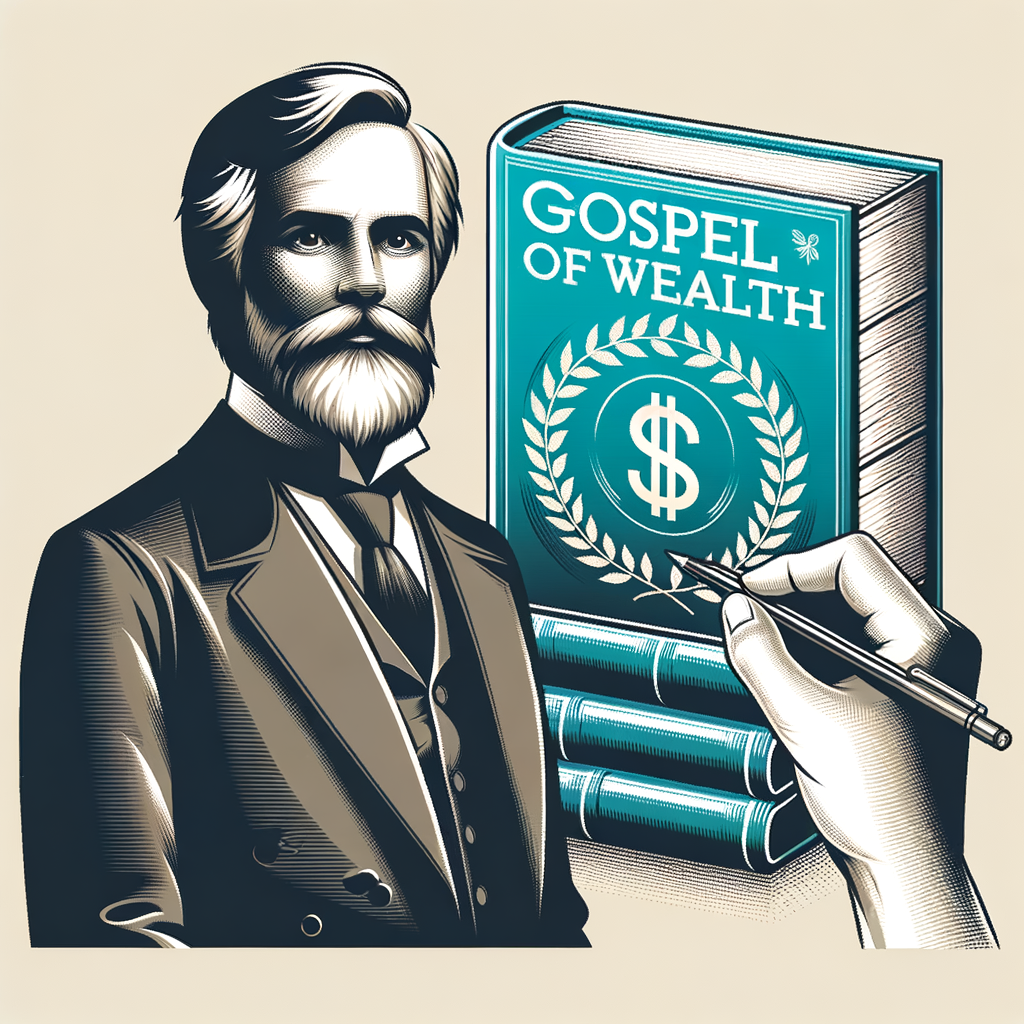
Andrew Carnegie, “The Gospel of Wealth” (1889)
Andrew Carnegie was a poor Scottish immigrant turned
millionaire who came to symbolize the opportunity for social mobility
that some call the American Dream. He formed the Carnegie Steel
Corporation and his profits from the steel industry made him one of
the wealthiest men in the United States. Also a noted philanthropist,
Carnegie gave away some $350 million mostly to build public libraries
and endow universities. In “Wealth” how does Carnegie depict
the wealthy and the responsibilities of being wealthy? How does he
depict the poor, and charity for the poor? Why?
This, then, is held to be the duty of the man of wealth: first, to
set an example of modest, unostentatious living, shunning display or
extravagance;… and after doing so to consider all surplus revenues
which come to him simply as trust funds, which he is… strictly
bound as a matter of duty to administer in the manner which, in his
judgment, is best calculated to produce the most beneficial results
for the community the man of wealth thus becoming the mere
agent and trustee for his poorer brethren, bringing to their service
his superior wisdom, experience, and ability to administer, doing for
them better than they would or could do for themselves….
Those who would administer wisely, must, indeed, be wise, for one
of the serious obstacles to the improvement of our race is
indiscriminate charity. It were better for mankind that the millions
of the rich were thrown into the sea than so spent as to encourage
the slothful, the drunken, the unworthy. Of every thousand dollars
spent in so-called charity today, it is probable that $950 is
unwisely spent; so spent, indeed, as to produce the very evils which
it proposes to mitigate or cure….
A well-known writer… admitted the other day that he had given a
quarter of a dollar to a man who approached him…. He knew nothing
of the habits of this beggar; knew not the use that would be made of
this money, although he had every reason to suspect that it would be
spent improperly…. The quarter-dollar given that night will
probably [injure more than it will help]…. [The donor] only
gratified his own feelings, saved himself from annoyance and
this was probably one of the most selfish and very worst actions of
his life….
In bestowing charity, the main consideration should be to help
those who will help themselves; to provide part of the means by which
those who desire to improve may do so; to give those who desire to
rise the aids by which they may rise; to assist…. Neither the
individual nor the race is improved by almsgiving. Those worthy of
assistance… seldom require assistance. The really valuable men of
the race never do…. He is the only true reformer who is as careful
and as anxious not to aid the unworthy as he is to aid the worthy…
in almsgiving more injury is probably done by rewarding vice than by
relieving virtue….
The best means of benefiting the community is to place within its
reach the ladders upon which the aspiring can rise parks… by
which men are helped in body and mind; works of art, certain to give
pleasure and improve the public taste… in this manner
returning their surplus wealth to the mass of their fellows in the
form best calculated to do them lasting good….
The man who dies leaving behind him millions of available wealth,
which was his to administer during life, will pass away “unwept,
unhonored and unsung”…. Of such of these the public verdict will
then be: “The man who dies thus rich dies disgraced.”
Such in my opinion is the true Gospel concerning Wealth, obedience
to which is destined some day to solve the problem of the Rich and
the Poor, and to bring “Peace on earth, among men good will.”
1. According to Andrew Carnegie, what are the duties of the man of
wealth?
2. How does Carnegie view charity? In what instances does Carnegie
believe that charity is most beneficial?
3. Why, according to Carnegie, are some people “worthy” of
charity and others “unworthy”?
Frequently Asked Questions
1. What is ‘The Gospel of Wealth’ by Andrew Carnegie?
‘The Gospel of Wealth’ is an essay written by Andrew Carnegie in 1889, where he articulates his philosophy on the responsibility of the wealthy to give back to society. Carnegie argues that those who accumulate substantial wealth should use it in a way that is beneficial to the community, outlining the idea that the rich have a moral obligation to redistribute their wealth in a manner that promotes the welfare and upliftment of the less fortunate. He believed in using wealth to create opportunities for individuals to improve themselves, rather than simply giving it away. This ideology stems from the notion that wealth should be considered a trust or stewardship, and should be administered responsibly to address inequalities and foster a better society.
2. How did Andrew Carnegie implement his ideas from ‘The Gospel of Wealth’ in his own life?
Andrew Carnegie practiced what he preached through extensive philanthropic activities throughout his lifetime. He was profoundly influenced by his own rise from poverty to immense wealth and felt a deep, personal responsibility to use his fortune for the greater good. Carnegie donated approximately $350 million, a significant portion of his wealth, to various causes. His most notable contributions include the establishment of public libraries, which offered free access to knowledge and education, thereby empowering the masses. He also endowed universities and supported scientific research, demonstrating his belief in education as a powerful tool for societal improvement. Furthermore, Carnegie founded the Carnegie Corporation of New York, the Carnegie Endowment for International Peace, and the Carnegie Institution for Science, all aimed at advancing human knowledge and promoting global understanding. These actions were direct reflections of his views expressed in ‘The Gospel of Wealth’.
3. Why did Andrew Carnegie believe that giving directly to individuals in need wasn’t the best approach to philanthropy?
Andrew Carnegie was a proponent of strategic philanthropy over simply handing out charity to individuals. He argued that direct almsgiving could perpetuate dependency and didn’t always lead to long-term positive change. Instead, he advocated for investments in institutions and infrastructure that would provide broader opportunities for self-improvement and empower individuals to support themselves. This approach was designed to address systemic issues and provided tools for personal development. For example, Carnegie poured resources into building libraries because access to books and information could help individuals educate themselves, thus enabling them to improve their own circumstances. Carnegie believed that philanthropy should aim to uplift society by creating sustainable and transformative outcomes, rather than providing mere temporary relief.
4. How did Andrew Carnegie’s own background influence his views in ‘The Gospel of Wealth’?
Andrew Carnegie’s background as a poor Scottish immigrant who rose to become one of the wealthiest men in America heavily influenced his views expressed in ‘The Gospel of Wealth’. Having experienced poverty firsthand, Carnegie understood both the hardships of the working class and the potential for social mobility when given opportunities. His ascent from a working-class family to a titan of industry exemplified the American Dream, and his writings reflect his belief in the transformative power of hard work, initiative, and access to resources. Carnegie acknowledged the role of luck and opportunity in his success, which fueled his sense of responsibility to create those opportunities for others. His philanthropy aimed to break down barriers for those who had talents and ambitions but lacked resources, which was a reflection of his understanding of the societal landscape he navigated personally.
5. What impact did ‘The Gospel of Wealth’ have on philanthropy and the approach to wealth distribution?
‘The Gospel of Wealth’ had a profound impact on the world of philanthropy by shifting the narrative on how wealth should be distributed and used for social good. It revolutionized the concept of philanthropy by suggesting that the wealthy should act as trustees of their wealth on behalf of the public. Since its publication, Carnegie’s principles have inspired generations of philanthropists to engage in strategic and responsible giving. This approach to philanthropy encourages not just giving, but giving with the purpose of creating lasting positive change, a concept that resonates in modern philanthropic practices. Organizations and wealthy individuals today often focus on tackling root causes of societal issues rather than merely addressing symptoms, which is indicative of Carnegie’s enduring influence. Funders like the Rockefeller Foundation, the Gates Foundation, and many others have adopted a strategic approach to philanthropy that reflects the principles Carnegie articulated over a century ago.