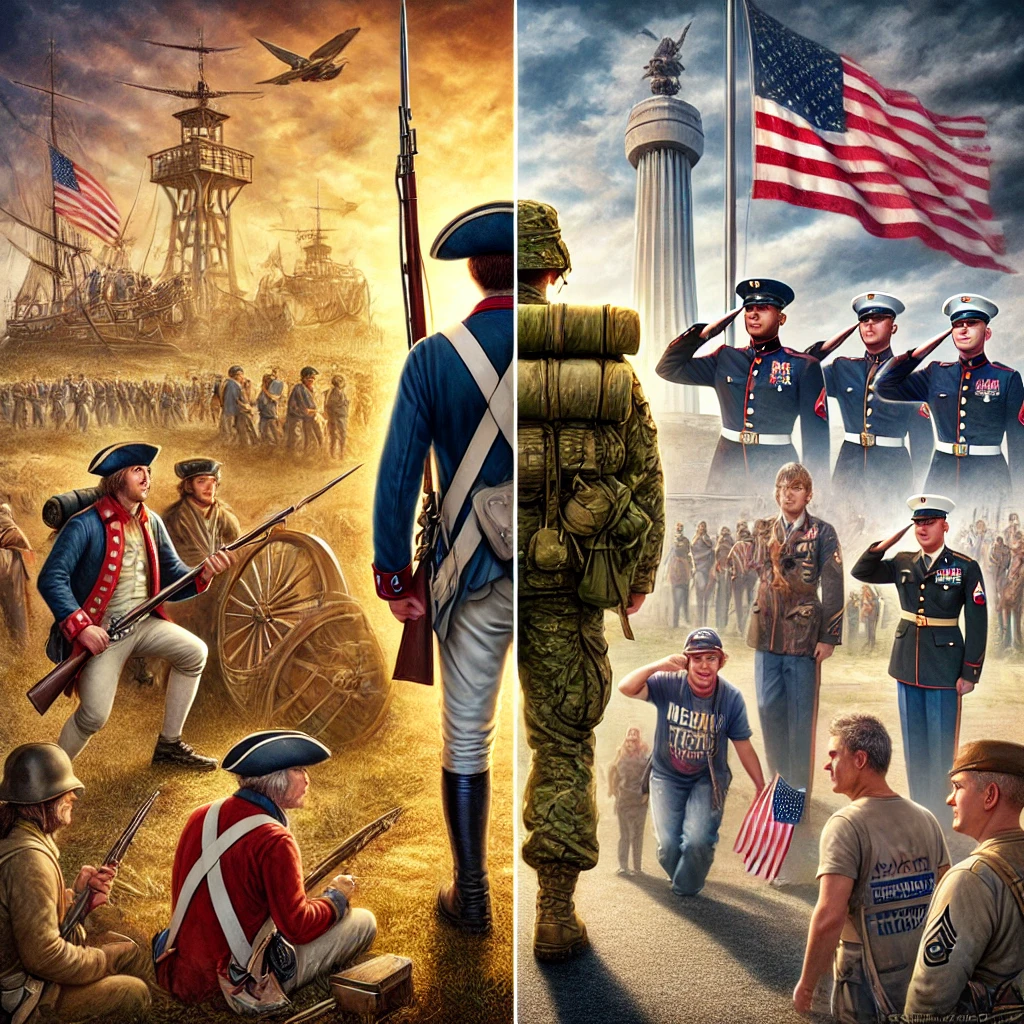
America’s relationship with its military has taken many turns over the centuries, shaped by wars, political movements, social change, and technological innovation. From the nation’s founding, when citizens viewed a standing army with suspicion, to the modern era, where service members are often held in high esteem, the public sentiment has constantly shifted. This evolution is closely tied to America’s changing global role, domestic priorities, and ideals of freedom and civic responsibility.
In the early days, most Americans saw a large standing army as a threat to liberty—an idea inherited from Europe’s history of militaristic monarchies. Over time, major wars demanded a powerful military presence, and a sense of national pride in American forces grew. However, controversies such as the Vietnam War revealed moments of distrust and division over military policy. Today, the U.S. Armed Forces stand as a volunteer force widely respected for its professionalism, yet the relationship between the public and the military continues to evolve as new challenges emerge. Let’s take a closer look at the major turning points in American history that have shaped this ever-changing dynamic.
Origins: The Revolutionary War
When the thirteen colonies declared independence from Britain in 1776, many colonists were wary of any permanent military structure. During the Revolutionary War, the Continental Army was formed out of necessity, but many Americans still favored relying on local militias. The young nation won its independence thanks, in large part, to the dedication of these citizen-soldiers, foreign allies like France, and visionary leaders such as George Washington.
Even after victory, the Founding Fathers debated the danger of maintaining a large peacetime army. Some argued it would threaten the democracy they had just fought to establish. As a result, the U.S. Constitution granted Congress the power to raise and support armies but required funding to be reauthorized every two years. This compromise showed how Americans wanted a military strong enough to defend freedom but not so powerful that it might undermine the rights of citizens. Thus, skepticism of standing armies shaped early American views, forging a reluctant acceptance of the necessity for some organized military force.
The War of 1812 and the Growth of Nationalism
A few decades after independence, the War of 1812 tested the young country’s ability to defend itself against British forces once again. Many in the government still believed small militias could handle most threats, but the conflict revealed the limitations of this approach. Despite setbacks, American forces managed to hold off the British, leading to a surge in patriotism.
This war also led to the “Star-Spangled Banner,” which remains a cornerstone of national identity. Americans began seeing their military less as a potential enemy of liberty and more as a source of pride capable of defending the nation’s interests. Still, there was no rush to create a massive standing army, and the U.S. continued relying on state militias and a relatively modest federal military. Yet, growing national confidence made the military a symbol of unity, at least in times of external threat.
The Civil War and the Transformation of the American Military
The Civil War (1861–1865) significantly altered America’s military landscape. The struggle between the Union and the Confederacy became the deadliest conflict in U.S. history. Both sides mobilized massive armies, and the scale of the war demanded new approaches to organization, logistics, and tactics. The sheer number of volunteers and draftees—along with advances in weapons technology—pushed the military to professionalize in ways previously unseen.
The Union’s victory not only preserved the nation but also reshaped how Americans viewed the federal government’s power, including the role of the U.S. Army. In the post-war period, the military took on responsibilities such as Reconstruction in the South, demonstrating its ability to project federal authority over the states. The draft was initially unpopular, fueling riots and unrest, but it also showcased the government’s willingness to compel service for the greater good. Over time, this large-scale mobilization and subsequent federal authority expanded the public’s sense of what the American military could—and sometimes should—do.

Expanding Influence: The Spanish-American War and Beyond
By the late 19th century, America had emerged as a growing industrial power with an expanding global presence. The Spanish-American War (1898) was a key moment when the U.S. used its military might overseas to acquire territories such as Puerto Rico, Guam, and the Philippines. This shift ignited debates about imperialism and the proper role of American forces abroad. Yet, many Americans were proud of these victories, seeing them as signs of the nation’s modern strength.
Following this era, the U.S. continued building its naval power, guided by thinkers like Alfred Thayer Mahan, who argued that a strong navy was essential for global influence. Americans began to expect their military to protect commercial interests and support diplomatic goals around the world. While some critics believed this was a betrayal of America’s anti-colonial roots, military involvement beyond national borders increasingly became part of the country’s identity as a player on the world stage.
World War I and Shifting Public Attitudes
When World War I broke out in 1914, the United States initially remained neutral. President Woodrow Wilson won re-election in 1916 on the slogan “He kept us out of war.” However, by 1917, German submarine warfare and other provocations brought the U.S. into the conflict. The government quickly raised a massive expeditionary force through conscription. Once again, Americans were called upon to serve in large numbers.
The war boosted patriotic fervor, but it also created divisions over free speech, civil liberties, and America’s global responsibilities. Propaganda campaigns built popular support for the troops, and returning veterans were generally hailed as heroes. Yet, after the war ended, many Americans grew disillusioned with overseas entanglements and retreated into a period of isolationism. The sense that the military should only be used for clear, direct threats to national security took hold, setting the stage for debates that would continue throughout the 20th century.
World War II: The Rise of a Superpower
World War II marked a major turning point in America’s military evolution. After the Japanese attack on Pearl Harbor in 1941, overwhelming public support surged behind the war effort. Millions of Americans enlisted or were drafted into the fight against the Axis powers. Women also served in new roles, such as the Women’s Army Corps, and worked on the home front in factories, producing ships, planes, and tanks to support the war.
By the war’s end, the United States emerged as an economic and military superpower. The success of the American military effort became a source of enormous pride, forging what has sometimes been referred to as “The Greatest Generation.” The G.I. Bill and various veterans’ benefits programs further cemented the military’s positive role in society, offering returning service members opportunities for education, home ownership, and entrepreneurship. This period saw the U.S. public largely unified in reverence for the military’s contributions to defeating totalitarian regimes and establishing a new global order.
The Cold War and the Military-Industrial Complex
After World War II, the geopolitical tension between the U.S. and the Soviet Union shaped American life for nearly half a century. The government massively expanded the Pentagon’s budget to contain the spread of communism. President Dwight D. Eisenhower, himself a celebrated World War II general, warned of the growing “military-industrial complex,” referring to the powerful alignment of the defense industry and the armed forces.
Nevertheless, many Americans accepted this military buildup as a necessary shield against Soviet aggression. Advances in nuclear weapons led to a delicate balance of power known as “Mutually Assured Destruction,” which influenced everything from foreign policy to schoolchildren’s “duck and cover” drills. While the Cold War era made the military a constant presence in national conversations, it also created anxiety about the arms race, the draft, and the possibility of global nuclear war. The U.S. public generally supported a strong defense but remained concerned about military overreach and the potential for foreign conflicts, laying the groundwork for the divisions that would erupt during the Vietnam War.
Vietnam War and the Shift in Public Opinion
The Vietnam War became a turning point in how Americans viewed their government and their military. Unlike World War II, the conflict in Southeast Asia was not universally supported. The draft once again swept countless young Americans into service, but this time, large segments of the public questioned the rationale for fighting so far from home. Nightly television reports brought the war’s brutality into living rooms, fueling anti-war sentiment. Protests on college campuses and in major cities reflected deep divisions.
As the war dragged on, trust in government figures declined, particularly after events like the Tet Offensive and revelations about the My Lai Massacre. Vietnam veterans often returned home to a fractured society, receiving far less support or respect than previous generations of service members. This period stained the military’s reputation in some circles and led to a broader conversation about accountability, transparency, and the moral weight of warfare. For many Americans, Vietnam was a lesson in questioning why and how military force is used.
The All-Volunteer Force and Post-Cold War Conflicts
In 1973, the draft ended, and the United States moved to an all-volunteer military. This shift changed how the public interacted with the armed forces, as far fewer families were directly affected by recruitment in times of peace. Some people worried this would create a disconnect, separating military service from everyday American life. Others believed an all-volunteer force would be better trained, more motivated, and more professional.
When the Cold War ended in the late 1980s, U.S. military involvement took new forms, including humanitarian missions and short interventions in places like Grenada and Panama. The Gulf War of 1991 saw widespread public support, boosted by clear goals and swift victory. But as the 1990s progressed, debates about the use of force in places like Somalia and the Balkans reflected continuing questions about America’s role as a global police force. Overall, the professional, volunteer military remained popular with many Americans, even if they disagreed about specific operations abroad.
War on Terror and the Modern Era
The terrorist attacks of September 11, 2001, fundamentally changed the country’s outlook. The U.S. launched a “War on Terror,” beginning with the invasion of Afghanistan to topple the Taliban, followed by the 2003 invasion of Iraq. In the immediate aftermath of 9/11, public support for the military soared, and recruitment spiked. Flags adorned porches nationwide, and service members were often hailed as heroes upon their return.
However, as the conflicts dragged on, the American public grew wary of extended deployments, rising casualties, and unclear end goals. Discussions about treatment for veterans with physical injuries and post-traumatic stress disorder highlighted the burden carried by a relatively small segment of the population. Meanwhile, controversies over intelligence failures, questions about the existence of weapons of mass destruction in Iraq, and debates over military tactics revealed the complexity of sustaining public support. Still, even amid disagreements, respect for individual service members remained high.
Contemporary Challenges and Public Perceptions
Today, the United States maintains one of the world’s most powerful and technologically advanced militaries. While polls often show that the military is among the most trusted public institutions, there are ongoing challenges. Some Americans worry about the nation’s defense budget, which far exceeds that of most other countries combined. Others question the sustainability of frequent interventions around the globe.
Cybersecurity and emerging technologies also pose new threats and dilemmas, requiring a shift in how the military operates and how much it invests in innovation. On the home front, service members’ mental health and the cost of veterans’ care have become focal points of public debate, reflecting a renewed recognition that supporting the troops goes beyond bumper stickers and parades. The public generally wants to ensure service members receive proper resources, but opinions vary on how and where the military should be deployed.
Women, Minorities, and Diversity in the Armed Forces
Over time, America’s armed forces have evolved in terms of representation as well. Historically, African Americans served in segregated units until President Harry S. Truman desegregated the military in 1948. Today, African Americans, Latinos, Asian Americans, and other minorities play crucial roles in all branches, reflecting the country’s diversity.
Women also serve at high levels, including in combat roles that were previously closed off. From nurses in World War I to modern-day fighter pilots and generals, women’s expanding participation has reshaped the military’s culture and the public’s perception of who can serve. These changes mirror broader social movements, as the military has often been a testing ground for integration policies that eventually spread to civilian society. Still, challenges around discrimination, harassment, and equal opportunities persist, fueling ongoing discussions about making the armed forces more inclusive.
Looking Ahead
The future of America’s relationship with its military will likely hinge on balancing national security needs with public sentiment. In an age when threats are both traditional (like military aggression) and unconventional (like cyberattacks and terrorism), defining the mission of the U.S. Armed Forces is more complex than ever. The all-volunteer system appears to be here to stay, but questions remain about potential recruitment shortfalls and how to fairly compensate and care for those who serve.
Technological advancements—from drones to artificial intelligence—raise moral and ethical questions regarding warfare. How will Americans respond when machines, rather than human soldiers, carry out critical missions? Additionally, as domestic issues such as economic inequality, healthcare, and climate change gain attention, policymakers and the public may debate whether to shift resources away from military spending. Finding the right balance between readiness, restraint, and responsibility will continue to shape the nation’s evolving relationship with those in uniform.
Conclusion
Since the earliest days of the Republic, Americans have wrestled with the tension between liberty and security. The Founding Fathers worried about the dangers of a large standing army, yet history has shown that the country often needs robust military power. From the War of 1812, which bolstered national pride, to the Civil War, which forced the military into a transformative role, each conflict highlighted new dimensions of the relationship between the armed forces and the public.
World War I and World War II established the U.S. as a global power, solidifying public respect for service members and spurring initiatives like the G.I. Bill. The Cold War ushered in continuous military readiness, but also heightened concerns about unchecked defense spending and potential government overreach. The Vietnam War stands out as a moment of profound distrust and societal upheaval, illustrating the stark divide that can occur when the purpose and execution of military action are called into question. In contrast, the post-9/11 years often saw strong support for the troops, even amid debates over the length and purpose of overseas conflicts.
Today, the military garners significant respect, though opinions differ on budget priorities and the scope of foreign engagements. Debates persist about whether America’s armed forces should act primarily in a defensive capacity or continue in a proactive global leadership role. Diversity, inclusion, technology, and care for veterans remain pressing topics. No matter how these discussions evolve, one thing is clear: the relationship between the American people and their military is complex, constantly shaped by current events, and deeply rooted in the nation’s ideals of freedom and democracy. As the world changes, so too will the ways Americans perceive, support, and challenge those who wear the uniform.
Frequently Asked Questions
1. How did America’s early settlers view a standing army, and why?
America’s early settlers, deeply influenced by their experiences and history under British rule, were generally suspicious of a standing army. Having seen such forces used as instruments of oppression in the old world, they feared that a permanent military could be a threat to the freedoms they cherished. This distrust was reflected in the Second Amendment to the U.S. Constitution, which emphasizes the importance of well-regulated militias over a large, centralized federal army. Essentially, these early Americans were wary of concentrated military power outside civilian control, preferring to maintain military forces that were citizen-based and temporary, summoned only in times of need.
2. How did the perception of the military change after the American Revolution?
Following the Revolutionary War, public perception of the military began to shift, albeit gradually. Initially, there remained a strong distrust of maintaining a large standing army. However, the heroism and strategic importance of the Continental Army during the Revolution established a new level of respect for military service. As the newly founded nation faced external threats and internal instabilities, like Shays’ Rebellion, there was a growing recognition of the need for a reliable military presence. Over time, this contributed to an acceptance of a small peacetime army, though larger forces were typically mobilized only during times of conflict.
3. What was the impact of the Civil War on America’s military evolution?
The Civil War was a pivotal moment in the evolution of the American military, fundamentally altering its structure and public perception. The scale of the war required both Union and Confederate forces to raise vast armies, which in turn led to unprecedented levels of government involvement in military affairs and the professionalization of forces. New military technologies emerged, such as ironclad ships and rifled muskets, which prompted further changes in tactics and organization. The successful Union strategies, often executed by a core of professional officers, validated the need for a standing army that could respond rapidly and effectively in large-scale conflicts, paving the way for a more robust and permanent military establishment in peacetime.
4. How did the World Wars contribute to the modernization of the U.S. military?
The two World Wars were crucial in modernizing the U.S. military, transforming it into one of the most powerful forces globally. During World War I, the U.S. military had to rapidly expand from a small pre-war force to millions of soldiers. This necessitated advancements in logistics, training, and technology. The nature of modern warfare, including aerial and chemical warfare, required new tactical and strategic thinking. By World War II, the U.S. had developed into a global military power, utilizing innovations like aircraft carriers and strategic bombing. The war effort also catalyzed industrial and technological innovation, leading to the development of crucial wartime technologies, such as radar and the atomic bomb, solidifying America’s global military stance.
5. What role does technology play in America’s modern military strategy?
Technology is at the heart of America’s modern military strategy, influencing every aspect from battlefield tactics to logistics and intelligence. Advanced technology enables the U.S. military to maintain a strategic advantage and effectively respond to a wide range of threats. For example, the development of precision-guided weapons allows for highly targeted operations that minimize collateral damage. Technologies such as drones and cyber warfare capabilities have transformed how the military conducts reconnaissance and engages in combat. Moreover, the integration of real-time data and artificial intelligence in military operations has enhanced decision-making processes and operational efficiency. These technological advancements ensure that the American military remains a dominant, flexible force capable of addressing both traditional and unconventional threats.