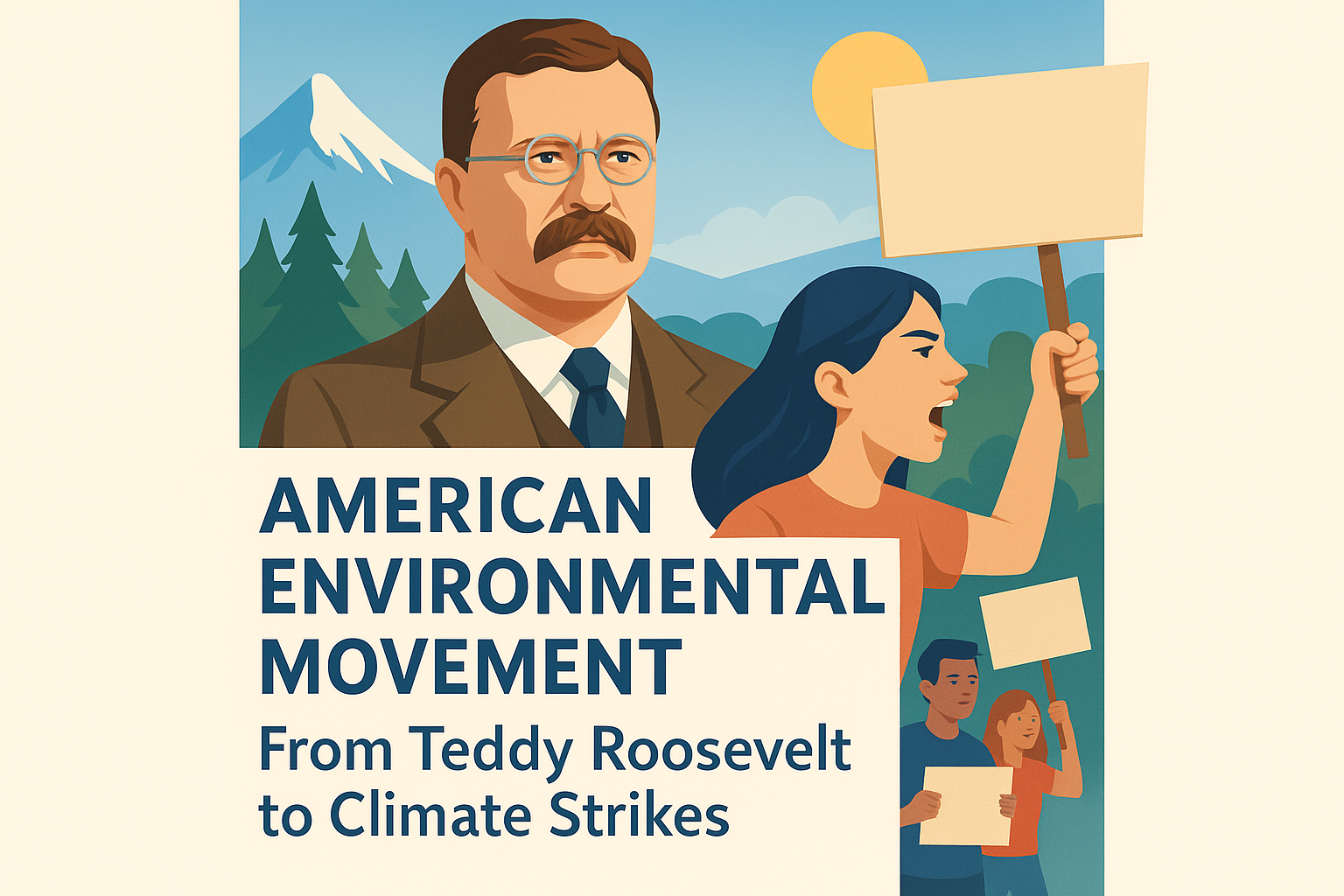
The American environmental movement has evolved significantly over the past century, from early conservation efforts to today’s global climate strikes. It is a dynamic narrative where policy, public activism, and scientific understanding have merged to address pressing ecological challenges. This movement holds significance as it influences both national policy and grassroots initiatives, which aim to mitigate the impending threats of environmental degradation and climate change. Key terms in understanding this movement include conservation, preservation, sustainability, and climate activism.
Conservation refers to the sustainable management of natural resources to prevent their exploitation or destruction. Preservation focuses on protecting nature from human use. Sustainability emphasizes meeting present needs without compromising future generations’ ability to meet theirs. Climate activism is the effort to promote policies and practices aimed at reducing the impact of climate change. Recognizing the importance of the environmental movement is crucial, as our survival and the preservation of Earth’s ecosystems depend on these collective efforts.
The Birth of a Movement: Early 20th Century Conservation
The environmental movement in America can be traced back to the early 1900s, with President Theodore Roosevelt’s robust advocacy for conservation. Known as the “Conservation President,” Roosevelt established major national parks, forests, and monuments, believing that America’s natural beauty was a resource to be protected for future generations. His policies were instrumental in transforming the nation’s approach to natural resources.
Roosevelt’s push for conservation laid the foundation for the U.S. Forest Service in 1905, emphasizing sustainable yield forestry. His initiatives highlighted the need for scientific management of public lands, a groundbreaking shift from the exploitative practices of the past. A real-world example of Roosevelt’s conservation efforts is the creation of Yellowstone National Park, a protected area that continues to serve as a testament to early conservationist ideals.
Mid-Century Escalation: The Rise of Environmental Awareness
Following the early conservation efforts came an era of increased environmental awareness in the mid-20th century. This period was marked by Rachel Carson’s seminal book, “Silent Spring,” published in 1962. Carson’s work brought to light the detrimental effects of pesticides on the environment, particularly on bird populations, and galvanized public opinion against unsustainable chemical practices.
The impact of “Silent Spring” was profound, leading to policy changes such as the banning of DDT in the U.S. and the formation of the Environmental Protection Agency (EPA) in 1970. The creation of Earth Day in the same year further underscores this period’s heightened environmental consciousness. These events reflected a growing recognition of human activities’ impact on the planet.
Legislation and Policy: Environmental Protection as a National Priority
The 1970s marked a significant shift in environmental policy, driven by legislative action. The introduction of landmark laws such as the Clean Air Act, the Clean Water Act, and the Endangered Species Act exemplified the era’s commitment to preserving natural resources and protecting human health.
These legislative milestones came in response to increased scientific data on pollution and its effects. For instance, the Clean Air Act helped reduce air pollution levels significantly, leading to improved public health outcomes. The legislative framework laid during this era set the stage for more comprehensive environmental policies that persist today.
| Legislation | Year | Impact |
|---|---|---|
| Clean Air Act | 1970 | Reduced air pollution, improved health outcomes |
| Clean Water Act | 1972 | Regulated pollutant discharges, protected water bodies |
| Endangered Species Act | 1973 | Protected threatened and endangered species |
The Late 20th to Early 21st Century: Globalization and Climate Action
As globalization expanded, environmental issues became a global concern. The late 20th and early 21st centuries witnessed increased international collaboration on climate change, particularly with agreements like the Kyoto Protocol in 1997 and the Paris Agreement in 2015. These agreements highlighted the global consensus on addressing climate change through shared responsibility and action.
A significant real-world example is the United States’ involvement in the Paris Agreement, where countries committed to limit global warming to well below 2 degrees Celsius compared to pre-industrial levels. This period also saw the emergence of the Intergovernmental Panel on Climate Change (IPCC), which provides comprehensive assessments of climate science to inform policy decisions worldwide.
The Present Day: Climate Strikes and Youth Activism
In recent years, the environmental movement has reached new heights with the rise of climate strikes and youth activism, primarily driven by figures like Greta Thunberg. This new wave of activism emphasizes the urgent need for transformative policies to combat climate change.
Real-world events, such as the global climate strikes initiated by Thunberg, illustrate the power and reach of grassroots activism. In September 2019, millions of people across the globe participated in climate strikes, demanding action from political leaders. These strikes reflect the increasing frustration and impatience of younger generations facing the looming threat of climate change.
Youth activism highlights the intergenerational aspect of environmental advocacy, where younger generations are demanding immediate action to ensure a sustainable future. This movement has reinvigorated discussions around sustainable practices, renewable energy adoption, and the necessity of rapid systemic change.
Conclusion: Converging Paths Toward a Sustainable Future
The American environmental movement has come a long way since Theodore Roosevelt’s conservation efforts, evolving through various phases of awareness, policy, and activism. From early 20th-century conservation initiatives to modern climate strikes, the movement underscores the American commitment to preserving the environment and addressing climate change.
The key takeaway from this narrative is the continuous evolution of environmental consciousness, shaped by policy, pioneering individuals, and grassroots movements. As we move forward, it is crucial for citizens, policymakers, and global leaders to work collaboratively towards a sustainable future.
As individuals interested in supporting environmental causes, we can start by staying informed, reducing our carbon footprint, and supporting policies and initiatives that promote sustainability. Joining local environmental groups and participating in climate action events can also help bolster collective efforts toward a healthier planet.
The continuous engagement and commitment to this movement will be instrumental in addressing the challenges posed by climate change and achieving a sustainable future for generations to come.
Let’s take action today for a better tomorrow.
Frequently Asked Questions
1. How did the American environmental movement start with Teddy Roosevelt?
The American environmental movement can trace its roots back to the early 20th century with President Teddy Roosevelt, who was a formidable advocate for conservation. Roosevelt recognized the need to preserve America’s natural resources and beauty for future generations, which was revolutionary at the time. He used his presidential powers to establish the United States Forest Service and signed into law the creation of five National Parks, 18 National Monuments, and 150 National Forests, encompassing roughly 230 million acres of public land.
Roosevelt’s love for the outdoors and understanding of ecological balance instigated the federal protection of wildlife and their habitats. One of his significant achievements was the signing of the Antiquities Act of 1906, which allowed the president to designate national monuments, often seen as a way to bypass Congress to protect land. Through this act, Roosevelt laid down a legacy of environmental stewardship, setting a precedent for future advocacy and policy-making in environmental protection. His passion for conservation highlighted the importance of maintaining natural landscapes against the backdrop of the Industrial Revolution’s rapid expansion and exploitation of resources.
2. What were the significant milestones in the American environmental movement from Roosevelt’s era to the late 20th century?
From Roosevelt’s foundational steps in the early 1900s, the American environmental movement expanded significantly over the decades, marked by several pivotal milestones. In the 1960s, awareness about environmental challenges heightened with Rachel Carson’s seminal book, “Silent Spring,” published in 1962. Carson’s work exposed the dangers posed by pesticides, particularly DDT, galvanizing public interest and concern about the impact of chemicals on ecosystems and human health.
In 1970, Earth Day was celebrated for the first time, bringing significant visibility to environmental issues and leading to the establishment of the Environmental Protection Agency (EPA). This decade also saw the introduction of key legislation like the Clean Air Act, Clean Water Act, and the Endangered Species Act, which laid a robust legal framework for environmental protection.
The late 20th century continued to build upon these efforts with the growing scientific consensus on climate change. The inauguration of the World Climate Conference in 1979 and the establishment of the Intergovernmental Panel on Climate Change (IPCC) in 1988 marked significant steps towards global recognition and action against climate change—spurring further policy development within the United States and beyond.
3. How have grassroots initiatives influenced the environmental movement in America?
Grassroots initiatives have played a critical role in advancing the American environmental movement by mobilizing local communities, raising awareness, and pushing for policy changes from the ground up. These initiatives often begin at the local level, tackling community-specific environmental issues, such as pollution, waste management, conservation, and sustainable practices, and they can scale to influence national and even global environmental policy.
One of the key successes of grassroots movements is their ability to engage diverse groups of people, fostering a sense of community ownership and responsibility for environmental issues. Notable examples include the efforts to clean up local rivers and protect endangered species, which have led to wider policy changes and conservation efforts across state and national levels. The increased accessibility to information technology and social media has further empowered these movements, enabling organizers to quickly disseminate information, recruit volunteers, and advocate for policy changes.
Moreover, these initiatives are often driven by advocacy against large industrial interests or questionable governmental policies, challenging them through protests, legal actions, and public campaigns. This local advocacy not only galvanizes public opinion but also pressures governmental and corporate decision-makers to adopt greener policies, ultimately leading to broader systemic changes.
4. How has scientific understanding shaped the environmental movement?
Scientific understanding and research have been at the forefront of the environmental movement, providing crucial data, analysis, and forecasts that shape both public perception and policy-making. As early as Rachel Carson’s “Silent Spring,” which relied heavily on scientific findings to communicate the implications of pesticide use, science has been a powerful tool for illustrating the need for environmental protection and regulation.
With advances in climate science and ecology, the movement gained substantial evidence to support the narratives around biodiversity, ecosystem services, and climate change. Comprehensive assessments from bodies like the IPCC have crystalized the debate by providing irrefutable evidence of human-induced climate change and its potential catastrophic effects.
Scientific research has been instrumental in identifying the sources and impacts of pollution, such as greenhouse gases and plastics, resulting in more targeted environmental policies and international agreements. It also aids in developing new technologies and methods for reducing human ecological impact, such as renewable energy sources and energy efficiency measures.
Furthermore, science serves as a crucial bridge between the environmental movement and policy-makers, offering clear and actionable data to inform regulatory measures, international agreements, and sustainable development agendas.
5. What is the significance of global climate strikes within the context of the American environmental movement?
Global climate strikes, notably catalyzed by youth movements like Fridays for Future led by Greta Thunberg, have brought unprecedented dynamism to the environmental movement worldwide, including in America. These strikes symbolize a powerful resurgence and transformation of grassroots advocacy into a global phenomenon, raising consciousness about climate change issues and demanding urgent action from governments and industries.
In the context of the American environmental movement, climate strikes underscore a shift in the demographic and cultural dynamics of activism. They emphasize the younger generation’s growing anxiety about the future and their demand for accountability and immediate action to mitigate the impacts of climate change. These strikes foster intergenerational dialogue and emphasize that climate change is not an isolated environmental issue but one intricately linked to social justice, economic instability, and national security.
The mass mobilization of people across the world through climate strikes has substantial political implications, influencing public opinion, electoral platforms, and policy agendas. They serve as a disruptive force, reminding stakeholders of the electorate’s growing concern for the climate crisis and the urgency for legislative and executive actions to avert environmental disasters. The strikes have been fundamental in pressuring governments, including the United States, to take more meaningful steps toward reducing carbon emissions and transitioning to a sustainable economy.