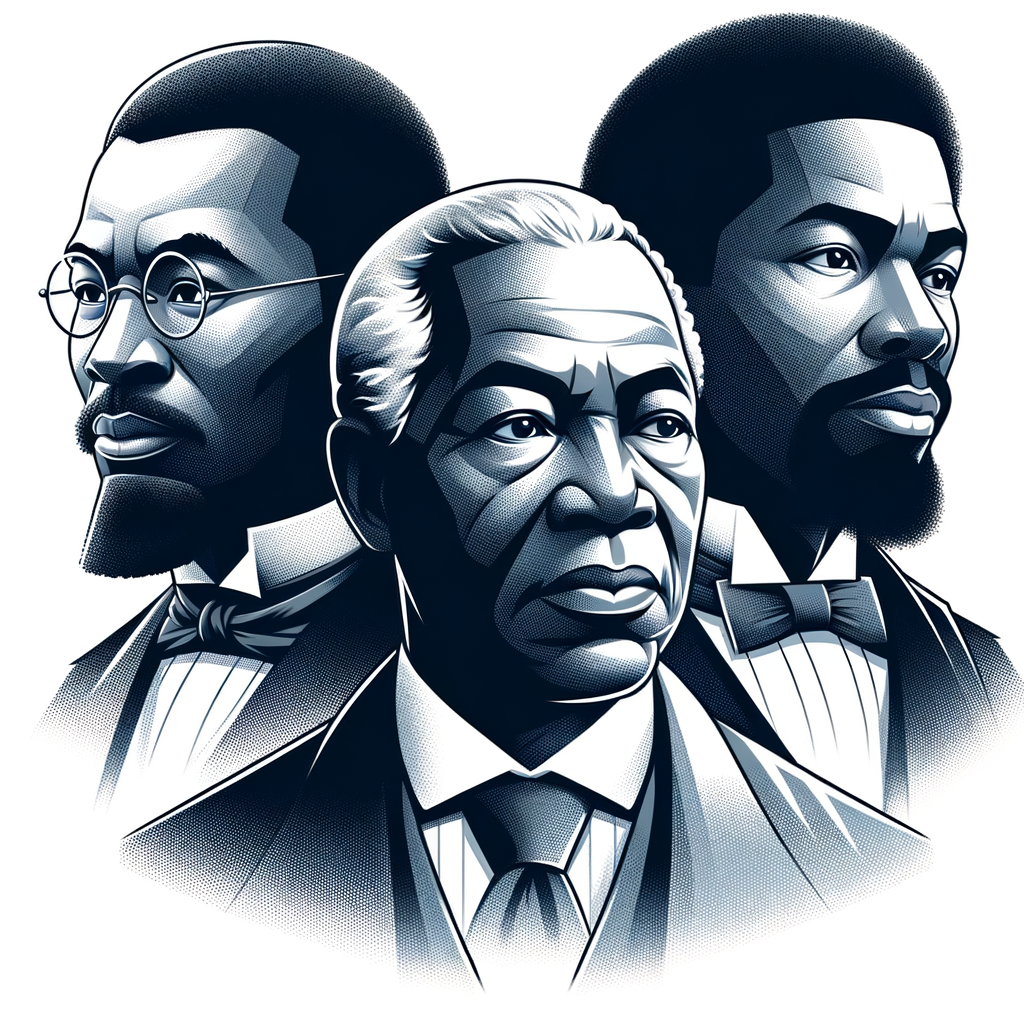
African Americans at the Turn of the Century
As America entered the turn of the
century much attention was given to the plight of those living in the
industrial north. Writers, photographers and journalists exposed the
dark side of industrial urbanism. These activists, called muckrakers
by President Theodore Roosevelt, were the warriors in a battle to
reform America. These efforts at reform met with great success. From
1900 to 1917 America experienced great political and social reform.
From the leadership of Presidents like Roosevelt and Woodrow Wilson
and Governors such as Robert LaFollette of Wisconsin to private
citizens like Jane Addams. The spirit of progress swept through
America. But it did not sweep south.
The Progressive Movement was centered
in northern industrial cities and the problems inherent in that
environment. The problems of African Americans, known then as
Negroes, seemed distant. African Americans toiled in the darkness of
discrimination while white America looked on. The Supreme Court,
given the opportunity to address the evils of Jim Crow failed to do
so. Plessy v Ferguson, established “separate but equal” as the legal
precedent thus ensuring years of de Juris segregation. Attempting to
escape the discrimination of the south many African American migrated
north. Segregation, de Juris and de facto followed them. “Negro” and
“Colored” schools and neighborhoods created a system of continuing
discrimination and in opportunity. Clearly the progressives did not
include the Negro in their plight.
There arose many who would stand up
against the injustice and the inhumanity. Among these were W.E.B. Du
Bois, Booker T. Washington and Marcus Garvey.
Booker T.
Washington
(1856-1915), American educator,
who urged blacks to attempt to
uplift themselves through educational attainments and economic
advancement.
Washington was born April 5, 1856, on
a plantation in Franklin County, Virginia, the son of a slave.
Following the American Civil War, his family moved to Malden,
W.Virginia, where he worked in a salt furnace and in coal mines,
attending school whenever he could. From 1872 to 1875 he attended a
newly founded school for blacks, Hampton Normal and Agricultural
Institute (now Hampton University). After graduation he taught for
two years in Malden and then studied at Wayland Seminary, in
Washington, D.C. In 1879 he became an instructor at Hampton
Institute, where he helped to organize a night school and was in
charge of the industrial training of 75 Native Americans. The school
was so successful that in 1881 the founder of Hampton Institute, the
American educator Samuel Chapman Armstrong, appointed Washington organizer and principal
of a black normal school in Tuskegee, Alabama (now Tuskegee
University). Washington made the institution into a major center for
industrial and agricultural training and in the process became a
well-known public speaker.
On September 18, 1895, in Atlanta,
Georgia, Washington made his famous compromise speech. In this
address he urged blacks to
accept their inferior social position for the present and to strive
to raise themselves through vocational training and economic
self-reliance. Many whites,
pleased by his views, and many blacks, awed by his prestige, accepted
Washington as the chief spokesperson of the American black. More
militant blacks, such as the American writer and sociologist
W. E. B. Du Bois, objected to
such quiescent tactics, however, and strongly opposed
Washington.
Washington founded several
organizations, including the National Negro Business League, to
further black advancement. He died on November 14, 1915, at Tuskegee.
Among his books are The Future of the American Negro (1899), the
autobiography Up from Slavery (1901), Life of Frederick Douglass
(1907), The Story of the Negro (1909), and My Larger Education
(1911). The site of the plantation where Washington was born is now a
national monument.
71
W.E.B. Du
Bois
(1868-1963), American writer and
sociologist, who helped found
the National Association for the Advancement of Colored People
(NAACP).
Du Bois was born on February 23,
1868, in Great Barrington, Massachusetts, and educated at Fisk and
Harvard universities and the University of Berlin. In 1895 he became
the first black to be awarded a Ph.D degree from Harvard. He taught
history and economics at Atlanta University from 1897 to 1910. In
1903, in his famous book The
Souls of Black Folk,
Du Bois charged that
Washington’s strategy, rather than freeing the black man from
oppression, would serve only to perpetuate it. Du Bois, as an ardent
advocate of complete racial equality, discounted Washington’s views of blacks as a
minority in a white society.
This attack crystallized the opposition
to Booker T. Washington among many black intellectuals, polarizing
the leaders of the black community into two wings–the “conservative”
supporters of Washington and his “radical” critics. Although originally Du Bois had believed that
social science could provide the knowledge to solve the race problem,
he gradually came to the conclusion that in a climate of virulent
racism, expressed in such evils as lynching, peonage,
disfranchisement, Jim Crow segregation laws, and race riots, social
change could be accomplished only through agitation and
protest.
After the founding of the NAACP in 1910,
Du Bois served as the association’s director of publications
(1910-32) and as the editor of The Crisis, the official organ of the
NAACP. In 1926 he visited the
Soviet Union and thereafter became increasingly convinced that
advancement of American blacks could best be achieved through
socialism. In 1934, having
left the NAACP, Du Bois returned to teach at Atlanta University; he
also served (1940-44) as editor of the university’s quarterly Phylon.
In 1944 he again joined the staff of the NAACP, as director of the
department of special research; he remained with the organization
until 1948. Du Bois, increasingly involved in the promotion of world
peace and nuclear disarmament, became chairman of the Peace
Information Center in New York City in 1950, but the next year the
organization was declared subversive by the U.S. government. During
the 1950s he traveled extensively in Eastern Europe. Awarded the 1959
Lenin Peace Prize, Du Bois joined the Communist party in 1961 and
settled in Ghana later the same year. Shortly before his death in
Accra, on August 27, 1963, he became a citizen of Ghana. At the time
of his death Du Bois was engaged in editing the Encyclopedia
Africana.
Du Bois wrote some 20 books,
including The Philadelphia Negro (1899), Black Reconstruction (1935),
and a trilogy, Black Flame: The Ordeal of Mansart (1957), Mansart
Builds a School (1959), and Worlds of Color (1961).
Marcus
Garvey
(1887-1940), black nationalist leader, who created a “Back
to Africa” movement in the United States.
Garvey was born the youngest of 11
children in Saint Ann’s Bay, Jamaica. He left school at the age of 14
to serve as a printer’s apprentice. A few years later, he took a job
at a printing company in Kingston, where in 1907 he led a printer’s
strike for higher wages. Garvey then traveled to South America and
Central America. In 1912 he went to England, where he became
interested in African history and culture. He returned to Jamaica in
1914 and shortly thereafter founded the Universal Negro Improvement
Association (UNIA) and the African Communities League.
In 1916 Garvey moved to the United
States and settled in New York City. There he incorporated the UNIA
and started a weekly newspaper, the Negro World. A persuasive orator and author, Garvey urged
American blacks to be proud of their race and preached their return
to Africa, their ancestral homeland. To this end he founded the Black Star Line in
1919 to provide steamship transportation, and the Negro Factories
Corporation to encourage black economic independence. Garvey
attracted thousands of supporters and claimed two million members for
the UNIA. He suffered a series
of economic disasters, however, and in 1922 he was arrested for mail
fraud. Garvey served as his own defense attorney at his trial, was
convicted, and went to prison in 1925. His sentence was commuted two
years later, but he was immediately deported to
Jamaica. Unable to resurrect
the UNIA or regain his influence, Garvey moved to London, where he
died in relative obscurity.
Frequently Asked Questions
1. Who were some prominent African American reformers at the turn of the century?
At the turn of the century, African American reformers played pivotal roles in advocating for civil rights and social justice. Noteworthy figures included W.E.B. Du Bois, a sociologist and historian who co-founded the NAACP and was a leader in the fight against racial discrimination. Another significant figure was Booker T. Washington, an educator and author who promoted vocational training and economic self-reliance among African Americans. Ida B. Wells-Barnett was a fierce journalist and activist who led anti-lynching campaigns and highlighted racial injustices in the South. Mary Church Terrell, as one of the first African American women to earn a college degree, was a tireless advocate for education and women’s rights. These individuals and others worked tirelessly to expose inequalities and push for reforms, shaping the discourse on race and justice in America.
2. What challenges did African American reformers face during this period?
African American reformers at the turn of the century encountered significant obstacles in their quest for social justice. Segregation laws, often referred to as Jim Crow laws, institutionalized racial discrimination and denied African Americans equal access to public facilities, education, and employment opportunities. These laws were further reinforced by the 1896 Supreme Court decision in Plessy v. Ferguson, which upheld the doctrine of “separate but equal.” Additionally, African Americans faced widespread disenfranchisement due to literacy tests, poll taxes, and other discriminatory practices designed to suppress their voting rights. Socially, African American reformers were often met with hostility and violence, including lynchings and race riots, which sought to intimidate and silence those advocating for change. Despite these formidable barriers, reformers persisted, employing a variety of strategies ranging from grassroots organizing to litigation and lobbying.
3. What were the main goals of African American reformers during the early 20th century?
At the heart of their efforts, African American reformers at the turn of the century aimed to achieve civil rights, social equality, and economic opportunities. One of their primary goals was to dismantle the pervasive Jim Crow laws that enforced racial segregation and discrimination. They sought to secure voting rights, which were systematically denied through discriminatory practices across the Southern states. Reformers also focused on improving educational opportunities for African Americans, advocating for access to quality education as a means of empowerment and upward mobility. Economic advancement was another key objective, with reformers pushing for fair labor practices, the establishment of black-owned businesses, and vocational training. Beyond these tangible goals, African American reformers endeavored to shift public perception by challenging prevailing racial stereotypes and highlighting the contributions of African Americans to American society and culture.
4. How did African American reformers contribute to the broader Progressive Era reform movements?
African American reformers were integral to the Progressive Era reform movements, advocating for social change alongside their white counterparts. While much of the Progressive movement focused on addressing issues like labor rights, women’s suffrage, and political corruption, African American reformers brought attention to racial injustice and inequality. They highlighted the intersectionality of race and class, emphasizing how economic and social reforms must include racial dimensions to be truly impactful. Reformers like Ida B. Wells-Barnett collaborated with white allies such as social worker Jane Addams to address shared goals, including anti-lynching campaigns and educational reform. Moreover, African American reformers established their own organizations, like the National Association for the Advancement of Colored People (NAACP), which became key players in the broader reform landscape. Their activism forced broader Progressive movements to confront and address racial issues, expanding the scope and depth of reforms during this pivotal era.
5. In what ways did the efforts of African American reformers at the turn of the century lay the groundwork for future civil rights movements?
The efforts of African American reformers during the early 20th century set invaluable precedents that laid the foundation for future civil rights movements. These reformers established critical organizations, like the NAACP, which would become instrumental in later civil rights advocacy and litigation efforts, including the landmark case of Brown v. Board of Education in 1954. Their advocacy for voter rights laid the groundwork for the Voting Rights Act of 1965, and their continuous fight against segregation set the stage for the Civil Rights Act of 1964. By emphasizing education, African American reformers opened doors for greater access to academic institutions, contributing to the rise of a new generation of educated African American leaders. Additionally, the tactics and strategies developed during this period, including non-violent protest, grassroots organizing, and legal challenges, would be adopted and expanded by the civil rights leaders of the 1950s and 1960s. The legacy of early 20th-century African American reformers is evident in the continued struggle for racial equality and serves as a testament to their enduring impact on American society.