The Roaring Twenties and the Great Depression are two defining eras in American history that, at first glance, couldn’t be more different. The 1920s stood for prosperity and a carefree spirit—flappers, jazz music, and a booming stock market captured national attention. Then came the crash of 1929, ushering in massive unemployment, economic anxiety, and a new reality for millions of Americans. During this tumultuous time, one event that significantly influenced how everyday citizens viewed the federal government and its obligations was the Bonus Army movement. These were World War I veterans who marched on Washington, D.C., seeking payment for their wartime service. Their peaceful protest, and the government’s response to it, became a turning point in shaping public opinion about the role of federal intervention and the responsibilities of the presidency.
The Economic Climate of the Roaring Twenties
Before diving into the Bonus Army itself, it’s important to understand the atmosphere that set the stage for this protest. After World War I ended in 1918, America entered a period of economic growth and prosperity. Factories that had once churned out weapons and supplies for the war began producing consumer goods like automobiles, radios, and household appliances. Credit became widely available, encouraging people to buy expensive items they might not be able to afford in one lump sum. This surge in consumer spending fueled a stock market boom, creating a sense of optimism across the nation.
For many Americans, the 1920s felt like a time of unbridled opportunity. The idea of “buy now, pay later” became commonplace, and speculation on the stock market soared. Some politicians even claimed that the United States had entered a new era where prosperity would never end. That belief was widely shared until the Great Depression struck—shattering financial markets and plunging the country into a severe economic downturn.
When the stock market crashed in October 1929, millions lost their jobs, their savings, and for many, their faith in the American economic system. Rather than continuing along a path of endless growth, the country was forced to reckon with profound financial hardship. Factories closed, banks failed, and unemployment rates skyrocketed. In the face of so much uncertainty, the American public began to question whether the government should do more to help its citizens survive the crisis. This debate would soon come to a head with the arrival of the Bonus Army in Washington, D.C.
Origins of the Bonus Payment
During World War I, more than four million Americans served in uniform. Many joined because they felt a sense of duty to defend freedom overseas. Others were drafted and had little choice. Regardless of their reasons for serving, these soldiers spent months or even years in difficult conditions on the Western Front. Recognizing these sacrifices, Congress passed a piece of legislation in 1924 called the Adjusted Compensation Act, sometimes referred to as the “Bonus Act.” This law granted World War I veterans a bonus, but here’s the catch: they wouldn’t receive the full payment until 1945.
In theory, this delayed payment was supposed to reward veterans for lost wages and time served. However, as the Great Depression took hold, waiting until 1945 became an increasingly difficult proposition for many veterans who needed immediate financial relief. Unemployment for veterans was widespread, mirroring the national crisis, and they felt they deserved to access their bonus when they needed it most. Rumors began to circulate that Congress might not pay the bonus early, despite the dire circumstances. Veterans felt overlooked by a government they believed should appreciate their wartime service and urgent economic needs.
To many of these former soldiers, the government’s stance seemed unfair. At a time when a large portion of the country was struggling, taking care of veterans who had put their lives on the line sounded like the right thing to do. Yet political debates in Washington moved slowly, as lawmakers were wary of increasing spending while the country was already grappling with the economic crisis. The stage was set for a public confrontation that would put the needs of veterans in the spotlight and test the federal government’s willingness to intervene.
Formation of the Bonus Army
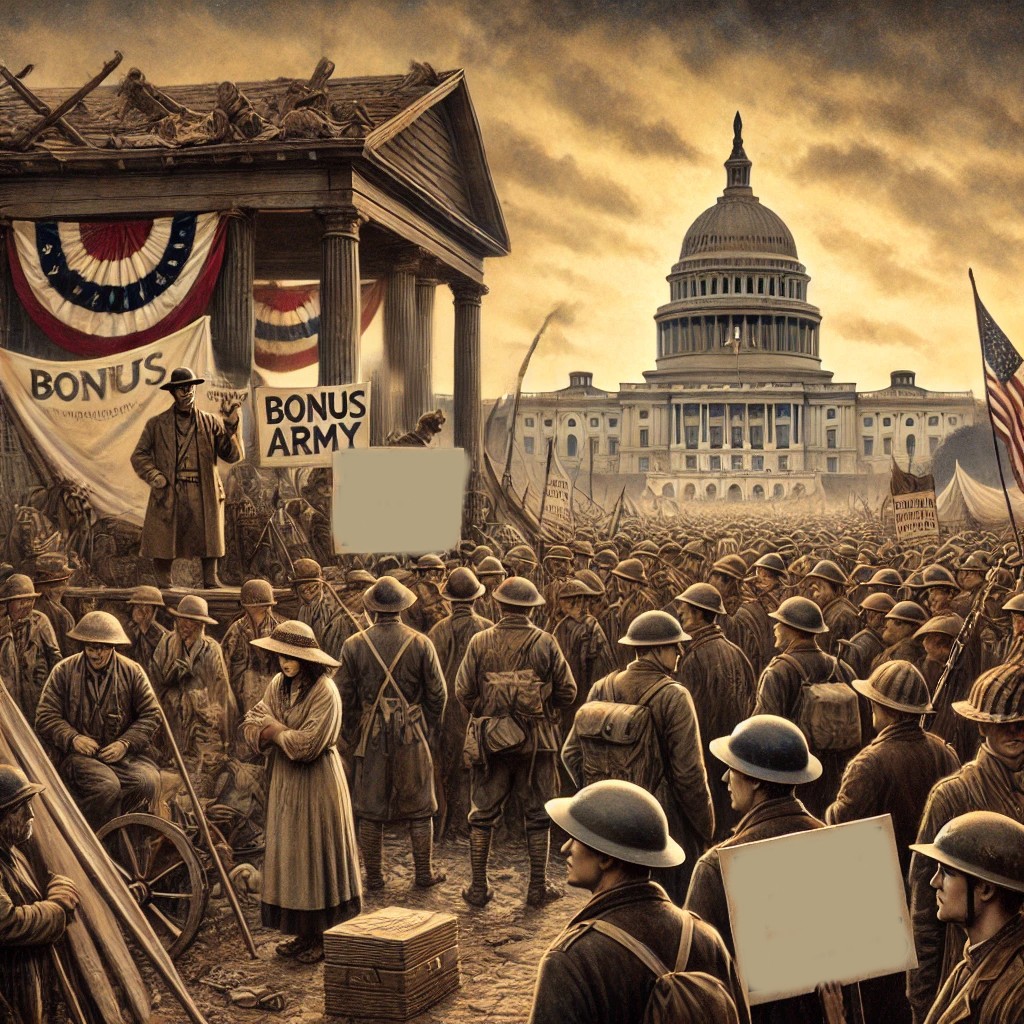
Led by a man named Walter W. Waters—a former sergeant and an unemployed veteran—veterans from all over the country began organizing in 1932 with a single goal: to persuade Congress to make immediate cash payments of their bonuses. Initially called the “Bonus Expeditionary Force,” this collection of determined men, and in some cases their families, traveled from across the nation to gather in Washington, D.C.
For many veterans, the trip to the nation’s capital was both a symbolic journey and a last resort. They believed that if they presented their cause directly to lawmakers, the urgency of their plight would be impossible to ignore. Some hopped freight trains, others hitchhiked, and a few drove battered cars—whatever it took to get to Washington. Upon arrival, they set up makeshift camps or “Hoovervilles,” named sarcastically after President Herbert Hoover. These ragtag communities were built from scrap wood, cardboard, and whatever materials they could scrounge. Conditions were far from ideal: there was limited sanitation, minimal shelter from the elements, and a general lack of resources. However, the spirit of unity and shared purpose united the diverse group of veterans.
Their movement quickly gained media attention, in part because seeing so many war heroes living in such dire conditions was shocking to many Americans who still remembered the recent triumph of World War I. The name “Bonus Army” stuck because, like a disciplined military force, they were determined and organized, pressuring the government for what they believed they had rightfully earned. From the start, the Bonus Army was mostly peaceful, stressing order and discipline among its ranks. They even held daily marches and petitions to Congress, displaying banners, chanting slogans, and engaging with politicians whenever possible.
The March on Washington and the Government’s Response
As the Bonus Army’s numbers swelled to around 20,000 veterans by the summer of 1932, the issue of early bonus payment moved to the forefront of congressional debate. Tensions ran high in the Capitol. Some lawmakers argued that paying the veterans early was both morally necessary and financially prudent, especially given the harsh economic conditions. Others claimed the government simply didn’t have the funds to make such a large, unplanned payment and feared setting a precedent for other groups to demand similar treatment.
A bill that would have authorized the early bonus payment actually passed in the House of Representatives but failed in the Senate. This outcome was a bitter disappointment for the veterans who had traveled long distances and were now living in cramped, unsanitary camps. Many believed they should stay in Washington to continue pressuring officials, hoping that some last-minute compromise or political maneuver might still deliver their overdue funds.
President Hoover grew increasingly uneasy with the presence of so many protesters in the city. The administration viewed the veterans’ camps as unsightly and potentially dangerous. There was fear that the situation could escalate into violence or encourage other disaffected groups to gather en masse. While a significant number of veterans chose to leave Washington after the Senate’s refusal, thousands remained. As tensions rose, the government ordered the veterans to clear out. When some refused, the administration responded with a show of force that would soon echo across the nation’s front pages.
Media Coverage and the Turning Tide of Public Opinion
On July 28, 1932, troops led by General Douglas MacArthur, with assistance from Major George S. Patton and Major Dwight D. Eisenhower, were dispatched to remove the remaining veterans. Cavalry, tanks, and infantry marched into the camps to disperse the protesters. While some veterans retreated as ordered, others held their ground, and clashes ensued. In the chaos, tear gas was used, and the encampments were set ablaze. Images of uniformed troops driving out former soldiers—many of whom were still wearing parts of their old uniforms—spread rapidly through newspapers and radio reports.
This forceful response shocked the nation. Although it remains unclear how much violence was intended versus how much stemmed from confusion, the optics of armed troops confronting and burning the camps of war veterans did not sit well with the American public. The press was quick to highlight the bravery of the veterans during World War I and their humiliation at the hands of the U.S. Army. Reporters pointed out that these men had once served their country honorably, only to be met with force when they asked for help during desperate times.
People across the country wondered: If the government would treat these veterans so harshly, could everyday Americans also face such tactics for speaking out or asking for assistance? The incident called into question President Hoover’s leadership and the broader willingness of the federal government to support its own citizens during a crisis. Many saw the Bonus Army’s expulsion as a betrayal, a move that undercut the government’s reputation and moral standing. These perceptions swiftly shaped public opinion, paving the way for significant political changes in the months and years that followed.
Political Fallout and the 1932 Election
By the time the camps were destroyed, President Hoover was already struggling with low approval ratings due to his handling of the Great Depression. The spectacle of the U.S. Army forcibly evicting impoverished veterans only worsened his reputation. In the public eye, Hoover appeared aloof, out of touch, and unwilling to help people in need.
When Franklin D. Roosevelt challenged Hoover in the 1932 presidential election, he capitalized on the widespread feeling that Hoover’s administration had failed to provide adequate relief. Roosevelt promised a “New Deal” for Americans, one that would bring about reforms, job programs, and economic support. While the Bonus Army incident was not the only factor that propelled Roosevelt to a landslide victory, it served as a stark example of what many saw as Hoover’s callous approach to the crisis. It gave Roosevelt a powerful talking point: the existing administration seemed more willing to use force against its own veterans than to offer them tangible help.
It’s worth noting that, when Roosevelt took office, he also did not immediately support paying out the veterans’ bonuses in full. Nevertheless, his administration was far more sympathetic to their cause, creating programs aimed at alleviating poverty and unemployment. This gave many Americans the sense that at least someone in Washington was attempting to address their struggles.
Lasting Impact on American Perceptions of Government
The Bonus Army protests and the government’s reaction fundamentally shifted how Americans viewed the role of the federal government. Before the Great Depression, there was a strong tradition of limited government intervention in economic and social matters. Many believed private charities, communities, and local governments should handle hardships as they arose. However, the scale of the economic collapse in the 1930s exceeded the capacity of local entities to cope, leaving millions of Americans in dire circumstances.
When the federal government under Hoover appeared reluctant to offer direct aid, the public felt betrayed, especially since the crisis was so severe. The use of force against veterans was an extreme example of the administration’s perceived insensitivity, reinforcing the notion that a major shift was needed in American politics. The episode demonstrated to the public that if the government would not help even its former soldiers—men who had risked their lives in the defense of the nation—then perhaps deeper, systemic changes were required to restore faith in the country’s leadership.
In the years that followed, the federal government assumed a much more active role in providing relief and recovery programs through Roosevelt’s New Deal. While not all of these programs were immediately successful, and some faced strong criticism, the overall approach moved the United States toward a more robust social safety net. This evolution in government responsibilities would likely have taken a different course without the national outcry sparked by the Bonus Army’s treatment.
The Bonus Army’s Influence on Public Consciousness
The saga of the Bonus Army had a powerful ripple effect, not just in policy circles but also in the national psyche. Americans who read newspaper accounts or listened to radio broadcasts describing the dramatic clashes in Washington were moved by the plight of the veterans. Many felt a new empathy for those struggling during the Depression. The idea of government responsibility in ensuring a basic standard of living, at least for the most vulnerable, began to gain traction across a broader swath of society.
As the Depression continued, more and more people came to believe that federal intervention was necessary to prevent total economic collapse and widespread suffering. Even those who were previously skeptical about big government could see that private charities and local efforts alone weren’t enough. In this context, the Bonus Army protest acted as a moral and emotional pivot, making it harder for politicians to ignore the demands of a public that was becoming increasingly vocal about its needs.
The growing acceptance of government’s expanded role paved the way for Social Security, unemployment insurance, and other federal programs that still exist today. Though the Bonus Army didn’t directly cause these reforms, their protest brought attention to the human cost of the economic downturn and spotlighted the potential consequences of government inaction. Their story became part of a broader narrative about American resilience, protest, and the pursuit of justice in hard times.
Reactions from Key Figures
It’s interesting to note how various military and political leaders involved in the Bonus Army incident later reflected on the events. General Douglas MacArthur believed that the Bonus Army posed a grave threat to national security, which influenced his decision to act decisively. Major Dwight D. Eisenhower, who served under MacArthur at the time, advised caution, reportedly worrying that using force would be a public relations disaster. President Hoover, for his part, claimed that he never authorized a full-scale assault on the veterans and that the actions taken were more forceful than he intended.
These varying accounts highlight the complexity of political decision-making under pressure. The immediate aftermath of the eviction was that Hoover shouldered the bulk of the blame, rightly or wrongly. Although history continues to debate the specifics of how events unfolded on that July day, one thing is certain: the images of the U.S. Army advancing on unarmed veterans stuck in the public’s mind, influencing perceptions of Hoover’s presidency and the broader direction of American politics.
Aftermath and the Final Payment
Despite the violent dispersal in 1932, the push for early bonus payment did not disappear. Over the next few years, the veterans continued to lobby for their funds. When Roosevelt assumed office, he steered a delicate path on the issue. Eventually, in 1936, Congress overrode a presidential veto to authorize the early payment of the bonus. By then, some veterans had already endured years of financial hardship, but receiving this money did help many weather the tail end of the Depression.
This final resolution showed that sustained public pressure could indeed influence Congress. The Bonus Army’s protest had transitioned from a dramatic confrontation to a legislative victory. Although the means were messy and painful, it offered a lesson about the power of collective action, particularly when protesters can galvanize public opinion to stand behind a cause.
Conclusion
The story of the Bonus Army is more than a historical footnote; it’s a powerful lesson about the relationship between citizens and their government during one of America’s darkest economic moments. These World War I veterans, desperate for relief in a time of immense hardship, traveled to Washington, D.C., to demand what they believed was rightfully theirs. In doing so, they helped reveal the shortcomings of an administration struggling to respond to widespread suffering. Their treatment at the hands of federal troops stirred outrage among Americans who had grown disillusioned with President Hoover’s approach to the Great Depression.
By shining a light on these injustices, the Bonus Army influenced public opinion in ways that set the stage for profound changes in federal policy. While not the only factor in Franklin D. Roosevelt’s rise to power, the crisis surrounding the Bonus Army played a significant role in illustrating the stark contrast between those who sought to maintain the status quo and those who promised to reshape government to meet the needs of the people. Once Roosevelt took office, the larger question of government responsibility in times of crisis became central to American politics, an idea that was eventually codified through New Deal legislation.
Looking back, the Bonus Army’s legacy reminds us that public perception can pivot quickly when confronted with stark moral dilemmas. Seeing veterans—who had risked their lives for the country—treated as if they posed a dangerous threat undermined confidence in the Hoover administration and galvanized a collective demand for change. Ultimately, their protest demonstrated the power of organized, peaceful action to sway the direction of public policy, a principle that resonates to this day. The Bonus Army serves as a testament to how moments of crisis can spark national debates that redefine the role of government, influence elections, and reshape the social contract between leaders and the people they serve.
Frequently Asked Questions
1. What was the Bonus Army, and why did they march on Washington, D.C.?
The Bonus Army was a group of approximately 43,000 marchers—comprising World War I veterans, their families, and affiliated groups—who gathered in Washington, D.C., in 1932. They were demanding the early payment of a bonus that had been promised by the government for their wartime services. The bonus was originally scheduled to be paid in 1945, but due to the dire economic circumstances of the Great Depression, these beleaguered veterans needed immediate relief. The government, however, declined to meet this request, prompting the veterans to amass in the nation’s capital to peacefully protest and make their case for early compensation.
2. How did the handling of the Bonus Army impact public opinion of the U.S. government in the 1930s?
The handling of the Bonus Army was a pivotal moment that had dramatic effects on public opinion toward the U.S. government. Initially, the veterans were encamped in makeshift camps around Washington, D.C., peacefully demonstrating for their bonuses. However, the situation escalated when President Herbert Hoover ordered the U.S. Army, led by General Douglas MacArthur, to remove the veterans. The use of military forces, including tanks and tear gas, to forcibly evict these veterans and their families from their camps, shocked the nation. Images of this violent removal were widely publicized, fostering sympathy for the veterans and anger at the government’s harsh response. This incident underscored the growing dissatisfaction with Hoover’s administration and significantly damaged his reputation, contributing to his defeat in the reelection campaign later that year.
3. What economic and social conditions compelled these WWI veterans to demand their bonuses early?
The backdrop of the Great Depression played a significant role in compelling the Bonus Army veterans to demand their bonuses prematurely. The stock market crash of 1929 had initiated an unprecedented economic decline, resulting in widespread poverty, massive unemployment, and a general sense of despair across the country. Many of these veterans, who had already sacrificed greatly for their country during World War I, found themselves jobless and struggling to support their families as the economy plummeted. The scheduled payouts in 1945 seemed a world away when faced with the immediate need for survival. The bonus represented a glimmer of hope, a financial lifeline that could provide some measure of stability amid the uncertainty of the depression-era economy.
4. What were the long-term effects of the Bonus Army incident on veterans’ rights and policy changes in the United States?
The Bonus Army incident was a turning point in how the United States addressed veterans’ rights and welfare. While their effort in 1932 failed to secure immediate payment, it highlighted the urgent need for comprehensive veterans’ benefits and social safety nets. The public outcry following the government’s response to the Bonus Army catalyzed changes that ultimately led to the establishment of better support systems for veterans. In 1936, the Adjusted Compensation Payment Act was passed, finally granting the veterans their bonuses. More broadly, the incident helped pave the way for other significant changes, such as the GI Bill of Rights in 1944, which provided educational benefits, housing assistance, and financial support to returning World War II veterans. It underscored the necessity of treating veterans with dignity and respect, while also ensuring that their sacrifices were matched by concrete government support.
5. How did the Bonus Army incident portray the struggles of the average American during the Great Depression?
The Bonus Army’s plight was emblematic of the broader struggles faced by countless Americans during the Great Depression. Their march vividly illustrated the desperation and frustration that so many felt as they battled economic hardships. The encampments and demonstrations in Washington, D.C., served as a visible reminder of the widespread poverty affecting not only veterans but also millions of citizens who were caught in an economic downturn they could not escape. By spotlighting the human impact of governmental policy failures and the inadequacies of social safety nets, the Bonus Army dramatized the need for immediate reform and relief measures. For many Americans, the plight of these veterans mirrored their own struggles, fostering a sense of solidarity and urgency to demand better from those in power as they fought for survival in a profoundly challenging era.