
The 1876 presidential election stands out as one of the most hotly contested and controversial races in American history. It took place during a turbulent period defined by the aftermath of the Civil War and the challenges of Reconstruction. Newfound rights for formerly enslaved people and deep divisions between the North and the South were at the forefront of the national conversation. Adding to this tension was rising political corruption in Washington, a rift between conservative and more progressive factions, and the looming threat of economic downturns. Against this backdrop, the election pitted Samuel J. Tilden, the Democratic governor of New York, against Rutherford B. Hayes, the Republican governor of Ohio. Their narrow contest eventually led to a standstill, with neither side agreeing on who had fairly won the presidency. The eventual resolution—often called the Compromise of 1877—changed the course of Reconstruction efforts and ushered in a new political environment known as the Gilded Age. In this article, we will explore the key events, personalities, and consequences of the 1876 election and its aftermath, demonstrating how this pivotal moment influenced race relations, federal power, and the broader direction of the country.
Setting the Stage: America after the Civil War
By 1876, the United States had been grappling with the aftermath of the Civil War for over a decade. President Abraham Lincoln’s assassination in 1865, just as the war ended, had thrust Andrew Johnson into the presidency. Johnson favored a lenient Reconstruction policy for the Southern states, which clashed with the more radical faction of the Republican Party in Congress. These Radical Republicans advocated strict measures to transform Southern society, protect the civil rights of formerly enslaved people, and ensure loyalty to the Union. This approach led to significant friction with many white Southerners who resented the federal government’s influence over their state laws and practices.
During the early years of Reconstruction, newly freed African Americans in the South made unprecedented gains in political representation. The 14th and 15th Amendments, ratified in 1868 and 1870 respectively, granted citizenship and voting rights to Black men. In some areas, African Americans became influential players in local, state, and national politics, even serving in the U.S. Congress. However, these strides sparked fierce resistance from white Southerners who sought to maintain racial hierarchies. Organizations like the Ku Klux Klan emerged to use violence, terror, and intimidation to keep African Americans from voting or asserting their rights.
Over time, growing Northern fatigue with the complexities of enforcing Reconstruction policies led to waning support for continued federal oversight in the South. The economic crisis of the Panic of 1873 shifted national attention to concerns about economic recovery. People focused more on their own financial well-being than on upholding Reconstruction ideals. As the 1876 election approached, the country was deeply divided: the Republican Party still associated itself with Lincoln’s legacy and the Union cause, while the Democratic Party found increasing support from Southern whites eager to retake control of their state governments. This climate set the perfect stage for the drama that would unfold.
The Main Candidates: Samuel J. Tilden and Rutherford B. Hayes
The Democrats nominated Samuel J. Tilden, a prominent lawyer and politician who had gained a reputation for fighting political corruption. As governor of New York, Tilden notably opposed the infamous Tweed Ring, led by the corrupt leader William “Boss” Tweed in New York City. Tilden used his public office to crack down on fraudulent contracts, exposing the misuse of taxpayer funds. This made him particularly appealing as a candidate who could restore honesty and integrity to the federal government.
The Republicans, on the other hand, nominated Rutherford B. Hayes, the sitting governor of Ohio. Like Tilden, Hayes was regarded as a figure of moral character, a Union veteran, and a politician whose reputation was relatively unblemished compared to more openly scandal-ridden Republicans. By 1876, the Republican Party struggled with the fallout from the scandals that tainted President Ulysses S. Grant’s administration, including the notorious Whiskey Ring—a conspiracy among government agents and whiskey distillers to evade taxes. Hayes positioned himself as a reform-oriented candidate, advocating the continued protection of civil rights for African Americans, but also signaling a readiness to heal the national divisions that lingered after the war.
Both candidates promised to promote clean governance in the wake of corruption. Tilden appealed to those exhausted by Republican dominance and drawn to calls for states’ rights, particularly in the South. Hayes, although more understated in his campaign style, promised to continue the Republicans’ push for civil rights. Yet, at the same time, he wanted to encourage reconciliation between North and South. As the election season heated up, it became clear that the outcome would be remarkably close.
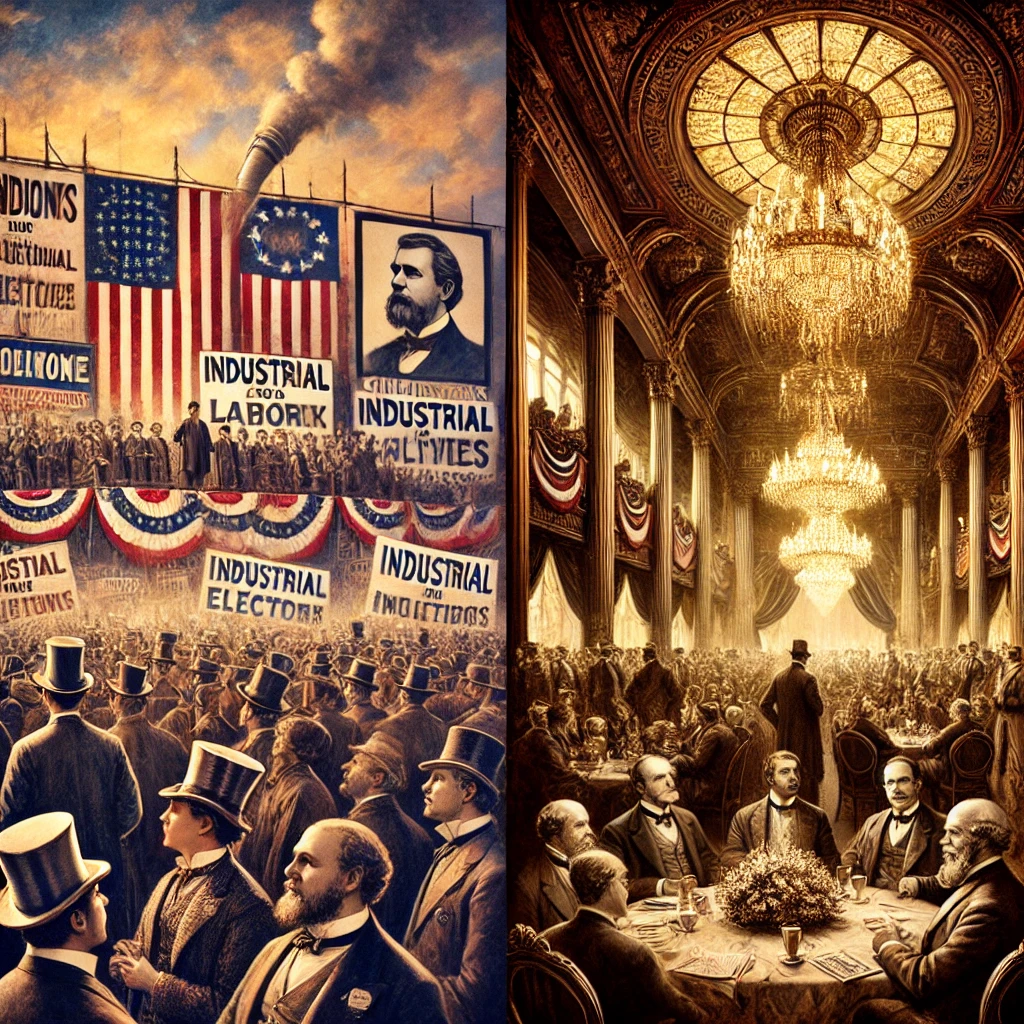
Election Day Chaos: November 7, 1876
On Election Day, November 7, 1876, millions of Americans cast their votes. Initial returns suggested that Tilden held a lead in the popular vote. He performed especially well in Northern states where voters were disillusioned by the various scandals of the Grant administration. As more votes were counted, Tilden’s edge appeared insurmountable: he ended up winning the popular vote by a margin of more than 200,000. However, at the time, the presidency was determined by electoral votes, and in that realm, the race was far from decided.
By the evening of November 7, it became clear that 20 electoral votes from four states—Florida, Louisiana, South Carolina, and (initially) Oregon—were disputed. Tilden had accumulated 184 electoral votes to Hayes’s 165, with 185 being the number required to win. The controversy centered on allegations of voter intimidation, fraud, and mismanagement at polling stations in these states. Both Republicans and Democrats claimed victory, charging each other with rampant misdeeds. Because these 20 votes would determine the next president, the election descended into a stalemate.
The alleged abuses were numerous: reports circulated of ballot stuffing, intimidation of Black voters, claims that election officials had disqualified votes for dubious reasons, and competing slates of electors who insisted they were the legitimate representatives of their states. The Constitution provided no clear method for resolving such a widespread, multistate electoral dispute. As tension soared, many Americans worried about the prospect of renewed violence or even civil war. Some newspapers fanned the flames, predicting chaos if the country could not decide who would become the next president.
The Constitutional Crisis and the Electoral Commission
With emotions running high, Congress sought a way to defuse the crisis. The result was the creation of a special Electoral Commission in January 1877. This body consisted of 15 members: five from the U.S. House of Representatives, five from the U.S. Senate, and five from the Supreme Court. Initially, the composition of the commission aimed to be balanced, with seven Democrats, seven Republicans, and one independent. However, when the independent member, Supreme Court Justice David Davis, left the commission to accept an Illinois Senate seat, a Republican justice took his place. This shift resulted in a commission with eight Republicans and seven Democrats.
Over several weeks, the commission heard arguments from both sides regarding the disputed electoral votes. Ultimately, in each contested state, the commission voted 8–7 along party lines to award the votes to Hayes. With these disputed votes settled in the Republican’s favor, Hayes garnered 185 electoral votes—exactly the number needed to become president—while Tilden remained at 184. Outraged Democrats argued that the process was rigged. Still, the real turning point came not merely through the commission’s decision but through secret negotiations between Republican and Democratic leaders. These negotiations produced a political arrangement that would go down in history as the Compromise of 1877.
Negotiating the End of Reconstruction: The Compromise of 1877
The Compromise of 1877 was never a single, formal document; rather, it was an unwritten agreement between various political power players. In essence, Democrats agreed to acknowledge Hayes as the rightful president. In return, Republicans promised to withdraw the last remaining federal troops from the Southern states of South Carolina and Louisiana, where they had been stationed to oversee Reconstruction, uphold African American civil rights, and support Republican state governments that were struggling to remain in power.
By accepting the compromise, Southern Democrats effectively secured a return to “home rule,” which meant fewer federal interventions in their state affairs. With the troops removed, these states quickly moved to restore policies that hindered Black political participation. Jim Crow laws, literacy tests, poll taxes, and other mechanisms of disenfranchisement soon followed, systematically stripping African Americans of many of the rights they had briefly enjoyed. While the deal resolved the immediate crisis over the presidency and prevented any resurgence of mass violence, it came at a steep cost for Black communities in the South. Their political and social progress was effectively stunted for nearly a century.
In addition to troop withdrawal, the compromise also included promises of federal investment in Southern infrastructure, particularly railroads, which many Southern leaders believed would stimulate economic recovery. Republicans hoped this development would modernize the region and possibly create opportunities to attract Black voters in the future. Yet, while some money was allocated, the expected large-scale improvements never fully materialized. Over time, the South remained predominantly rural, and the disparities between the North and South persisted.
Aftermath and the Rise of the Gilded Age
Once Hayes took office, he tried to foster a “new” South built on the principles of economic growth and racial harmony—at least in theory. Unfortunately, the reality was that the retreat of federal oversight allowed white Southern Democrats to regain full control. They passed laws and enacted policies to maintain white supremacy, limiting Black political engagement for generations to come. Reconstruction effectively ended, leaving its accomplishments fragile and the promise of racial equality unfulfilled.
Nationally, the Hayes administration also marked the beginning of what historians call the Gilded Age, a period that lasted from the late 1870s to about 1900. This era was characterized by rapid industrialization, an influx of immigration, and significant wealth accumulation by a small group of business tycoons. On the surface, America seemed prosperous—new factories, booming railroads, and skyscrapers symbolized progress. However, beneath this shiny facade lay stark economic inequalities, rampant political corruption, and dire working conditions for many laborers. The Gilded Age witnessed the rise of giant trusts and monopolies, run by famous “robber barons” such as John D. Rockefeller and Andrew Carnegie. These developments transformed the United States into a world economic power but also triggered a wave of labor unrest and new social movements.
Politically, the era was dominated by stalemate and party patronage. Both major parties, Republicans and Democrats, often found themselves locked in close contests. Elections frequently produced razor-thin margins, and partisan allegiances were strong. The significant moral cause of ending slavery and defending civil rights gradually took a back seat to business interests, protective tariffs, and debates over currency standards. In this environment, the promises of Reconstruction, including the possibility of real equality for African Americans, were largely abandoned.
The Impact on African Americans
The Compromise of 1877 had an immediate and devastating effect on African Americans in the South. While Reconstruction was never perfect, the presence of federal troops and the enforcement of federal laws had offered some protection for Black voters and officeholders. After the compromise, local authorities had free rein to pass laws curbing Black rights and to tolerate or even encourage vigilante violence.
The new Southern regimes—often dubbed “Redeemer governments” by white conservatives—enforced segregation in every aspect of life. Public schools, transportation, and other facilities were separated by race, always favoring the white population. Furthermore, widespread Black disenfranchisement meant that African Americans lost representation in the government. Without the vote, they had little recourse against discriminatory legislation or acts of violence. Lynching and other forms of terror became a grim reality for many Black communities. A once-promising democracy began to look more like a closed oligarchy dominated by white elites.
Despite these setbacks, African American communities continued to organize and push back. Churches became central to activism, and leaders like Booker T. Washington, W.E.B. Du Bois, and Ida B. Wells would later emerge to challenge Jim Crow laws and demand an end to racial violence. But these broader civil rights struggles would not gain serious federal support again until the mid-20th century.
A Close Call for Constitutional Governance
Another critical takeaway from the election of 1876 was the near collapse of America’s electoral system. The Constitution did not fully anticipate an election with widespread disputes over electoral votes, leaving the nation without a clear procedure to resolve it. The creation of the Electoral Commission was a stopgap measure, developed under dire circumstances. Critics argue that the commission’s partisan division—eight Republicans versus seven Democrats—was inherently unfair and practically guaranteed the outcome.
Despite these flaws, Congress and party leaders managed to avoid more extreme scenarios. Unlike in previous or later periods, the process remained within the bounds of negotiation and legal maneuvering rather than descending into open conflict. Still, the crisis exposed significant weaknesses in the American political structure, prompting discussions about potential electoral reforms. Some have suggested that the events of 1876 underscore the fragility of democracy when political tensions run high and partisan divisions cloud interpretations of the law. While the Electoral Count Act of 1887 later provided more specific guidelines, debates about the proper handling of disputed elections persist to this day.
Lessons for Today
The 1876 election and the Compromise of 1877 offer more than just historical intrigue. They highlight the far-reaching consequences that a single election can have, especially when it is divisive and disputed. Here are some key lessons:
- Significance of Voting Rights: The election’s disputed outcome hinged on voter suppression, fraud, and the discounting of ballots—particularly in places with large African American populations. When democratic processes are not fair or transparent, the legitimacy of the entire government is called into question.
- Fragility of Civil Rights Advances: Gains made during times of progress can be rolled back if political will shifts. The federal government’s retreat from enforcing Reconstruction-era civil rights proves how easily a community’s social and political advances can be undermined.
- Importance of Checks and Balances: The crisis led to the formation of an Electoral Commission. While it resolved the immediate election, it also illustrated how ad-hoc solutions can reflect partisan interests rather than a neutral judgment of facts. Institutions must be strong and impartial enough to manage disputes without favoring one side.
- Power of Compromise—For Better or Worse: The agreement that ended the dispute paved the way for a peaceful transition of power. However, it also sacrificed the rights of African Americans in the South for the sake of maintaining national harmony, revealing a darker side to the notion of compromise.
- Long-Term Impact of Short-Term Decisions: The Compromise of 1877 shaped regional politics and race relations for decades. It stands as a reminder that political deals made today can echo long into the future.
Conclusion: Why 1876 Matters
In many ways, the 1876 presidential election was a tipping point for the United States. Coming just eleven years after the Civil War, it tested the nation’s commitment to the ideals of Reconstruction—particularly the pursuit of equality and the integration of formerly enslaved individuals into American civic life. The political drama that unfolded revealed deep fractures in the young post-war nation and demonstrated the complexities of a federal system trying to reconcile states’ rights with individual civil liberties. The ensuing Compromise of 1877 effectively ended Reconstruction, shaping the political, social, and economic landscape of the South for nearly a century. African Americans bore the brunt of this shift, as their constitutional protections were undermined, and white supremacist structures were allowed to regain control.
Meanwhile, the Gilded Age that followed embodied a new set of national priorities focused on rapid economic growth and industrial expansion. Political leaders often turned away from the moral imperatives that had driven earlier reform efforts, favoring corporate alliances and the pursuit of wealth. The bitter lessons of 1876 and 1877, however, continue to resonate. They underscore that democracy’s success depends on fair elections, respect for all citizens’ rights, and the willingness of leaders to uphold principles of justice, even in the face of partisan pressures.
Understanding the 1876 election and the Compromise of 1877 sheds light on the enduring challenge of balancing unity with justice. It reminds us that political compromises can help avert crises, but they can also leave entire groups disenfranchised. When we examine this time period, we see how fragile the gains of Reconstruction were—and how vital it is for society to remain vigilant in protecting the rights of all citizens. If nothing else, the legacy of 1876 serves as a cautionary tale for any democracy that faces a divisive election and must choose whether to protect the most vulnerable or pursue expediency at their expense. Ultimately, these events stand as a reminder that the promise of freedom can only be sustained when it is paired with accountability, transparency, and an unwavering commitment to equal rights under the law.
Frequently Asked Questions
1. What made the 1876 presidential election so controversial?
The 1876 presidential election was one of the most controversial in U.S. history due to several key factors. Taking place in a post-Civil War America still grappling with Reconstruction, the election reflected deep divides across the country. These divisions were not only geographical but also social and political, particularly regarding the rights of formerly enslaved people. On top of that, the election was marred by widespread reports of political corruption, voter intimidation, and outright fraud. The candidates—Rutherford B. Hayes for the Republicans and Samuel J. Tilden for the Democrats—were locked in a tight race where the initial popular vote favored Tilden but did not decisively determine the outcome in the Electoral College. As a result, a special commission was set up to decide the contested electoral votes, leading to further arguments and a bitter political standoff.
2. How did the Compromise of 1877 resolve the disputed election?
The Compromise of 1877 effectively resolved the deadlock of the 1876 election, though it did so in a manner that left many feeling dissatisfied. After months of intense negotiation and backroom deals, a compromise was reached that awarded the 20 contested electoral votes to Rutherford B. Hayes, thereby granting him the presidency. In exchange for this concession, Hayes and the Republicans agreed to several Democratic demands. These included the withdrawal of federal troops from Southern states, effectively ending Reconstruction, and allowing Southern Democratic governments to take control without further Northern interference. While this compromise brought an end to the immediate electoral crisis, it came at the cost of significantly impacting civil rights protections for African Americans in the South, contributing to nearly a century of institutionalized segregation and discrimination.
3. What were the main issues during the 1876 presidential campaign?
The 1876 campaign was dominated by issues reflecting the period’s significant social and political upheaval. Central topics included the direction of Reconstruction, civil rights for freedmen, and the ongoing regional tensions between the North and South. Economic themes also featured prominently, with debates over currency reforms and the need to address widespread political corruption. At the time, Washington was viewed as rife with graft and scandal, a reputation not helped by the administration of President Ulysses S. Grant. Voters were deeply divided over how to address these problems, with Democrats advocating a return to home rule in the South, which would inevitably lead to the dismantling of Reconstruction efforts, while Republicans continued to push, at least publicly, for protective measures for African Americans and new reforms to address corruption.
4. What impact did the political climate of the post-Civil War era have on the election?
The post-Civil War era set a tense and divided stage for the 1876 election. The nation’s political climate was heavily influenced by the aftermath of the war and the contentious, frequently obstructed process of Reconstruction. The fissures between the North and the South were exacerbated by differing views on how to integrate formerly enslaved individuals into society and protect their newly won rights. Additionally, the electoral process itself became entwined with deeply entrenched systems of patronage and corruption, diminishing public trust in government affairs. Voter intimidation and violence were prevalent, especially in the Southern states where groups like the Ku Klux Klan actively worked to suppress the black vote and cement the power of white Democrats. Against this backdrop, the struggle for political control became not just a policy battle, but one that threatened to unravel the fragile fabric of national unity.
5. How did the resolution of the election affect African Americans and their civil rights in the South?
The resolution of the 1876 election, particularly through the Compromise of 1877, had dire consequences for African Americans in the South. The withdrawal of federal troops and the cessation of Reconstruction efforts removed critical protections that previously afforded some measure of civil rights and political participation to black citizens. With the Republican government’s retreat from Southern oversight, many of the advances made during Reconstruction were swiftly reversed. Southern states enacted Jim Crow laws that institutionalized segregation and disenfranchised black voters, setting up a system that enforced racial inequality and white supremacy for decades. Despite having gained citizenship and suffrage rights through the 14th and 15th Amendments, African Americans faced systematic discrimination, violence, and economic exploitation, a situation that persisted until the civil rights movement of the mid-20th century mounted new, successful challenges to these injustices.