
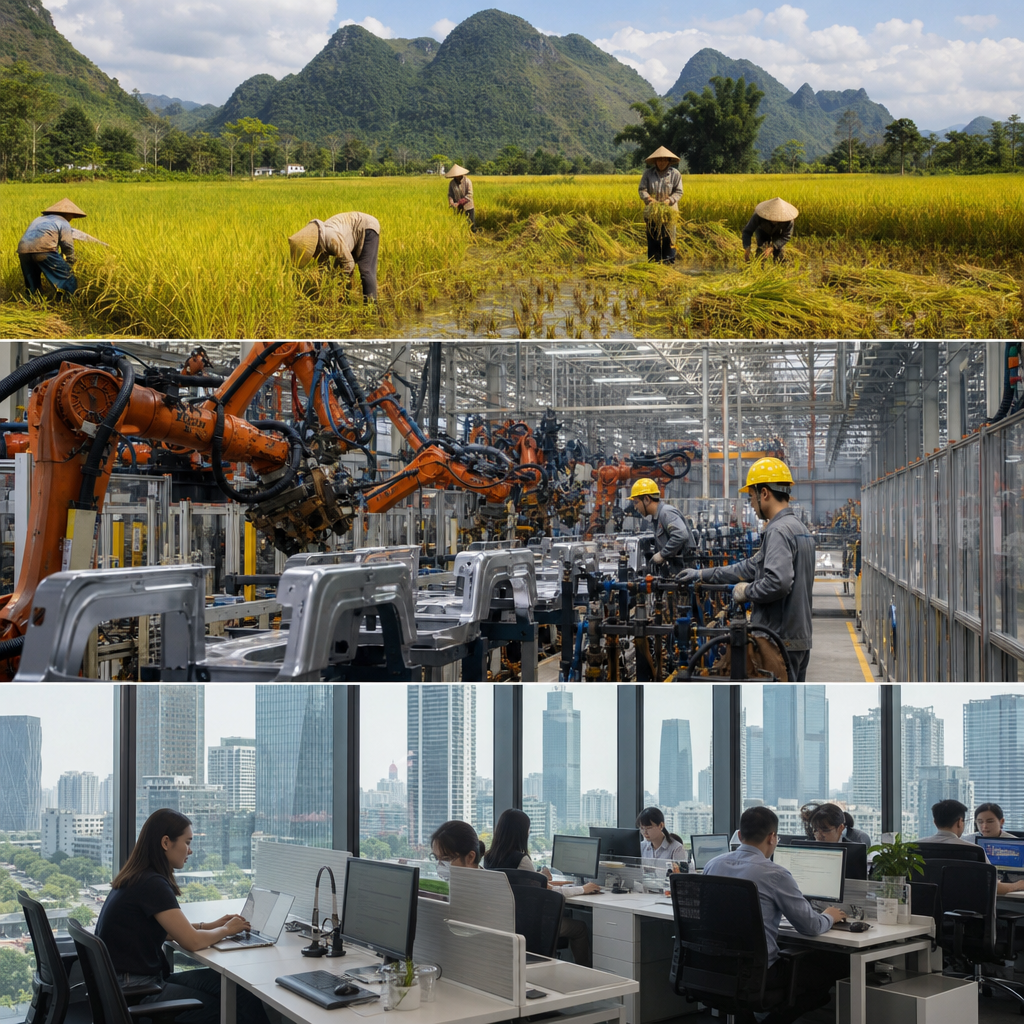
Structural transformation describes the long-run shift in how economies produce, employ workers, and generate income: first from agriculture into manufacturing, then from manufacturing into services, and increasingly into knowledge-intensive digital activities. Economists use the term to explain one of the clearest patterns in development history. As countries grow richer, fewer people work on farms, industry expands, cities grow, education levels rise, and service sectors such as finance, health care, retail, logistics, software, and tourism become dominant. This process matters because it shapes wages, productivity, inequality, migration, trade, politics, and the daily lives of households.
In practice, structural transformation is not just about moving workers from one sector to another. It also includes changes within sectors. Agriculture becomes more productive through mechanization, irrigation, improved seed varieties, fertilizer, land consolidation, and better market access. Manufacturing evolves from labor-intensive assembly into higher-value engineering, precision production, and integrated supply chains. Services stop being viewed as low-productivity leftovers and become the center of modern value creation, especially when backed by data systems, skilled labor, intellectual property, and network infrastructure. When I have analyzed country growth paths, the key question has rarely been whether transformation is happening, but whether it is happening fast enough, broadly enough, and with enough productivity gains to sustain higher living standards.
The classic development pattern can be seen in Britain during industrialization, the United States in the late nineteenth and early twentieth centuries, Japan after the Meiji era, South Korea and Taiwan in the postwar decades, and China after market reforms. In each case, labor moved out of low-productivity farming into factories, then later into transport, education, health, finance, communications, and business services. The underlying logic is straightforward: rising farm productivity frees workers and food supply, industrialization absorbs labor and raises output per worker, and richer households spend a larger share of income on services. Yet the sequence is not identical everywhere, and some countries experience stalled industrialization, informal urban employment, or early expansion of services without a deep factory base.
That is why structural transformation remains central in economics. It helps explain why some nations converge toward high income while others remain trapped in low-productivity activities. It clarifies debates about industrial policy, trade openness, education systems, infrastructure, labor regulation, and social protection. It also connects older development questions with current issues such as automation, global value chains, climate policy, regional inequality, and remote work. Understanding structural transformation means understanding how economies change their backbone over time, and why that change can create both prosperity and dislocation.
The farm-to-factory transition: why agriculture shrinks first
The first major stage of structural transformation is the declining employment share of agriculture. In low-income economies, agriculture often employs more than half the labor force while contributing a much smaller share of gross domestic product. That gap signals low output per worker. When crop yields rise through improved inputs and farming methods, fewer workers are needed to produce the same amount of food. The released labor can then move into construction, manufacturing, transport, or urban services. This is one reason economists treat agricultural productivity growth as a foundation for development rather than a side issue.
England’s agricultural improvements before and during industrialization illustrate the mechanism. Crop rotation, selective breeding, drainage, and enclosure raised output, while transport links helped move food into growing cities. In twentieth-century Asia, the Green Revolution played a similar role. High-yield wheat and rice varieties, irrigation expansion, and fertilizer use raised yields sharply in countries such as India and Indonesia. The result was not simply more food. It also lowered real food costs, stabilized urban wages, and made labor reallocation politically and economically easier.
Rural transformation, however, is never frictionless. Land inequality, weak roads, poor storage, credit constraints, and insecure property rights can trap households in subsistence production. If farm productivity remains low, workers may leave the countryside without finding productive urban jobs, creating underemployment rather than true transformation. That is why successful economies often pair agricultural reform with investments in rural roads, electrification, extension services, commodity markets, and basic education. The goal is not to abandon farming. The goal is to make farming productive enough that labor can move by choice rather than distress.
Industrialization and the productivity engine of manufacturing
Manufacturing has historically been the most reliable escalator for broad-based income growth. Factories can absorb large numbers of moderately skilled workers, exploit economies of scale, standardize processes, and learn rapidly through repetition. Tradable manufactured goods also allow firms to reach world markets, which expands demand beyond domestic purchasing power. In development analysis, this combination of scale, learning-by-doing, and export potential is why manufacturing has long occupied a special role.
East Asia provides the clearest evidence. South Korea moved from agrarian poverty in the 1950s to a manufacturing powerhouse within a generation. Textiles and light industry were followed by steel, shipbuilding, autos, semiconductors, and electronics. Taiwan followed a related path through small and medium export firms, then moved into sophisticated hardware production. China repeated the pattern at far greater scale after 1978, combining township enterprises, special economic zones, foreign direct investment, logistics upgrades, and disciplined manufacturing ecosystems. These cases show that industrialization is not one policy but a system: reliable electricity, ports, technical training, supplier networks, macroeconomic stability, and access to foreign demand.
Manufacturing matters not because services are unimportant, but because factories have often delivered faster productivity catch-up for developing countries. A garment plant can train workers, impose quality standards, connect to foreign buyers, and create spillovers into packaging, transport, finance, and maintenance. A cluster of machine shops can seed engineering capabilities that later support aerospace, medical devices, or industrial software. In the field, I have seen how one export-oriented plant can transform a local labor market by raising standards for punctuality, bookkeeping, inventory control, and technical supervision.
| Stage | Typical employment pattern | Main productivity driver | Common policy priorities |
|---|---|---|---|
| Agrarian economy | Most workers in farming | Higher crop yields and market access | Land policy, irrigation, roads, extension services |
| Industrializing economy | Rapid rise in factory and construction jobs | Scale economies, exports, learning-by-doing | Power, ports, vocational training, investment climate |
| Service-led economy | Most workers in retail, logistics, health, finance, education, and digital services | Human capital, technology, data, networks | Universities, competition policy, broadband, regulation |
From factories to services: the modern structure of advanced economies
As incomes rise further, the service share of output and employment expands. Part of this is demand-driven. Households with higher incomes spend proportionally less on food and more on education, travel, entertainment, insurance, professional advice, and health care. Part is statistical. Manufacturing firms increasingly outsource logistics, design, software, maintenance, and customer support, so activities once counted inside factories appear as services. Part is technological. Digital platforms, cloud computing, telecommunications, and financial systems create entirely new service industries with high value added.
Services are often misunderstood as uniformly low productivity. Some are indeed labor intensive and hard to scale, especially face-to-face care work. But many high-productivity services are tradable and deeply innovative. Software development, engineering design, asset management, consulting, architecture, audiovisual production, business process outsourcing, and medical diagnostics can all be exported. India’s information technology services sector is a major example. It did not replace the need for industrial capabilities, but it showed that a country could achieve global scale in a service category by combining education, English proficiency, telecom links, and business process discipline.
Advanced economies still manufacture, but often at a smaller employment share and a higher technological level. Germany remains a manufacturing leader through machine tools, autos, chemicals, and precision engineering, yet services dominate total employment. The United States illustrates another pattern: a highly productive farm sector, world-leading advanced manufacturing in selected industries, and a very large service economy that includes finance, health care, digital platforms, research, higher education, and entertainment. The key point is that structural transformation does not mean industry disappears. It means the center of employment and value creation changes.
Urbanization, labor markets, and inequality during transformation
Structural transformation usually goes hand in hand with urbanization. Cities reduce transport costs, concentrate labor, and make specialization possible. A farmer in a village cannot easily become a machinist, nurse, coder, or logistics planner without firms, training centers, and infrastructure nearby. Dense urban areas create matching effects between workers and employers, lower the cost of shared utilities, and support supplier networks. Historically, Manchester, Osaka, Seoul, Shenzhen, and Ho Chi Minh City all grew because industry and services clustered there, not by accident.
But urbanization can magnify inequality if housing, transit, sanitation, and public services lag behind job growth. Informal settlements, congestion, and underemployment are common in rapidly growing cities. Rural migrants may find work, but not secure work. Women may face barriers to formal labor participation despite rising demand in services. Younger workers may adapt faster than older workers displaced from farms or factories. These frictions matter because structural transformation is successful only when productivity gains translate into durable improvements in living standards across regions and social groups.
Labor institutions shape outcomes. Countries with strong basic education, apprenticeships, labor mobility, and social insurance usually manage transitions better. Denmark’s labor market model, Germany’s vocational system, and Singapore’s skills upgrading programs all show how institutions can reduce adjustment costs. By contrast, when education quality is weak and safety nets are thin, workers may be pushed into low-value informal services such as street vending or unstable gig work. Economists therefore watch not only sector shares, but also wage growth, informality, female labor force participation, and regional convergence.
Can countries skip manufacturing and move straight to services?
This is one of the most important current debates. Some economists argue that digital technology allows countries to leap directly into service exports, online work, tourism, and business process outsourcing. There is truth in that view. The Philippines built a large call-center and business services sector. Rwanda has invested heavily in conference tourism, logistics ambitions, and digital public systems. Kenya developed notable strengths in mobile payments through M-Pesa and in tech-enabled services. These examples prove that services can create growth, foreign exchange, and urban employment.
Still, skipping manufacturing entirely is difficult. Many service exports require strong human capital, stable institutions, and digital infrastructure that low-income countries do not yet have at scale. Manufacturing often remains the fastest route for absorbing workers with basic to intermediate skills. It can also teach production discipline and quality management in ways that support later service sophistication. Dani Rodrik has described the challenge of premature deindustrialization, where countries reach lower peaks of manufacturing employment and output than earlier developers did. If factory growth stalls too early, economies may urbanize without enough productive jobs.
The practical answer is not either-or. Countries need a portfolio approach. Competitive agriculture, targeted manufacturing capabilities, and scalable services can reinforce one another. Agro-processing links farms to industry. Logistics and payments support both goods and services trade. Tourism creates demand for food supply chains, construction, transport, and creative industries. Software strengthens factory automation and customs systems. The best development strategies build connections across sectors instead of treating them as isolated silos.
Policy lessons and why the pattern is changing
No single blueprint guarantees structural transformation, but the record is consistent on several foundations. First, macroeconomic stability matters. High inflation, volatile exchange rates, and chronic fiscal crises discourage the long-horizon investment needed for factories, infrastructure, and skill formation. Second, public goods matter: electricity, ports, roads, water, courts, cadastre systems, and digital connectivity. Third, human capital matters at every stage, from literacy and numeracy to technical training and university research. Fourth, integration with world markets matters, whether through commodity exports, manufacturing supply chains, or tradable services.
The pattern is changing because technology, geopolitics, and climate constraints are changing. Automation reduces the labor-cost advantage of some factory activities. Supply chains are being redesigned for resilience after pandemic disruptions and trade tensions. Decarbonization is shifting investment toward batteries, power grids, public transit, efficiency upgrades, and clean industrial processes. This opens opportunities for countries with minerals, renewable energy potential, or strategic geographic positions, but it also raises the bar for regulation and capability. Structural transformation in the twenty-first century is therefore less linear than the old farm-factory-services story, even though the underlying productivity logic still holds.
For policymakers, businesses, and students of economics, the central lesson is clear. Sustainable development happens when workers move into activities that produce more value, when firms adopt better technology and management, and when institutions help households handle change rather than fear it. To understand growth, jobs, and national competitiveness, follow the structure of the economy: where people work, what they produce, and how productivity spreads. That is the essence of structural transformation. Use this hub as your starting point, then explore the linked economics subtopics to see how trade, labor, urbanization, productivity, and innovation fit into the same story.
Frequently Asked Questions
1. What does structural transformation mean in economic development?
Structural transformation is the long-term process through which an economy changes the way it produces goods and services, employs workers, and generates income. In the earliest stage, most people work in agriculture, often in low-productivity farming with limited technology and low wages. As productivity improves and economies begin to grow, labor and investment gradually move into manufacturing, where factories, machinery, and larger-scale production create higher output per worker. Over time, a growing share of employment and value added then shifts again into services such as transport, retail, education, healthcare, finance, information technology, and professional business services.
This transition is one of the clearest historical patterns in development economics because it reflects deep changes in productivity, technology, consumption, and institutions. When fewer workers are needed to produce food, labor can move into sectors that generate higher incomes. At the same time, as households become richer, they tend to spend a smaller share of income on basic food and a larger share on manufactured products, education, healthcare, leisure, and digital services. Structural transformation is therefore not just about sectoral change. It also includes urbanization, rising educational attainment, changing family and labor market patterns, and the expansion of more complex economic activities. In short, it is the broad reorganization of an economy from farms to factories to services, and increasingly toward knowledge-intensive and digital industries.
2. Why do economies usually move from agriculture to manufacturing and then to services?
Economies tend to move in this sequence because productivity growth and consumer demand evolve in fairly predictable ways as countries develop. In low-income economies, agriculture dominates because food is the most basic necessity and a large share of the population must work to produce it. Once agricultural productivity rises through better seeds, irrigation, mechanization, transport, and market access, fewer workers are needed on farms. That releases labor for other sectors and raises rural incomes, which also increases demand for tools, clothing, construction materials, and household goods. Manufacturing becomes the natural next step because it can absorb large numbers of workers, benefit from specialization, and achieve major productivity gains through scale, standardization, and technology.
As incomes rise further, the structure of demand changes again. Households begin to spend proportionally less on food and basic manufactured goods and more on services that improve quality of life or support more complex economies. These include healthcare, banking, logistics, education, tourism, telecommunications, software, and legal or consulting services. Manufacturing often remains important, but its employment share may decline even when output stays strong, because automation and productivity improvements allow factories to produce more with fewer workers. Services then become the main source of jobs and, increasingly, of value creation. In advanced economies, a further layer emerges in the form of digital and knowledge-intensive services, where innovation, data, research, design, and advanced skills drive growth. So the movement across sectors is not arbitrary; it follows from changing technology, productivity, and patterns of consumption.
3. How does structural transformation affect workers, wages, and living standards?
Structural transformation can dramatically improve wages and living standards, but the gains are not always evenly distributed and the transition can be disruptive. In successful cases, workers move from low-productivity activities into sectors where each hour of work produces more value. That usually supports higher incomes, better job stability, improved access to formal employment, and stronger public revenues that can fund schools, healthcare, and infrastructure. As economies transform, people often gain access to electricity, sanitation, transportation, digital connectivity, and broader consumer choice. Education also becomes more valuable, especially as jobs shift toward technical, managerial, and service-oriented skills.
At the same time, structural transformation creates adjustment pressures. Workers leaving agriculture may need training, relocation support, or access to cities where new jobs are concentrated. Manufacturing workers can later face another round of disruption if factories automate or if global competition changes where production takes place. Service-sector growth can also be uneven: some services are highly productive and well paid, such as finance, engineering, or software, while others are informal, insecure, and low wage, such as some forms of retail or personal services. That is why the quality of transformation matters as much as the direction of change. Economies benefit most when labor moves not just out of agriculture, but into productive sectors that offer skills development, wage growth, and upward mobility. Strong institutions, labor market policies, education systems, and infrastructure are often what determine whether structural transformation becomes broadly shared progress or a more unequal transition.
4. Is manufacturing still important, or can countries skip directly from agriculture to services?
Manufacturing remains highly important for many countries because it has historically been a powerful engine of productivity growth, exports, technological learning, and job creation. Factory-based production can absorb large numbers of moderately skilled workers, connect domestic firms to global value chains, and generate spillover benefits in logistics, engineering, management, and supplier networks. For these reasons, manufacturing has often played a central role in helping countries move from lower-income to middle-income status. It can also be especially valuable because manufactured goods are tradable, which means countries can scale production beyond domestic demand and earn foreign exchange through exports.
That said, the global economy has changed. Some countries today see services expanding earlier in the development process, especially in telecommunications, business process outsourcing, tourism, finance, and digital platforms. In that sense, parts of the traditional path can look different than they did in the past. However, “skipping” manufacturing entirely is difficult for most economies. Many high-productivity services still depend on strong industrial capabilities, reliable infrastructure, urban ecosystems, and a skilled workforce. Even digital economies rely on hardware, logistics, power systems, and organizational capacity that often develop alongside industry. The real question is not whether a country must replicate history exactly, but whether it can build productive sectors that generate scale, learning, and good jobs. In many cases, manufacturing still offers a uniquely effective bridge between low-productivity agriculture and advanced services, even if the balance between sectors is evolving.
5. What role do cities, education, and technology play in structural transformation?
Cities, education, and technology are central to structural transformation because they make it possible for workers and firms to become more productive. Urbanization matters because dense cities reduce transport costs, connect workers to employers, and allow firms to cluster near suppliers, customers, and shared infrastructure. These agglomeration effects make production more efficient and accelerate innovation. Cities also support the growth of manufacturing and services by concentrating markets, institutions, finance, and specialized skills in one place. That is why economic transformation is so often accompanied by migration from rural areas to towns and urban centers.
Education is equally important because each stage of transformation demands new capabilities. Moving from subsistence farming to factory work often requires literacy, numeracy, punctuality, and familiarity with machinery or standardized processes. The later shift into advanced services and digital industries requires even more: problem-solving, communication, technical training, data skills, and continuous learning. Technology ties all of this together by raising agricultural productivity, enabling industrial production, and creating entirely new service industries. Mechanization and better farming techniques free labor from agriculture. Industrial technologies increase scale and efficiency in production. Digital tools then transform finance, healthcare, education, commerce, and remote work. Countries that combine urban development, broad-based education, and effective technology adoption are generally better positioned to manage structural transformation successfully and to turn sectoral change into long-term, inclusive economic growth.