
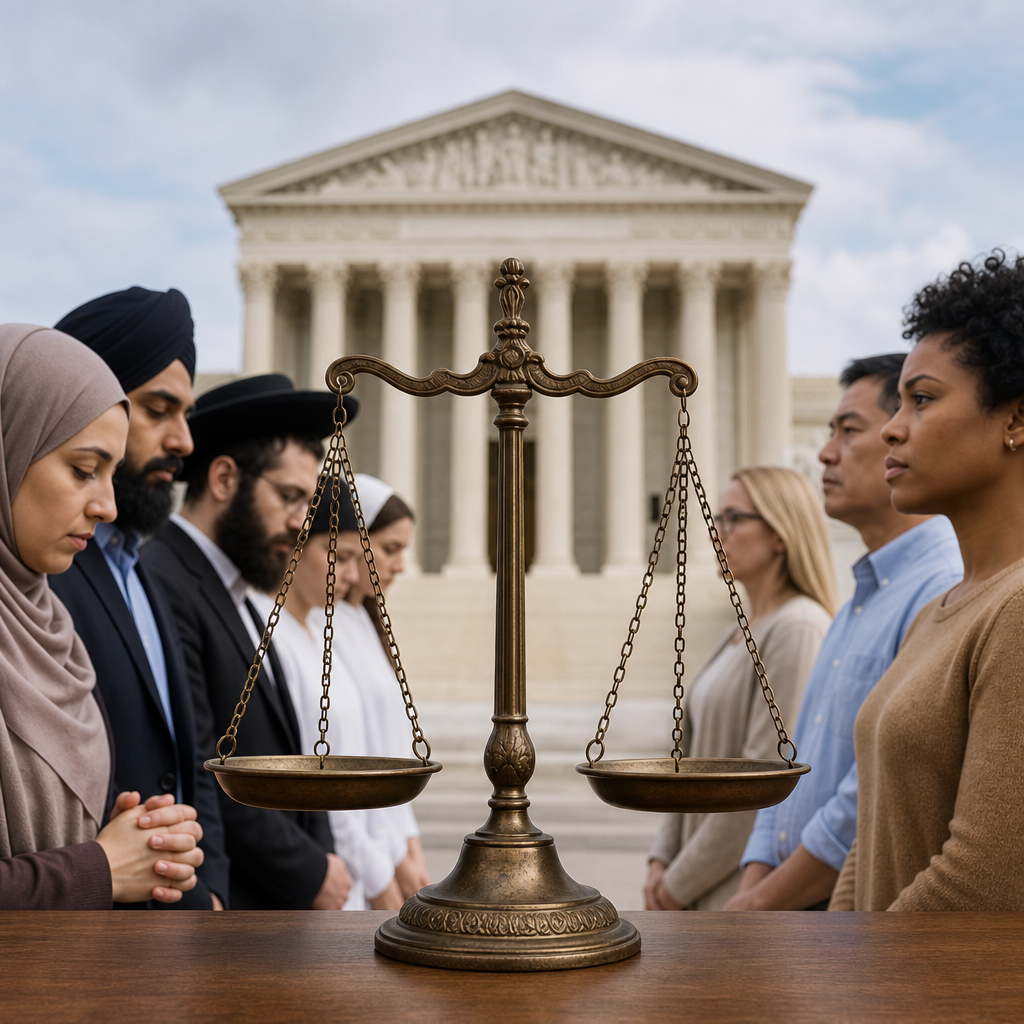
Religious exemptions and anti-discrimination law sit at one of the most contested intersections in American public life, where constitutional liberty, statutory rights, and everyday access to jobs, housing, schools, and services collide. In practical terms, a religious exemption is a legal protection allowing an individual, organization, or institution to avoid complying with a generally applicable rule when compliance would substantially burden religious exercise. Anti-discrimination law, by contrast, bars unequal treatment based on protected traits such as race, sex, religion, disability, and, in many jurisdictions, sexual orientation and gender identity. Courts are asked to reconcile these commitments when one party claims conscience and another claims exclusion.
This topic matters in AP Government and Politics because it brings together the First Amendment, federalism, civil rights statutes, judicial review, and the role of courts in resolving pluralism. It also matters because these disputes are no longer rare edge cases. They arise in employment decisions at religious schools, health insurance mandates, adoption and foster care contracts, wedding-service businesses, prison regulations, university policies, and public-accommodation enforcement. I have worked through these questions by reading opinions, tracking doctrinal shifts, and comparing how judges frame burdens, compelling interests, and institutional autonomy. The central lesson is consistent: courts do not simply choose religion over equality or equality over religion. They balance claims through a structured analysis grounded in text, precedent, and facts.
Understanding that balancing requires a few key terms. The Free Exercise Clause protects religious practice from improper government interference. The Establishment Clause limits government endorsement or sponsorship of religion. Strict scrutiny is the toughest standard of judicial review; it asks whether the government is pursuing a compelling interest through the least restrictive means. Rational basis review is far more deferential. A public accommodation is a business or provider offering goods or services to the public. The ministerial exception is a judge-made doctrine preventing courts from second-guessing a religious institution’s choice of ministers. Statutory protections matter too, especially Title VII of the Civil Rights Act, the Religious Freedom Restoration Act, and state-level religious freedom laws. Together, these doctrines create the framework courts use to decide who wins, who loses, and why.
Constitutional and statutory foundations
The modern legal framework begins with the First Amendment but cannot be understood without statutes and later judicial interpretation. Under Employment Division v. Smith in 1990, a neutral law of general applicability usually does not violate free exercise simply because it incidentally burdens religion. That rule narrowed constitutional protection and shifted many disputes into legislatures and statutes. Congress responded by enacting the Religious Freedom Restoration Act, known as RFRA, in 1993. RFRA reinstated a compelling-interest test for federal action: if the government substantially burdens religious exercise, it must show a compelling interest pursued through the least restrictive means. After City of Boerne v. Flores in 1997, RFRA no longer applied to the states as a general matter, so many states adopted their own versions.
Anti-discrimination law developed on a parallel track. The Civil Rights Act of 1964 prohibited discrimination in employment and public accommodations on several grounds, later joined by protections under the Fair Housing Act, Title IX, the Americans with Disabilities Act, and state and local civil rights laws. Some of these statutes contain explicit religious carveouts. Title VII, for example, allows religious organizations to prefer co-religionists in hiring for many positions. Other protections arise constitutionally, as with the ministerial exception recognized unanimously by the Supreme Court in Hosanna-Tabor Evangelical Lutheran Church and School v. EEOC in 2012 and expanded in Our Lady of Guadalupe School v. Morrissey-Berru in 2020. Those cases reflect a principle courts treat as foundational: civil authorities should not control who teaches or embodies a faith community’s religious mission.
When courts balance competing claims, they usually ask a sequence of questions. Is the law neutral and generally applicable? Does a statute like RFRA apply? Is the claimant an individual, a closely held business, a nonprofit, or a church? Is the setting employment, contracting, education, or retail commerce? Is the government regulating belief, conduct, or eligibility for public funds? And what harm does the exemption impose on third parties who would otherwise receive equal treatment? In actual litigation, outcomes often turn less on slogans than on these categories.
How courts perform the balancing test in real cases
In practice, judges weigh competing claims through recurring factors rather than a single universal formula. First, they identify the burden on religion. Courts generally do not assess whether a belief is correct; they ask whether it is sincerely held and whether the law pressures the claimant to act against that belief. Second, they define the government’s objective. Preventing discrimination is often described as a compelling interest, especially in access to employment, housing, education, and the commercial marketplace. Third, they examine fit. Could the government achieve its objective in a way that burdens religious exercise less? That least-restrictive-means inquiry is where many cases are won or lost.
The doctrinal path changes depending on the source of law. If the Constitution alone applies and a law is neutral and generally applicable, the government often prevails under Smith. If officials create individualized exemptions, however, or if the law is not neutral toward religion, strict scrutiny can return. That was central in Church of Lukumi Babalu Aye v. City of Hialeah, where ordinances targeting Santeria animal sacrifice failed because they were not truly neutral. More recently, in Fulton v. City of Philadelphia in 2021, the Court held that Philadelphia’s foster-care contract system triggered strict scrutiny because it allowed discretionary exemptions, and the city had refused to contract with Catholic Social Services unless it agreed to certify same-sex couples. The Court did not broadly overrule Smith, but it showed how contractual discretion can reshape constitutional analysis.
| Case | Core conflict | Court’s approach | Practical takeaway |
|---|---|---|---|
| Employment Division v. Smith (1990) | Drug law burdened religious peyote use | Neutral, generally applicable laws usually stand | Constitutional exemptions are limited without hostile targeting |
| Burwell v. Hobby Lobby (2014) | Federal contraceptive mandate challenged by closely held companies | Applied RFRA strict scrutiny to federal mandate | Statutory protection can exceed constitutional protection |
| Masterpiece Cakeshop v. Colorado (2018) | Baker objected to creating cake for same-sex wedding | Focused on impermissible hostility by officials | Government neutrality in enforcement matters greatly |
| Fulton v. Philadelphia (2021) | Faith-based foster agency declined same-sex couple certification | Discretionary exemptions triggered strict scrutiny | Policy design can determine the level of judicial review |
I have found that students understand these cases best when they separate status discrimination from message-based objections and constitutional claims from statutory ones. A bakery, adoption agency, or school may frame its case as one about compelled speech, religious exercise, institutional autonomy, or contract conditions, but the court will strip the dispute to legal elements. Was there a public-facing service? Did officials show hostility? Is the claimant exempt under statute? Are third parties denied a service available to others? Clear answers to those questions usually explain the result better than cultural labels do.
Employment, education, and institutional autonomy
Employment and education disputes reveal why courts often treat religious institutions differently from ordinary businesses. Churches, synagogues, mosques, and religious schools are not just associations; they are mission-driven bodies that define doctrine, worship, and formation. The ministerial exception reflects that reality. In Hosanna-Tabor, a teacher at a Lutheran school sued under disability discrimination law after being dismissed. The Supreme Court held that the First Amendment barred the claim because the employee had important religious duties and was considered a minister within the church’s structure. In Our Lady of Guadalupe, the Court emphasized function over title, holding that teachers entrusted with religious instruction could fall within the exception even without formal ministerial rank.
These cases do not create blanket immunity. Religious employers remain subject to many labor and civil rights laws, especially for workers performing nonreligious functions. Janitors, accountants, nurses, and food-service staff are not automatically outside anti-discrimination protection because they work for a faith-based employer. Title VII’s religious-organization exemption allows hiring based on religion in many settings, but it does not generally authorize race discrimination, and courts have long treated race discrimination as uniquely intolerable. Sex discrimination questions are more contested, especially after Bostock v. Clayton County in 2020 held that firing someone for being gay or transgender is discrimination because of sex under Title VII. After Bostock, lower courts have grappled with how Title VII, RFRA, and the ministerial exception interact when religious schools and universities defend employment decisions involving sexuality or gender identity.
Educational institutions add further complexity because they combine expressive, associational, and regulatory interests. A religious college seeking accreditation, federal funding, or state licensure may be required to follow nondiscrimination standards that affect housing, admissions, or student conduct policies. Courts then ask whether the institution is being excluded from a public program because of religious identity or because it refuses to follow neutral conditions attached to funding. Recent school-choice and aid cases, including Trinity Lutheran, Espinoza, and Carson v. Makin, show the Court’s increasing skepticism toward excluding religious entities from generally available public benefits. But inclusion in funding programs can create downstream conflicts over what conditions may constitutionally be attached.
Public accommodations, commerce, and third-party harm
The most publicly visible clashes often involve businesses serving the public. Public-accommodation laws are designed to ensure that customers can obtain goods and services without humiliation or exclusion. Historically, these laws were central to dismantling racial segregation. Courts therefore approach requests for exemptions in commerce with caution, especially when an exemption would allow a business open to the public to deny service based on a protected characteristic. At the same time, some businesses argue that custom expressive work implicates speech or religious conscience in a way that ordinary retail transactions do not.
Masterpiece Cakeshop did not establish a broad religious right to refuse service. Instead, the Court ruled narrowly that Colorado officials had shown impermissible hostility toward the baker’s religious beliefs, violating the requirement of neutrality. That left the larger conflict unresolved. In 303 Creative LLC v. Elenis in 2023, the Court addressed a related issue through compelled speech rather than free exercise, holding that Colorado could not force a designer to create custom wedding websites celebrating same-sex marriage. The decision was limited by the Court’s focus on original expressive content, but it intensified debate over where to draw the line between protected expression and ordinary commercial conduct.
One concept judges and scholars keep returning to is third-party harm. If a religious exemption significantly shifts costs onto employees, customers, tenants, or children in state-supervised systems, courts are less willing to grant it. That concern surfaced in debates over contraceptive coverage, foster-care certification, and service denial. In Burwell v. Hobby Lobby, the Court allowed closely held corporations to object under RFRA to part of the federal contraceptive mandate, but it relied heavily on the existence of a less restrictive alternative the government had already devised for religious nonprofits. Critics argued that employees still bore burdens; supporters argued the government could absorb those burdens without coercing objectors. That exchange captures the core balancing problem: exemptions are rarely cost free, so courts must decide who should bear the cost in a constitutional democracy.
Why this issue anchors AP Government and Politics
For AP Government and Politics, this subject works as a hub because it connects core institutions and recurring exam themes. It links constitutional clauses to public policy, demonstrates how precedent evolves, and shows why statutory drafting matters as much as constitutional text. It also illustrates federalism: federal RFRA applies to federal action, state RFRAs vary widely, and state civil rights protections often go beyond federal minimums. A student studying religious exemptions will also encounter bureaucracy, because many conflicts begin with agency rules; political behavior, because advocacy groups on both sides strategically select plaintiffs and forums; and comparative institutional power, because legislatures can create exemptions that courts then interpret.
The most useful takeaway is that courts balance competing claims through legal categories, not broad moral declarations. Strong religious claims do not always win, and strong equality claims do not always override. Outcomes depend on neutrality, general applicability, statutory text, institutional role, the presence of discretion, the availability of alternatives, and the extent of harm to others. For students, voters, and policymakers, the benefit of understanding this framework is clarity. It becomes easier to read a new case, predict the arguments, and see why small factual differences change the law. Keep this article as your starting point, then follow the linked cases and statutes in this subtopic to build a full map of how American government manages deep disagreement.
Frequently Asked Questions
What is a religious exemption, and how does it interact with anti-discrimination law?
A religious exemption is a legal protection that allows a person, business, nonprofit, school, or religious institution to seek relief from a law that would otherwise apply to everyone if following that law would substantially burden religious exercise. In the United States, these claims can arise under the First Amendment, under federal statutes such as the Religious Freedom Restoration Act, and under similar state constitutional and statutory protections. Anti-discrimination laws, by contrast, are designed to ensure equal access to employment, housing, education, public accommodations, and government services regardless of protected traits such as race, sex, religion, disability, and, in many jurisdictions, sexual orientation or gender identity. The tension emerges when one party argues that compliance with an anti-discrimination rule violates sincere religious beliefs, while another party argues that an exemption would deny equal treatment and inflict real-world harm.
Courts do not usually treat either side as automatically controlling. Instead, they ask what legal framework governs the dispute, how substantial the claimed burden on religion really is, what governmental interest the anti-discrimination law serves, and whether the law is being applied in a neutral and generally applicable way. In some cases, courts uphold the anti-discrimination rule because preventing exclusion and ensuring equal civic participation are compelling interests. In others, courts recognize an exemption, especially where the dispute involves internal religious governance, clergy relationships, sacramental functions, or settings where the government has less leverage to compel compliance. The key point is that these cases are rarely abstract. Courts are often balancing concrete religious liberty claims against equally concrete harms involving jobs, benefits, housing, schooling, or access to services.
How do courts decide when religious freedom should prevail over an anti-discrimination requirement?
The answer depends heavily on the source of law and the facts of the dispute. A common starting point is whether the challenged law is neutral and generally applicable. If a law targets religion, treats religious conduct worse than comparable secular conduct, or gives officials broad discretion that is applied in a way hostile to religion, courts are more likely to apply strict scrutiny. Under that demanding standard, the government must show that enforcing the law serves a compelling interest and is the least restrictive means of achieving it. That is a difficult burden, although not impossible, particularly when the government is trying to prevent serious discrimination or protect vulnerable populations from exclusion.
Even where a law appears facially neutral, statutory protections may create a separate path for religious claimants. Federal and state religious freedom laws can require courts to examine whether the government has substantially burdened religious exercise and, if so, whether it has a sufficiently strong justification for doing so. Courts also look closely at the setting. They are especially protective of decisions involving ministers, internal doctrine, religious teaching, and church governance. But they are often less willing to grant exemptions in the commercial marketplace when third parties would lose equal access to goods, services, or opportunities. In practice, judges weigh sincerity, burden, governmental purpose, available alternatives, the risk of undercutting civil rights enforcement, and the practical impact on those denied protection. The balancing is legal, but it is also deeply contextual.
Are religious organizations treated differently from private businesses or individuals in these cases?
Yes, often significantly differently. Religious organizations generally receive stronger constitutional and statutory protection when the dispute involves their internal mission, faith-based leadership, or doctrinal decisions. One of the clearest examples is the so-called ministerial exception, which bars many employment-discrimination claims brought by employees who perform important religious functions. Courts have recognized that forcing a church, synagogue, mosque, or religious school to accept or retain a ministerial leader would directly interfere with religious autonomy. Related doctrines also limit judicial review of internal ecclesiastical disputes, because courts are not supposed to decide theological questions or second-guess a religious body’s understanding of its own faith commitments.
Private businesses and individuals can still raise religious objections, but their claims are often evaluated more skeptically when they operate in the public marketplace and offer goods or services to the general public. The reasoning is straightforward: anti-discrimination law is meant to protect people from exclusion in ordinary civic and economic life. When a business serves the public, courts must consider not only the owner’s religious beliefs but also the customer’s right to equal treatment. That does not mean businesses always lose, but it does mean the analysis usually turns on whether the government is regulating conduct rather than belief, whether the law is neutrally enforced, and whether granting an exemption would impose material harm on third parties. The farther a case moves from church autonomy and the closer it gets to public-facing commerce, the more difficult a religious exemption can become to justify.
What role do third-party harms play when courts balance competing claims?
Third-party harm is one of the most important and practical considerations in these disputes. Courts increasingly recognize that a religious exemption is not cost-free if it shifts the burden of accommodation onto employees, tenants, students, patients, customers, or members of the public. For example, if an exemption allows an employer to deny equal workplace benefits, a landlord to refuse housing, or a service provider to turn away a protected customer, the person excluded may suffer more than inconvenience. The consequences can include lost income, humiliation, delayed medical care, reduced educational access, or the inability to participate fully in community life. Anti-discrimination law exists precisely because these harms are not merely private disagreements; they can reinforce systemic barriers and unequal citizenship.
That said, third-party harm is not always dispositive in a formal sense, and different courts describe its role differently. Some incorporate it into strict scrutiny by asking whether denying the exemption is necessary to serve a compelling interest in preventing discrimination. Others treat it as a core policy consideration when interpreting the scope of religious accommodations. In either approach, the practical effect is similar: the more directly an exemption would deprive another person of a legal protection or meaningful access, the less likely a court may be to grant it. Judges are often trying to avoid a rule under which religious liberty becomes a license to impose significant costs on others, while also preserving enough room for genuine faith-based dissent. That tension explains why outcomes can vary so much from case to case.
Why are these cases so fact-specific, and what trends are shaping future court decisions?
These disputes are highly fact-specific because small differences in context can change the governing doctrine and the outcome. A claim involving a church’s selection of clergy is not treated the same as a claim involving a hospital, a university, a wedding vendor, a foster-care contractor, or a landlord. Courts ask who the parties are, what law applies, what conduct is being required, whether the government has made individualized exceptions for others, whether the claimant is acting in a religious or commercial capacity, and who would bear the burden of any exemption. The legal labels matter, but so do the real-life details. A case can turn on whether an employee’s role was religious in substance, whether a licensing scheme gave officials too much discretion, or whether an alternative arrangement would protect both religious exercise and equal access.
Looking ahead, several trends are likely to keep shaping this area of law. First, courts continue to give robust protection to religious exercise in many contexts, especially where government action appears uneven, discretionary, or insufficiently neutral. Second, anti-discrimination protections based on sex, sexual orientation, and gender identity remain a major arena of conflict, particularly in employment, education, health care, and public accommodations. Third, judges are paying close attention to whether claimed exemptions would undermine broad civil-rights regimes or create cascading effects on third parties. Finally, legislatures and agencies will continue to matter alongside courts, because statutory drafting, regulatory exemptions, and enforcement choices often determine how these conflicts are framed before a judge ever decides them. For readers trying to understand the big picture, the best takeaway is that courts are not choosing between religious liberty and equality in the abstract; they are continually trying to define how both can coexist in a constitutional system committed to each.