
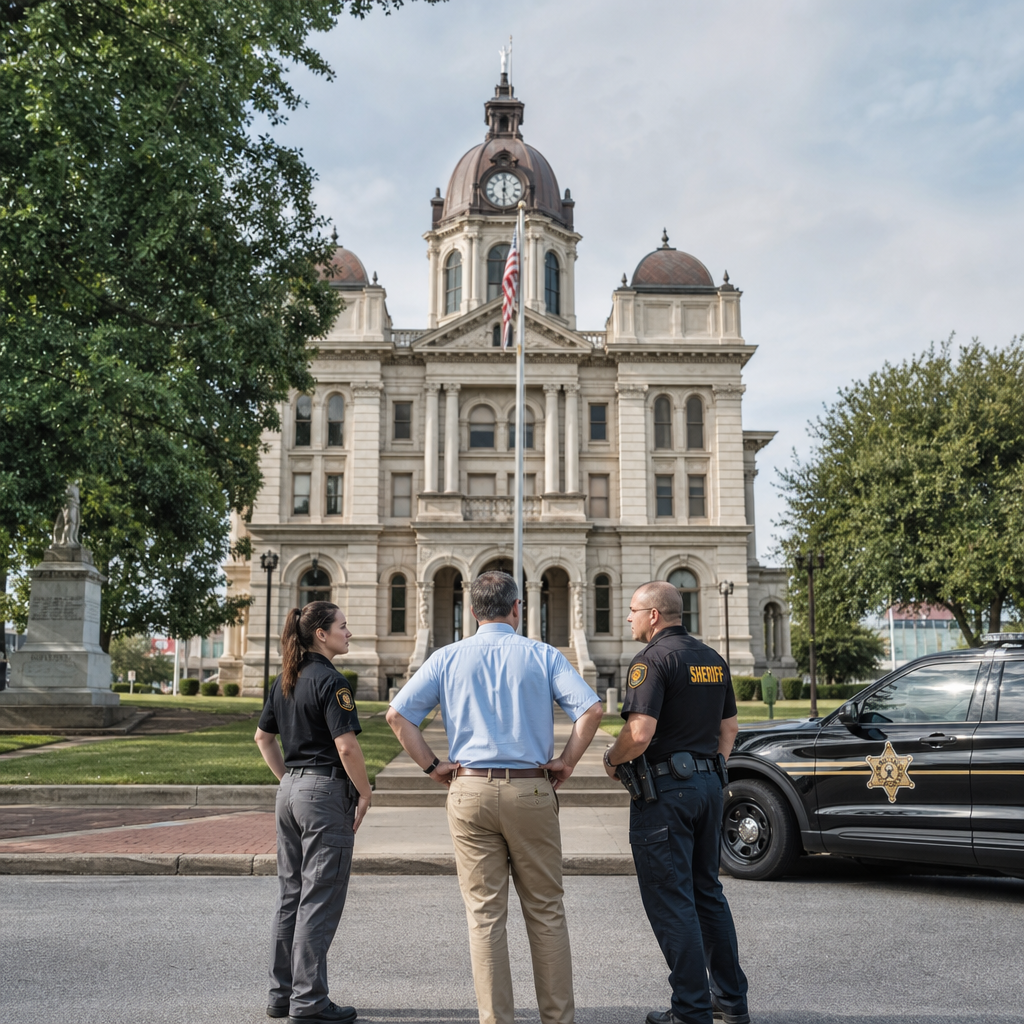
County government sits in the middle of American public life: close enough to residents to issue permits, record deeds, run elections, and operate jails, yet large enough to manage courts, roads, property taxes, and public health across entire regions. In AP Government and Politics, counties often receive less attention than Congress, the presidency, or state legislatures, but they matter because they translate state law into everyday administration. A county is a political and administrative subdivision of a state, created by state constitutions or statutes, with powers that vary widely by state. Louisiana calls them parishes, Alaska uses boroughs and census areas, and some places, such as Virginia’s independent cities, separate municipal authority from county authority entirely.
When students ask what counties actually do, the shortest accurate answer is this: counties deliver basic local government functions for areas that are too large for a single city but too local for the state to run directly. In practice, that includes assessing property, collecting taxes, maintaining records, administering elections, funding courts, managing land use in unincorporated areas, providing emergency services, and coordinating social services. I have worked with county budgets and public meeting packets, and the pattern is consistent across states even when job titles differ. The county is usually the place where abstract public policy becomes a permit, a ballot, a patrol route, a food inspection, or a case file.
This topic matters for three reasons. First, county government affects daily life more often than many people realize. Buying a home triggers county recording and assessment processes. Getting married may involve a county clerk. Calling 911 in an unincorporated area may bring a county sheriff or county fire service. Second, counties are central to how federalism works. States delegate authority downward, and counties carry it out under state supervision. Third, counties reveal how American government balances democracy and administration. Some officials are elected, such as sheriffs or assessors, while others are appointed professionals, such as county administrators or public health directors. Understanding counties helps students connect constitutional ideas to real institutions.
How counties are created and why their powers vary
Counties do not exist because the U.S. Constitution requires them; they exist because states create them. That single fact explains most of the confusion around county government. States decide county boundaries, official duties, revenue options, and organizational structure. As a result, Texas counties, California counties, and New York counties can look very different even though all are called counties. The National Association of Counties, commonly called NACo, counts more than 3,000 county-equivalent governments nationwide, including parishes and boroughs. Their legal authority depends on state law, not on an inherent local right to govern.
Political scientists often describe counties as administrative arms of the state. That is broadly correct, but it can understate county discretion. In many states, counties have “home rule” authority, meaning they can legislate on local matters unless state law forbids it. In other states, counties operate under stricter limits, often associated with Dillon’s Rule, under which local governments have only powers expressly granted by the state, necessarily implied, or essential to their purposes. For AP Government and Politics, the key point is that counties are not sovereign. They are subordinate governments whose scope can expand or shrink when a state legislature changes the law.
Variation also comes from settlement patterns. Rural counties often deliver more direct services because there are fewer cities to handle them. Urban counties may overlap with powerful municipalities, transit agencies, school districts, and special districts, creating a more fragmented local system. Miami-Dade County, for example, has broad metropolitan responsibilities and a mayor-commission structure, while many small counties rely on a board of commissioners and independently elected officials. County government is therefore best understood as a flexible state-designed framework for managing regional local needs.
What counties actually do day to day
The core responsibilities of county government fall into a handful of recurring categories. Administrative records are one of the biggest. Counties often keep deeds, mortgages, liens, plats, birth and death records in some states, marriage licenses, probate files, and business filings. These records support property markets, inheritance, identity documentation, and public transparency. When a title company verifies ownership before a sale, county records are usually part of the process.
Counties also run key parts of the justice and public safety system. Sheriffs enforce laws, operate jails, provide courthouse security, serve warrants and civil papers, and in many jurisdictions patrol unincorporated areas. Counties fund trial courts, prosecutors or district attorneys in some states, public defenders in many places, probation services, and emergency management offices. During natural disasters, county emergency managers coordinate shelters, debris contracts, and mutual aid with cities and states.
Another major function is taxation and finance. County assessors appraise property for tax purposes, treasurers collect taxes, and boards set tax rates within state limits. Property tax revenue helps support county operations and often schools, libraries, and special districts. In fast-growing areas, assessment accuracy is politically sensitive because residents quickly notice valuation increases. Counties also prepare annual budgets, issue bonds for capital projects, and undergo independent audits under state law.
Public works and land use are equally important. Counties maintain roads and bridges outside city limits, review subdivision plats, enforce building and septic rules where authorized, and manage zoning in unincorporated areas. A developer proposing a new rural subdivision may need county approval for road access, drainage, water availability, and lot layout. Public health departments, often county-based, inspect restaurants, track communicable diseases, run vaccination clinics, and monitor environmental hazards.
| County function | What it means in practice | Example |
|---|---|---|
| Property administration | Recording deeds, assessing value, collecting taxes | A home sale is filed with the recorder, then updated by the assessor |
| Public safety | Jails, sheriff patrols, warrants, emergency management | The sheriff responds in unincorporated areas and operates the county jail |
| Justice system support | Funding courts, clerks, prosecutors, defenders | County budget pays for court facilities and case processing staff |
| Infrastructure | Roads, bridges, drainage, solid waste in some areas | A washed-out county road is rebuilt after flooding |
| Health and human services | Clinics, inspections, benefits administration, child services | The health department conducts restaurant inspections and immunization clinics |
| Elections | Voter registration, polling places, ballot counting | The county board of elections certifies local results |
County structure: commissioners, executives, clerks, and sheriffs
Most counties are governed by an elected board, commonly called a board of commissioners, supervisors, or county council. This body adopts the budget, enacts ordinances where authorized, approves contracts, and oversees broad policy. The board may be elected by district, at large, or through a mixed system. Larger counties may also elect a county executive or mayor who prepares the budget and directs departments, creating a local version of separation between legislative and executive functions. Smaller counties often use a county administrator or manager hired by the board.
A distinctive feature of county government is the number of independently elected officials. The sheriff, clerk, assessor, treasurer, recorder, coroner, and register of deeds may all answer directly to voters rather than to the commission. Supporters argue this creates accountability because residents can remove poorly performing officeholders. The drawback is fragmentation. I have seen counties where budget coordination becomes difficult because each elected office protects its own systems, staffing model, and political base. That can slow modernization even when everyone agrees services should improve.
The judicial role also differs by state. Some county clerks manage court records and election records. In other states, courts operate more directly under the state judiciary, though counties still pay for buildings, security, and support staff. Students should remember that titles are not perfectly standardized. A county clerk in one state may handle records and elections, while in another state those duties are divided among several offices. The safe analytical approach is to identify function first and title second.
How counties make policy and pay for services
County policy making is usually less ideological than national politics, but it is not apolitical. Budgets force tradeoffs among patrol staffing, road resurfacing, jail expansion, public health, parks, and employee pay. Revenue typically comes from property taxes, sales taxes where allowed, user fees, intergovernmental transfers, fines, and grants. Because states impose tax caps and unfunded mandates, county officials often face a structural squeeze: residents want services, but state law restricts local fiscal flexibility.
The annual budget process is the clearest way to understand county priorities. Departments submit requests, finance staff estimate revenue, elected officials negotiate, and the board adopts a spending plan after public hearings. Capital improvement plans identify long-term needs such as courthouse renovations, radio systems for first responders, bridge replacements, or landfill expansion. Counties also use procurement rules, performance audits, and bond covenants to constrain how money is spent. These technical tools matter because local governance often succeeds or fails on administrative competence rather than speeches.
Public participation is closer to the ground at the county level. Residents speak at hearings on tax rates, rezoning proposals, road projects, jail conditions, or sheriff budgets. Interest groups are often practical rather than ideological: homebuilders, chambers of commerce, public employee unions, neighborhood associations, and environmental advocates. In growth counties, land use fights can define local politics for years. In declining rural counties, the hardest questions may concern hospital access, opioid response, and how to maintain roads with a shrinking tax base.
Counties, cities, and special districts: who does what?
Many people confuse counties with cities because both are local governments. The difference is jurisdiction and service area. Cities govern incorporated municipalities. Counties govern larger territories and usually provide services to unincorporated areas plus regionwide services that benefit everyone, including city residents. A city police department may patrol within city limits, while the county sheriff covers unincorporated territory and runs the jail for the whole county. A city may manage its own zoning, but the county handles zoning beyond municipal boundaries.
Special districts complicate the picture further. School districts, water districts, transit authorities, mosquito control districts, and fire protection districts can all overlap with counties. States create these entities to target a single function across boundaries. The result is a layered local system. For example, a resident might pay taxes to a county, city, school district, and community college district, while receiving water from a special utility district. Understanding local politics means mapping these overlapping jurisdictions rather than assuming one government does everything.
Consolidation sometimes changes the model. Nashville and Davidson County, Indianapolis and Marion County, and Louisville and Jefferson County are examples of city-county consolidation, though the details vary. Consolidation can reduce duplication and align service delivery with metropolitan realities, but it does not automatically save money. Political identity, labor agreements, and service level expectations all affect outcomes. The broader lesson is that county government is adaptable, not uniform.
Why counties matter in elections, public health, and emergency response
Counties become highly visible during elections because they often administer voter registration, polling locations, early voting sites, ballot tabulation, and canvassing. Even where states set election rules, county election offices do the operational work. After 2020, public attention to chain-of-custody procedures, post-election audits, machine testing, and bipartisan observation increased dramatically. County election administration is a reminder that democratic legitimacy depends on competent local operations.
Public health offers another vivid example. During COVID-19, county health departments tracked cases, issued local guidance consistent with state law, coordinated vaccine distribution, and communicated risk to the public. Their authority differed sharply across states, but their practical role was indispensable. Long before the pandemic, counties were handling tuberculosis control, foodborne illness investigations, maternal health programs, and environmental testing. When these systems are strong, residents barely notice them. When they fail, the consequences are immediate.
Emergency response shows why counties exist at all. Wildfires, hurricanes, floods, and tornadoes do not stop at city lines. County governments coordinate evacuation routes, mutual aid, mass sheltering, debris management, and damage assessment across jurisdictions. Federal disaster aid often flows through state and county channels before reaching local projects. The county is therefore not just a bureaucratic layer; it is often the operational hub during crisis.
County government is where state authority meets daily life. Counties record the documents that define ownership, run elections that define representation, fund institutions that define justice, and maintain infrastructure that makes communities function. Their exact powers differ because states design them differently, but the core pattern is consistent: counties manage regional local services, especially in areas beyond city boundaries and in functions that require coordination across a whole area.
For AP Government and Politics, the most important takeaway is that counties illustrate federalism, local administration, and democratic accountability at the same time. They are subordinate to states, yet indispensable to implementing policy. They can be highly fragmented, yet they are often the first government residents encounter when they need a permit, pay a tax bill, check a deed, vote, or seek emergency help. If you want to understand how government works beyond the textbook, study the county budget, the county clerk, the sheriff, and the commission agenda. That is where public policy becomes real.
Use this hub as your starting point for the wider “Misc” area of AP Government and Politics, then explore related articles on local government, federalism, elections, public administration, and civil society. The better you understand county government, the easier it becomes to see how American institutions actually operate on the ground.
Frequently Asked Questions
What is a county government, and why does it matter in everyday life?
A county government is a local unit of government created by a state to administer public services and enforce state law over a broad geographic area. In practical terms, counties often sit between city governments and the state government. They matter because many of the services people rely on every day are handled at the county level, even if residents do not always realize it. Counties commonly maintain public records, oversee local courts, collect property taxes, run elections, manage jails, operate health departments, assess property values, issue certain permits, and maintain roads in unincorporated areas.
What makes counties especially important is that they turn state policy into everyday administration. A state legislature may pass laws on public health, criminal justice, land records, taxation, or elections, but counties are often the institutions that carry those laws out. That gives county governments a practical, hands-on role in American democracy. If someone registers to vote, records a deed after buying a house, pays property taxes, serves on a jury, applies for a marriage license, or interacts with the local court system, there is a good chance county government is involved.
Counties also matter because they serve both urban and rural populations, though the exact services vary from place to place. In some states, counties are powerful and visible. In others, they are more limited. But across the United States, they are a major part of how government reaches residents directly. For students of AP Government and Politics, counties are worth paying attention to because they show how federalism and decentralization work in practice: states create counties, define their powers, and rely on them to carry out core public responsibilities.
What do counties actually do, and which services are most commonly handled at the county level?
County responsibilities differ by state, but several functions are especially common. One major role is administering the justice system. Counties often fund and operate trial courts, maintain court records, support prosecutors and public defenders, and run county jails. They may also support sheriffs’ offices, which can provide law enforcement in unincorporated areas, manage courthouse security, serve legal documents, and transport detainees.
Another core county responsibility is recordkeeping. Counties frequently maintain official records such as property deeds, liens, marriage licenses, birth and death records in some states, and other legal documents. This function may seem technical, but it is fundamental to economic life and legal order. Without reliable county records, property ownership, inheritance, taxation, and many business transactions would become much more difficult to verify.
Counties are also central to elections in many states. They may register voters, maintain voter rolls, assign polling locations, print ballots, process absentee ballots, certify local results, and manage election staffing. In addition, county governments often play a large role in taxation and finance. Property tax assessment and collection are commonly county functions, and those revenues can help fund schools, law enforcement, infrastructure, and other public services depending on the state’s system.
Public health is another major county responsibility. Counties may operate health clinics, vaccination programs, restaurant inspections, disease monitoring systems, mental health services, and emergency preparedness efforts. During crises such as disease outbreaks or natural disasters, county agencies are often among the first to respond in a coordinated way. Counties may also maintain roads and bridges outside city limits, oversee land use or zoning in unincorporated areas, provide waste services, and administer social services. In short, counties do a wide range of practical work that keeps communities functioning, often behind the scenes.
How is county government different from city government and state government?
The biggest difference is jurisdiction and legal authority. State governments are sovereign within their constitutional sphere and create county governments through state law. That means counties do not exist independently in the same way states do. Instead, counties are administrative and political subdivisions of the state. Their powers are usually limited to what state constitutions, statutes, and court decisions allow. In contrast, city governments are municipal corporations created to govern specific incorporated communities such as towns and cities.
Counties usually serve larger geographic areas than cities and often cover both incorporated and unincorporated territory. A city government focuses on municipal services such as policing, fire protection, water systems, trash collection, and local zoning within its boundaries. A county government, by comparison, often has broader regional responsibilities. It may provide services across the whole county or specifically in areas that are outside city limits. For example, if a resident lives in an unincorporated area, the county may be the main local government they deal with for roads, law enforcement, land use, and permits.
There can also be overlap. Both cities and counties may have roles in public safety, transportation, planning, and public works, depending on the state. In some metro areas, city and county functions are consolidated or closely coordinated. But generally, states set the rules, counties administer many regional and legal functions, and cities handle more localized municipal services. This layered arrangement is a good example of American federalism and local governance: different levels of government perform different tasks, but they often interact constantly in practice.
Who runs a county government, and how are county officials chosen?
County government is usually run by a combination of elected officials and professional administrators, though the exact structure varies widely by state. In many counties, the central governing body is called a county commission, county board, board of supervisors, or something similar. This body typically adopts budgets, sets policy priorities, approves ordinances where permitted, and oversees county departments. Members are often elected by district or at large, which gives residents a direct voice in county leadership.
Beyond the governing board, many county offices may be independently elected. Common examples include the sheriff, clerk, treasurer, assessor, recorder, coroner, district attorney, and judges in some systems. Because these officials may be elected separately, county government can be more fragmented than people expect. That fragmentation reflects a long-standing American preference for dispersing power, but it can also make coordination more challenging. A county board may control the budget, for example, while other county officials retain independent authority over how their offices operate.
Many larger counties also rely on professional management. A county administrator or county executive may oversee day-to-day operations, supervise departments, implement board policies, and coordinate service delivery. In some places, the executive is elected; in others, appointed. This blend of elected accountability and administrative management is one reason county government can seem complicated. Still, the logic is straightforward: residents elect key officials to ensure democratic control, while trained public administrators help manage the scale and technical complexity of county operations.
Why are counties important in AP Government and Politics, even if they receive less attention than national institutions?
Counties are important in AP Government and Politics because they illustrate how government functions beyond the national spotlight. Congress, the presidency, and the Supreme Court often dominate attention, but county governments show where public policy becomes concrete. They are a strong example of implementation, administration, and intergovernmental relations. States make laws and establish broad policy frameworks, but counties often carry out the actual work of enforcing those laws, collecting data, managing systems, and delivering services to residents.
Studying counties also helps students understand the practical side of federalism. American government is not just divided between the national government and the states. States themselves distribute power downward to counties, municipalities, school districts, and special districts. Counties reveal how authority is shared, delegated, and limited. Because county powers vary by state, they also show how institutional design differs across the country. That variation is politically significant: a county in one state may oversee major health and justice functions, while a county in another state may be much weaker.
Just as importantly, counties are where many citizens experience government most directly. Elections administration, court proceedings, taxation, property records, public health orders, and local infrastructure all shape public trust and political participation. If students want to understand how democratic institutions affect daily life, counties offer a clear and useful case study. They may be less glamorous than national institutions, but they are essential to understanding how American government actually works on the ground.