
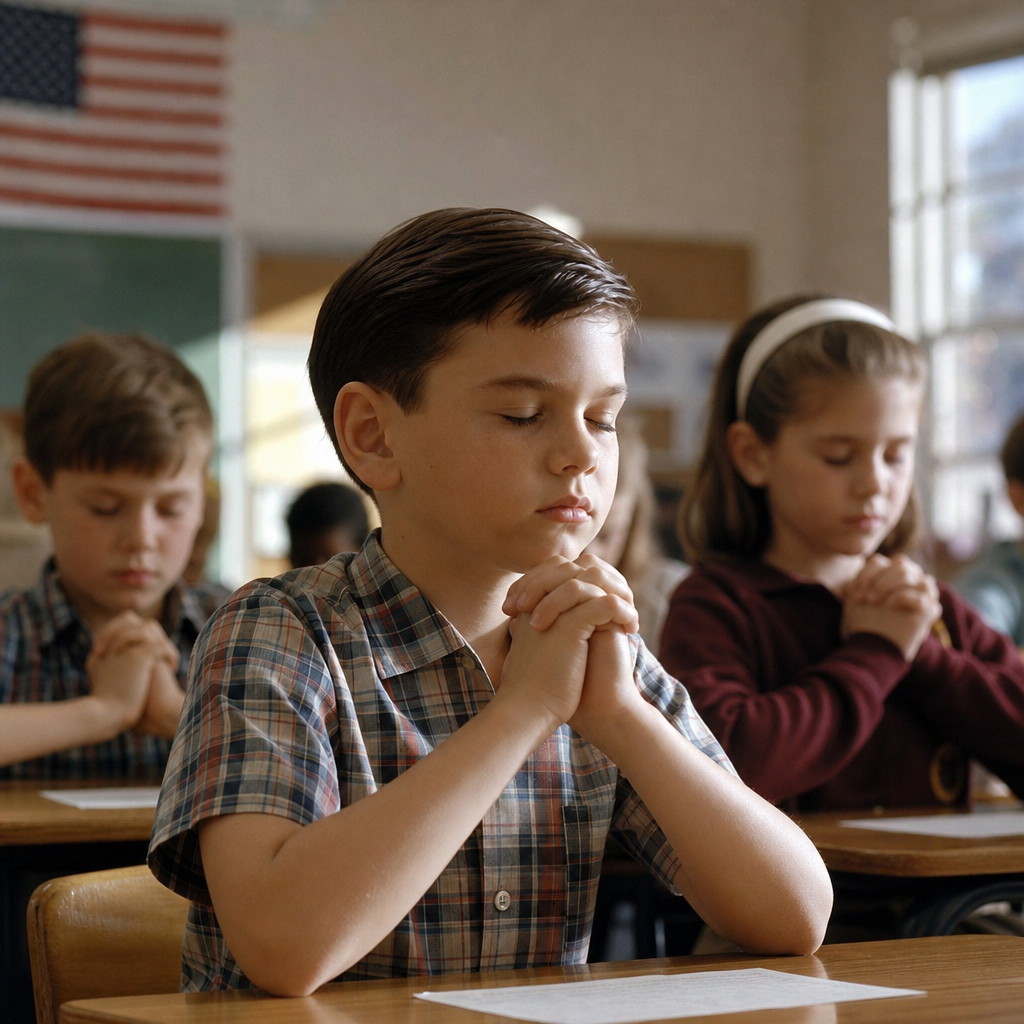
Engel v. Vitale is one of the most important Supreme Court decisions in AP Government and Politics because it defined how the Establishment Clause limits school-sponsored prayer in public education. In 1962, the Court held that government-written prayer recited in public schools violates the First Amendment, even when participation is technically voluntary and the prayer is nonsectarian. For students studying constitutional law, civil liberties, or religion in public life, this case is a foundation for understanding how the Supreme Court interprets the separation of church and state.
The case arose from a New York policy that encouraged public schools to begin the day with a short official prayer composed by state authorities: “Almighty God, we acknowledge our dependence upon Thee, and we beg Thy blessings upon us, our parents, our teachers and our Country.” School officials argued that the prayer was brief, generic, and optional. The Court disagreed. Justice Hugo Black, writing for the majority, concluded that the Constitution forbids government from composing official prayers for any group of American citizens to recite as part of a government program. That principle became a central rule in school prayer cases.
To understand Engel v. Vitale, you need to define three key ideas clearly. First, the Establishment Clause is the part of the First Amendment stating that “Congress shall make no law respecting an establishment of religion.” Through incorporation under the Fourteenth Amendment, that limit applies to state and local governments, including public school districts. Second, school-sponsored prayer means prayer organized, endorsed, or promoted by public officials acting through a public school. Third, voluntary prayer by students is different from official prayer. Students retain rights to private religious expression, but government institutions cannot direct or sponsor worship.
This distinction matters because public schools are arms of the state and students are a captive audience. I have found that many students initially assume a prayer must be coercive or tied to one denomination to be unconstitutional. Engel shows that this is not the rule. The constitutional problem begins earlier: when government writes, selects, or promotes religious exercise, it exceeds its proper authority. That is why this case remains a frequent anchor for exam questions about civil liberties, selective incorporation, judicial review, and the meaning of neutrality in public institutions.
Background, facts, and the constitutional question
Engel v. Vitale began when the New York State Board of Regents recommended that public schools use a short daily prayer. The Regents were not a church body; they were public officials supervising education. Their involvement is exactly what made the case constitutionally significant. A group of parents in New Hyde Park challenged the practice, arguing that state-composed prayer in public schools violated the First Amendment. The lead named plaintiff was Steven Engel, and the defendant was William Vitale, a local school board official. The dispute therefore placed state educational policy directly against constitutional protections for religious liberty.
The constitutional question was straightforward: Can a state sponsor an official prayer in public schools if the prayer is denominationally neutral and students may remain silent or be excused? The Supreme Court answered no. That answer matters because it rejected a narrow view of establishment. The Court did not require proof that New York had created an official church, compelled attendance at worship, or punished dissenters. Instead, it looked to the historical purpose of the Establishment Clause, which was to prevent government from composing and promoting religious exercises in the first place.
Justice Black relied heavily on history. He pointed to the reasons many early Americans opposed state involvement in religion, especially the European and colonial experiences with governmentally approved prayer and worship. The Framers understood that official religious exercises, even seemingly mild ones, carry the danger of political division, pressure on conscience, and misuse of public power. In plain terms, the government cannot improve freedom of religion by writing prayers for citizens. Once the state composes a prayer, it is acting in a religious role the Constitution denies it.
For AP Government students, the practical takeaway is clear: Engel is not about hostility to religion. It is about institutional boundaries. Public schools may teach about religion in history, literature, and civics. They may not lead students in prayer as an official exercise. That line between teaching religion and practicing religion in a state-run setting appears again and again in later establishment cases.
The Supreme Court’s reasoning and what the ruling actually said
The majority opinion in Engel v. Vitale established a durable constitutional rule: government may not compose official prayers and encourage their recitation in public schools. Justice Black emphasized several points that students should know precisely. First, the prayer’s nonsectarian wording did not save it. A prayer does not become constitutional simply because it avoids specific denominational language. Second, the voluntary nature of participation did not save it either. The Court recognized that state endorsement of prayer is itself the problem, regardless of whether every student is forced to speak.
This is where many classroom summaries become too shallow. The case did not say that religion must disappear from public life, nor did it ban all prayer in schools under all circumstances. It prohibited officially sponsored prayer. If a student prays individually before a test, joins a voluntary religious club during noninstructional time, or discusses religion in an assignment when relevant, those actions raise different legal questions. Engel addressed the state’s role, not the private beliefs of students.
The dissenters worried that the ruling pushed the nation too far from its religious traditions. That criticism has persisted for decades, often in political debates that portray Engel as removing God from schools. But that slogan distorts the holding. In practice, the decision removed state-written prayer from the official school day. It did not strip students of their own free exercise rights. In the schools I have worked with, confusion usually fades once students separate private religious expression from government-sponsored devotional activity.
The decision also set up a method of constitutional analysis later refined in other cases. Courts examining religion in schools ask who is speaking, who is organizing the activity, whether attendance is effectively coercive, and whether the state is endorsing religion. Engel strongly suggests that when public officials write the prayer, schedule it, and place it inside the school program, the constitutional violation is clear.
Why public schools are treated differently in Establishment Clause cases
Public schools occupy a special place in constitutional law because they educate minors under state authority. Students are required by law to attend school, school officials exercise substantial control over the day, and peer pressure can make nominally optional activities feel mandatory. The Supreme Court has repeatedly recognized that these conditions heighten the risk of indirect coercion. A student who stays silent during a teacher-led prayer may be singled out socially even if no formal punishment exists. That practical reality is one reason school prayer cases are analyzed more strictly than many disputes involving adults in less controlled settings.
Engel therefore stands for more than a technical rule about one New York policy. It reflects a broader constitutional judgment that government neutrality matters most where citizens are young, impressionable, and assembled by the state. In a legislative session, adults may expect ceremonial references to religion and can leave, object, or organize politically. In an elementary classroom, those safeguards are weaker. The Court saw the school setting as uniquely vulnerable to government religious influence.
Another reason schools are different is that public education serves families from many faith traditions and from none. State-sponsored prayer inevitably raises the question of whose beliefs will be reflected. A generic prayer may seem inclusive, but it still assumes that prayer to a deity is appropriate, which excludes some students and families. Once government starts drafting religious language, neutrality becomes impossible to maintain in any fully satisfactory way.
| Issue | Engel v. Vitale rule | Practical example |
|---|---|---|
| State-written prayer | Unconstitutional in public schools | School board drafts a daily classroom prayer |
| Voluntary participation | Does not cure state endorsement | Students may opt out, but teacher still leads prayer |
| Private student prayer | Generally protected if not disruptive | Student prays silently before lunch |
| Teaching about religion | Permitted for secular educational purposes | Class studies the Reformation in world history |
That distinction helps on exams and in real civic debate. The Constitution protects religious liberty best when government neither prescribes prayer nor suppresses private faith. Engel is a landmark because it enforced both sides of that balance.
How Engel connects to later school prayer and religion cases
Engel v. Vitale did not end litigation over religion in schools; it started a line of decisions that clarified the boundaries. In School District of Abington Township v. Schempp, decided in 1963, the Court struck down school-sponsored Bible readings and the Lord’s Prayer in public schools. Together, Engel and Schempp established that devotional exercises organized by public schools are unconstitutional. Later, in Lee v. Weisman in 1992, the Court invalidated clergy-led prayer at a public school graduation, emphasizing subtle coercion. In Santa Fe Independent School District v. Doe in 2000, the Court struck down student-led prayer over the public address system at football games because the setting still carried official school endorsement.
These later cases matter because they show how Engel’s principle travels across different facts. The exact format changes—morning prayer, Bible reading, graduation invocation, football game message—but the constitutional concern remains the same when school authority organizes or endorses religious exercise. Courts look beyond labels. Calling something student-initiated or voluntary does not settle the issue if the school has structured the platform and message.
Students should also connect Engel to broader Establishment Clause tests used in later years. Although the Supreme Court has not applied one single formula consistently in every case, concepts such as endorsement, coercion, historical practice, and secular purpose repeatedly appear. Engel fits comfortably within all of them. A state-written prayer is an endorsement of religion, exerts pressure in a school setting, lacks a genuine secular purpose, and conflicts with the historical reasons the Establishment Clause was adopted.
For AP Government review, this makes Engel a hub case. It links to civil liberties, federalism through incorporation, the role of the Supreme Court, and disputes over public symbolism. If you understand Engel well, you can analyze many later controversies involving religion and government with more confidence and precision.
Misconceptions, AP Government significance, and how to write about the case
The biggest misconception about Engel v. Vitale is that it banned religion from public schools. That is false. The case barred official school prayer, not personal faith. Students may usually pray privately, read religious texts during free time, form student religious groups under rules that apply equally to other clubs, and express religious viewpoints in assignments when relevant to the task. Teachers and administrators, however, cannot use their official authority to organize prayer with students. That distinction is essential for both constitutional accuracy and AP exam scoring.
Another common misconception is that a prayer becomes constitutional if it is broad, inclusive, or voluntary. Engel rejects that logic. Government neutrality is not preserved by writing a generic prayer. Nor is coercion the only constitutional problem. Official sponsorship alone can violate the Establishment Clause because the state has no authority to compose worship. When I grade practice responses, the strongest essays state this rule directly and then apply it to the facts without drifting into slogans about “separation of church and state” unsupported by doctrine.
On an AP Government free-response question, strong analysis usually includes five points: identify the Establishment Clause; note incorporation through the Fourteenth Amendment; state that New York composed and promoted an official prayer; explain that voluntariness did not cure the constitutional defect; and connect the ruling to later cases involving school-sponsored religious activity. Precise language helps. Instead of saying the Court was “anti-religion,” say it barred government-authored devotional exercises in public schools while leaving room for private religious expression.
Engel also matters beyond exams. It explains why public institutions in a religiously diverse society must protect conscience by avoiding official worship. That rule does not weaken religion; it prevents government from controlling it. For students building a larger AP Government and Politics framework, Engel v. Vitale is the hub case for understanding school prayer, the Establishment Clause, and the constitutional line between private belief and state power. Review the facts, memorize the holding, compare it to Schempp, Lee, and Santa Fe, and you will be ready to analyze almost any school religion controversy with accuracy.
Frequently Asked Questions
What was the Supreme Court’s decision in Engel v. Vitale?
In Engel v. Vitale, decided in 1962, the Supreme Court ruled that a government-composed prayer recited in public schools violates the Establishment Clause of the First Amendment. The case involved a short, officially recommended prayer written by the New York State Board of Regents and used in public schools at the start of the school day. Even though the prayer was brief, nonsectarian, and students could technically choose not to participate, the Court concluded that the state had crossed a constitutional line by composing and promoting a religious exercise in a public school setting.
This decision was significant because it made clear that the Constitution does not allow government officials to write prayers for citizens and encourage their use in public institutions, especially schools. The ruling did not say that religion is banned from public life, and it did not outlaw private prayer by students. Instead, it focused on the idea that government must remain neutral on matters of religion. In AP Government and constitutional law, Engel v. Vitale is a foundational case because it illustrates how the Establishment Clause limits state involvement in religious activity.
Why did the Court say the school prayer was unconstitutional if participation was voluntary?
One of the most important lessons of Engel v. Vitale is that a constitutional violation does not disappear simply because participation is labeled voluntary. The Supreme Court recognized that public schools are government institutions and that students are in a setting where authority, peer pressure, and social expectations matter a great deal. When school officials lead or endorse a prayer, students may feel indirect pressure to join in, even if they are told they can remain silent or opt out.
The Court also emphasized a broader constitutional principle: the Establishment Clause forbids government from officially sponsoring religious exercises. That prohibition does not depend on whether people are forced to participate. In other words, the problem was not only coercion in the narrow sense, but government authorship and endorsement of prayer itself. By writing the prayer and encouraging its recitation in public schools, the state aligned itself with religious practice, which the First Amendment forbids. This is why the “voluntary” nature of the prayer did not save it.
What does Engel v. Vitale say about the Establishment Clause?
Engel v. Vitale is one of the clearest examples of the Supreme Court applying the Establishment Clause to prevent government sponsorship of religion. The Establishment Clause, found in the First Amendment, states that “Congress shall make no law respecting an establishment of religion.” Through later constitutional interpretation, this limitation applies not only to Congress but also to state and local governments. In Engel, the Court interpreted this clause to mean that government cannot compose official prayers and promote their use in public schools.
The decision reflects the broader principle that the state must remain neutral between religion and nonreligion, and also among different religious beliefs. Even though the prayer in Engel was intentionally written in a general, non-denominational way, the Court said that this did not solve the constitutional problem. A supposedly inclusive prayer is still a prayer, and when government writes or endorses it, the state becomes involved in religion in a way the Constitution is designed to prevent. For students of constitutional law, the case shows that the Establishment Clause is not limited to creating an official national church; it also bars more subtle forms of official religious endorsement.
Did Engel v. Vitale ban prayer in public schools altogether?
No. A common misunderstanding is that Engel v. Vitale banned all prayer in public schools. That is not what the Court held. The ruling prohibits school-sponsored or government-written prayer, not private religious expression by students. Students do not lose their religious freedom when they enter a public school. They may still pray individually, read religious texts during appropriate noninstructional time, or participate in student-led religious groups when those activities comply with general school rules and do not amount to official school endorsement.
The key distinction is between private religious exercise and government-sponsored religious activity. If a student chooses to pray quietly on their own, that is protected by the Free Exercise Clause and free speech principles. But if school officials organize, lead, write, or promote a prayer for the class, the school is acting as the government and may violate the Establishment Clause. Engel v. Vitale is therefore best understood not as a rejection of religion, but as a ruling about the constitutional limits on government involvement in religion within public education.
Why is Engel v. Vitale so important in AP Government and constitutional law?
Engel v. Vitale is a major case in AP Government and Politics because it sits at the intersection of civil liberties, religion, education, and the role of the Supreme Court in interpreting the Constitution. It helps students understand how the First Amendment applies in real-world conflicts involving public institutions. The decision shows that constitutional rights are not just abstract principles; they shape everyday experiences in places like public schools, where government authority is highly visible.
The case is also important because it established a lasting precedent for later school religion decisions. It reinforced the idea that even well-intentioned efforts to include religion in public school ceremonies can violate the Establishment Clause when the state appears to endorse or organize the practice. In academic study, Engel often serves as an entry point for examining later cases involving Bible reading, moments of silence, graduation prayers, and other church-state controversies. More broadly, it teaches students how the Supreme Court balances religious liberty with government neutrality, making it one of the foundational cases for understanding the constitutional boundaries of religion in public life.