Student speech rights after Tinker v. Des Moines and Mahanoy Area School District v. B.L. sit at the center of modern First Amendment law in schools because they define when public schools may regulate what students say, wear, post, or protest. In AP Government and Politics, this topic usually appears inside broader lessons on civil liberties, judicial review, incorporation, and the balance between individual rights and institutional authority. A clear understanding starts with key terms. Student speech rights are the First Amendment protections students retain in public schools. Public schools are state actors, so constitutional limits apply to administrators and school boards. The central legal question is not whether students have free speech rights at all; it is when those rights yield to the school’s responsibility to maintain order, protect students, and carry out its educational mission.
I teach this area by starting with a simple contrast. Outside school, the government faces a high bar before punishing speech. Inside school, courts have recognized that children learn in supervised settings with compulsory attendance, minors, and safety concerns. That is why student speech doctrine developed as a separate line of cases rather than a direct copy of ordinary First Amendment rules. The landmark case is Tinker from 1969, where the Supreme Court held that students do not “shed their constitutional rights to freedom of speech or expression at the schoolhouse gate.” But that famous line is only the beginning. Later cases carved out important exceptions for vulgar speech, school-sponsored speech, and advocacy of illegal drug use. Then Mahanoy in 2021 addressed off-campus social media speech, a problem Tinker never anticipated.
This matters because nearly every modern controversy over dress codes, walkouts, social media discipline, transgender expression, political slogans, and student journalism turns on how these cases fit together. It also matters academically. On the AP Government and Politics exam, student speech rights are a recurring bridge topic that connects constitutional interpretation, Supreme Court reasoning, federalism, equal protection controversies, and public policy tradeoffs. As a hub for the miscellaneous side of this subtopic, this article gives the big picture: what the leading cases say, how schools apply them, where the line remains uncertain, and what students should remember when analyzing a school speech dispute.
The foundation: what Tinker established
Tinker v. Des Moines Independent Community School District arose when students wore black armbands to protest the Vietnam War. School officials suspended them under a policy aimed at stopping the armband protest. The Supreme Court ruled for the students. The Court treated the armbands as symbolic speech, meaning nonverbal expression protected by the First Amendment. It said schools may restrict student expression only when they can reasonably forecast that the speech will cause a material and substantial disruption of school operations or invade the rights of others. That standard is the core of student speech doctrine.
Two parts of Tinker matter most. First, officials need more than discomfort with an unpopular opinion. Fear of controversy is not enough. The school in Tinker could not point to serious disorder caused by silent armbands. Second, the standard is practical, not absolute. If student expression seriously interrupts classes, triggers fights, blocks hallways, targets specific students, or undermines basic school functions, discipline may be constitutional. In practice, courts ask what evidence administrators had at the time. A generalized claim that speech might become distracting usually fails. Specific facts about prior incidents, credible threats, or immediate interference are much stronger.
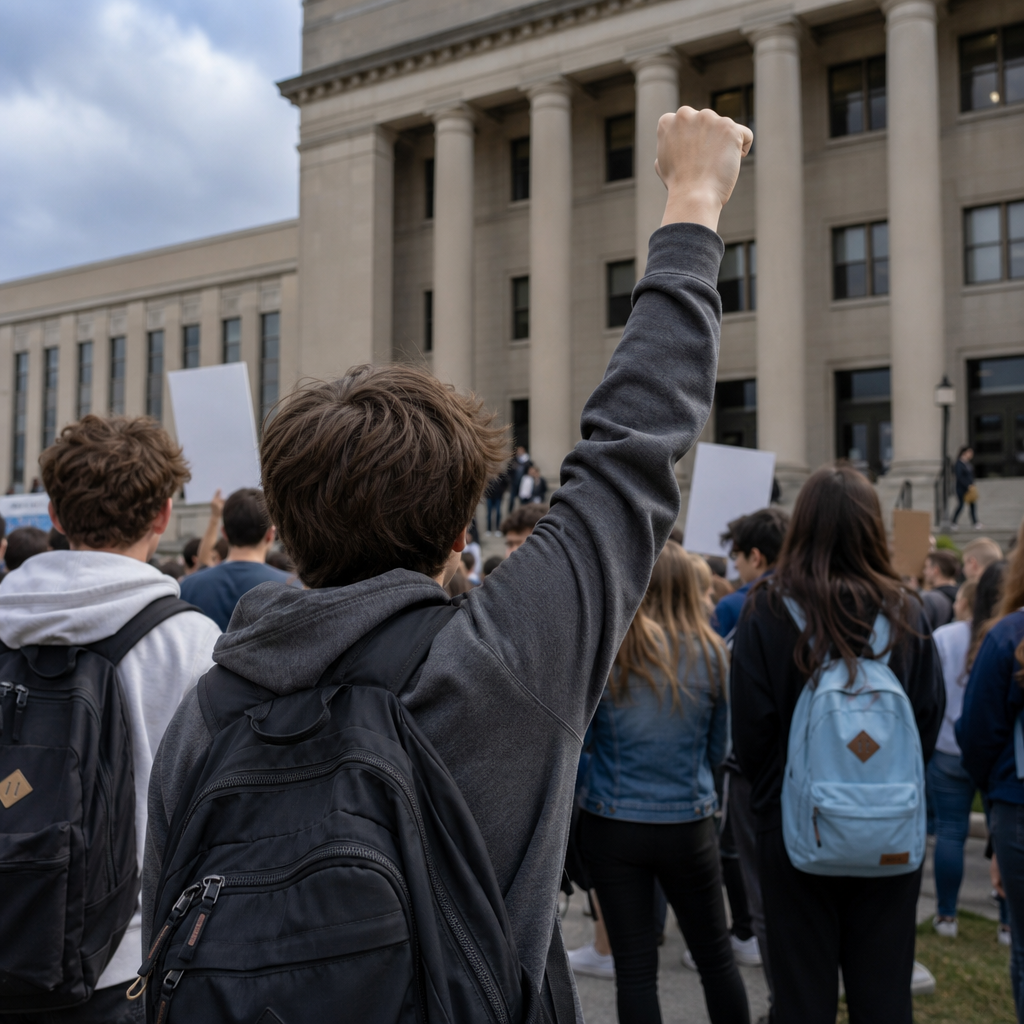
I often tell students that Tinker protects political expression best. Peaceful protest, opinion clothing, buttons, signs, and silent demonstrations usually receive the strongest protection when they do not disrupt instruction. Real examples include student walkouts over gun violence, armbands supporting social causes, and apparel with messages on immigration, abortion, or war. Schools can still enforce neutral time, place, and manner rules, such as attendance requirements or limits on blocking entrances, but they cannot suppress a viewpoint simply because it is controversial. That principle explains why Tinker remains the default rule whenever none of the later exceptions clearly applies.
The major exceptions after Tinker
After 1969, the Supreme Court decided that not all student speech should be analyzed only through Tinker. In Bethel School District v. Fraser in 1986, the Court allowed discipline for a student’s lewd and sexually suggestive speech at a school assembly. The key idea was that public schools may teach the boundaries of socially appropriate behavior and are not required to tolerate vulgar expression in school settings. In Hazelwood School District v. Kuhlmeier in 1988, the Court held that schools may exercise editorial control over school-sponsored student speech, such as a school newspaper produced as part of the curriculum, if their actions are reasonably related to legitimate pedagogical concerns. In Morse v. Frederick in 2007, the Court upheld discipline for the “BONG HiTS 4 JESUS” banner because schools may restrict student speech reasonably viewed as promoting illegal drug use during a school-supervised event.
These cases do not erase Tinker; they narrow it in defined categories. Fraser covers vulgarity in school. Hazelwood covers speech that could be perceived as bearing the school’s imprimatur, especially in curricular settings. Morse covers pro-drug messages at school or school-supervised events. Everything else usually returns to Tinker. That structure is essential for AP Government and Politics because exam questions often ask students to distinguish among standards. The legal analysis usually begins by identifying the forum and the type of speech: independent student expression, school-sponsored expression, or speech tied to a special safety concern recognized by the Court.
| Case | Year | Main Rule | Common Example |
|---|---|---|---|
| Tinker v. Des Moines | 1969 | Schools need evidence of material and substantial disruption or invasion of rights | Silent political protest or symbolic clothing |
| Bethel v. Fraser | 1986 | Schools may punish lewd, vulgar, or plainly offensive speech in school settings | Sexually suggestive speech at an assembly |
| Hazelwood v. Kuhlmeier | 1988 | Schools may regulate school-sponsored speech for legitimate pedagogical reasons | Editing a curricular student newspaper |
| Morse v. Frederick | 2007 | Schools may restrict speech reasonably seen as encouraging illegal drug use | Banner at a school-supervised event |
| Mahanoy Area School District v. B.L. | 2021 | Off-campus speech is usually protected, though schools retain limited authority in serious cases | Weekend social media post criticizing school activities |
What Mahanoy changed for off-campus speech
Mahanoy Area School District v. B.L. involved a high school student who, after failing to make varsity cheerleading, posted a Snapchat image off campus on a weekend using profanity to criticize the school and team. The school suspended her from cheerleading. The Supreme Court ruled for the student. The Court did not say schools can never regulate off-campus speech. Instead, it held that a school’s regulatory interests are diminished when speech occurs off campus, and that the student’s post in this case was protected. That was a major clarification for the social media era, where student speech often happens away from school grounds but still reaches classmates instantly.
The Court identified three reasons schools have less authority off campus. First, off-campus speech usually falls within parental responsibility, not school control. Second, allowing schools to regulate all off-campus speech would effectively subject students to round-the-clock speech supervision. Third, schools themselves have an interest in protecting unpopular expression because schools are nurseries of democracy. At the same time, the Court listed situations where off-campus regulation may still be justified, including serious bullying or harassment targeting specific individuals, threats aimed at teachers or students, failures to follow rules concerning lessons or online school activities, and breaches of school security systems.
In practical terms, Mahanoy did two things. It strengthened protection for ordinary off-campus criticism, venting, and political speech, especially on social media. But it also left room for discipline when off-campus speech causes concrete school harm. That means lower courts still examine facts closely. A weekend post saying “school is unfair” is very different from a targeted campaign of racist harassment directed at a classmate, a doxxing post aimed at a teacher, or a message encouraging violence at Monday’s assembly. The first is likely protected; the others may trigger school authority even though they started off campus.
How courts analyze modern student speech disputes
When I walk students through a modern case, I use a sequence that mirrors actual litigation. First ask whether the school is public. The First Amendment constrains public schools, not private schools unless state law provides separate protections. Second ask whether the speech happened on campus, at a school-supervised event, through a school platform, or entirely off campus. Third identify the category. Is it independent political expression under Tinker, vulgar speech under Fraser, school-sponsored speech under Hazelwood, or a drug-promotion message under Morse? Fourth examine the evidence of disruption, harm, or pedagogical concern. Courts want facts, not speculation.
The phrase “material and substantial disruption” deserves careful attention because schools often invoke it broadly. Courts usually look for class stoppages, large-scale disorder, threats to safety, substantial interference with discipline, or significant impacts on students’ ability to learn. Minor distraction, gossip, or emotional disagreement rarely meets the standard by itself. “Invasion of the rights of others” is also important, though less precisely defined. It can support regulation of severe bullying, targeted harassment, or expression that directly interferes with another student’s access to education. In recent cases involving cyberbullying and threats, that part of Tinker often does more work than the classic disruption test.
Another recurring issue is viewpoint discrimination. Even when schools have authority to regulate a category of speech, they generally cannot favor one side of a political debate over another without strong justification. For example, a school that allows shirts supporting one movement but bans shirts criticizing that movement faces serious constitutional risk unless it can show concrete, content-neutral reasons tied to disruption. Likewise, schools must apply dress codes and club policies consistently. Uneven enforcement often becomes the strongest evidence that discipline was based on disagreement with a student’s viewpoint rather than a neutral rule.
Common issues: social media, dress codes, journalism, and protest
Social media disputes now dominate this field. Students post on Snapchat, TikTok, Instagram, and group chats, then schools must decide whether the effects inside school justify discipline. The strongest cases for school authority involve true threats, coordinated harassment, nonconsensual image sharing, racist or antisemitic targeting, or posts that predict and encourage violence. The weakest cases involve crude complaints, jokes in poor taste, criticism of coaches, or political commentary unrelated to school operations. Because screenshots spread quickly, administrators often feel pressure to act. Legally, pressure is not enough; they need a record showing why the speech caused or foreseeably would cause serious school harm.
Dress codes are another frequent battleground. Courts generally allow neutral rules against disruptive clothing, gang identifiers, or vulgar messages, but students often win when schools ban political messages without evidence of disruption. Cases about Confederate flags, pride symbols, Black Lives Matter shirts, and anti-abortion apparel usually turn on specific local facts, including prior incidents, racial tensions, or threats of confrontation. Student journalism raises different concerns. If a newspaper, yearbook, or broadcast is school-sponsored and curricular, Hazelwood gives administrators more control. If students publish independently off campus or through a noncurricular outlet, their protection is stronger.
Protest and walkouts remain highly teachable examples. Students generally have the right to express political views, wear symbols, circulate petitions, and engage in peaceful demonstration. Schools, however, may impose consequences for skipping class under neutral attendance rules, provided the punishment targets absence rather than the viewpoint expressed. That distinction matters. A school can mark students absent for leaving class during a gun-control protest, but it cannot punish only students on one side of the issue while excusing others who stage a different political walkout. In constitutional terms, conduct regulations are easier to defend than selective suppression of ideas.
Why this doctrine matters in AP Government and Politics
For AP Government and Politics, student speech rights are not just a single civil liberties case set; they are a compact study of how the Supreme Court balances liberty and order. Tinker illustrates protection for symbolic speech and the importance of factual standards. Fraser, Hazelwood, and Morse show that rights vary by context. Mahanoy shows how the Court adapts old doctrine to new technology without giving schools unlimited power. Together, these cases are excellent evidence in FRQs about First Amendment rights, the role of the judiciary, selective incorporation, and the limits of government authority in public institutions.
The best way to master this hub topic is to remember a simple framework. Start with the default: students keep First Amendment rights in public schools. Then ask whether the speech fits an exception or whether the school can prove substantial disruption, invasion of others’ rights, or a legitimate pedagogical reason. Finally, pay attention to location, audience, and evidence. If you are studying related topics in this miscellaneous section of AP Government and Politics, connect student speech to symbolic speech, prior restraint, public schools as government actors, due process in student discipline, and equal protection issues that arise when rules are enforced unevenly. Review the cases, compare the standards, and practice applying them to current controversies. That is the fastest way to turn doctrine into confident analysis.
Frequently Asked Questions
What did Tinker v. Des Moines establish about student speech rights in public schools?
Tinker v. Des Moines (1969) is the foundational Supreme Court case on student speech in public schools. The Court famously said that students do not “shed their constitutional rights to freedom of speech or expression at the schoolhouse gate.” That principle means public school students generally retain First Amendment protection while at school. In Tinker, students wore black armbands to protest the Vietnam War, and the Court held that the school could not punish them simply because school officials disliked the message or wanted to avoid controversy.
At the same time, Tinker did not create an unlimited right to say anything, anywhere, in any manner. The Court explained that schools may regulate student expression when they can reasonably forecast that the speech will cause a “material and substantial disruption” to school operations or interfere with the rights of other students. That standard is still central in student speech law. In practical terms, it means schools usually cannot censor peaceful, passive political expression just because it is unpopular, but they may intervene when speech seriously disrupts classwork, school discipline, or student safety.
For AP Government and Politics, Tinker matters because it shows how the Court balances individual liberty against institutional authority. It is also a strong example of judicial review in action: the Supreme Court interpreted the First Amendment and limited what government actors, in this case public school officials, may do. The case often serves as the starting point for discussing later student speech cases, because those later rulings either apply, narrow, or distinguish the broad protection announced in Tinker.
How did Mahanoy Area School District v. B.L. change the law on off-campus student speech?
Mahanoy Area School District v. B.L. (2021) addressed one of the biggest modern questions in student speech law: how far school authority extends beyond campus, especially in the age of social media. In that case, a student posted a vulgar message on Snapchat off campus, outside school hours, expressing frustration after not making the varsity cheerleading team. The school punished her, but the Supreme Court ruled in the student’s favor. The Court made clear that schools have a much weaker claim to regulate student speech when that speech occurs off campus.
The Court did not say schools can never regulate off-campus speech. Instead, it emphasized that the authority of schools is reduced outside the school environment and that courts should be especially skeptical when schools try to punish speech that takes place away from campus, on personal time, and through a student’s private device or social media account. The Court pointed to several reasons for this caution: schools rarely stand in loco parentis off campus, regulating both on-campus and off-campus speech risks sweeping too broadly into a student’s entire life, and protecting even unpopular speech is especially important when the speech expresses criticism of institutions.
Still, Mahanoy left room for schools to respond to some off-campus expression, particularly in serious situations such as threats, severe bullying or harassment, cheating, or breaches of school security. That makes the case important not because it produced a simple bright-line rule, but because it confirmed a principle of restraint: public schools do not have unlimited power over students’ speech just because the speech might later reach campus. For students studying constitutional law, Mahanoy is significant because it adapts First Amendment doctrine to digital communication while preserving the idea that student rights remain meaningful beyond the classroom.
When can a public school legally discipline a student for speech after Tinker and Mahanoy?
After Tinker and Mahanoy, the basic rule is that public schools may discipline student speech when they have a constitutionally sufficient reason, not merely because they dislike the viewpoint being expressed. On campus, the strongest justification usually comes from the Tinker standard: school officials may act if they can reasonably predict a material and substantial disruption to school activities or an invasion of the rights of other students. Evidence matters here. A school generally needs more than speculation, discomfort, or a desire to avoid debate. Courts often look for concrete facts showing likely disruption, conflict, intimidation, or interference with instruction.
Off campus, discipline becomes harder to justify because of Mahanoy. Courts are more likely to protect speech that occurs away from school grounds, on personal time, and outside school supervision. But schools still may have authority in exceptional cases, especially when speech involves true threats, targeted harassment, serious bullying, doxxing, cheating schemes, or messages that directly undermine school safety or core school functions. The key point is that off-campus speech is not automatically beyond school reach, but it does receive stronger constitutional protection.
It is also important to remember that Tinker is not the only student speech rule in the Supreme Court’s cases. Schools have somewhat broader authority over school-sponsored speech, such as a school newspaper or assembly, and they may regulate lewd or plainly offensive expression in certain school settings. But if the question is specifically about political, personal, or social expression by students, especially expression that is not school-sponsored, Tinker and Mahanoy provide the most relevant framework. In short, discipline is most likely to be lawful when speech poses a real threat to school order, student rights, or safety, and least likely to be lawful when the school is reacting to unpopular opinions or criticism.
Why are these cases so important in AP Government and Politics?
Tinker and Mahanoy are important in AP Government and Politics because they connect several major course themes at once. First, they are core civil liberties cases. They show how the First Amendment protects freedom of speech and how that protection applies in a public institution run by the government. Second, they illustrate the ongoing constitutional tension between individual rights and government authority. Public schools are charged with maintaining discipline, safety, and an effective learning environment, but they are still government actors bound by constitutional limits.
These cases also help students understand judicial review and constitutional interpretation. The Supreme Court is not just reciting the text of the First Amendment; it is applying broad constitutional principles to real-world conflicts. In Tinker, the Court protected symbolic political protest inside school. In Mahanoy, it addressed social media and off-campus expression in a digital era the framers could not have imagined. That makes both cases excellent examples of how precedent evolves while still relying on enduring constitutional values.
From a test-preparation perspective, these rulings are useful because they can be connected to many recurring AP Gov concepts: selective incorporation, the role of the Supreme Court, the limits of state and local government power, and the balancing of competing interests. They also provide strong evidence for free-response answers. A student who can explain Tinker as the “substantial disruption” case and Mahanoy as the off-campus social media case has a solid foundation for analyzing whether a school policy likely violates the First Amendment. In that sense, these cases are not isolated trivia; they are building blocks for broader constitutional reasoning.
What is the difference between protected student speech and speech schools can restrict?
The difference usually comes down to context, impact, and the school’s justification. Protected student speech often includes peaceful political expression, symbolic protest, criticism of school officials, personal opinions, and other forms of expression that do not materially disrupt school operations or infringe on the rights of others. A student wearing an armband, expressing a political view, or posting criticism of school decisions off campus is often speaking in a way that receives significant First Amendment protection, especially if the expression is nonthreatening and does not interfere with school activities.
By contrast, schools have stronger grounds to restrict speech when it crosses into disruption, intimidation, harassment, or threats. Speech that causes substantial disorder in school, targets other students in a way that invades their rights, or undermines safety can lose constitutional protection in the school setting. The same is true for some categories of school-related expression that the Court has treated differently from ordinary personal speech, such as school-sponsored communication or vulgar speech in certain school environments. The Constitution protects student expression, but it does not require schools to ignore serious harm to instruction, discipline, or student welfare.
The most important takeaway is that student speech cases are highly fact-specific. Courts often ask where the speech occurred, whether it was school-sponsored, whether it was political or merely offensive, how directly it affected the school environment, and whether the school can point to real evidence of harm. After Tinker and Mahanoy, the law still strongly rejects viewpoint discrimination: schools generally cannot punish students simply for expressing unpopular ideas. But the law also recognizes that rights in public schools operate within a structured environment. Understanding that balance is the key to analyzing almost any student speech problem.