
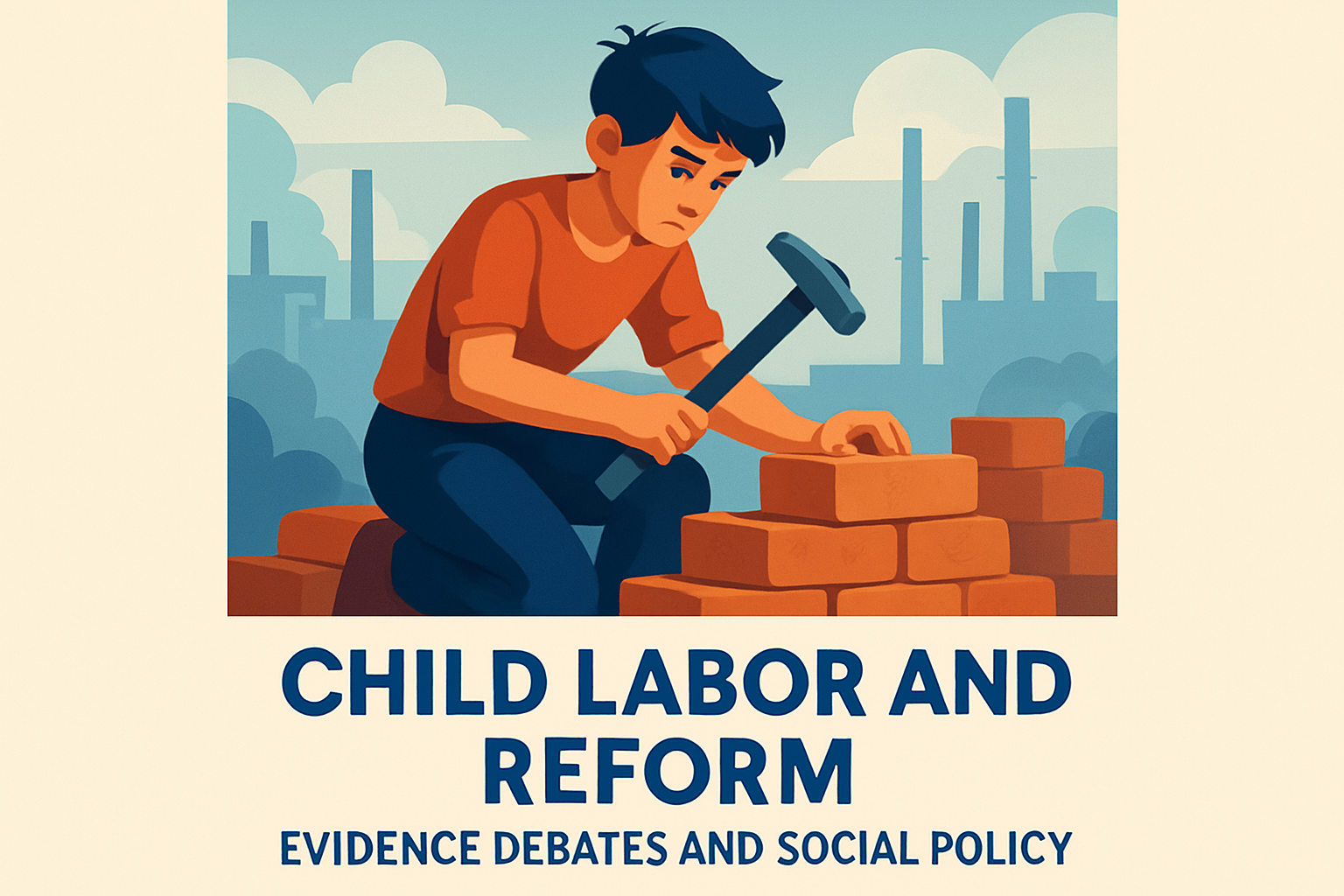
Child labor and reform sit at the center of one of the hardest debates in social policy: how to protect children from exploitation without ignoring the poverty, labor markets, and family survival strategies that push children into work. In policy practice, child labor usually refers to work that is harmful to a child’s health, safety, schooling, or development, while light work, age-appropriate household tasks, and carefully regulated apprenticeships may fall outside that definition. The International Labour Organization distinguishes between acceptable work by children above minimum age thresholds and the “worst forms of child labor,” including slavery, trafficking, forced recruitment, hazardous work, commercial sexual exploitation, and illicit activities. That distinction matters because effective reform depends on precision. If lawmakers treat every form of youth work as identical, they risk weak enforcement, political backlash, and unintended harm to poor households.
I have worked with labor compliance teams and social policy analysts reviewing factory audits, school attendance data, and household livelihood surveys, and the same lesson appears repeatedly: child labor is rarely explained by a single cause. It emerges where low wages, informal employment, weak schools, debt, migration, gender norms, and poor state capacity overlap. That is why evidence debates matter. Activists often emphasize moral urgency, economists often stress household constraints and incentives, and governments balance rights commitments against limited budgets and enforcement reach. The best reforms take all three seriously. They rely on clear legal standards, credible inspection, income support, functioning schools, and sector-specific interventions. Understanding what the evidence actually shows is essential for anyone designing policy, evaluating corporate claims, or asking a practical question: what reduces harmful child labor in the real world, and what merely shifts it out of sight?
What child labor includes, and why measurement shapes the debate
Any serious discussion must begin with measurement, because the way institutions count child labor shapes what problems become visible. The ILO and UNICEF estimate global child labor using age, hours worked, sector, school status, and whether tasks are hazardous. Their joint 2021 report estimated 160 million children in child labor worldwide, including 79 million in hazardous work, with agriculture accounting for the largest share. Those numbers are widely cited because they combine household survey data with internationally standardized definitions. Yet they still undercount hidden work. In my experience reviewing survey instruments, domestic service in private homes, unpaid family work, seasonal migration, and street-based work are consistently harder to capture than factory employment. Girls are especially at risk of statistical invisibility when labor is folded into household responsibilities.
The evidence debate often turns on this point. One side argues prevalence data justify broad bans and aggressive sanctions. Another argues counts are too blunt because they do not separate occasional light work from exploitative labor, or because they miss tradeoffs within poor households. Both claims contain some truth. A child helping in a family shop for limited hours after school is not equivalent to a child handling pesticides, carrying bricks, or stitching garments ten hours a day. But that nuance should never be used to minimize risk. Long hours, dangerous tools, toxic exposure, night work, and school disruption are reliable markers of harm. Better policy starts by identifying those markers precisely and then targeting resources where injury, dropout, and coercion are most likely.
Why children work: poverty, markets, schooling, and social norms
Children work because families make decisions under constraint, and those constraints are often severe. The strongest predictor is poverty, but poverty alone does not explain variation across regions, sectors, or time. When adult wages are low, harvest seasons are labor-intensive, schools are distant or poor quality, and credit markets fail, children become part of the household labor strategy. In rural areas, unpaid family labor often rises when labor demand spikes and hired workers are unaffordable. In urban informal economies, children may contribute through vending, waste picking, transport assistance, food service, or home-based piecework. Employers prefer them in some sectors because they can be paid less, are easier to control, and are hidden in subcontracting chains.
Schooling conditions are equally important. Free education on paper does not eliminate fees for uniforms, transport, books, exam charges, or lost labor time. I have seen attendance records improve dramatically after districts subsidized transport and meals, even without changing labor law. Quality matters too. Families are more willing to forgo a child’s earnings when schools are safe, staffed, and perceived to improve future income. Where classrooms are overcrowded and learning outcomes are weak, the opportunity cost of schooling rises. Gender norms also shape labor patterns. Boys are overrepresented in mining, construction, herding, and street work, while girls often face hidden burdens in domestic labor, care work, and home-based production. Migration, disability, caste or ethnic exclusion, and conflict intensify vulnerability because they weaken family bargaining power and state protection at the same time.
What the evidence says about bans, income support, and school incentives
Evidence from multiple countries shows that legal prohibition is necessary but rarely sufficient on its own. Minimum-age laws, hazardous-work lists, and labor inspection create the baseline norm that children should not be employed in harmful conditions. They also give courts, regulators, and buyers a basis for enforcement. But where informal work dominates and inspections are infrequent, a stricter law without complementary policy can displace children into less visible and more dangerous work. That is a recurring finding in policy reviews: reform succeeds when it changes household incentives and employer behavior simultaneously.
Cash transfer programs are among the most studied tools. Conditional cash transfers in Latin America, including Mexico’s Progresa/Oportunidades and Brazil’s Bolsa Escola and later Bolsa Família, showed that modest income support tied to school attendance can raise enrollment and reduce child labor, especially among younger children and in poorer households. Unconditional transfers can help as well when conditions are costly to monitor or schools are weak. The mechanism is straightforward: transfers relax liquidity constraints and reduce the need for children’s earnings. Yet effects vary. If labor demand is high, schools are inaccessible, or payments are too small, reductions may be limited. Public works for adults, wage subsidies, school feeding, and health insurance can reinforce gains by lifting overall household security.
| Policy tool | How it works | Typical strength | Main limitation |
|---|---|---|---|
| Minimum-age and hazardous-work laws | Set legal boundaries and enable enforcement | Creates clear norm and sanction framework | Weak impact where informality is high |
| Cash transfers | Replace lost income and support school attendance | Strong evidence on enrollment gains | Needs reliable payment systems and service access |
| School feeding and fee reduction | Lower direct and indirect education costs | Improves attendance quickly | Less effective if teaching quality is poor |
| Supply-chain monitoring | Pushes firms to inspect suppliers and remediate cases | Useful in export sectors | Can miss hidden subcontracting and home work |
Industry, supply chains, and the problem of hidden labor
Public debate often focuses on export manufacturing, but most child labor occurs in agriculture and domestic production, not formal factories. That matters because policy tools differ by sector. In cocoa, cotton, tobacco, palm oil, fishing, and artisanal mining, work may happen on dispersed farms, family plots, boats, or informal sites far from routine inspection. In garments and handicrafts, the highest risk is often not the branded factory but the unauthorized subcontractor or home workshop working to impossible deadlines. I have reviewed audit trails where first-tier facilities appeared compliant while production was quietly pushed to village units using adolescent workers after peak orders arrived. This is why social auditing by itself is not enough.
Better corporate practice combines traceability, worker interviews, grievance mechanisms, purchasing reform, and remediation. The OECD Due Diligence Guidance for Responsible Business Conduct and the UN Guiding Principles on Business and Human Rights provide the right framework: identify risks, prevent and mitigate harm, track outcomes, and provide remedy. Importantly, remediation should not mean simply dismissing a child. If a supplier fires underage workers without income support or school placement, harm may worsen. Strong programs arrange family assessment, bridge schooling, wage replacement where feasible, and follow-up monitoring. Regulatory pressure is rising through mandatory due diligence laws and import controls on forced labor and abusive sourcing. Still, firms cannot solve structurally low farm incomes, absent schools, or weak labor inspectorates alone. Supply-chain action works best when aligned with local social protection and education policy.
Historical reform lessons and the limits of simple narratives
History shows that child labor declines through economic and institutional change, not through moral outrage alone. In Britain and the United States, reform was driven by factory acts, compulsory schooling, labor inspection, changing technology, rising adult wages, union pressure, and shifts in public expectations about childhood. The pattern is important because it cautions against simplistic narratives. Industrial growth did not automatically eliminate child labor; in some periods it increased demand for cheap young workers before regulation and schooling systems caught up. At the same time, legal bans were more enforceable once states had administrative reach and families had alternatives.
This historical record shapes current evidence debates. Some economists warn that abrupt boycotts of goods made with child labor can reduce family income and push children into agriculture, domestic work, or prostitution. That concern is not theoretical; policy responses to supplier scandals have sometimes produced displacement rather than protection. But the opposite error is to treat growth as the only solution and postpone enforcement indefinitely. Countries that have reduced child labor most effectively typically combined growth with compulsory education, targeted transfers, labor standards, birth registration, and local enforcement. Social norms changed because institutions changed. The lesson for modern policy is direct: rights-based law and poverty reduction are complements, not substitutes. When reformers choose one and neglect the other, results are weaker.
What effective social policy looks like in practice
The most effective social policy package is integrated, local, and measurable. First, governments need clear law aligned with ILO Convention No. 138 on minimum age and Convention No. 182 on the worst forms of child labor, backed by hazardous-work lists tailored to national industries. Second, labor inspectorates need realistic coverage strategies. In low-capacity settings, that means using risk mapping, school absenteeism data, agricultural extension networks, and community reporting rather than relying only on urban factory inspections. Third, schools must be usable: free in practice, physically accessible, safe for girls, and able to absorb overage children through bridge classes or flexible schedules.
Fourth, social protection must offset household risk. Cash transfers, disability support, emergency income assistance, and adult employment programs reduce dependence on children’s earnings. Fifth, policy should focus on transitions, not single events. A child removed from hazardous labor needs case management, not just rescue. Sixth, governments and firms should measure outcomes that matter: injury rates, attendance continuity, grade completion, and recurrence, rather than counting only inspections or training sessions. In my experience, the strongest programs are built around named responsibilities, local referral pathways, and data sharing between labor, education, and social welfare agencies. For readers evaluating reform proposals, the practical test is simple: does the policy reduce both the supply of child labor from vulnerable households and the demand for child labor from employers and intermediaries? If not, it is incomplete. Child labor reform succeeds when protection, schooling, enforcement, and income security move together. Support policies that do all four.
Frequently Asked Questions
1. What counts as child labor, and how is it different from children simply helping at home or learning work skills?
Child labor does not mean every form of work done by a child. In social policy and international law, the term usually refers to work that is harmful to a child’s health, safety, education, or overall development. That includes labor that is dangerous, excessively time-consuming, physically damaging, coercive, or disruptive to schooling. By contrast, many societies recognize that age-appropriate household chores, light work for limited hours, and carefully supervised training or apprenticeships can be part of normal socialization and skill-building, provided they do not expose children to exploitation or keep them out of school.
This distinction matters because debates about reform often become polarized when all child work is treated as identical. A child occasionally helping in a family shop after school is not in the same situation as a child working long hours in a mine, factory, field, or informal urban job under unsafe conditions. Policymakers therefore focus not only on whether a child is working, but also on the type of work, the hours involved, the risks, the child’s age, and whether education and healthy development are being undermined. Good reform depends on precision: if definitions are too broad, policy can become unrealistic; if they are too narrow, harmful exploitation can be ignored.
2. Why is child labor so difficult to eliminate if most people agree that harmful child labor should end?
The hardest reality is that harmful child labor is often tied to poverty, insecure labor markets, weak schools, and household survival strategies. Many families do not rely on child work because they prefer it morally or culturally, but because their income is unstable, adult wages are too low, employment is seasonal, or social protection is absent. In those settings, a child’s earnings, however small, may help pay for food, rent, debt, transport, or school supplies for siblings. That means reform cannot succeed through legal prohibition alone if the economic pressures that drive child labor remain unchanged.
Another difficulty is that child labor often exists in informal sectors where regulation is weak and inspection is difficult. Domestic service, street vending, small workshops, agriculture, home-based production, and subcontracted supply chains can hide exploitative work from view. In some contexts, children move between school, work, and household labor in ways that are hard to measure, which complicates enforcement and evidence gathering. This is one reason the debate often turns to policy design: banning harmful labor is essential, but effective reform usually also requires stronger schools, income support, labor standards for adults, enforcement capacity, and programs that make it possible for families to say no to dangerous or excessive child work.
3. What are the main evidence debates in child labor policy?
One major evidence debate concerns what actually reduces child labor in durable ways. Researchers and policymakers often agree on the goal but disagree about which interventions matter most. Some emphasize school access and quality, arguing that when education is affordable, nearby, and meaningful, children are more likely to attend school instead of work. Others stress household economics, pointing to evidence that cash transfers, food support, debt relief, or improved adult earnings can lower reliance on child labor. Still others focus on enforcement, corporate accountability, and labor inspections, especially in sectors where children face clear hazards.
A second debate is about unintended consequences. Some reforms reduce visible child labor in formal workplaces but push children into more hidden and potentially more dangerous informal jobs. For example, if a factory stops employing underage workers without any support for affected families, those children may move into street work, domestic labor, or hazardous agricultural work that is harder to monitor. This does not mean reform should be avoided; it means policies should be evaluated not only by whether children leave one type of work, but also by what happens next to their income, schooling, safety, and family well-being.
There is also debate over measurement. Child labor is not always easy to capture with simple survey questions, because children may combine paid work, unpaid family work, household duties, and school attendance. Researchers also differ on how to assess harm across contexts. Long hours, hazardous tasks, school absence, injury risk, and psychosocial stress all matter, but they may not appear in the same way across regions or occupations. As a result, the evidence base is strongest when it looks beyond slogans and examines intensity of work, conditions, educational outcomes, health effects, and family context together.
4. What kinds of social policies are most effective for reducing harmful child labor without worsening family hardship?
The most effective approaches are usually integrated rather than single-track. Strong social policy addresses the reasons children work in the first place while also protecting them from exploitation. Income support for poor households can be especially important, including cash transfers, school meal programs, fee reductions, transportation support, and emergency assistance during economic shocks. These measures reduce the immediate pressure to send children into harmful work and can make schooling more realistic for families living close to the edge.
Education policy is equally central. Expanding school access is not enough if classrooms are overcrowded, unsafe, far away, or disconnected from local realities. Families are more likely to keep children in school when education is affordable, reliable, and visibly valuable. That means attention to teacher quality, attendance, flexible scheduling where appropriate, and support for children who are already behind academically. In some settings, bridge schooling or reintegration programs are essential for children transitioning out of labor and back into education.
Labor market policy also matters. When adults earn too little or face unstable work, children are more likely to be pulled into income-generating activity. Raising adult wages, strengthening labor protections, improving job security, and supporting rural livelihoods can indirectly reduce child labor. At the same time, governments need credible enforcement against hazardous and exploitative child labor, especially in high-risk sectors. The best reforms combine protection with practicality: they prohibit harmful labor, support family income, improve education, and create pathways for children to leave dangerous work without pushing households deeper into crisis.
5. Is the goal to ban all child work everywhere, or to focus on the most harmful forms first?
In practice, most serious policy frameworks focus first and most urgently on the worst forms and clearly harmful types of child labor. That includes slavery-like practices, trafficking, debt bondage, forced labor, commercial sexual exploitation, and work that is dangerous to health, safety, or morals. There is also strong concern about labor that keeps children out of school or severely limits their development, even when it does not fit the most extreme categories. This priority-based approach reflects both moral urgency and policy realism: the gravest abuses demand immediate action, and resources are often limited.
At the same time, focusing only on the worst forms is not enough if other patterns of excessive or developmentally harmful work are ignored. A child may not be in a legally recognized “worst form” of labor but may still be missing school, working exhausting hours, or facing long-term physical and emotional harm. That is why many reformers advocate a layered strategy: eliminate the most dangerous exploitation immediately, strengthen minimum age standards and education protections, and gradually reduce broader forms of harmful labor through social investment and labor market reform.
This approach avoids two common mistakes. One is moral minimalism, where policy addresses only the most shocking abuses and leaves many children unprotected. The other is unrealistic absolutism, where governments declare total bans without building the economic and social conditions needed to make those bans workable. Effective reform recognizes that children need protection now, families need viable alternatives, and long-term success depends on aligning legal standards with poverty reduction, quality education, and broader social policy.