
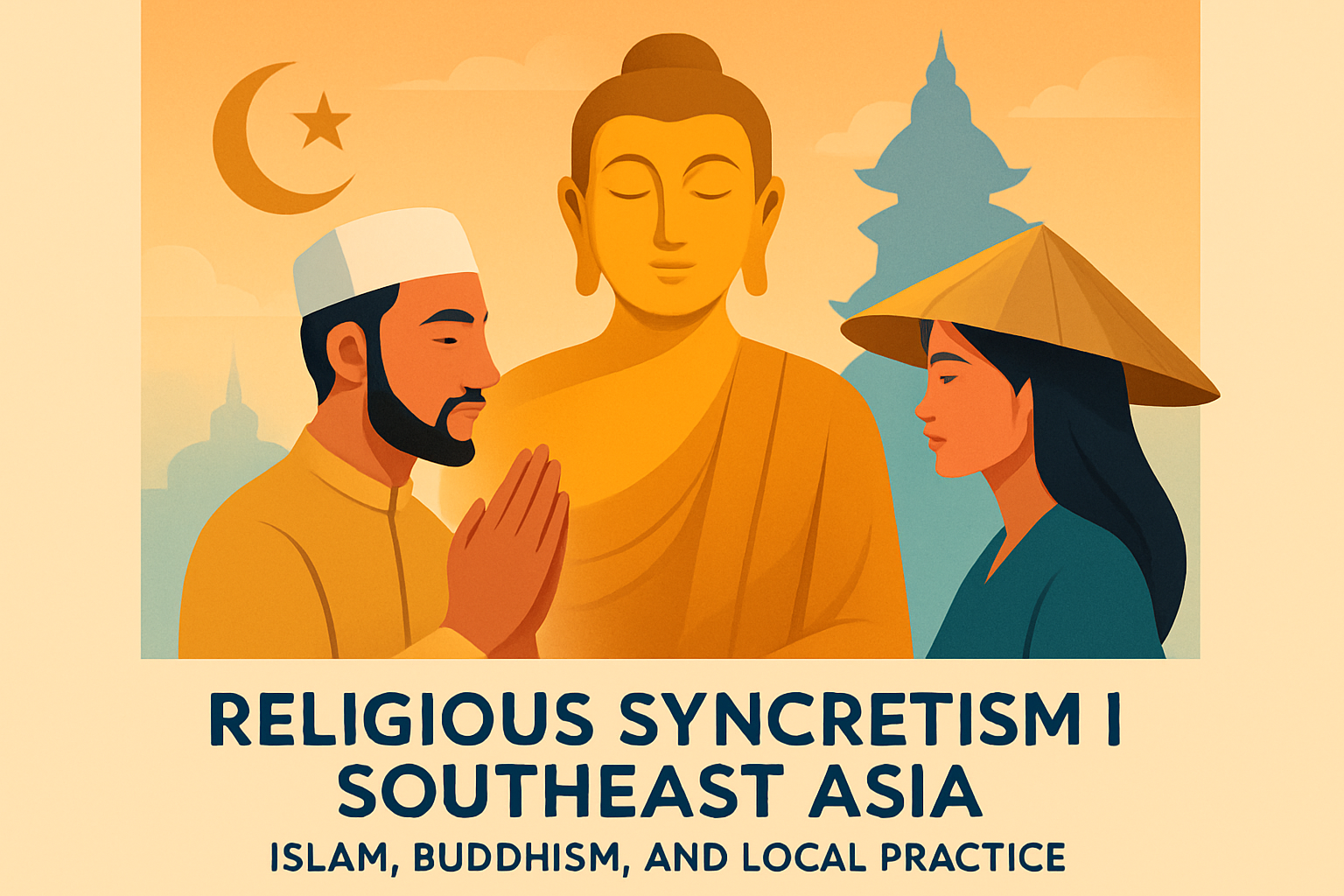
Religious syncretism in Southeast Asia describes the blending of Islam, Buddhism, Hindu inheritances, Christianity, animist belief, and local ritual into lived religious practice. The phrase matters because it explains a reality anyone who has worked across Indonesia, Malaysia, Thailand, Cambodia, Myanmar, Vietnam, and the southern Philippines encounters quickly: communities rarely practice religion as a sealed system. Instead, they adapt inherited doctrines to older cosmologies, local authority structures, sacred landscapes, and everyday needs such as healing, protection, harvest timing, and ancestor remembrance.
In practical terms, syncretism means that a Muslim family may observe Qur’anic recitation while also visiting a saint’s grave associated with pre-Islamic sacred geography; a Buddhist community may affirm orthodox teachings on karma and merit while consulting spirit mediums tied to village guardians; and a court ritual may preserve Indic royal symbolism centuries after formal conversion to Islam or Theravada Buddhism. None of this is marginal. It is central to how religion has actually developed in Southeast Asia.
Scholars debate the term because some believers hear “syncretism” as an accusation of impurity. That concern is real. In fieldwork and editorial work on regional religion, I have found that communities usually describe their practices with insider terms such as adat in Indonesia and Malaysia, bomoh or dukun for ritual specialists, keramat for sacred sites, or nat and phi for spirits in mainland Southeast Asia. Using those terms alongside the broader concept of religious syncretism keeps analysis accurate and respectful. It also helps readers understand that doctrinal religion and local practice are not opposites; they are often intertwined layers of one social world.
The topic matters for three reasons. First, it explains history better than simple conversion narratives. Islam did not arrive in the Malay-Indonesian world as a blank replacement system, and Buddhism in mainland Southeast Asia did not erase older spirit cults. Second, it helps policymakers, educators, and journalists avoid misreading local religion through rigid categories imported from the Middle East or Europe. Third, it reveals how communities negotiate authority: scriptural scholars, monks, shamans, rulers, healers, and shrine custodians all compete and cooperate in defining what counts as legitimate practice.
Southeast Asia became especially fertile ground for religious blending because of trade networks, maritime mobility, and layered political history. Indianized courts introduced Sanskrit concepts, epics, cosmology, and temple forms long before Islam expanded through ports and merchant connections. Chinese migration added Taoist, Confucian, and popular religious elements. Colonial administrations later categorized populations into fixed religious boxes, yet village life remained more flexible than census forms suggested. The result is a region where official affiliation may look clear on paper while actual devotional life remains mixed, negotiated, and highly localized.
How syncretism developed across maritime and mainland Southeast Asia
Religious syncretism in Southeast Asia developed through gradual accretion rather than sudden fusion. Ports such as Melaka, Aceh, Gresik, Banten, and Makassar connected merchants, Sufi teachers, jurists, craftsmen, and pilgrims. Inland courts then translated new religious prestige into local idioms of kingship. In Java, for example, Islam spread not only through legal instruction but through court patronage, saint veneration, vernacular literature, and adaptation of earlier Hindu-Buddhist political symbolism. The famous Wali Songo tradition itself reflects this process: saints are remembered as preachers, miracle workers, and cultural translators who embedded Islam in familiar social forms.
Mainland Southeast Asia followed a related but distinct pattern. Theravada Buddhism became dominant in Myanmar, Thailand, Laos, and Cambodia, yet it settled atop older Mon, Khmer, and Tai cosmologies full of territorial spirits, guardian beings, and ancestor obligations. In villages I have reported on, people do not experience a contradiction between sponsoring a Buddhist ordination and making offerings to a local spirit house before construction. They understand these acts as addressing different dimensions of risk and order. Monks cultivate merit and moral discipline; spirits regulate place, fortune, illness, and social harmony.
State formation intensified these mixtures. Courts used religion to legitimize rule, but rulers rarely governed through doctrine alone. They sponsored monasteries, mosques, or scholars while preserving rituals for fertility, royal charisma, rainmaking, and protection of the realm. The Thai concept of kingship, Khmer ceremonial traditions, and Javanese court etiquette all preserve traces of Brahmanical and indigenous ritual logics. Even where reform movements later criticized them, these practices remained embedded in calendars, architecture, and public symbolism.
Trade also mattered because merchants carried habits, not just texts. A Gujarati trader, Hadrami sayyid, Chinese temple patron, or Tamil Muslim community did more than preach. They married locally, endowed shrines, supported schools, and linked households to transregional prestige. This explains why Islam in Southeast Asia often carried strong Sufi and saintly dimensions, and why Chinese popular religion could merge with local spirit cults in urban centers from Penang to Ho Chi Minh City. Syncretism was not confusion. It was the ordinary social mechanism by which imported religions became local institutions.
Islam, adat, and sacred local practice in the Malay-Indonesian world
The clearest example of Islamic syncretism in Southeast Asia appears in the relationship between Islam and adat, the body of customary norms governing kinship, land, ritual, and community obligation. In Indonesia and Malaysia, many Muslim communities distinguish between what is explicitly required by sharia and what belongs to adat, yet in practice the two overlap constantly. A life-cycle event such as birth, circumcision, marriage, or death may include Qur’anic recitation, Arabic prayer formulas, communal feasting, offerings associated with local etiquette, and respect for ancestors or place spirits reframed in Islamic language.
Java provides some of the region’s best-known cases. Clifford Geertz’s older categories of santri, abangan, and priyayi are debated today because they oversimplify modern identities, but they remain useful historically for describing different emphases within Javanese Islam. Courtly mysticism, slametan communal meals, pilgrimage to wali tombs, shadow-puppet narratives drawn from the Mahabharata and Ramayana, and the use of amulets all illustrate how Islamic belief became rooted in older Javanese worlds. Reformist organizations such as Muhammadiyah and Persis have long criticized some of these practices as bid’ah or superstition, while Nahdlatul Ulama often defends selected local traditions when they can be interpreted within Sunni norms. That debate is itself part of the story.
One recurring question searchers ask is whether visiting saints’ graves is Islamic or pre-Islamic. The accurate answer is that grave visitation has a recognized place in many Muslim societies, especially within Sufi traditions, but its local forms vary widely. In Java, Sumatra, and parts of the Malay Peninsula, pilgrimage to keramat sites or wali tombs may involve Qur’an recitation, vows, requests for intercession, and beliefs about baraka, or sacred blessing. Critics object when veneration appears to attribute independent power to the dead. Supporters argue that God remains the ultimate source of aid and that saints are honored as righteous intermediaries or exemplars. The practice persists because it answers emotional and social needs that legal texts alone do not exhaust.
Similar blending appears in healing. A dukun or bomoh may recite Qur’anic verses while also using numerology, herbal knowledge, astrology, or inherited techniques of spirit negotiation. Urban middle classes may reject such specialists publicly but still consult them privately for unexplained illness, family conflict, or business anxiety. That tension shows why syncretism survives modernization. It addresses uncertainty in ways formal institutions often cannot.
Buddhism, spirit cults, and everyday religion on the mainland
In mainland Southeast Asia, Buddhism and spirit religion function less as rivals than as parallel systems of meaning. Orthodox Theravada teaching centers on the Four Noble Truths, karma, rebirth, merit, and the monastic sangha. Yet village and urban practice across Thailand, Myanmar, Cambodia, and Laos includes powerful spirit traditions. Thailand’s phi, Myanmar’s nats, and Cambodia’s neak ta are not fringe survivals. They remain active presences in domestic life, agriculture, politics, and business culture.
A direct answer to a common question is this: Why do Buddhists in Southeast Asia make offerings to spirits? Because spirits are understood to govern place-specific dangers and obligations that differ from the Buddha’s path to liberation. A family can seek merit by supporting monks and also appease a land spirit before opening a shop. These actions operate on different levels. One concerns long-term moral causation; the other manages immediate relations with unseen local powers.
Myanmar offers a classic example through the nat tradition. Although the Burmese state has repeatedly emphasized Theravada orthodoxy, nat festivals, spirit mediums, and household shrines remain widespread. The official list of Thirty-Seven Nats itself shows how incorporation works: spirits linked to violent death, local power, and legendary history were not erased but domesticated into a broader Buddhist cosmos. Thailand shows a similar pattern with spirit houses outside homes, hotels, factories, and malls. Corporate developers who otherwise project modern rationality still fund Brahman priests, Buddhist monks, and offerings to site spirits before breaking ground. In practical religion, compatibility matters more than abstract system boundaries.
Cambodia demonstrates another layer: post-conflict religious rebuilding revived monasteries but also strengthened rituals for ancestors, territory, and protection. Ritual specialists, lay mediums, and monks sometimes cooperate around healing ceremonies or memorial rites. This is syncretism not as static folklore but as adaptive social recovery.
| Country | Formal religious framework | Local syncretic element | Everyday example |
|---|---|---|---|
| Indonesia | Islam | Adat, saint veneration, ritual healing | Pilgrimage to wali tombs and slametan meals |
| Malaysia | Islam | Keramat shrines, bomoh practice | Seeking blessings or healing at local sacred sites |
| Thailand | Theravada Buddhism | Phi spirit cults, Brahman ritual | Installing spirit houses at homes and offices |
| Myanmar | Theravada Buddhism | Nat worship and mediumship | Attending nat festivals alongside monastery donations |
| Cambodia | Theravada Buddhism | Neak ta territorial spirits, ancestor rites | Village offerings for land protection and harvests |
Local practice, identity, and the politics of religious purity
Syncretism is never just about ritual; it is also about power. Modern states, reformist movements, and transnational religious networks often push believers toward standardized forms of Islam or Buddhism. Ministries of religion classify populations, certify clergy, regulate sermons, and build school curricula around cleaner doctrinal boundaries. Social media accelerates this process by allowing preachers from Cairo, Riyadh, Islamabad, Bangkok, or Colombo to critique local customs instantly. Practices once accepted as ordinary village religion can suddenly be labeled shirk, heresy, or superstition.
I have seen this dynamic most clearly in debates over shrine visitation, spirit possession, and local healing. Younger urban believers, especially those educated through scripturalist institutions, may regard their grandparents’ practices as embarrassing remnants. Yet when illness, infertility, or crisis strikes, families often return to those same rituals. This pattern shows that religious purity campaigns rarely eliminate syncretism completely. They change its public language, push it into private spaces, or force practitioners to reinterpret it within officially acceptable frameworks.
Indonesia’s experience after the twentieth century is instructive. Islamic reform and state bureaucracy strengthened orthodoxy, but they did not erase kebatinan, saint pilgrimage, or ritual meals. Instead, communities negotiated. Some ceremonies were Islamicized through more Arabic recitation; others were dropped; others survived as “culture” rather than “religion.” Thailand and Myanmar show related tensions when spirit cults are tolerated as heritage, tourism, or local custom even while monks and lay reformers warn against excessive reliance on mediums. The category of culture often becomes a political compromise that allows old practices to remain visible without openly challenging doctrinal authority.
There is also a class dimension. Elites may publicly endorse purified religion while quietly maintaining court rituals, auspicious timing, geomancy, or shrine patronage. Businesses that denounce superstition still hire ritual experts for openings, blessings, and risk management. Syncretism persists because it is woven into institutions as much as households.
Why religious syncretism in Southeast Asia endures
Religious syncretism endures in Southeast Asia because it solves practical problems, preserves memory, and fits the region’s historical pattern of layered belonging. People do not live by theology alone. They marry into families, inherit land, fear misfortune, care for ancestors, navigate patronage networks, and mark sacred places. Local practices endure when they continue to answer those needs better than more abstract alternatives.
Another reason is that Southeast Asian religions have long been transmitted through performance as much as doctrine. Ritual meals, pilgrimage circuits, epics, healing sessions, seasonal festivals, spirit dances, and shrine maintenance create embodied continuity. Once these practices become part of community identity, removing them is socially costly. Reformers may win arguments in print but lose support if they strip away the rites that make religion feel communal and protective.
The digital age will not end this pattern. It may even diversify it. Online preaching sharpens orthodoxy, yet the same networks spread videos of shrine miracles, amulet markets, possession ceremonies, and hybrid devotional music. Tourism, heritage policy, and diaspora communities also repackage syncretic traditions for new audiences. What changes is not the existence of syncretism but its framing: as religion, culture, identity, wellness, or heritage.
The key takeaway is simple. To understand Islam, Buddhism, and local practice in Southeast Asia, start with lived religion rather than rigid labels. The region’s religious history is not a sequence of pure replacements. It is a record of translation, negotiation, and selective incorporation. Adat within Muslim societies, spirit cults within Buddhist societies, sacred kingship, shrine devotion, and ritual healing all demonstrate that formal doctrine and local practice develop together.
This perspective improves scholarship, journalism, education, and interfaith understanding because it describes what communities actually do. It also encourages better questions. Instead of asking whether a practice is purely Islamic or purely Buddhist, ask who authorizes it, what problem it addresses, how participants explain it, and why it persists despite reform. Those questions reveal the real structure of belief.
For readers studying the region, the benefit is clarity. Religious syncretism is not a side note to Southeast Asian history; it is one of the main engines of religious change. Follow local terms, watch ordinary rituals, compare official teaching with community behavior, and you will see how belief is made on the ground. If you want a stronger grasp of Southeast Asian religion, begin there and keep looking closely.
Frequently Asked Questions
What does religious syncretism mean in Southeast Asia?
In Southeast Asia, religious syncretism refers to the way communities combine teachings, symbols, rituals, and moral frameworks from more than one religious tradition into a lived form of belief. Rather than practicing Islam, Buddhism, Christianity, Hindu inheritances, or animist traditions as completely separate systems, many people absorb elements from several sources and apply them within everyday life. This can include visiting a mosque while still observing local spirit rituals, participating in Buddhist merit-making while honoring ancestral customs, or preserving older cosmological ideas about land, protection, and sacred power alongside scriptural religion.
This matters because religion in the region has long developed through trade, migration, royal patronage, conquest, intermarriage, and local adaptation. Islam spread through ports and courts, Buddhism moved through monastic and political networks, Hindu influences shaped classical states, Christianity arrived through colonial and missionary channels, and indigenous systems of belief remained deeply rooted in village life. The result is not simply “mixing” in a casual sense, but an ongoing process of interpretation. Communities often see these practices as coherent, practical, and meaningful responses to illness, family obligation, fertility, protection, social harmony, and moral order. Syncretism, then, is one of the clearest ways to understand religion in Southeast Asia as it is actually lived, rather than only as it is formally described in doctrine.
How do Islam, Buddhism, and local beliefs blend in everyday practice?
The blending happens most clearly in ordinary life rather than in abstract theology. In Muslim-majority areas, for example, people may follow Islamic prayer, fasting, marriage norms, and Qur’anic recitation while also participating in ceremonies tied to ancestors, sacred heirlooms, village guardians, or places believed to hold spiritual force. In Buddhist-majority societies, people may observe temple rituals, make merit for the dead, and support monastic institutions while also consulting spirit mediums, honoring local deities, or following protective rites linked to pre-Buddhist cosmologies. These are not always seen as contradictions. For many practitioners, scriptural religion addresses salvation, ethics, and communal identity, while local ritual addresses protection, healing, luck, fertility, and relations with unseen beings tied to specific landscapes and lineages.
Across the region, this blending appears in life-cycle events, agricultural ceremonies, healing practices, annual festivals, and responses to misfortune. A family may invite a religious specialist to recite Islamic verses, while elders also prepare offerings associated with older local customs. A Buddhist household may sponsor monks for a funeral and separately perform rites to calm the spirit of the deceased. Shrines, amulets, saint veneration, sacred mountains, spirit houses, protective tattoos, and ritual specialists all show how formal religion and local practice can coexist. What makes Southeast Asia distinctive is the durability of these layered systems. They persist because they answer social needs and because local communities have historically treated religion as something to be integrated into the moral and spiritual ecology they already inhabited.
Why is syncretism especially important for understanding religion in countries like Indonesia, Thailand, Cambodia, and Myanmar?
Syncretism is essential because these countries cannot be understood accurately through rigid religious labels alone. Indonesia, for instance, is often described through Islam, but regional practice varies enormously. Javanese traditions, Sufi influence, court ritual, saint reverence, and older Hindu-Buddhist and animist inheritances all shape religious life. In Thailand, Theravada Buddhism is central to national identity, yet spirit cults, protective magic, astrology, and local guardian beliefs remain deeply influential. Cambodia’s Buddhism exists alongside strong ancestral and territorial spirit traditions, while Myanmar combines Buddhist devotion with nat spirit worship in ways that have defined ritual life for centuries.
Looking through the lens of syncretism helps explain why official doctrine and everyday religion can look different without one simply replacing the other. It also clarifies the role of political authority, ethnic diversity, and regional history. Courts, kingdoms, and states often adopted major world religions to legitimate rule, but those religions were localized through existing ritual structures. Village communities did not abandon older systems overnight; instead, they translated new teachings into familiar frameworks. This is why sacred geography, kingship symbolism, merit, charisma, spirit power, and ancestral obligation remain so significant. Syncretism gives scholars, travelers, and policy observers a more realistic picture of how religion shapes public life, family structure, conflict, healing, and community belonging across the region.
Is religious syncretism seen as accepted tradition or controversial practice?
It can be both, depending on the community, the historical moment, and who has authority to define religious authenticity. In many places, syncretic practice is simply normal. Families inherit it, local religious leaders accommodate it, and community rituals continue without much debate. People may not even describe what they do as “syncretic”; they see it as proper custom, respectful tradition, or the natural way religion has always been practiced in their locality. This is especially true when rituals are tied to ancestors, harvest cycles, healing, village protection, or major life events such as birth, marriage, and death.
At the same time, syncretism can become controversial when reformist movements seek to purify religion according to scripture, law, or centralized institutional standards. In Muslim contexts, reformists may criticize shrine visitation, spirit rituals, or sacred-object traditions as un-Islamic innovations. In Buddhist settings, some may argue that mediumship, magical rites, or spirit propitiation distract from core teachings. Christian communities may also debate the incorporation of local ritual forms into worship. These tensions are not just theological; they often reflect class change, urbanization, education, globalization, state regulation, and media influence. In other words, debates over syncretism are also debates over identity, modernity, authority, and who gets to define what counts as legitimate religion. That is why syncretism in Southeast Asia should be understood not as a relic of the past, but as a living and sometimes contested feature of the present.
What does religious syncretism reveal about culture and society in Southeast Asia?
It reveals a great deal about how Southeast Asian societies organize belonging, authority, memory, and adaptation. First, it shows that religion is deeply embedded in social life rather than confined to formal institutions. Belief is connected to kinship, land, kingship, ethnicity, trade, healing, and the moral obligations people have to both the living and the dead. Syncretism also shows how resilient local cultures are. Even when major religions spread through powerful networks, local communities did not passively absorb them. They interpreted them through existing values, ritual expectations, and sacred landscapes.
Second, syncretism highlights the region’s long history of exchange. Southeast Asia has always been a crossroads shaped by merchants, pilgrims, migrants, empires, monasteries, and colonial powers. Religious life reflects those encounters. Layers of Hindu, Buddhist, Islamic, Christian, and indigenous influence remain visible because societies adapted new ideas selectively rather than uniformly. Finally, syncretism reveals a practical orientation toward religion. Many communities ask not only what is doctrinally true, but also what sustains harmony, protects families, honors ancestors, and manages uncertainty. That pragmatic dimension helps explain why blended religious forms remain powerful even in modern cities and nation-states. Far from being evidence of confusion, syncretism often reflects cultural intelligence: the capacity to preserve continuity while absorbing change.