
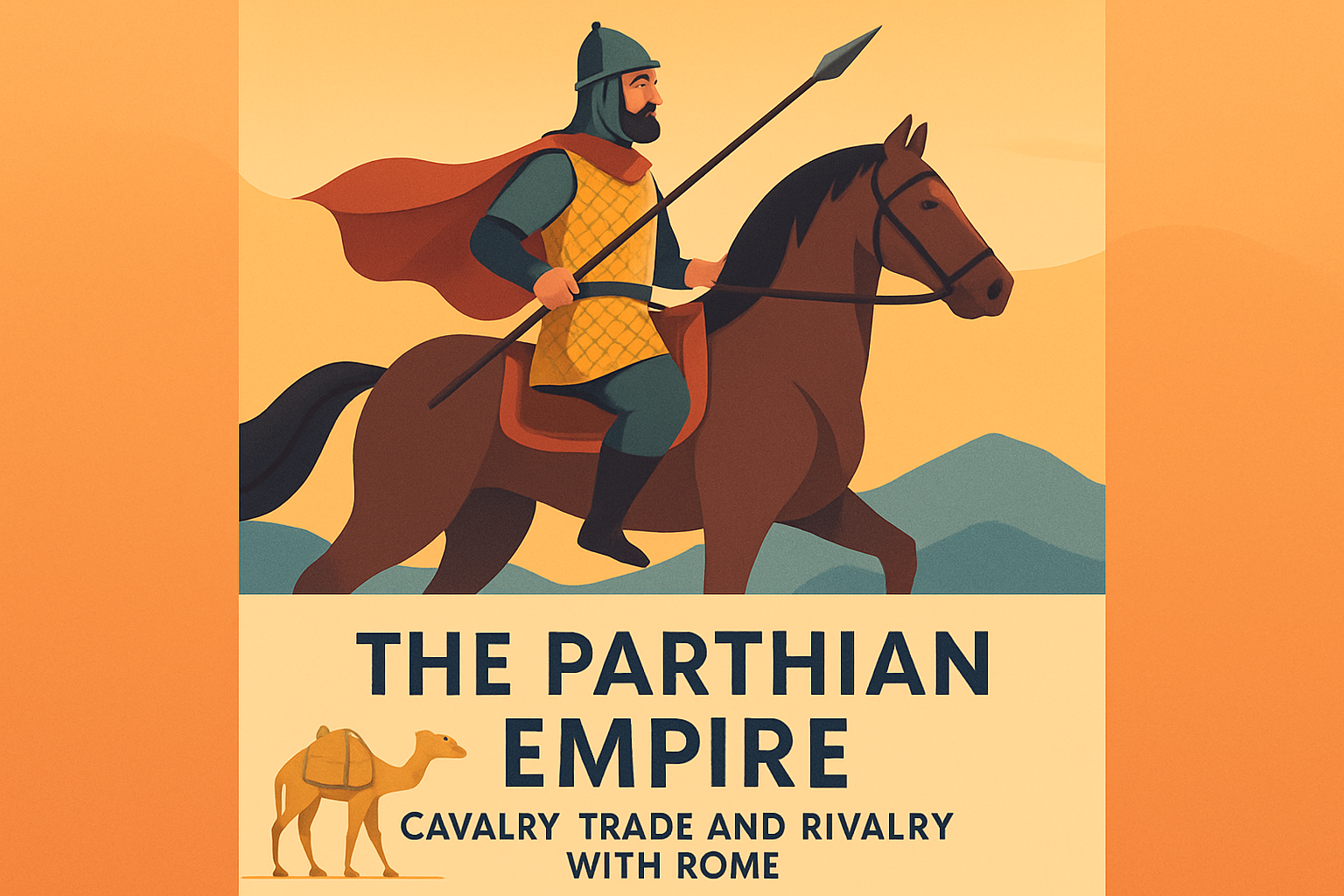
Introduction to the Parthian Empire
The Parthian Empire, a prominent power from 247 BC to 224 AD, was strategically located between the Roman Empire to the west and the Han Dynasty to the east. The Empire’s position in what is now modern-day Iran allowed it to control key sections of the Silk Road, functioning as a significant bridge between Eastern and Western civilizations. Renowned for its skilled cavalry and strategic geographical foothold, the Parthian Empire was both a formidable military power and an economic hub. Their sophisticated cavalry units were famous for their effectiveness in combat, particularly for the ‘Parthian shot’—a military tactic that involved shooting arrows backward while in full retreat.
This empire matters because it significantly influenced the political and military landscape of its era, particularly in its interactions with the Roman Empire. Understanding the Parthian Empire’s cavalry and their conflict and trade relations with Rome offers insights into ancient military strategies, the complexities of ancient interstate diplomacy, and the development of long-distance trade networks that were predecessors to our modern global supply chains.
The Power of the Parthian Cavalry
The Parthian cavalry was a hallmark of their military prowess, distinguished by its agility and versatility in warfare. Unlike the Roman legions, which primarily relied on heavily armed infantry, the Parthians employed horse archers and heavily armored cavalry known as cataphracts. These units were capable of conducting rapid hit-and-run attacks, a tactic that allowed them to defeat numerically superior Roman forces on several occasions.
The Battle of Carrhae in 53 BC serves as a quintessential example of Parthian cavalry effectiveness. Roman general Crassus faced a devastating defeat against the Parthians due to his inability to anticipate and counter their horse archers’ and cataphracts’ strategies. The Parthian cavalry used mobility combined with the expertise of their archers to debilitate the Roman infantry, ultimately resulting in one of the most significant military defeats for Rome during the era.
Trade and Cultural Exchange
The Parthian Empire was a vital conduit for trade between the East and the West, with its influence extending to the major trade routes of the Silk Road. This network facilitated not just the exchange of goods such as silk, spices, and precious metals but also ideas, culture, and technology. The Parthians levied tolls and taxes on goods traveling through their territory, enriching their empire and furthering their economic power.
One prominent example of this trade relationship is Roman glassware found in Parthian territories and Parthian textiles in Roman lands. Such artifacts indicate a rich cultural exchange that went beyond mere commerce. This cultural exchange contributed to a blend of artistic styles and technological advancements originating from both ends of the trade route.
Persistent Rivalry with Rome
The Parthian Empire and the Roman Empire engaged in a series of military confrontations and political maneuvers over control of Armenia and Mesopotamia. These regions were critical for their strategic and economic value, as well as for acting as buffer zones to larger confrontational engagements.
A notable instance of this rivalry was the Parthian campaign of Roman Emperor Trajan in 113 AD. Trajan aimed to emulate Alexander the Great by conquering Parthian territories. Although initially successful, with the capture of key cities and the advancement into Parthian heartlands, the campaign faced logistical issues and local resistance, ultimately forcing a Roman retreat after Trajan’s death.
Legacy and Influence through Historical Context
The Parthian Empire left a lasting legacy on military tactics, diplomatic engagements, and trade practices. Its decline came with the rise of the Sassanian Empire, but its influence persisted, as seen in the continued use of cavalry-based warfare and the sustained significance of Silk Road trade routes.
Modern understanding of intercultural communications and globalization can be partially attributed to the trade practices and diplomatic relations pioneered by empires like Parthia. Their strategic trade positioning and military diplomacy offer valuable lessons applicable to contemporary international relations.
| Aspect | Parthian Empire | Roman Empire |
|---|---|---|
| Military Strategy | Cavalry, Hit-and-run tactics | Legions, Infantry-based |
| Trade | Silk Road Control | Mediterranean Trade Network |
| Key Rivalry Region | Mesopotamia | Armenia |
Summary and Call to Action
The history of the Parthian Empire provides a profound understanding of the complexities and richness of ancient geopolitical dynamics. Their superior cavalry tactics and strategic trade positioning made them a key player in the ancient world, particularly in their interactions with Rome. These historical insights underscore the importance of military strategy and economic control in shaping world events, a concept very much relevant in today’s global economic and political arenas.
For modern readers, studying the Parthian Empire reminds us of the deep-rooted interconnectedness of human societies through time, facilitated by trade and cultural exchanges. To further understand the development of these ancient relationships, one might explore additional readings on the Silk Road’s impact or dive into military histories detailing cavalry developments. By appreciating these past dynamics, we can glean insights applicable to present-day international relations and economic strategies.
Engage deeper with this fascinating empire and reflect on how historical tales of rivalry and trade can illuminate paths to future peace and mutual prosperity.
Frequently Asked Questions
1. What was the significance of the Parthian Empire’s location?
The Parthian Empire’s strategic location played a critical role in its historical significance. Nestled in the region that corresponds to modern-day Iran, it was ideally positioned between two of the ancient world’s superpowers: the Roman Empire to the west and the Han Dynasty to the east. This location allowed Parthia to serve as an essential bridge between these cultures, most notably through the Silk Road. The Silk Road was a trade network spanning Asia to Europe, and the Parthians capitalized on their control of key segments of these trade routes. This central position made the Parthians cultural intermediaries that facilitated the exchange of goods, ideas, technologies, and influences between East and West. Their influence on economic activities cannot be overstated, as they enhanced trade opportunities, contributing significantly to the economic prowess of the region.
2. How did the Parthian cavalry contribute to the Empire’s military strength?
The Parthian cavalry was legendary and is often credited as a central factor in the empire’s military success. What made their cavalry so formidable was not only the number of horsemen they could deploy but also their innovative tactics and equipment. The cavalry was divided primarily into two types: the heavily armored cataphracts, comparable to medieval knights in terms of armor and shock tactics, and the lighter, more agile horse archers. The latter were especially renowned for the “Parthian Shot,” a tactical maneuver where the rider, feigning retreat, would turn in the saddle to shoot arrows at pursuing enemies. This technique baffled and disrupted many opponents, including the Roman legions, which were traditionally more accustomed to face-to-face combat. The effective use of cavalry allowed the Parthians to outmaneuver and outfight more conventionally organized armies.
3. What was the nature of the rivalry between the Parthian Empire and Rome?
The rivalry between the Parthian Empire and the Roman Empire was characterized by a series of conflicts aimed at territorial and political dominance. This intense competition primarily took place in the regions today known as Iraq, Armenia, and parts of the Middle East. Various Roman Emperors attempted to assert control over these areas because of their strategic and economic importance but faced stiff resistance from the Parthians. The Parthian’s effective military defenses and their cavalry’s strategic agility were significant obstacles for Roman forces. Key events in this rivalry included the Battle of Carrhae in 53 BC, where a numerically inferior Parthian force decisively defeated a Roman army led by Crassus. This battle became a symbol of Parthian martial prowess and Roman overextension. The ongoing contest led to numerous subsequent campaigns and negotiations, reflecting a dynamic yet unresolved power struggle.
4. How did trade flourish under the Parthian Empire, especially in terms of cavalry and horses?
Trade under the Parthian Empire flourished due to their strategic policies and exploitation of available resources, notably through the trade of horses. As a bridge civilization along the Silk Road, the Parthians were incredibly adept at facilitating trade between the east and west, and one of their significant exports was their superior breed of warhorses. These horses were highly sought after for their strength and endurance, essential qualities for both domestic markets and foreign armies, including those of Rome and the Han Dynasty. The Parthians also invested in well-maintained trade routes and caravan cities, which attracted merchants from all over the known world. The benefit for Parthia was twofold: they gained immense wealth through trade tariffs and fostered a diverse and cosmopolitan society enriched by interactions with different cultures and ideas. This emphasis on trade through skilled networks exemplifies why the Parthian Empire was a major conduit for commerce during its reign.
5. How did cultural exchanges shape the Parthian Empire?
The Parthian Empire was a melting pot of cultures due to its strategic position as a trade and transport hub on the Silk Road. This confluence of cultures led to significant cultural exchanges affecting art, religion, and everyday life within the empire. Greek influence was particularly strong due to the remnants of Alexander the Great’s empire, seen in the Hellenistic style of art and coinage. Simultaneously, the Parthian society absorbed Persian elements, evident in their administrative practices and the Zoroastrian religion. Artifacts from this era display a blend of Greek, Persian, and local styles, highlighting the diverse range of cultural influences. Moreover, religious practices were equally syncretic as Buddhist, Zoroastrian, and, at times, even early Christian communities co-existed within Parthia’s borders. Such eclecticism led to a dynamic and robust culture that contributed significantly to the region’s history and provided a template for cultural coexistence that persisted even after the empire ceased to exist.