
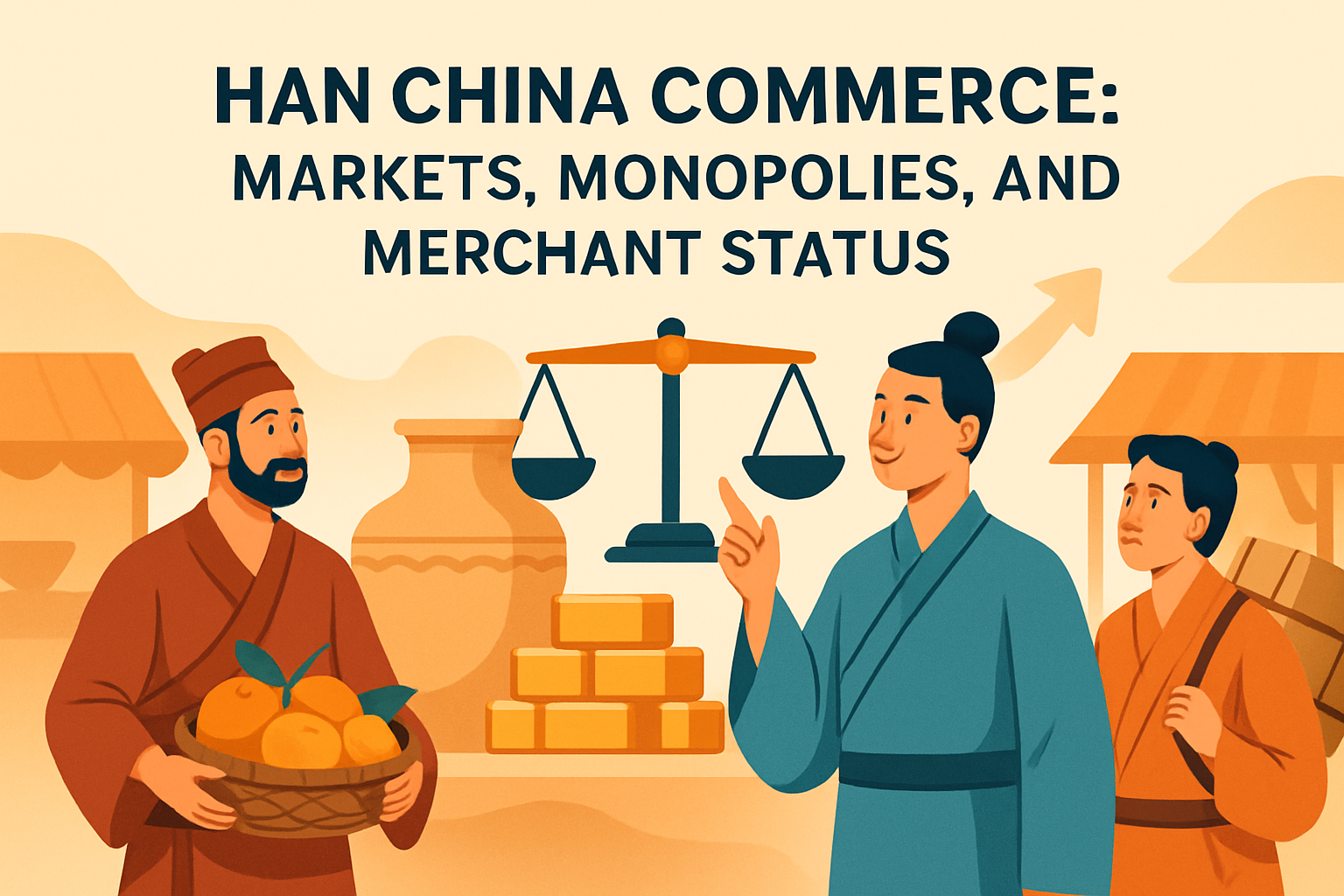
Commerce during the Han Dynasty (206 BCE – 220 CE) was integral to shaping China’s economy, social structures, and even political strategies. Understanding the commerce of this era is crucial as it mirrors many modern concepts, including markets, monopolies, and merchant status within society. Through innovative trade practices and policies, the Han Dynasty set a foundation for economic growth, challenged by societal views of commerce and merchants. It matters because it provides insights into how the early Chinese economy operated, highlighting both the ingenuity and the challenges faced by those in the trade sector. By examining markets, monopolies, and merchant status, we gain a comprehensive view of the complexities the Han navigated and their relevance to contemporary economic systems.
The Structure and Dynamics of Han Markets
The markets during the Han Dynasty were dynamic centers of economic activity, involving both local and long-distance traders. Markets were places where various goods, including silk, ceramics, and spices, were bought and sold. These markets served not only as economic hubs but also as places for social interaction and cultural exchange, fundamentally influencing Han China’s urban centers.
In the markets, traders could find goods from different parts of Asia, facilitated by the Silk Road. This vast network connected China with regions as far west as Rome, allowing for the exchange of products, ideas, and technologies. For instance, Chinese silk reached the Roman Empire, while Roman glassware and precious metals made their way to the Han territories. The existence and operation of these markets demonstrate how global connections were harnessed even in ancient times.
Markets were not merely economic entities but also nurturing grounds for innovation and growth. Cities such as Chang’an and Luoyang stood out as significant trading hubs where commercial activities thrived. These marketplaces operated under official regulations, where the government sometimes involved itself to stabilize prices and assure quality, reflecting an early form of market regulation that resonates with modern-day economics.
Monopolies: State Control and Economic Stability
Monopolies in Han China were government-controlled enterprises and were strategic for maintaining the stability and supply of essential goods. The state implemented monopolies on goods like salt, iron, and alcohol to generate revenue and ensure resources were available to the people at stable prices. These monopolies represent one of the earliest known efforts at macroeconomic management, illustrating an advanced understanding of supply and demand concepts.
The government leveraged profits from these monopolies to fund military ventures, infrastructure projects, and other public expenses. By centralizing control over key commodities, the Han Dynasty could better manage shortages and price fluctuations that could have destabilized the economy. This strategy of economic intervention by the state allowed for resilience in the market and a safeguard against private exploitation.
However, the monopoly system was not without its challenges. It often led to corruption and inefficiencies, where officials might exploit the system for personal gain. These problems necessitated reforms and reflected a delicate balance of control between state intervention and free trade, an issue still relevant in today’s economic policies.
Merchant Status: Social Structures and Economic Perception
Merchants during the Han Dynasty occupied a unique and somewhat ambiguous position in society. Confucian ideals prevalent at the time typically held farmers in high esteem due to their direct role in food production, whereas merchants were often viewed with suspicion as they were perceived to profit from others’ labor. Despite these societal attitudes, merchants played a crucial role in the economy by facilitating trade and distribution of goods across regions.
Many merchants rose to prominence and accumulated wealth, but this didn’t automatically translate into social status or political power due to prevailing societal norms. Instead, merchants often had to navigate these social constraints by forming alliances with government officials or investing in land, which was a more respected asset. In doing so, merchants were able to exert influence indirectly and maintain their status.
Interestingly, the state’s ambivalence towards merchants also had practical benefits; it allowed the government to levy taxes on commercial transactions, thus incorporating merchants into the economic framework despite their lower social standing. This duality highlights the complex dynamics between economic utility and social mores in the Han period.
Commerce in Han China: A Case Study of Silk Production
Silk production and trade in the Han Dynasty provide an illustrative example of how commerce functioned during this period. China’s silk was highly coveted across Eurasia, making its production a well-guarded state secret for many centuries. Silk trade exemplified the intersection of market demand, state control, and product value, underpinning much of China’s trade economy.
- Silk production involved rural households, which spun silk threads and wove silk fabric, contributing to the rural economy.
- The state regulated silk production to maintain quality and reliable output, often imposing quotas or collecting taxes in silk.
- Merchants played a crucial role in exporting silk along the Silk Road, acting as intermediaries who connected producers with distant markets.
- The resulting trade aided in revenue generation, cultural exchange, and the dissemination of Chinese technological advances.
This trade in silk served as a powerful economic engine that not only capitalized on existing resources but also extended China’s influence far beyond its geographic borders. The demand for silk promoted technological advancements, such as improvements in looms and sericulture techniques, which in turn enhanced production efficiency and product quality.
Lessons from Han China’s Commerce
Examining Han China’s commerce systems illuminates a society that was both innovative and strategic in managing its economy. From regulating markets to maintaining monopolies and navigating the societal perceptions of merchants, the Han Dynasty displayed both an understanding of economic principles and adaptability to the challenges they faced. This reveals timeless lessons in economic development and state management that are relevant in comparing ancient economic systems to those in place in the modern world.
As with many societies, the Han Dynasty faced balancing acts between control and freedom, efficiency and corruption, societal respect and economic necessity—challenges that continue to echo through the ages. Understanding these dynamics provides not only a window into the past but also a mirror reflecting the complexities of modern economic frameworks. By studying these aspects of Han commerce, contemporary societies can better appreciate the roots of global economics and the enduring importance of balancing governance with economic freedom.
Summarizing the Impact of Han China’s Commerce
In conclusion, the commerce of Han China showcases an advanced understanding of economic principles like markets, monopolies, and merchant status, with lasting implications for global trade practices. Through a well-structured market system supported by state-controlled monopolies, and an intricate management of merchant roles, Han China navigated through the economic challenges of the era, building a legacy that still informs modern economic practices and theories.
The key takeaways from Han China’s commerce highlight the importance of strategic resource management, the benefits of controlled yet open markets, and the nuanced balance between economic activity and social perception. For today’s readers, understanding these historical insights could foster a better comprehension of the dynamics involved in managing large-scale economies and the necessity of aligning economic strategies with societal values.
For anyone interested in economics or history, delving deeper into Han China’s commerce offers valuable lessons on the integration of economic policies and societal structures. Reading more on this subject or exploring the vast resources available on ancient economic history can provide further insight and inspire discussions on current economic challenges. As the past often echoes in the present, understanding these topics is not merely an academic exercise but a step towards crafting informed and effective economic strategies today.
Frequently Asked Questions
1. What role did commerce play in the Han Dynasty’s economy and society?
Commerce during the Han Dynasty was a cornerstone of both the economy and society, significantly influencing the political and social dynamics of the time. The Han Dynasty, ruling from 206 BCE to 220 CE, saw commerce as a tool for bringing economic prosperity, which in turn stabilized and unified the vast empire. Trade routes, notably the Silk Road, connected China with distant lands, facilitating the exchange of goods, ideas, and culture. This not only brought wealth but also helped to integrate China into a broader world economy, enhancing its power and prestige.
In terms of social structure, commerce began to challenge traditional Confucian values, which typically regarded merchants with suspicion due to their profit-seeking motives, as opposed to the scholarly and agrarian ideals of society. Despite societal ambivalence, successful merchants were able to amass considerable wealth, sometimes rivalling that of the gentry, which subtly began to shift social hierarchies and opinions about wealth and status in social classes. This economic vitality fostered by commerce allowed the Han government to support military campaigns and public works projects, thus weaving commerce deeply into the social and political fabric of Han Dynasty China.
2. How did markets function during the Han Dynasty, and what were some of their characteristics?
Markets during the Han Dynasty functioned both as bustling trade hubs and vital centers of social interaction. They were typically regulated by local officials, who ensured that market activities were orderly and conducted within designated areas. This regulation was necessary to manage the chaos that could ensue from unbridled trading activities. Han markets offered a wide array of goods—from local agricultural produce to exotic imports from faraway lands—thanks in part to the Silk Road’s extensive trade network.
A defining characteristic of Han markets was their periodic nature. Unlike modern markets that are open daily, many Han markets operated on specific days to coincide with the lunar calendar or local festival schedules. This regular, yet intermittent schedule allowed traders from surrounding regions to plan their travel and sales accordingly. Markets were not just economic venues but also cultural melting pots where people from various backgrounds interacted, shared news, and exchanged traditions. As such, they played a critical role in cultural diffusion and the social engagement of the Han populace.
3. What types of monopolies existed in Han China, and how did they impact the economy?
During the Han Dynasty, the government established several state-controlled monopolies primarily to stabilize the economy, increase revenues, and regulate the production of essential goods. Notably, monopolies were set up in industries like salt, iron, and liquor. These monopolies allowed the government to control production quantities and prices, which helped prevent market instability and ensured the fair distribution of these vital resources.
The impact of these monopolies was mixed. On the positive side, they provided a significant source of revenue for the state, funding essential public amenities such as infrastructure, military campaigns, and emergency relief efforts during disasters. However, monopolies also faced criticism and opposition, especially from private entrepreneurs who were edged out of profitable markets. Additionally, critics contended that monopolies led to inefficiencies and corruption amongst state officials. Over time, these issues prompted debates on the role and extent of state intervention in the economy, reflecting tensions that continue to be relevant in contemporary economic assessments.
4. How were merchants perceived in Han China, and how did this perception affect their social status?
Merchants in Han China faced a complex array of perceptions and societal attitudes. Traditionally, the Confucian ideals dominant during the Han period placed merchants at the bottom of the social hierarchy, after scholars, farmers, and craftsmen, because their work was seen as profit-driven rather than contributing to societal good. This philosophical stance was prevalent because it was believed that accumulation of wealth through trade could lead to social disparity and moral decay.
Despite this general societal disdain, some merchants were highly successful and could accumulate significant wealth, which occasionally enabled them to improve their social status by purchasing official positions or engaging in philanthropy. Wealthy merchants could also exert influence by becoming patrons of arts and culture, challenging traditional social norms that downplayed their importance. Over time, while stereotypes persisted, the undeniable economic importance of merchants slowly began to alter perceptions, although they never fully matched the prestige of the traditional gentry and scholar-official classes.
5. What innovative trade practices did the Han Dynasty employ, and what were their effects?
The Han Dynasty was marked by several innovative trade practices that had profound and lasting effects on both the empire and the broader regions connected by trade routes. One key innovation was the establishment and expansion of the Silk Road, an extensive network of trade routes that connected China with Central Asia, the Middle East, and even parts of Europe. This network facilitated not only the exchange of silk, from which it derives its name, but also a multitude of goods, ideas, and technologies, greatly enriching the cultures involved and enhancing diplomatic relationships.
Additionally, the Han administration implemented policies to standardize weights and measures, making trade more efficient and reducing disputes. They also issued bronze coinage to simplify and enhance trade transactions, increasing liquidity in the market. Caravan trade was facilitated as safe passage agreements were often enforced along the trade routes to ensure the security of traders and goods.
These practices led to significant economic prosperity and cultural exchange, cementing China’s role as a central hub in ancient global trade networks. These innovations not only boosted the economy within the empire but also laid the groundwork for future international trade relations, profoundly influencing the historical trajectory of economic and cultural globalization.