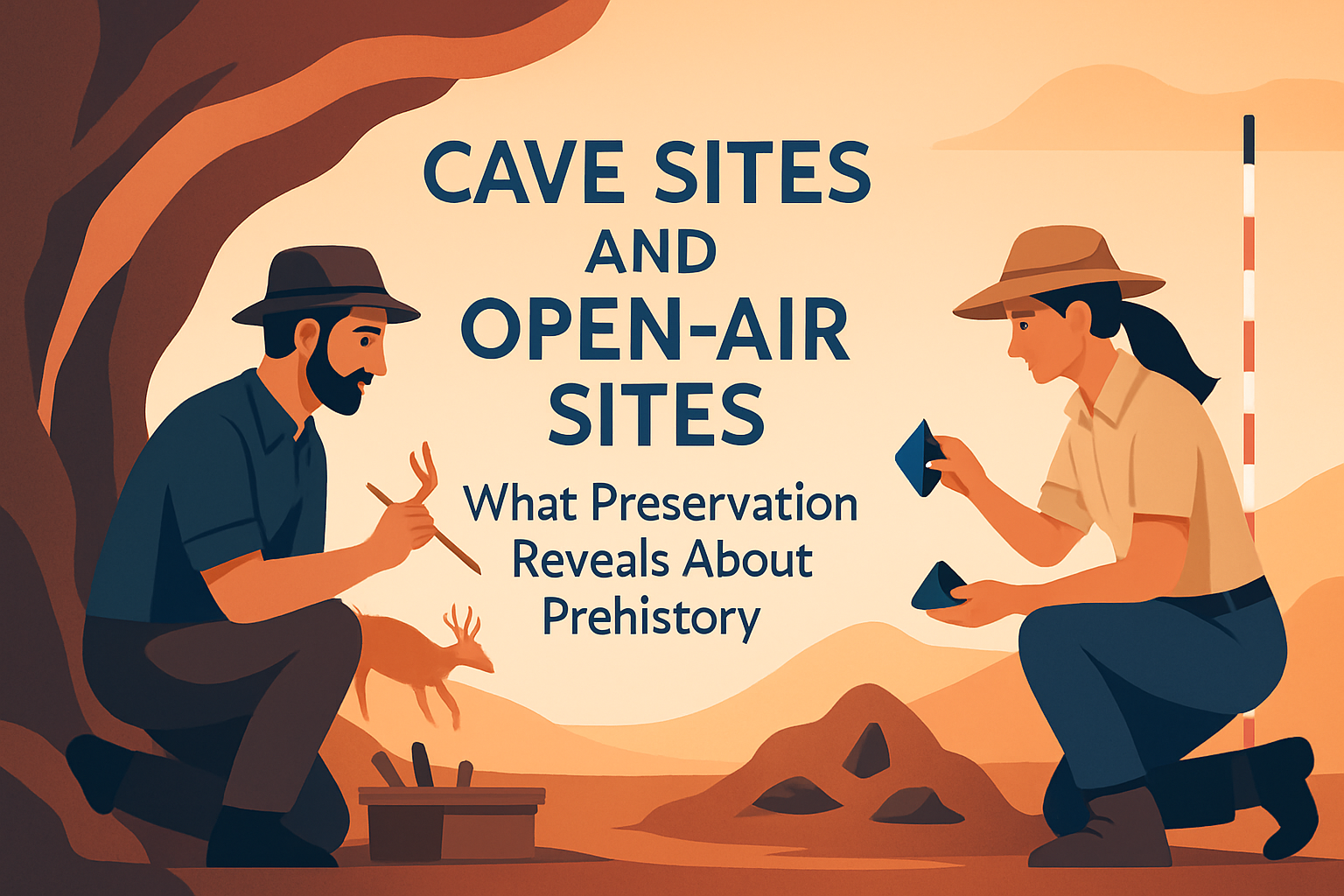
The study of prehistoric sites is fundamental to understanding early human life. Among these sites, cave sites and open-air sites are particularly noteworthy. While both types serve as vital keys to unlocking the past, they offer different insights into prehistoric life. Cave sites, usually sheltered and thereby preserving organic materials more effectively, have been a rich source of archeological finds. In contrast, open-air sites, being more exposed, reveal different aspects of survival and adaptation in ancient human activity. Understanding what these sites hold and how they preserve it matters deeply because it offers us a glimpse into the behaviors, culture, and evolution of early humans. Exploring the types of artifacts found in these distinct sites, the preservation conditions, and the archaeological methods applied can significantly enhance our knowledge of human ancestry and evolution.
Defining Cave Sites and Their Significance
Cave sites refer to natural rock formations that have provided shelter for ancient humans. These sites are often favored for their ability to protect inhabitants from the elements, contributing to their value in studies of prehistory. Sheltered by rock, caves have unique preservation conditions, where reduced exposure to environmental factors like sunlight, wind, and rain helps in the retention of organic materials such as bones, wooden tools, and textiles.
One exemplary cave site is Chauvet Cave in France, famous for its well-preserved prehistoric wall paintings dating back around 33,000 to 30,000 years. The artwork discovered offers insights into the cognitive abilities and artistic sensibilities of early humans. In addition, faunal remains and scattered human artifacts found in caves often represent broader aspects of daily life, diet, and social structures. These preserved elements provide a more comprehensive view of life during those times, giving archaeologists crucial data to analyze human behavior over millennia.
Open-Air Sites: Pathways to Understanding Early Human Movement
Unlike cave sites, open-air sites exist on open landscapes where ancient humans lived and moved. The lack of natural shelter exposes findings to the elements, making preservation more difficult than in caves. These sites, however, hold great archeological importance as they often reveal mobility patterns, trade routes, and the spread of technological innovation across regions.
A notable example of an open-air site is Olduvai Gorge in Tanzania, which has contributed immensely to our understanding of early hominins. It was here that Louis and Mary Leakey unearthed evidence of some of the earliest forms of stone tools, dating back to 2 million years ago. Open-air sites like this reveal how early humans adapted to changing environments, as well as how populations might have interacted with other groups.
Preservation Challenges in Cave and Open-Air Sites
The preservation of artifacts varies significantly between cave and open-air sites due to differing environmental conditions. In caves, the absence of harsh weather conditions typically allows for exceptional preservation of organic materials, which is not usually the case in open-air sites. This is shown in the preservation of remains found within Turkey’s Altamira Cave, where even fine details of pollen and plant fibers have been preserved.
Open-air sites need more sophisticated methodologies for archaeological study since remains exist in less stable environments. Here, fossils and artifacts degrade quickly due to moisture, temperature fluctuations, and biology. High-altitude open-air sites in the Andes have provided insight despite degradation through the use of advanced analytical techniques that assess soil and rock chemistry to trace human activities and occupation layers.
Archaeological Techniques for Analyzing Prehistoric Sites
Both cave and open-air sites benefit from technology like carbon dating and stratigraphy for reconstructing timelines. For cave sites, Lascaux’s paintings have been effectively dated using carbon-14, giving invaluable context. Additionally, 3D scanning allows for detailed documentation of cave interiors and artifacts without physical interference.
Open-air sites frequently employ methods that consider larger area geography and environmental samples. Archaeologists at Ayacucho Basin, Peru, have used satellite imagery and predictive modeling to locate potentially significant excavation zones. Furthermore, the advent of ground-penetrating radar speeds up the identification of subsurface structures in massive open spaces, such as ceremonial grounds or residential areas in early civilizations.
Visualizing Differences in Artifact Preservation
A comparison of artifact types typically found at these sites highlights preservation impacts:
| Site Type | Commonly Preserved Artifacts | Preservation Challenges |
|---|---|---|
| Cave Sites | Organic materials (bones, textiles), Ceramics, Artworks | Vandalism, Modern pollution |
| Open-Air Sites | Stone tools, Fire remains, Large structures | Weathering, Soil erosion |
Interpreting the Cultural Aspects Through Archeological Finds
Cultural practices and changes are best evaluated through artifacts that endure through time. Cave sites, often seen as sanctuaries, have unearthed cultural artifacts indicating religious or spiritual significance. For instance, the Cave of Altamira showcases not only artistic advancement but also hinted at the spiritual life of prehistoric humans through animal depictions.
For open-air sites, the development of tool-making strategies and migration patterns reveal societal adaptation and progression. By examining tool debris and site layouts, scholars better understand community life from seasonal living arrangements to resource management. Analyzed collectively, findings from both site types can establish evolutionary narratives of human development across geographical territories.
The Importance of Conservation and Debate over Site Restoration
The significance of both cave and open-air sites means preserving these cultural heritages takes precedence. Preservation techniques range from maintaining humidity levels in cave systems to meadow caretaker projects in open-air sites, which aim to protect from agricultural encroachment. However, debate often arises between conservation efforts and the urge to expose sites to educational tourism, which can result in damage.
There are growing movements emphasizing digital preservation, such as virtual reconstructions, ensuring access without physical interaction. Open dialogues between archaeologists, local governments, and international bodies aim to balance the valuable educative role of these sites against preservation imperatives.
Conclusion: Uniting Preservation Insights for Future Inquiry
In summary, cave sites and open-air sites uniquely contribute to our understanding of prehistory through their distinctive preservations and can inform endless inquiries into the past’s intricacies. By preserving the artifacts within and understanding conditions that aid or hinder preservation, we gain invaluable evidence that forms the tapestry of human history. For the reader, leveraging this understanding might pave pathways to exploring further archaeological studies or advocating for preservation actions worldwide.
One simple next step could be to engage in community outreach or educational programs that discuss the importance of preserving historical sites, thus throwing open doors to preserving our shared heritage. As guardians of our history, whether academically or casually, everyone holds the keys to connect what remains intact today with the cultural narratives of tomorrow.
Frequently Asked Questions
1. What is the main difference between cave sites and open-air sites in prehistoric studies?
The primary distinction between cave sites and open-air sites in the realm of prehistoric studies lies in their respective environments and how these affect what remains are preserved. Cave sites are typically enclosed and sheltered, which makes them highly effective at preserving organic materials over millennia. This protection means that in caves, you can often find well-preserved artifacts, such as tools, bones, and sometimes even remnants of artwork or wall carvings, that provide insight into the day-to-day lives and cultural practices of early humans.
On the other hand, open-air sites are more exposed to the elements and therefore, they often show a different side of prehistoric existence. While they might not preserve organic materials such as bone or wood as well as cave sites do, open-air sites offer crucial insights into larger aspects of early human life. This can include the spatial organization of living, hunting strategies, or patterns of movement and migration. Essentially, while cave sites often excel in detail due to the preservation of smaller, organic materials, open-air sites are invaluable for understanding the broader social and environmental context in which early humans lived.
2. Why are organic materials better preserved in cave sites?
Organic materials tend to preserve better in cave sites primarily due to the stable environmental conditions within caves. Caves usually provide a more consistent temperature and humidity level compared to external environments. This stability significantly slows the process of decay caused by environmental factors such as temperature fluctuations, moisture, and exposure to wind and sun, which are common in open-air settings.
Additionally, being sheltered from rainwater and other weathering elements helps reduce erosion and other natural processes that might otherwise degrade or destroy organic material over time. With these protective factors in play, archeologists often find bone fragments, wooden tools, textiles, and even fragile remains such as plant materials in a much better state of preservation in cave sites. This makes these locations invaluable for studying the diet, tools, and shelters used by our prehistoric ancestors.
3. How can studying open-air sites help us understand ancient human survival strategies?
Open-air sites offer a window into numerous aspects of prehistoric life that are not as easily discerned from cave sites alone. These sites can provide evidence of how early humans adapted to different environments, their interactions with surrounding flora and fauna, and how they structured their daily life in response to these conditions. Because open-air sites are more affected by environmental change, they reveal information about how early humans might have coped with climate variations, made use of different locales seasonally, and how they organized their spatial environment for activities like food gathering, hunting, and tool-making.
Furthermore, open-air sites can often show larger communal living arrangements, such as the spatial distribution of dwellings or storages, offering insights into social structures and community organization. They may also reveal migration and trade patterns by showing how far certain materials, seeds, or artifacts traveled from their original source, suggesting connections or exchanges between different groups and regions. By understanding these survival strategies, archeologists can piece together a more comprehensive picture of human development and adaptability.
4. Do cave sites or open-air sites provide better insights into ancient art and cultural expression?
Both cave sites and open-air sites contribute valuable insights into ancient art and cultural expression, but in different ways. Cave sites have historically been known for their remarkable preservation of prehistoric art, such as carvings, paintings, and engravings on walls and ceilings. The stable environment within caves helps protect such artwork, allowing modern archeologists to study color use, symbolism, and techniques that may have been employed by prehistoric artists. Some of the world’s most famous prehistoric art, like the paintings in the Lascaux Cave in France, provides exceptional insights into how early humans expressed themselves and their perceptions of the world.
In contrast, open-air sites might not contain art as well-preserved, but they can provide evidence of cultural practices through artifacts indicating art production, such as remnants of colors and pigments, materials used for sculpting, or even the locations of artworks that could have been outside but have since been eroded by time and weather. Furthermore, the study of the spatial arrangement and context of these artifacts at open-air sites can imply broader cultural practices related to community rituals, social gatherings, and the sharing of knowledge and skills. Thus, both site types are crucial for understanding the full spectrum of prehistoric artistic and cultural expression.
5. How do archeologists balance research between these two types of sites to build a comprehensive view of prehistory?
To build a comprehensive view of prehistory, archeologists must balance their research focus between cave sites and open-air sites, as each offers a unique puzzle piece to our understanding of early human life. They often employ a multidisciplinary approach, integrating various methods and technologies such as radiocarbon dating, soil analysis, paleoenvironmental reconstructions, and even modern digital technologies like 3D mapping and virtual reconstructions.
In practice, this means that well-preserved, detailed findings from caves can offer a framework of human behavior, technology, and diet that can then be contextualized and expanded upon with the broader environmental and societal insights gathered from open-air sites. By cross-referencing data from both types of locations, like settlement patterns from open-air sites with cultural artifacts from cave sites, archeologists can gain a multidimensional understanding of prehistoric life.
This integrative approach enables researchers to appreciate the complex interrelations between early humans and their environment over time, offering a more holistic picture of how they lived, adapted, and evolved. By continually expanding excavations and research efforts to both site types, scientists and historians are continually piecing together the intricate tale of our shared prehistoric past.