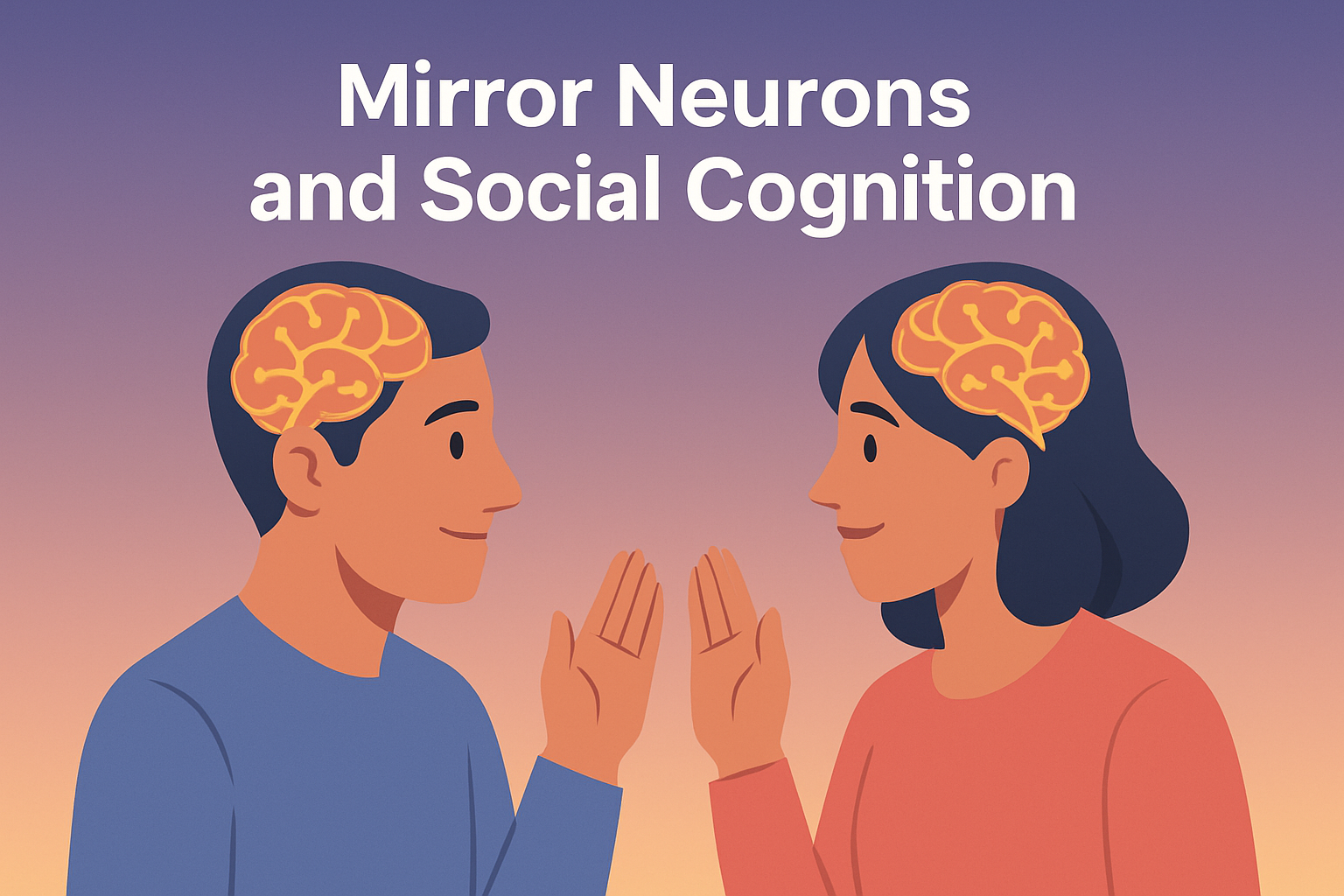
In the diverse and dynamic realm of neuroscience, a particular discovery has stirred the imagination of researchers and laypeople alike: mirror neurons. Discovered accidentally in the 1990s by a group of Italian scientists, these neurons provide an unexpectedly intimate window into social cognition—the process by which we understand and interact with those around us. But why should you care about these biological marvels? Because they are believed to play a critical role in everything from empathy and learning to communication and cultural development. Their mechanism helps us understand not only human behavior but also offers insights into mental health disorders that disrupt social interactions, like autism. Understanding mirror neurons, therefore, is vital not just for science, but for enhancing our ability to connect with and support others effectively.
Understanding the Basics: What are Mirror Neurons?
Mirror neurons are a specific type of brain cell that responds equally whether we perform an action ourselves or witness someone else perform the same action. Found in the premotor cortex and other regions associated with movement and sensation, they are unique in how they seem to ‘mirror’ the actions and intentions of others, hence their name. Imagine walking past a bakery and seeing a person savor a mouth-watering pastry. Your mirror neurons fire, not just because you observe the action, but because, in a cerebral sense, you are experiencing it too. This response underlies our ability to empathize and learn through imitation.
Consider learning to play a musical instrument. Watching a skilled musician play invokes mirror neurons that can enhance your own ability to mimic those actions when you attempt to play the instrument yourself. This ‘observe and imitate’ loop extends far beyond simple physical tasks, providing a neurological grounding for teaching methods and collaborative endeavors.
- Physical actions: like watching someone kick a ball
- Emotional experiences: like seeing someone else smile or express sadness
- Learning processes: such as language acquisition in children
Mirror Neurons and Empathy: Bridging Emotional Gaps
Empathy—the ability to understand and share the feelings of another—roots deeply in the activity of mirror neurons. These neurons potentially offer an explanation for how we ‘feel’ another’s pain or joy. When observing someone in distress, our mirror neurons activate in a way that enables us to internally simulate their emotional state, allowing us to feel with, rather than simply for, the other person.
A practical example of this is seen in caregivers of patients with chronic illness. Effective caregivers often exhibit heightened empathic abilities, which are now thought to be linked to the activity in their mirror neuron systems. This capacity to internally reconstruct the experiences of the patients enables caregivers to respond with appropriate emotional support and care strategies.
Learning Through Social Interaction
In educational settings, the potential of mirror neurons is particularly significant. These neurons allow students to learn not just by doing, but by observing others. This is a crucial aspect of childhood development, where children learn behaviors, language, and skills through observing parents and peers. The mirror neuron system thus bridges the gap between watching and learning, transforming it into doing and understanding.
For instance, language acquisition in toddlers provides a clear example. Children exposed to rich verbal environments with lots of interactions tend to develop language skills more rapidly. This is because their mirror neurons are constantly active, helping them to replicate sounds, words, and even sentence structures, which they have merely observed or heard.
| Aspect of Learning | Role of Mirror Neurons |
|---|---|
| Language Acquisition | Mirrors others speaking to learn speech patterns |
| Skill Development | Observing skilled peers enhances personal skill level |
| Behavioral Modeling | Understanding social norms through observation |
Implications in Autism Spectrum Disorders
Research suggests that malfunctioning mirror neuron systems could be linked to autism spectrum disorders (ASD), which are marked by difficulties in social communication and interaction. Individuals with ASD may have impaired mirror neuron activity, which affects their capability to imitate and empathize, key components of developing social cognition. By studying these neurons, scientists aim to unravel the biological roots of autism, providing better frameworks for therapies that can enhance social skills and improve quality of life.
An approach derived from this understanding involves therapies that encourage interactive play and observational learning, where children with autism engage more fully with others in an environment enriched by social cues. By potentially activating their mirror neuron system through structured play interventions, therapists aim to improve social understanding and empathy.
Mirror Neurons and Cultural Evolution
Culture is inherently social; the transmission of behaviors, rituals, and knowledge across generations hinges on our ability to observe, imitate, and innovate upon what we see. Mirror neurons facilitate this cultural transmission by enabling individuals to replicate complex behaviors seen in others, thus allowing cultural knowledge to be passed along seamlessly.
An everyday example is seen in culinary practices. Cooking methods, recipes, and even the nuanced art of seasoning and plating dishes are transferred from one person to another through observation, modeling, and practice—all of which depend on the functioning of mirror neurons. This not only fosters tradition but also innovation, as individuals learn to adapt and modify techniques to create something new.
Enhancing Interpersonal Communication
Communication is more than words; it’s a complex symphony of verbal and non-verbal cues, an area rich with mirror neuron activity. By observing others’ body language or facial expressions, we activate similar neural processes that help us respond appropriately, fostering more effective and meaningful interactions.
Think about a business negotiation. Successful negotiators often excel not because of what they say, but due to their acute ability to read and respond to the unspoken elements conveyed by their counterparts. Their mirror neurons engage to reflect the subtle non-verbal communication, aiding them in crafting a response that aligns with the emotional undertone of the conversation.
Such insights are not confined to professional settings but applicable across our interpersonal endeavors. They enhance marital bonds, friendship dialogs, and parent-child communication, all built on the foundational ability to connect through empathy and understanding.
The Neuroethical Edge: Mirror Neurons in a Social Context
Understanding the power and potential of mirror neurons also compels us to face certain ethical considerations. For instance, media violence and its portrayal can engage our mirror neurons similarly as if those acts were observed in real life, potentially desensitizing individuals to violence. This prompts dialogues on the responsibility of content creators, educators, and parents in mitigating negative influences.
Moreover, the study of mirror neurons encourages inclusivity and diversity within social structures. By appreciating the mechanisms of empathy and learning, initiatives aiming to integrate various social demographics can foster more compassionate and understanding communities, where diverse perspectives are not only acknowledged but valued.
Conclusion: Mirror Neurons Unlock the Secrets of Social Success
Mirror neurons illuminate the pathways of social cognition, acting as a cornerstone for empathy, learning, and communication. This understanding offers profound implications across educational, social, and cultural domains, illustrating the deep interconnectivity present in our social existence. By furthering our understanding of these unique cells, we not only gain insight into human behavior but enhance our capacity to empathize and connect with others meaningfully.
As you navigate your interpersonal relationships and community interactions, consider how mirror neurons might influence your perceptions and responses. Foster environments of rich social interaction and empathy, allowing these neurons to bridge gaps and build collaborative, compassionate cultures. To deepen your understanding, engage in active listening and observational learning, and embrace opportunities for diverse social exchanges. The journey of unraveling the power of mirror neurons reflects the broader journey of enhancing human connection—one mirrored experience at a time.
Frequently Asked Questions
1. What are mirror neurons, and how were they discovered?
Mirror neurons are a special type of brain cell that activates both when we perform an action and when we observe someone else performing that same action. These fascinating little cells were discovered quite by accident in the early 1990s by a team of Italian researchers at the University of Parma. Originally, the scientists were studying the brain of a monkey, observing its neural response as it picked up food. They noticed that certain neurons fired not only when the monkey performed this action but also when the monkey merely watched a human perform it. This revelation opened up a whole new understanding of how our brains mirror the actions of others, providing a potential neural basis for empathy, imitation, and social understanding.
2. How do mirror neurons contribute to social cognition?
The contribution of mirror neurons to social cognition is profound and multifaceted. Social cognition refers to the mental processes involved in perceiving, interpreting, and responding to the social world, including understanding others’ actions, intentions, and emotions. Mirror neurons are believed to play a key role in these processes by enabling us to “mirror” or internally simulate the experiences of others. For instance, when you see someone smiling, the mirror neurons that would activate if you yourself were smiling may become active. This subliminal mirroring helps create a shared space of understanding, making it easier for us to grasp what others are feeling or why they are acting in a particular way. It is this mechanism that is thought to underlie our capacity for empathy and our ability to learn through imitation.
3. Can mirror neurons help explain why we feel empathy?
Absolutely! Empathy, the ability to understand and share the feelings of another, is closely tied to the functioning of mirror neurons. When we observe someone experiencing a particular emotion, mirror neurons in our brain activate as if we are experiencing the same emotion ourselves. This mirroring facilitates a deeper connection and understanding between people, acting as a neural bridge that helps us resonate with others’ internal states. The activation of mirror neurons does not happen consciously; rather, it’s an automatic process that makes empathy an inherent part of social interactions, suggesting why sometimes we can almost “feel” others’ pain or joy just by watching them. This link to empathy underscores the importance of mirror neurons in fostering social bonds and enhancing cooperative behavior.
4. What implications do mirror neurons have for understanding disorders like autism?
Mirror neurons offer intriguing insights into several neurodevelopmental disorders, particularly autism spectrum disorder (ASD). ASD is often characterized by difficulties in social interaction, communication challenges, and restricted, repetitive patterns of behavior. Some researchers propose that a dysfunction in the mirror neuron system could contribute to the social and communicative difficulties seen in autism. If the mirror neurons do not fire as they should, a person with ASD might struggle to automatically interpret others’ intentions or empathize with their emotions, which are crucial elements of social cognition. This potential link has sparked considerable research interest, with scientists exploring ways to use this understanding to develop interventions that could help improve social functioning in individuals with autism.
5. Are mirror neurons unique to humans, or are they found in other species as well?
Mirror neurons are not unique to humans; they have been identified across various species, particularly in primates like monkeys, which is where they were first discovered. This cross-species presence suggests that mirror neurons have been beneficial in evolution, contributing to social learning and communication across the animal kingdom. In monkeys, for example, these neurons support the imitation of actions, which is critical for survival by facilitating learning of new tasks through observation. In humans, while they are involved in more complex social behaviors and cultural learning, the fundamental role of mirror neurons in bridging observed and executed actions is a common thread across species. The study of mirror neurons in animals continues to provide valuable insights into the fundamental mechanisms of social cognition and how they may have evolved.