
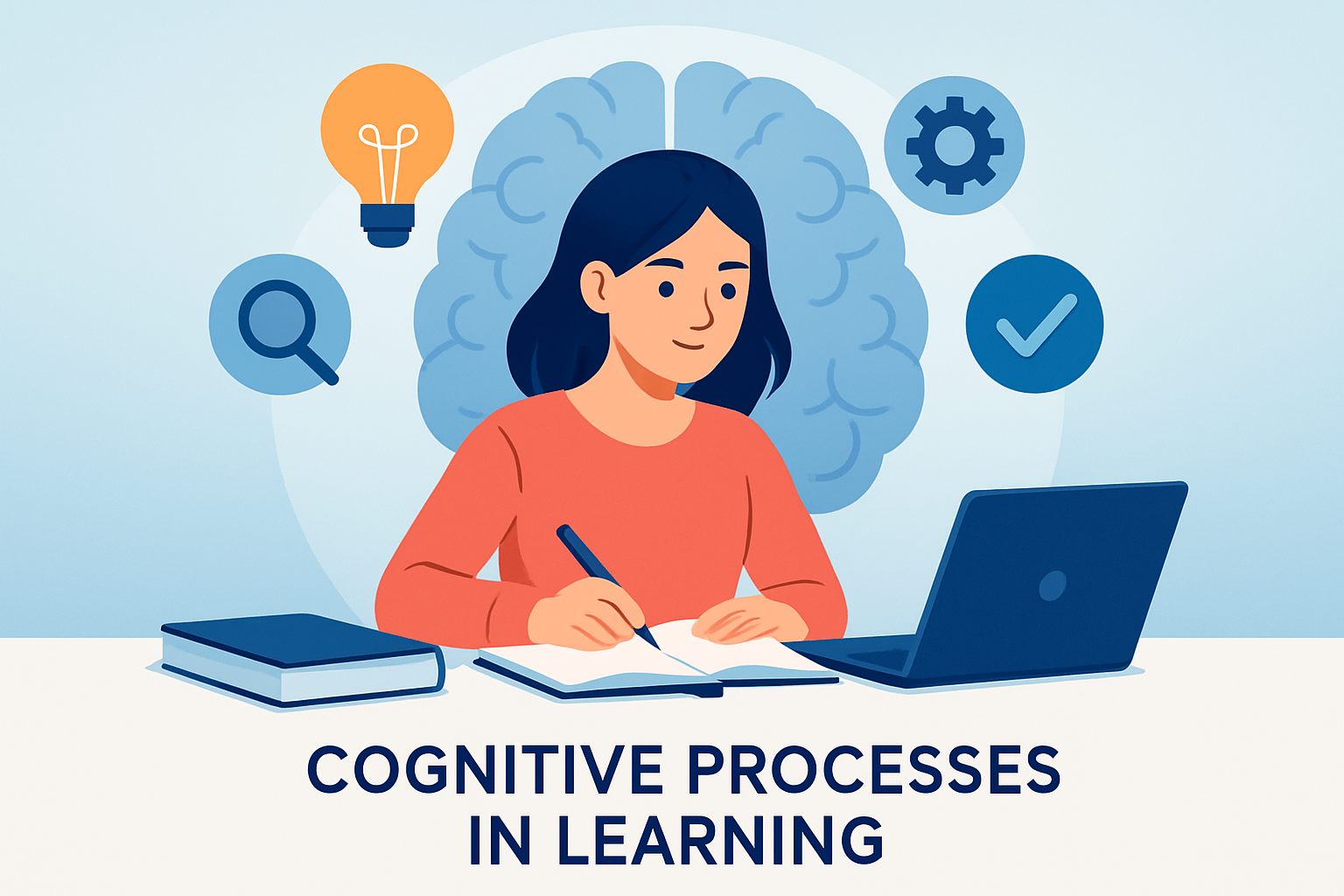
Cognitive processes are integral to learning, shaping how we acquire, process, and store information. Understanding these processes is essential for educators, students, and anyone interested in optimizing learning experiences. This article explores key cognitive processes involved in learning, such as perception, attention, memory, and problem-solving, and discusses their significance and practical implications. By delving into these processes, we can better comprehend how learning occurs and devise effective strategies to enhance educational outcomes. Whether you’re a student aiming to improve study habits or a teacher designing curricula, grasping cognitive processes in learning can offer valuable insights and lead to improved academic performance and lifelong learning skills.
Perception and Learning
Perception plays a vital role in learning as it involves interpreting sensory information to understand the environment. This process allows us to receive and interpret signals from our surroundings, forming the basis for all subsequent cognitive tasks. For instance, when reading a book, perception enables us to recognize letters and words, as we convert visual stimuli into meaningful information. Sensory modalities, such as vision and hearing, provide the data needed for perceptual processing, facilitating different types of learning, from reading and writing to listening and speaking.
A real-world example of perception in learning is a child learning to read. Initially, the child perceives letters as unfamiliar marks. Through repetition and guided instruction, these marks are perceived as associated sounds and words, which eventually form into sentences and stories. Perception essentially sets the stage for further cognitive development by enabling the recognition of complex patterns and systems.
Attention as a Gatekeeper
Attention functions as a cognitive gatekeeper, determining which stimuli receive focus amidst a plethora of external information. This selectivity is crucial, as only attended information enters the short-term memory, where further processing occurs. For learners, attention allows concentration on relevant details while filtering out distractions, consequently influencing the retention and understanding of information.
An example of attention in learning can be found in the classroom setting. Students are bombarded with various stimuli, such as teacher instructions, peers’ conversations, and external noises. To learn effectively, they must selectively attend to the teacher’s explanations while disregarding extraneous distractions. Techniques like mindfulness training and structured environment setups help enhance attention, thereby improving the learning outcomes.
Memory Systems in Learning
Memory is central to learning, enabling the storage and retrieval of information. It involves several subsystems: sensory memory, short-term memory, and long-term memory. Sensory memory holds information for a fraction of a second and transfers it to short-term memory upon attention. Short-term memory, also known as working memory, temporarily holds information for use and processing. Long-term memory provides a vast storage space for information, retaining it for future retrieval.
| Memory Type | Duration | Capacity |
|---|---|---|
| Sensory Memory | Milliseconds | Large |
| Short-Term Memory | Seconds to Minutes | Limited (7 ± 2 items) |
| Long-Term Memory | Indefinite | Unlimited |
A practical illustration of memory systems is how students memorize vocabulary for a foreign language class. Initially, words enter sensory memory upon hearing or seeing them. With focused attention, these words move to short-term memory for practice and repetition, eventually consolidating into long-term memory for fluent retrieval during conversations.
Problem-Solving and Learning
Problem-solving is an advanced cognitive process that involves identifying solutions to complex issues. It encompasses several strategies, such as trial and error, algorithmic solutions, and heuristic approaches, enabling learners to apply knowledge in new contexts and develop critical thinking abilities.
Consider a mathematics student faced with a challenging geometry problem. The student employs problem-solving skills by deconstructing the problem, identifying known variables, and systematically testing possible solutions. Success in problem-solving not only demonstrates comprehension of mathematical principles but also builds confidence and adaptive reasoning skills applicable beyond the classroom.
Metacognition: Thinking About Thinking
Metacognition, or ‘thinking about thinking,’ involves self-awareness and self-regulation of cognitive processes. This higher-order thinking skill enables learners to evaluate and modify their thought processes, leading to improved learning outcomes. Metacognitive strategies include monitoring comprehension, planning learning tasks, and assessing the effectiveness of study techniques.
An example of metacognition in action is a student preparing for an exam who reviews past test results to identify areas requiring more focus. By planning a study schedule addressing weak areas and monitoring understanding through self-assessment quizzes, the student applies metacognitive strategies to enhance learning efficacy and academic performance.
Application of Cognitive Processes in Education
The application of cognitive processes in education enhances teaching methodologies and student learning. Educators can leverage knowledge of these processes to design curricula that align with cognitive development stages, employ teaching techniques fostering effective perception, attention, memory, and offer problem-solving opportunities.
- Perception: Utilizing visual aids and hands-on activities to enhance perception.
- Attention: Creating structured environments minimizing distractions.
- Memory: Encouraging active recall and spaced repetition in lessons.
- Problem-Solving: Incorporating open-ended questions and real-world scenarios.
- Metacognition: Teaching strategies for self-monitoring and reflection.
Incorporating these cognitive insights into classroom strategies not only improves individual student performance but nurtures a lifelong learner mindset.
Conclusion
Understanding cognitive processes in learning is fundamental to optimizing educational experiences and achieving meaningful learning outcomes. From perception and attention to memory, problem-solving, and metacognition, each cognitive process plays a distinctive role in how individuals acquire and apply knowledge. Grasping these processes equips educators, students, and lifelong learners with practical tools to enhance learning efficacy and foster critical thinking skills.
The key takeaway is the significant impact of cognitive processes on learning behaviors and achievements. By appreciating how these processes function, stakeholders can implement targeted interventions benefiting diverse learners, tailored to strengths and areas for improvement. As we continue advancing in our understanding of cognitive psychology, these insights promise to revolutionize educational methodologies and empower all learners in their pursuit of knowledge.
Advancing your learning journey begins with a simple step: exploring your cognitive strengths and identifying areas of growth. Utilize the information presented here to reflect on your learning habits and choose a strategy to experiment with in your study sessions or teaching practices. By cultivating a metacognitive awareness of your cognitive processes, you open the doors to enhanced learning and personal development.
Engage with your educational environment actively, and remember that the pursuit of knowledge is a lifelong journey, where every cognitive insight propels you closer to mastery and success. The key to cognitive excellence lies within your reach—embrace it and continuously strive for improvement.
Frequently Asked Questions
1. What are cognitive processes in learning?
Cognitive processes in learning refer to the mental activities that our brains use to understand, process, and store information. These processes are fundamental to how we learn and include several key elements such as perception, attention, memory, and problem-solving. Let’s break these down further:
Perception: This is the process through which we interpret and make sense of sensory information. Perception affects how we view the world around us and plays a crucial role in learning by influencing how we gather data and insights.
Attention: Attention involves focusing mental resources on specific information. It is the gateway to learning as it determines what information is processed and what is ignored. Effective learning occurs when we can maintain good attention and filter out distractions.
Memory: Memory is about how we store and recall information over time. It is divided into short-term and long-term memory. Short-term memory holds information temporarily, while long-term memory allows us to store data for extended periods. Learning relies heavily on transferring information from short-term to long-term memory.
Problem Solving: This process involves using previously learned information to find solutions to new or novel challenges. It requires higher-order thinking and is essential for adapting to various learning scenarios.
Overall, understanding and optimizing these processes can significantly enhance learning experiences and outcomes.
2. How does attention impact learning?
Attention is a critical component of cognitive processes in learning, as it directly influences what information is processed and how effectively it is learned. Here’s how attention impacts learning:
Selective Attention: This allows learners to focus on specific information while ignoring others, ensuring that only relevant data is absorbed. For instance, in a classroom setting, selective attention helps students concentrate on the teacher’s instructions, filtering out background noise and chatter.
Sustained Attention: The ability to maintain focus over time is crucial for learning tasks that require continuous cognitive effort, such as reading a lengthy text or studying for exams. Poor sustained attention can lead to missed information and less effective learning.
Multitasking: While often perceived as a skill, multitasking usually divides attention and can hinder the learning process. It’s more effective to focus on one task at a time to ensure thorough understanding and retention.
In essence, developing strong attention skills is fundamental for effective learning, as it helps individuals allocate their cognitive resources efficiently and enhance their overall learning capabilities.
3. What role does memory play in the learning process?
Memory plays a pivotal role in the learning process as it involves the ability to retain and recall information when needed. It is essentially the foundation upon which learning occurs. Let’s explore its significance further:
Encoding: This is the first step in creating a new memory. It’s about how information is initially taken in and transformed into a format that can be stored. Encoding can be influenced by attention and engagement, with well-encoded information being more easily recalled.
Storage: This involves maintaining the encoded information over time. There are two primary types: short-term memory, which holds information temporarily, and long-term memory, which can store vast amounts of information for much longer. Effective learning strategies focus on transitioning information from short-term to long-term storage.
Retrieval: Accessing information stored in memory is crucial for applying what has been learned. Retrieval practices, like testing and quizzes, help consolidate memory and strengthen the recall process.
Memory is intertwined with various cognitive processes, and understanding its mechanisms can lead to improved learning strategies, such as spaced repetition and active recall, which enhance memory retention and educational performance.
4. How can educators optimize cognitive processes to enhance learning?
Educators can play a vital role in optimizing cognitive processes to enhance learning by adopting certain strategies that align with how our brains naturally process information. Here are several ways they can do this:
Creating Captivating Content: Using multisensory experiences (visual, auditory, kinesthetic) can enhance perception and engagement, making it easier for students to absorb information.
Reducing Cognitive Load: Breaking down complex information into manageable chunks aids learning. Simplifying instructions and using clear language can prevent overwhelming students’ cognitive resources.
Enhancing Attention: Incorporating varied teaching methods, such as group discussions, interactive activities, and technology, can help maintain students’ attention and interest.
Supporting Memory Retention: Educators can use techniques such as spaced repetition, which involves revisiting concepts over spread-out intervals, and mnemonics, which use acronyms or associations to aid recall.
Encouraging Problem Solving: Implementing project-based learning and real-world problem scenarios helps students apply their knowledge practically, fostering deeper understanding and critical thinking.
By aligning teaching practices with cognitive processes, educators can create a more effective and engaging learning environment that supports students’ cognitive development.
5. Why is it important for students to understand the cognitive processes involved in their own learning?
When students understand the cognitive processes involved in their learning, they are empowered to take more control over their educational journey. Here’s why this understanding is important:
Increased Self-awareness: By understanding how their brains work, students can identify their strengths and weaknesses, tailoring their learning strategies accordingly. This awareness can lead to more personalized and effective study habits.
Improved Metacognition: Metacognition, or thinking about one’s thinking, enables students to plan, monitor, and evaluate their learning strategies. This self-regulation is crucial for academic success and lifelong learning.
Enhanced Motivation: Knowing how cognitive processes interact during learning can boost students’ confidence and motivation. They realize that challenges in learning are part of the process and can be overcome with the right strategies.
Development of Effective Study Skills: Understanding cognitive processes helps students adopt study techniques such as spaced repetition, active recall, and concept mapping, which are aligned with how the brain processes information.
Ultimately, this knowledge fosters a growth mindset, encouraging students to view learning as a dynamic, manageable process, making them more resilient and adaptable learners.