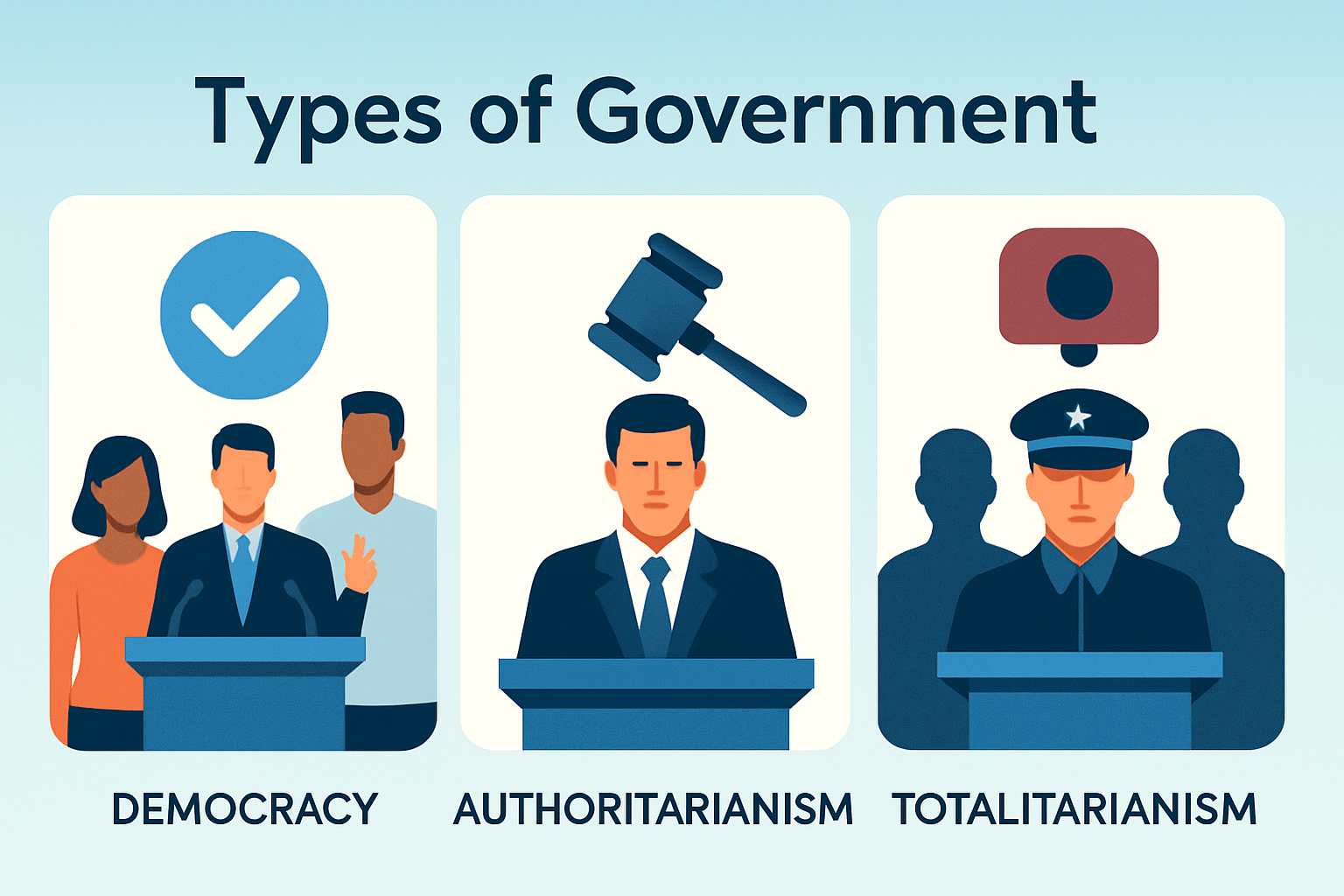
Governments are the systems or groups through which communities, societies, and countries are organized and controlled. They play a crucial role in the functioning of nations, influencing economic stability, societal norms, and individual freedoms. This discussion centers around three primary forms of government: democracy, authoritarianism, and totalitarianism. Each represents distinct ways of achieving order, decision-making, and control over populations, with vast differences in citizen participation and civil liberties.
The significance of understanding these government types cannot be overstated. As global citizens, having a clear grasp of how these systems operate allows us to engage more effectively in civic life and international discourse. It provides insight into current global conflicts, diplomatic relations, and the internal workings of nations worldwide. By exploring these governmental structures and their core principles, we enhance our ability to advocate for our rights and advance democratic ideals worldwide.
Democracy: A Government by the People
Democracy is a system of government where power resides with the people. This power is typically exercised through elected representatives and is characterized by free and fair elections, active participation, and the protection of individual rights and freedoms. Democracies prioritize the rule of law, ensuring that all citizens are equal under the legal framework and that leaders are held accountable for their actions.
One of the most renowned examples of democratic governance is the United States, where a complex system of checks and balances prevents any one branch from gaining too much power. Citizens elect representatives at local, state, and federal levels, and these representatives must serve according to the will of the voters or face electoral defeat. Knowledge of civic rights and responsibilities is crucial to the functioning of such a system, demanding an informed and engaged population to thrive.
At its best, democracy is a dynamic and adaptive system that holds leaders accountable, encourages civil liberties, and adapts to social changes through non-violent means. Despite occasional setbacks and challenges, such as political corruption or electoral manipulation, this form of governance remains one of the most effective in protecting individual rights and promoting widespread economic prosperity.
Authoritarianism: Concentrated Political Power
Authoritarian governments are characterized by the concentration of power in a singular authority or a centralized group that limits political freedom and suppresses dissent. Under this system, rulers hold significant power over the state and its citizens, often through unjust means, such as censorship, propaganda, or force.
An illustrative example of authoritarianism can be seen in Russia under the leadership of Vladimir Putin. In Russia, political opposition is often stifled, media outlets are heavily regulated, and state propaganda is utilized to consolidate power. The political landscape is largely controlled by the ruling party, with little room for opposing voices or genuine political debate. This type of government restricts individual freedoms and often exploits nationalism or fear to maintain control over the populace.
While authoritarian systems may permit some economic freedoms or limited civic engagement, they often lack true political pluralism or participatory governance. The centralization of power into the hands of a few unsurprisingly leads to systemic abuses and corruption, as leaders are often unaccountable to the public or external checks. In many cases, authoritarian regimes face economic challenges stemming from their inability to adapt to citizens’ needs or international pressures.
Totalitarianism: Extreme Control and Ideological Dominance
Totalitarianism takes the principles of authoritarian control to the extreme, involving complete subjugation of citizens in nearly all aspects of life, from political structures to personal beliefs and family dynamics. This form of government seeks to achieve complete and unwavering dominance over society, employing widespread surveillance, draconian control mechanisms, and strict enforcement of an overarching ideology.
An infamous example is North Korea, where the ruling government maintains strict control over the populace, emphasizing cult-like worship of its leadership and perpetuating state propaganda. In this environment, individual freedoms are almost non-existent, religious expression and dissent are severely punished, and the state intervenes in nearly all aspects of citizens’ lives, dictating education, employment, and even social behaviors.
Totalitarian regimes often utilize fear, isolation, and misinformation to suppress dissent and ensure loyalty among citizens, often creating strained or dysfunctional economies unable to compete globally. They discourage or eliminate traditional community or familial bonds that might challenge the state’s supreme authority. This governance model frequently leads to widespread human rights abuses and significant national isolation on the global stage.
| Type | Key Features |
|---|---|
| Democracy | Free elections, public participation, rule of law, protection of civil rights |
| Authoritarianism | Centralized power, limited political freedoms, state control over media |
| Totalitarianism | Extensive ideological control, pervasive surveillance, restricted personal freedoms |
Conclusion: Navigating the Global Political Landscape
Understanding the different types of government — democracy, authoritarianism, and totalitarianism — is essential in an ever-changing global environment. These regimes illustrate the fundamental ways societies prioritize different ideals, be that individual freedom, control, or the pursuit of state-driven objectives. Recognizing the strengths and limitations of each system allows us to better comprehend the complexities of international relations and domestic policies, as well as champion democratic values such as free expression, transparency, and government accountability.
The knowledge of these government types is not just academic but has real-world impacts, influencing everything from economic policy to human rights discourse. As citizens, we can use this understanding to navigate civic engagement more effectively, advocate for positive change, or contribute to discussions about international policy and human rights initiatives. It also provides a guide for recognizing early signs of authoritarian or totalitarian shifts, empowering citizens to hold governments accountable before the erosion of freedoms becomes the norm.
As we reflect on the many governments we encounter globally, we should consider how we can contribute to the promotion of democratic principles within our communities and globally. Stay informed, value civic engagement, and always advocate for a future where more societies can enjoy the freedoms and protections that democracy offers.
Frequently Asked Questions
1. What is Democracy, and how does it function?
Democracy is a system of government where the power lies with the people, who participate directly or indirectly in decision-making processes. This form of government is characterized by free and fair elections, where citizens have the right to vote and elect their leaders. It emphasizes the protection of individual freedoms and rights, like freedom of speech, religion, and assembly. Democratic systems typically operate under a rule of law where laws apply equally to all citizens, and there are clear, transparent regulations and institutions to ensure accountability.
Democracy functions through a variety of mechanisms, including representative bodies like parliaments or congresses, which draft and enact laws. Citizens can influence these bodies through regular elections. Democracy also often incorporates checks and balances across multiple branches of government—executive, legislative, and judicial—to prevent abuses of power. A strong civil society, including free media and non-governmental organizations, plays a crucial role in holding the government accountable and advocating for citizens’ interests.
2. What distinguishes Authoritarianism from Democracy?
Authoritarianism is a form of government characterized by centralization of power in a single authority or a small group, with little input or opposition from the general populace. Unlike democracies, authoritarian regimes often lack free and fair electoral processes, limiting or outright obstructing the citizens’ ability to participate in government and decision-making. Such regimes may suppress political dissent and limit freedoms of speech, assembly, and press to maintain control and order.
In contrast to the decentralized participation in democracies, authoritarianism often involves a top-down approach where decisions are made by the leader or elite group with minimal consultation or input from broader segments of society. Due to the concentration of power, these governments can enact policies rapidly but often at the expense of individual freedoms and checks and balances found in democratic systems. Authoritarian regimes tend to justify their governance style in terms of maintaining stability and order, sometimes arguing that an unrestricted democracy could lead to chaos or inefficiency.
3. How does Totalitarianism differ from Authoritarianism?
Totalitarianism is an extreme form of authoritarianism where the government seeks to control not only the political and economic aspects of life but also the personal and social aspects. In a totalitarian state, the government uses extensive surveillance, propaganda, and terror to exert its influence over every part of society, including the beliefs and values of its citizens. Totalitarian regimes aim to create a homogenous population loyal to the state ideology, often through intense indoctrination and suppression of dissent.
While authoritarianism focuses on maintaining political power and control, totalitarianism goes further by aspiring to dominate the very thoughts and behaviors of individuals. An example of this is a state-imposed ideology that governs all aspects of life, from work and education to family structure and personal relationships. This kind of government employs an extensive apparatus of censorship and propaganda to maintain its narrative and legitimacy while completely eradicating any form of resistance or alternative thought. In essence, while all totalitarian governments are authoritarian, not all authoritarian governments are totalitarian, as the latter involves the complete subjugation of private life to state control.
4. What impact do these types of government have on individual freedoms?
The impact of government type on individual freedoms varies significantly. In democracies, individuals typically enjoy high levels of personal freedom, including freedom of expression, religion, and assembly. Democratic governments protect rights through constitutions and legal systems, allowing individuals to voice their opinions, participate in protests, and challenge government actions through legal means. This atmosphere fosters creativity, innovation, and a strong sense of individual identity and autonomy.
On the other hand, in authoritarian regimes, individual freedoms are often curtailed. The government may impose strict controls over media, speech, and even movement, limiting peoples’ ability to express opposition or engage in activities that could be perceived as threatening to the stability of the regime. Such environments often create a climate of fear and restrict personal growth and creativity, as individuals might be hesitant to engage in activities that could attract unwanted scrutiny.
In totalitarian regimes, individual freedoms are even more restricted, as the state seeks pervasive control over all aspects of life. Citizens are often monitored continuously through surveillance and intelligence networks, and there is little to no private sphere separate from government influence. The suppression of personal freedom in totalitarian states stifles individual thought and expression, aiming to mold society in the state’s image. This leaves limited room for personal identity or dissenting opinion, severely impacting creativity and innovation.
5. Can governments transition between these types? If so, how?
Yes, governments can and do transition between these types, though the process can be complex and fraught with challenges. A democracy can transition to authoritarianism, often through the gradual erosion of democratic norms and institutions. This might involve undermining electoral processes, limiting press freedoms, concentrating power in the executive branch, and reducing checks and balances. Similarly, a popular leader might gradually consolidate power by altering constitutional rules to extend their tenure or limiting the judiciary’s independence.
Conversely, authoritarian states can transition to more democratic forms of governance, typically through significant societal demands for reform, economic pressures, or external influences and support. Such transitions often involve negotiations between ruling authorities and opposition groups, leading to power-sharing agreements, constitutional reforms, and eventually, free elections. However, these processes can be fragile, requiring robust institutional frameworks and protection of human rights to support sustainable democratic change.
In rare cases, totalitarian states can relax their grip, moving toward a less rigid form of authoritarianism, often stimulated by internal crises, economic challenges, or changing global contexts. These transitions demand significant shifts in ideology and governance style and typically involve a long-term process of dismantling the state’s pervasive control mechanisms while trying to maintain societal order. The success of such transitions greatly depends on the willingness of existing leaders to yield power and the readiness of opposition groups to engage constructively in shaping a new political landscape.