
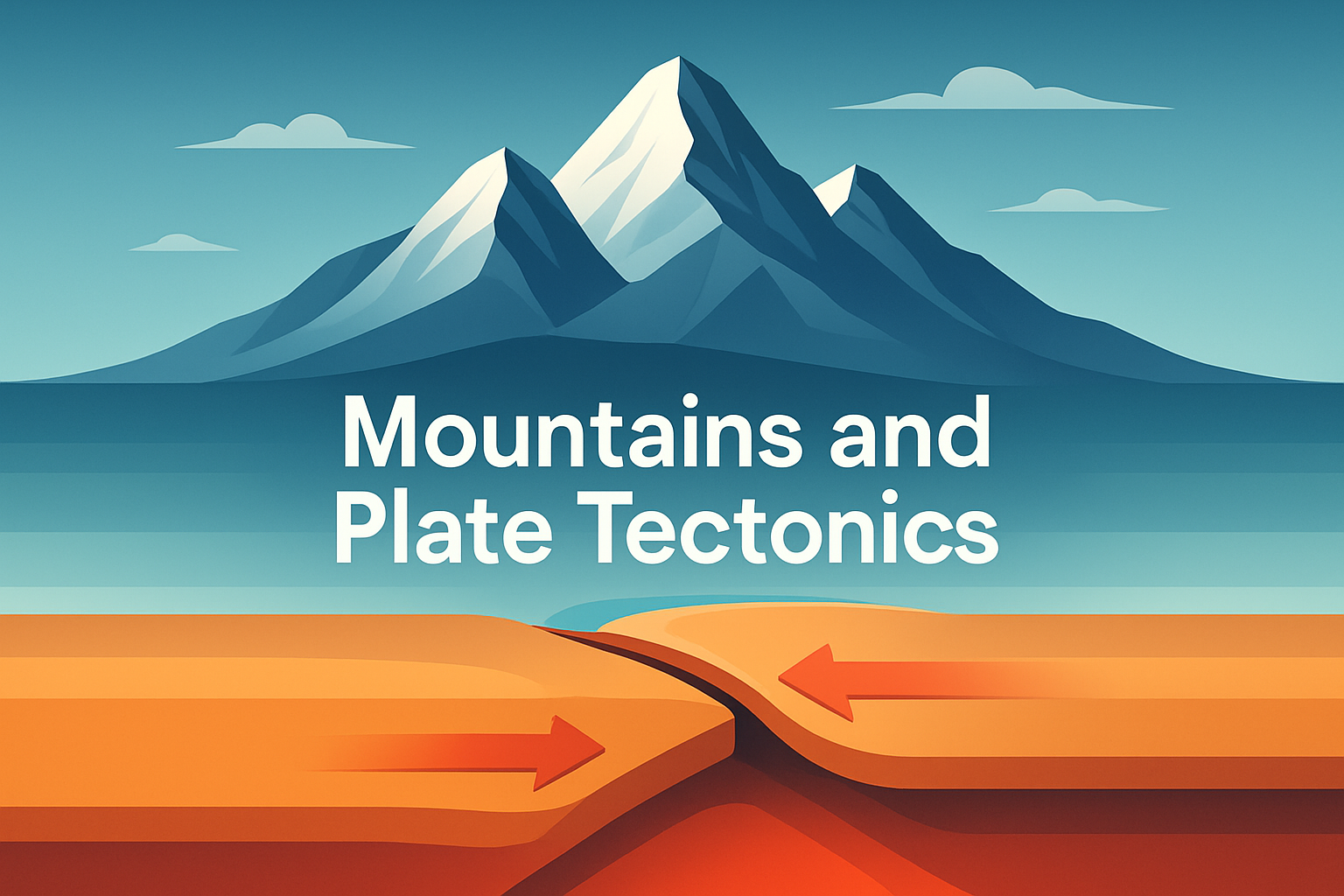
Introduction to Mountains and Plate Tectonics
Mountains have always captivated human beings with their majestic heights and fascinating formations. Whether they are the towering Himalayas or the rolling Appalachian Range, mountains are a significant aspect of Earth’s topography. The process that leads to their formation is deeply rooted in the science of plate tectonics. Plate tectonics is the theory that explains the movement and interaction of the Earth’s lithospheric plates, which leads to various geological phenomena including the creation of mountains. Understanding this process is of paramount importance as it provides insights into natural disaster preparedness, resource management, and the planet’s geological history.
Plate tectonics describes the large-scale movement of the Earth’s lithosphere, which is divided into several plates that float on the semi-fluid asthenosphere beneath them. These tectonic plates are constantly in motion, driven by forces such as mantle convection, slab pull, and ridge push. The interactions between these plates—such as converging, diverging, or sliding past each other—are responsible for the formation of many geological features, including mountains. This scientific understanding matters not only because it explains the physical landscapes of our planet but also because it helps anticipate tectonic hazards, locate mineral resources, and even understand past climate conditions.
In this article, we will delve deeper into the relationship between mountains and plate tectonics. We will explore the mechanisms that drive plate movements and lead to mountain formation. Furthermore, we will illustrate how different types of mountains are formed depending on the nature of the interacting plates. Real-world examples will be provided to offer a comprehensive understanding of this fascinating topic.
Types of Plate Boundaries and Associated Mountain Formation
To comprehend how mountains form, it’s crucial to understand the different types of plate boundaries: convergent, divergent, and transform. Each of these boundaries leads to distinct geological characteristics. When discussing mountains, convergent boundaries are often the most relevant.
- Convergent Boundaries: These are where two tectonic plates move towards each other. The collision of these plates often results in the formation of mountains. For example, the Himalayan Mountains were formed due to the convergence of the Indian Plate and the Eurasian Plate. The immense pressure and force from this collision have resulted in some of the highest peaks in the world, including Mount Everest.
- Divergent Boundaries: These boundaries occur where two plates move apart. While they primarily lead to the creation of new crust, thereby forming mid-ocean ridges, the tensional forces can also cause land uplift, forming features such as rift valleys. The Mid-Atlantic Ridge is a classic example of mountain formation at a divergent boundary.
- Transform Boundaries: These occur when two plates slide past each other horizontally. While they are not typically associated directly with mountain formation, transform boundaries can create mountainous landscapes due to the horizontal forces at play. The San Andreas Fault in California serves as an example where the motion has shaped local topography.
Orogeny: The Process of Mountain Building
Orogenesis, or orogeny, is the term used to describe the process of mountain formation, particularly through the mechanism of tectonic plate interactions. This process can take millions of years, as enormous stress and deformation slowly push up mountain ranges. Orogeny is typically associated with convergent plate boundaries, and different types of orogeny can arise depending on the nature of the converging plates.
The Andes mountain range in South America is a prime example of orogeny at work. It formed through the subduction of the Nazca Plate beneath the South American Plate. This phenomenon is not just a geological curiosity but also has real-world implications, such as volcanic activity and earthquakes, often associated with active orogenic belts.
Different types of orogeny include:
- Ocean-Continent Convergence: This results in volcanic mountain chains, such as the Andes, where the oceanic plate sinks beneath the continental plate, triggering volcanic activity.
- Continent-Continent Convergence: This leads to the thickening of the Earth’s crust and the formation of some of the world’s highest peaks. The Himalayas are an example.
- Ocean-Ocean Convergence: While this often results in the creation of island arcs rather than continental mountains, it can lead to mountainous island formation.
Role of Erosion and Weathering in Shaping Mountains
While tectonic activities are responsible for the initial uplifting of mountains, erosion and weathering shape these formations over time. These processes gradually wear down mountains, altering their structure and appearance. Weathering involves the breakdown of rocks through physical, chemical, and biological means, whereas erosion involves the movement of these broken-down particles through wind, water, or ice.
The Rocky Mountains in North America serve as a testament to the forces of erosion and weathering. Though the Rockies were formed millions of years ago, their current form is a result of consistent weathering by glaciers, rivers, and winds. This process leaves dramatic landscapes, characterized by rugged peaks and expansive foothills.
Understanding erosion and weathering is crucial from an environmental and geological perspective. It helps predict changes in water resources, influences the understanding of sedimentary basins, and plays a significant role in soil formation.
Mountains and Their Environmental Significance
Mountains have a profound impact on global and local ecosystems. They influence climate and weather patterns, serve as biodiversity hotspots, and are critical in water resource management. The interaction between mountains and atmospheric currents leads to the formation of rain shadows and diverse microclimates—contributing to varied flora and fauna.
The Alps in Europe are a prime illustration of mountains’ environmental significance. They act as a climatic divide, affecting weather patterns across the continent. Moreover, the Alps are rich in biodiversity and are home to many endemic species, providing critical habitats and supporting diverse ecosystems. The high-altitude climate conditions and variation in topography also influence the Alps’ role in water catchment, providing essential water resources to vast regions in Europe.
Human Interaction with Mountainous Regions
Throughout history, mountains have been both barriers and sanctuaries for human populations. While they pose challenges, such as difficult terrains and harsh climates, they also offer resources like minerals, timber, and water. Human settlements in mountainous areas have adapted to these conditions, often relying on traditional agricultural practices and using elevation to their advantage in trade and defense.
| Region | Human Adaptation | Resource Utilization |
|---|---|---|
| The Himalayas | Terraced farming | Timber, medicinal plants |
| The Andes | Vertical archipelagos | Quinoa, maize, potatoes |
| The Appalachians | Coal mining | Coal, forestry |
In modern times, mountains continue to be centers for tourism, adventure sports, and spiritual retreats. However, increased human activity poses threats, including pollution, habitat destruction, and climate change, which jeopardizes both the landscape and human livelihoods. Sustainable management and conservation efforts are necessary to preserve these natural wonders for future generations.
Conclusion: The Future of Mountains in a Changing World
Understanding the dynamics of mountains and plate tectonics provides a comprehensive view of Earth’s geological processes and their outcomes. Mountains are not only key features of our planet’s landscape but are also crucial to its ecological and cultural diversity. The study of tectonic activities helps predict natural disasters, guiding infrastructure development and safeguarding communities in vulnerable regions.
The knowledge gained from mountains and plate tectonics extends to diverse areas, from understanding climate systems to exploring the Earth’s interior. For anyone seeking to delve deeper into Earth’s processes, studying these geological features is both enlightening and essential.
As we continue to witness the impact of climate change and increasing human encroachment, preserving mountainous regions becomes more urgent. A call-to-action for readers is to advocate for sustainable practices, support conservation initiatives, and engage in mindful tourism to ensure these majestic formations continue to inspire and sustain life on Earth.
Frequently Asked Questions
1. What causes mountains to form?
Mountains are primarily formed through the process of plate tectonics, which involves the movement and interaction of the Earth’s lithospheric plates. When these massive plates converge, diverge, or slide past one another, they result in various geological features, including mountains. One common way mountains form is through the process known as orogeny, which is typically associated with convergent plate boundaries where two plates collide. Over millions of years, the intense compressional forces cause the crust to buckle and fold, creating mountain ranges such as the Himalayas, which arose from the collision of the Indian Plate and the Eurasian Plate. Divergent boundaries, where plates move apart, and transform boundaries, where plates slide sideways, can also contribute to mountain formation, although in different ways. Volcanism in these regions can build volcanic mountains, as seen with the Cascade Range in North America.
2. What are the different types of mountains?
Mountains come in various forms, primarily categorized by their origin and formation processes. The main types include:
- Fold Mountains: Created by the collision and folding of the Earth’s crust. Examples include the Himalayas and the Rockies. These mountains often feature complex structures with multiple ranges and high peaks.
- Fault-block Mountains: Formed when large areas of the Earth’s crust break and are displaced vertically along fault lines. The Sierra Nevada in California is a classic example where large blocks of the crust have tilted and uplifted.
- Volcanic Mountains: Built from volcanic activity when magma from beneath the Earth’s crust erupts through vents, cools, and solidifies. Mount Fuji in Japan and Mount St. Helens in the United States are prominent volcanic mountains.
- Dome Mountains: Formed when molten rock pushes the Earth’s crust upward, forming a dome shape as it cools and hardens. The Black Hills of South Dakota are an example of dome mountains.
- Plateau Mountains: Although technically formed through erosion rather than uplift, these mountains are part of high elevation plateaus that have been eroded into mountainous shapes. The Table Mountain in South Africa is an example.
3. How do plate tectonics lead to mountain building?
Plate tectonics contribute to mountain building through various mechanisms associated with plate boundary interactions. Here’s how these occur:
- Convergent Boundaries: The most dramatic mountain ranges form here, where plates collide. When an oceanic plate meets a continental plate, the denser oceanic plate sinks beneath the lighter continental plate, a process called subduction. This can create volcanic arc mountains. When two continental plates collide, neither can be subducted due to buoyancy. Instead, they crumple, fold, and uplift each other to form substantial mountain ranges like the Alps or Himalayas.
- Divergent Boundaries: While not traditionally associated with significant mountainous formations, divergent boundaries can create mid-ocean ridges, which are underwater mountain ranges formed by molten rock that rises to fill the gaps as plates pull apart. On continents, the pulling apart can lead to rift valleys flanked by uplifted mountain ranges.
- Transform Boundaries: Here, plates slide past each other, causing major earthquakes. While not responsible directly for mountain ranges, the tectonic activity can contribute to the uplifting of land in certain cases due to faulting, such as in parts of California.
4. Why are the Himalayas still rising?
The Himalayas are still rising due to the ongoing tectonic process of the Indian Plate continuing to push northward into the Eurasian Plate. This tectonic collision is one of the most active on Earth, resulting in the region frequently experiencing earthquakes, which are manifestations of the stresses accumulating and releasing as the plates interact. The continuous northward movement of the Indian Plate forces the crust to crumple and rise, which means that the Himalayas grow by a few millimeters each year. This is not only lifting the mountains but also creating a complex network of faults and internal deformation within the mountain’s structure.
5. How do mountains impact the climate?
Mountains have profound effects on climate both locally and globally due to their topography that influences air movement and weather patterns. Their impacts include:
- Orographic Effect: Mountains block moisture-laden winds, causing them to cool and lose moisture as precipitation on the windward side. This leads to lush, green landscapes, while the leeward side typically experiences a rain shadow effect, resulting in much drier conditions and desert landscapes.
- Temperature Gradient: As elevation increases, temperature generally decreases, creating cooler climates on high mountains. This variation considerably influences local ecosystems and biodiversity, leading to diverse environments within short distances.
- Influence on Atmospheric Circulation: Large mountain ranges can alter global atmospheric circulation patterns, influencing weather patterns far beyond their confines. For instance, the Himalayas play a critical role in shaping the monsoons of the Indian subcontinent.