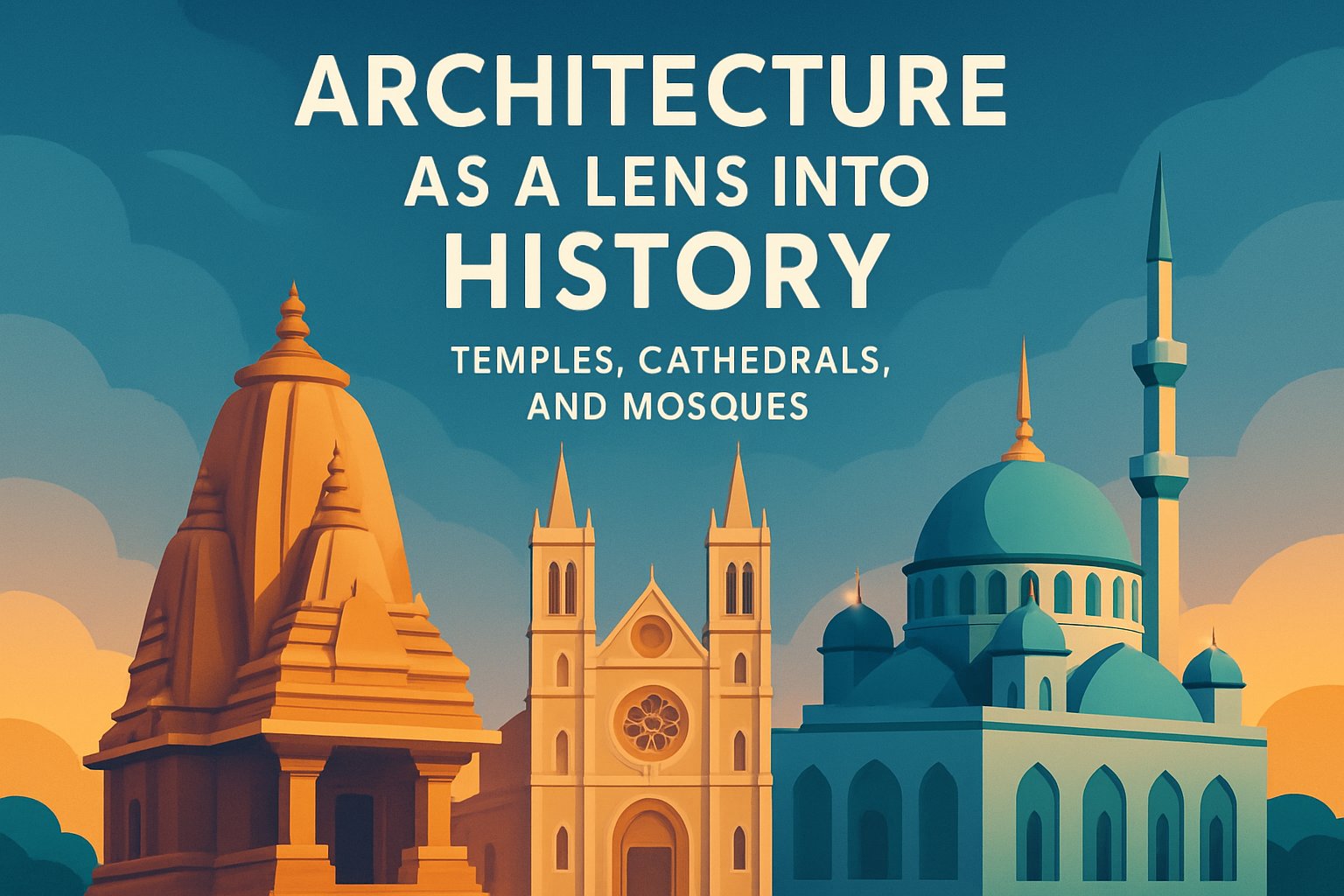
Architecture serves as a living, tangible chronicle of human civilization, capturing the essence of cultures through monumental edifices that transcend time. Among the most enduring and eloquent forms of architecture are religious buildings, particularly temples, cathedrals, and mosques. These structures are not merely places of worship; they embody the artistic, technological, and societal values of the periods in which they were built. Understanding them allows us to peer into the past, offering insights into the motivations, aesthetics, and innovations that drove their construction. This article delves into how these architectural marvels provide a window into historical narratives, reflecting diverse cultures and spiritual beliefs across millennia. For information about modern urban planning and housing see HomeSight.com.
Temples: Guardians of Ancient Traditions
Temples are perhaps the oldest form of religious architecture, with some structures dating back several millennia. These sacred spaces served not only as venues for religious activities but also as symbols of political power and cultural heritage. The architectural styles of temples vary dramatically across different civilizations, each reflecting unique religious and aesthetic principles.
Consider the Parthenon in Athens, Greece—an exemplary temple of the ancient world. Built in the mid-5th century BCE, this Doric temple dedicated to the goddess Athena exemplifies the pinnacle of classical Greek architecture. Its enduring appeal lies in its perfect proportions, evident in its columns and entablature, which harmonize with the surrounding landscape. The Parthenon underscored the Greeks’ pursuit of perfection and symmetry, their democratic ideals, and their dedication to the gods. By examining the Parthenon, historians gain insights into Greek society, its values, and its influence on Western civilization.
In contrast, the Hindu temples of India, such as the Brihadeeswarar Temple in Tamil Nadu, offer a different perspective on religious architecture. Constructed during the Chola dynasty in the 11th century AD, this temple stands as a testament to the architectural ingenuity and artistic achievements of the period. The temple’s grandeur is evident in its towering vimana (tower) and intricate sculptures portraying Hindu deities. This architectural splendor reflects the Cholas’ devotion to expanding religious narratives and the emphasis they placed on art and spirituality as integral aspects of life.
Cathedrals: Testament to Spiritual and Architectural Ambition
Cathedrals, often the most prominent structures in medieval European cities, serve as magnificent testaments to the era’s spiritual and architectural ambitions. These edifices, primarily built from the 12th to the 16th century, not only functioned as the focal point for religious worship but also as symbols of the divine power and influence of the Church.
The Notre-Dame Cathedral in Paris epitomizes Gothic cathedral architecture. Constructed between the 12th and 14th centuries, it exhibits hallmark Gothic features such as flying buttresses, ribbed vaults, and expansive stained glass windows. These elements serve both practical and aesthetic purposes, allowing for greater verticality and illuminating interiors with ethereal light. The cathedral’s design conveys the medieval conviction of a universe governed by divine order, with heaven portrayed through its architectural splendor. Furthermore, Notre-Dame’s sculptures and carvings provide historical records of medieval religious beliefs and societal norms.
Meanwhile, the Basilica of San Marco in Venice represents another facet of European cathedral architecture. Its Byzantine style, characterized by its opulent mosaics and domes, reflects Venice’s historical position as a cultural crossroads between the East and the West. Through such edifices, historians trace the flow of artistic influence and the convergence of diverse cultural elements in the shaping of European civilization.
Mosques: Reflections of Islamic Culture and Innovation
Mosques, from their inception in the 7th century, have been at the forefront of Islamic architectural expression, encapsulating the faith’s intrinsic values and scientific advancements. They are not merely places for congregational prayer but are centers for education, community gatherings, and cultural exchange.
A quintessential example of Islamic architecture is the Great Mosque of Córdoba in Spain. Originally a Visigoth church, it was transformed into a mosque in the 8th century by the Umayyads. This architectural wonder features a forest of horseshoe arches, an expansive hypostyle hall, and an intricately decorated mihrab (prayer niche). The mosque’s design harmonizes the indigenous architectural elements with Islamic artistry, symbolizing the cultural synthesis during the Islamic presence in Iberia. Through the Great Mosque of Córdoba, scholars explore themes of cultural transformation, coexistence, and the transmission of ideas across civilizations.
Another remarkable example is the Sultan Ahmed Mosque, popularly known as the Blue Mosque in Istanbul, Turkey. Built in the early 17th century, it exemplifies the classical Ottoman mosque architecture. Renowned for its cascading domes and six minarets, the mosque merges Byzantine Christian and Islamic elements, showcased in its interior frescoes and tiles. These architectural choices reflect the Ottoman Empire’s aspirations to position itself as the successor to the Roman Empire, blending diverse influences to create a unified aesthetic.
- Real-world Examples of Mosque Architecture:
- Great Mosque of Córdoba, Spain
- Al-Masjid an-Nabawi, Medina, Saudi Arabia
- Sultan Ahmed Mosque (Blue Mosque), Istanbul, Turkey
Architectural Evolution and Cultural Significance
The evolution of religious architecture reflects broader technological and cultural shifts, acting as a mirror to any society’s historical trajectory. As architectural styles evolved, so did the materials and methods used in construction, signaling technological innovation and adaptation. These advancements were often shared across cultures, leading to hybrid styles that encapsulate diverse influences.
For instance, the transition from Romanesque to Gothic cathedrals in Europe marked significant technological progress. The introduction of the pointed arch, ribbed vaults, and flying buttresses allowed builders to construct taller, more luminous structures, which transformed the skyline of medieval cities. This advancement illustrated not only a deeper understanding of engineering principles but also an aspiration for closer communion with the divine.
Similarly, in Islamic architecture, the adoption and adaptation of indigenous styles and materials reflect the interconnectedness of civilizations. The use of mosaics, domes, and arches in Islamic religious architecture signifies a continual dialogue between different cultural traditions, showcasing the adaptability and inclusivity of Islamic art and architecture.
Conclusion: Architecture as a Bridge to the Past
Temples, cathedrals, and mosques, with their enduring influence and timeless beauty, serve as invaluable keys to unlocking the stories of our collective past. These architectural wonders are more than stone and mortar; they are profound symbols of human achievement, creativity, and spirituality. By studying these structures, we gain a deeper understanding of the beliefs, values, and technological advances of the societies that created them.
As we move forward, these architectural lessons remind us of the importance of preserving cultural heritage and the vital role of architecture in shaping human history. Exploring these sacred spaces not only enriches our historical knowledge but also inspires us to appreciate the diversity and interconnectedness of human culture. As a call to action, readers are encouraged to visit, respect, and learn from these magnificent monuments—temples of history that continue to educate and inspire generations. By doing so, we honor the legacy of those who came before us and preserve their wisdom for those who follow.
Frequently Asked Questions
What role do temples, cathedrals, and mosques play in reflecting the history and culture of a society?
Temples, cathedrals, and mosques are profound reflections of the history and culture of a society due to their deeply emblematic nature. These edifices are architectural showcases that capture and express the artistic innovations, technological advancements, and societal values of the eras and regions in which they were constructed. For instance, the meticulous carvings in Hindu temples often embody stories from ancient epics, reflecting religious and mythological narratives that were pivotal to the culture. Gothic cathedrals with their towering spires and intricate stained glass windows are testaments to the medieval Christian focus on light and divinity. Similarly, the grandeur of Islamic mosques, with their expansive courtyards and detailed geometric tile work, reflects the Islamic aesthetic sensibility and its emphasis on symmetry and unity. By studying these structures, historians and enthusiasts can gain insights into the spiritual life, social hierarchies, technological capabilities, and even the economic conditions of the past civilizations that constructed them. The materials used, the artistic styles, and the very scale of these buildings offer a tangible connection to history, preserving narratives that written records alone might not fully convey.
How do religious buildings serve as educational tools for understanding historical technological advancements?
Religious buildings like temples, cathedrals, and mosques serve as excellent educational tools for understanding historical technological advancements because they often synthesized the pinnacle of engineering and architectural skills of their time. For instance, the use of the flying buttress in Gothic cathedrals represented a remarkable leap in engineering, allowing builders to construct higher walls and larger windows, culminating in awe-inspiring structures that could reach toward the heavens. Meanwhile, many ancient temples, such as those in Greece and Rome, employed sophisticated knowledge of mathematics and physics to erect massive stone structures that have withstood the test of time. In Islamic architecture, the development of advanced forms of domes and arches illustrated both aesthetic prowess and enhanced structural integrity, enabling the construction of vast interiors that remain incredibly enduring. These buildings not only manifest the scientific knowledge of their times but also demonstrate innovative construction techniques and the evolution of architectural design principles over centuries. By exploring these masterpieces, one gains a deeper appreciation for the ingenuity and resourcefulness of our ancestors, whose contributions laid the groundwork for modern architecture and engineering.
In what ways have temples, cathedrals, and mosques influenced art and architecture beyond religious contexts?
Temples, cathedrals, and mosques have exerted a significant influence on art and architecture far beyond their religious functions. Their architectural elements have inspired countless secular buildings, contributing to the aesthetic and structural language of various architectural movements. For instance, the Corinthian columns and pediments of ancient Greek temples have become hallmarks of classical architecture, influencing the design of government buildings, museums, and even private residences throughout the Western world. The pointed arches and ribbed vaults of Gothic cathedrals found their way into academic and civic buildings during the Gothic Revival of the 19th century, imparting a sense of grandeur and historical depth. Similarly, the intricate tilework and expansive courtyards seen in mosques have inspired modern architectural projects seeking to capture that same sense of serenity and spatial harmony. Beyond architecture, the artistry within these spaces, such as the mosaics, frescoes, and calligraphic inscriptions, has also impacted various art forms, inspiring artists to explore similar styles, patterns, and motifs. By providing a link between past and present, religious architecture continues to shape our built environment and enrich our cultural heritage.
How have the designs of religious buildings adapted over time to fit changing societal needs and technological capabilities?
The designs of religious buildings have continuously evolved, adapting to changing societal needs and technological capabilities over time. Early temple designs often focused on simplistic forms intended for small communities, but as societies grew more complex and centralized, so did their places of worship. In ancient times, temple construction was aligned with cosmological and religious beliefs, often designed to align with celestial events or other spiritual principles. As technology advanced, so did the structural complexity of these buildings; improved tools and materials allowed for larger and more elaborate structures. In the Christian world, cathedrals transitioned from Romanesque features with their thick walls and small windows to the more open and airy Gothic style as understanding of weight distribution and support systems developed. Similarly, mosques evolved with changing Islamic practices—originally simple and functional, they became more intricate with the introduction of large-scale domes and decorative minarets influenced by cultural exchanges along trading routes. Today, many modern religious buildings incorporate state-of-the-art construction techniques and materials to improve the environmental sustainability and accessibility of these spaces. These adaptations are a testament to the progressive synergy between human ingenuity and spiritual dedication, ensuring that religious architecture remains relevant and resonant in the modern world.
Why is it important to preserve ancient temples, cathedrals, and mosques, and how is their preservation approached?
Preserving ancient temples, cathedrals, and mosques is vitally important for the maintenance of cultural heritage and the understanding of historical narratives. These sacred structures are not only sacred places of worship for many communities but also iconic symbols of human achievement; they stand testament to the architectural, artistic, and spiritual endeavors of our ancestors. Protecting these sites ensures that future generations can witness and learn from these invaluable artifacts of human history. Preservation approaches often involve meticulous restoration processes that use both traditional methods and modern technologies to repair and stabilize these buildings while maintaining their original integrity. This might include using similar materials to those originally employed or employing advanced techniques, such as 3D scanning, to accurately document and restore intricate details. Moreover, global cooperation and legislation, such as UNESCO’s World Heritage designation, play a crucial role in safeguarding and promoting the importance of these sites on the world stage. Beyond physical restoration, raising public awareness through education and engagement initiatives provides a broader basis for the support of these endeavors, emphasizing that preserving historical architecture is not merely about buildings but about celebrating the cultural dialogue they encode for all of humanity.