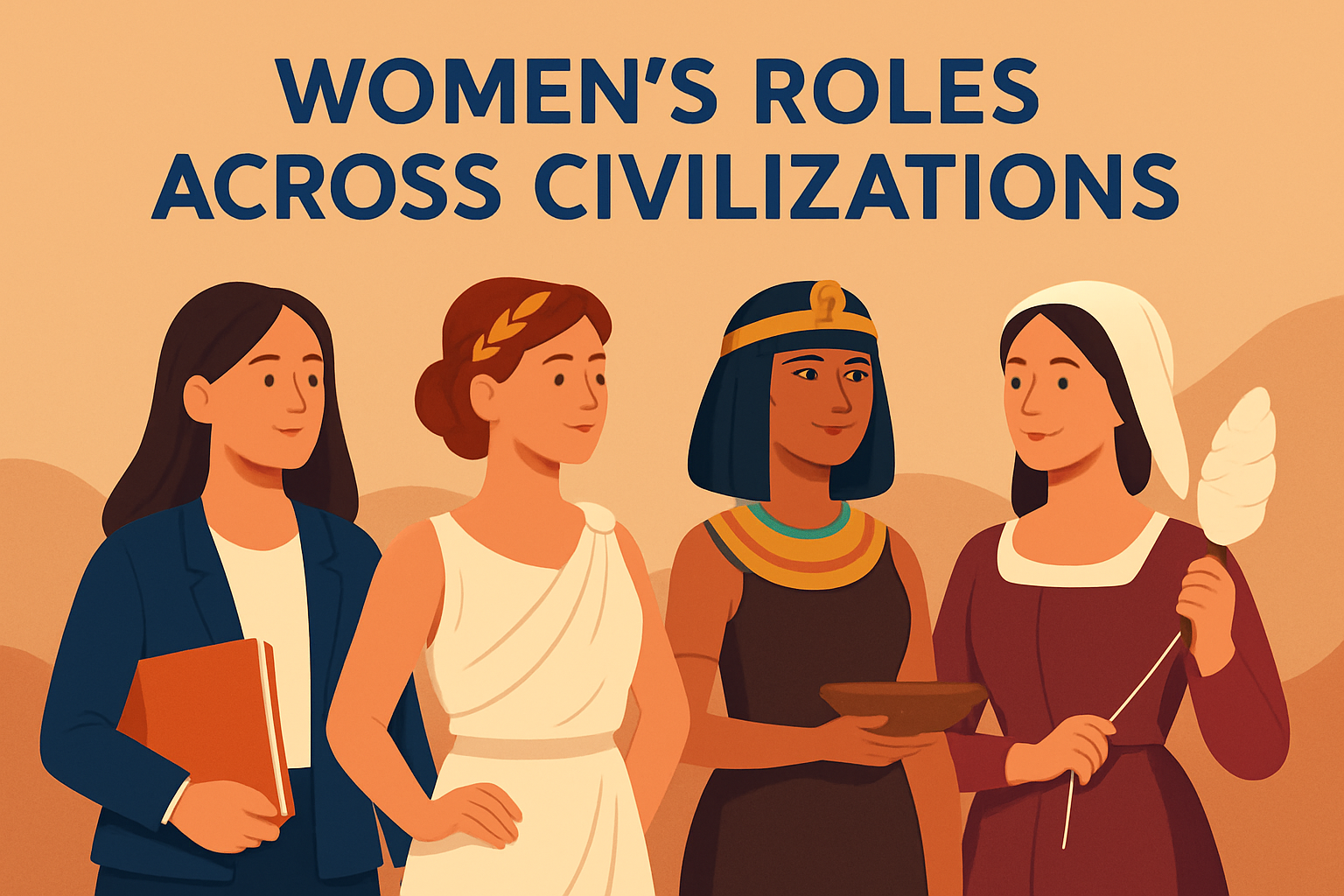
Throughout history, women’s roles have been defined and redefined across various civilizations, playing a crucial part in societal evolution. From the labor they performed to the cultural norms they influenced, women’s contributions have been both shaped by and influential upon their respective societies. This topic matters because understanding women’s historical roles provides insight into modern gender dynamics and societal growth. Further exploration reveals the intersections of gender, power, and economy, all critical in understanding both past and present human development.
Prehistoric and Ancient Societies
In prehistoric societies, women’s roles were largely centered around gathering, child-rearing, and domestic responsibilities. These tasks, however, were foundational to the survival of communities. Women’s knowledge of healing herbs and food resources contributed significantly to the group’s welfare. As societies transitioned into ancient civilizations, women’s roles diversified. For example, in Ancient Egypt, some women ascended to powerful positions; Queen Hatshepsut reigned as a Pharaoh, while others managed households, maintained family lineage, or served as priestesses. The social organization of these early civilizations set the groundwork for complex gender roles and responsibilities in societal development.
Classical Civilizations
The classical civilizations of Greece and Rome presented contrasting gender dynamics. In Ancient Greece, women’s roles varied significantly between city-states. In Athens, women were largely confined to domestic duties, restricted in public life, and expected to focus on managing households. However, in Sparta, the situation was different. Spartan women were granted more freedoms, such as owning property and receiving education, owing largely to the militaristic culture that promoted physical health for both men and women. Meanwhile, Roman women, especially of the upper classes, wielded influence in familial and social contexts, even though they lacked formal voting rights. The complex societal structures of these civilizations added layers to our understanding of ancient gender roles.
Medieval Period
During the medieval period, women’s roles were closely tied to the feudal system and the Church’s influence. Noblewomen managed estates in their husbands’ absences, while peasant women shouldered heavy agricultural duties alongside household chores. The emergence of convents offered women an alternative path, where they could wield spiritual influence and pursue education. A prominent example is Hildegard of Bingen, a German abbess known for her theological, musical, and scientific writings. Despite the predominantly patriarchal society, these women carved niches of authority and intellectual contribution, illustrating a nuanced view of medieval women’s roles.
Renaissance and Enlightenment
During the Renaissance, women’s roles began to evolve with the era’s revivals in art, culture, and intellectual curiosity. Women like Isabella d’Este and Catherine de’ Medici were patrons of the arts and held significant sway in political machinations. The Enlightenment brought about philosophical discussions on the nature of gender roles. Thinkers such as Mary Wollstonecraft began advocating for women’s education and equal rights. Although societal norms still limited public roles for women, these periods ignited conversations on gender equality that continued to evolve in later eras.
Industrial Revolution
The Industrial Revolution marked significant changes in women’s societal roles. As economies shifted towards industrial production, women increasingly entered the workforce, principally in factories and textile mills. This era highlighted the economic contributions of women and their roles as both wage earners and traditional homemakers. The hardships faced by women workers, such as long hours and poor working conditions, gradually led to labor reforms and the burgeoning suffrage movement. An example is the match girls’ strike in London in 1888, which brought attention to industrial exploitation and influenced policy changes. This period was pivotal not only for women’s socio-economic roles but for the broader movement towards gender equality.
| Era | Key Roles | Notable Figures |
|---|---|---|
| Ancient Egypt | Pharaohs, Priestesses, Household Managers | Hatshepsut |
| Ancient Greece | Domestic Managers, Property Owners (Sparta) | Sappho |
| Medieval Europe | Noble Estate Managers, Peasant Agriculturalists | Hildegard of Bingen |
| Renaissance | Patrons of the Arts, Advisors | Isabella d’Este |
| Industrial Revolution | Factory Workers, Homemakers | Match Girls Strike Leaders |
Modern Era
In the modern era, women’s roles have undergone further transformation and diversification. The 20th and 21st centuries witnessed tremendous progress through movements for voting rights, equal pay, reproductive rights, and representation in various sectors. Women increasingly hold leadership positions across fields, from politics to business and science. Figures such as Ruth Bader Ginsburg and Malala Yousafzai symbolize different aspects of women’s evolving roles—social justice and educational advocacy. Despite these advances, challenges persist in achieving global gender equality, as cultural, economic, and political barriers remain significant in many regions.
Summary
Throughout history, women’s roles across civilizations have been integral to how societies have evolved. From the domestic spheres of prehistory to the multifaceted roles in the modern world, women have profoundly influenced cultural, economic, and political landscapes. Recognizing these contributions underscores the importance of pursuing gender equality today. Understanding the past helps us appreciate the present and strategize for a more equitable future. As we reflect on these historical roles, it becomes imperative to support continued advocacy for women’s rights and encourage inclusive policies that promote diversity across all sectors of society.
The exploration of women’s roles across civilizations not only reveals the complexities of gender dynamics throughout history but also inspires ongoing discussions on equality. As such, we are called to action in recognizing and supporting measures that aim to eradicate gender-based disparities. Embracing this knowledge equips us to foster a world where opportunities and achievements are not limited by gender but embraced by all.
Frequently Asked Questions
1. How did women’s roles vary across different ancient civilizations?
Women’s roles have varied significantly across ancient civilizations due to cultural, economic, and social norms. In ancient Egypt, for example, women enjoyed relatively high status and rights; they could own property, initiate divorce, and were legally equal to men. They played important roles both at home and in places of worship and the marketplace. In contrast, women in ancient Greece, particularly in Athens, had more restricted roles. Athenian women were expected to manage the household and were rarely seen in public life beyond religious ceremonies. In the Spartan society, however, they had more freedoms, with an emphasis on physical fitness and participation in public life, given the society’s military focus. Meanwhile, in ancient China under the Zhou Dynasty, Confucian values emphasized male superiority, framing women primarily as dutiful daughters, obedient wives, and nurturing mothers. This diversity showcases how economic structures, religious beliefs, and political climates shaped women’s roles and their degree of autonomy.
2. What impact did women have on societal evolution throughout history?
Women have been instrumental in shaping societies through various contributions, although their roles often went unrecognized for centuries. They have been key drivers of familial stability and community cohesion, influencing cultural norms and moral values. In numerous civilizations, women have been at the forefront of preserving cultural practices and traditions, especially when men were off to war or engaged in other societal duties. From agricultural work to craft production and trade, women have significantly contributed to economic sustenance and local economies. Moreover, women have been change-makers and leaders throughout history, with figures like Cleopatra in Egypt, Queen Elizabeth I in England, and Empress Wu Zetian in China demonstrating leadership on national scales. Women’s participation in social and political movements, such as the suffrage movements and civil rights movements, has been pivotal in reshaping societies to become more just and equitable. These roles underscore a profound influence on societal growth by challenging existing power dynamics and advocating for equality and justice.
3. How did religious beliefs affect women’s roles in historical societies?
Religious beliefs have been both liberating and restrictive for women, depending on the context and interpretation of doctrines. In many ancient societies, women held religious roles, serving as priestesses or involved in religious ceremonies, which often afforded them significant societal influence. For instance, in Mesopotamia and Babylon, women could serve as high priestesses, wielding considerable religious and political power. However, in some societies, religious doctrines have been interpreted in ways that justified gender hierarchies and limited women’s public roles. In the Hebrew Bible and Christian Old Testament, women’s roles were often depicted as secondary to men’s, although there are notable exceptions such as Deborah, the prophetess and judge. Islamic societies throughout history have seen varying roles for women depending on the region and era, with some periods and places allowing women considerable influence and others imposing stricter patriarchal norms. The role of religion has thus been complex, serving both as a source of empowerment and a tool for maintaining male dominance.
4. How did women’s contributions change during wartime in different civilizations?
Wartime often necessitated shifts in gender roles, with women’s contributions becoming crucial in maintaining societal functions when men were away at war. In World War I and II, for example, women in many Western societies entered the workforce en masse, taking on roles traditionally held by men and proving essential to the war effort and the home front’s economic stability. In ancient Sparta, women managed estates and businesses, given the society’s constant military focus. During the American Civil War, women in Confederate and Union states operated as nurses, widows, spies, and soldiers in disguise, substantially affecting the war’s outcomes. Historical conflicts like these expanded societal perceptions of women’s capabilities and frequently led to long-term changes in gender roles and rights, including the women’s suffrage movement that followed World War I. Across cultures, women’s wartime contributions highlighted their ability to adapt and excel, pressing for greater recognition and rights post-conflict.
5. How has the study of women’s historical roles influenced modern gender dynamics and societal developments?
Studying women’s historical roles is vital for understanding and addressing contemporary gender dynamics. It provides context for the persistent gender disparities and injustices that modern societies grapple with and highlights women’s resilient histories of overcoming adversity. Historical examples of women’s leadership, innovation, and resistance inspire and guide current movements for gender equality. By acknowledging past contributions often overlooked in traditional historical narratives, we reshape the understanding of history as not solely patriarchally constructed. This expanded historical perspective encourages more inclusive and diverse representations across all societal sectors, influencing policies and initiatives aimed at fostering equality. Furthermore, recognizing the continuities and changes in gender roles over time helps us comprehend the dynamic nature of societal developments and gender norms, prompting reevaluation and potential restructuring for a better-balanced society. This recognition cultivates respect for diverse experiences and contributions, which is essential for a just and equitable world.