
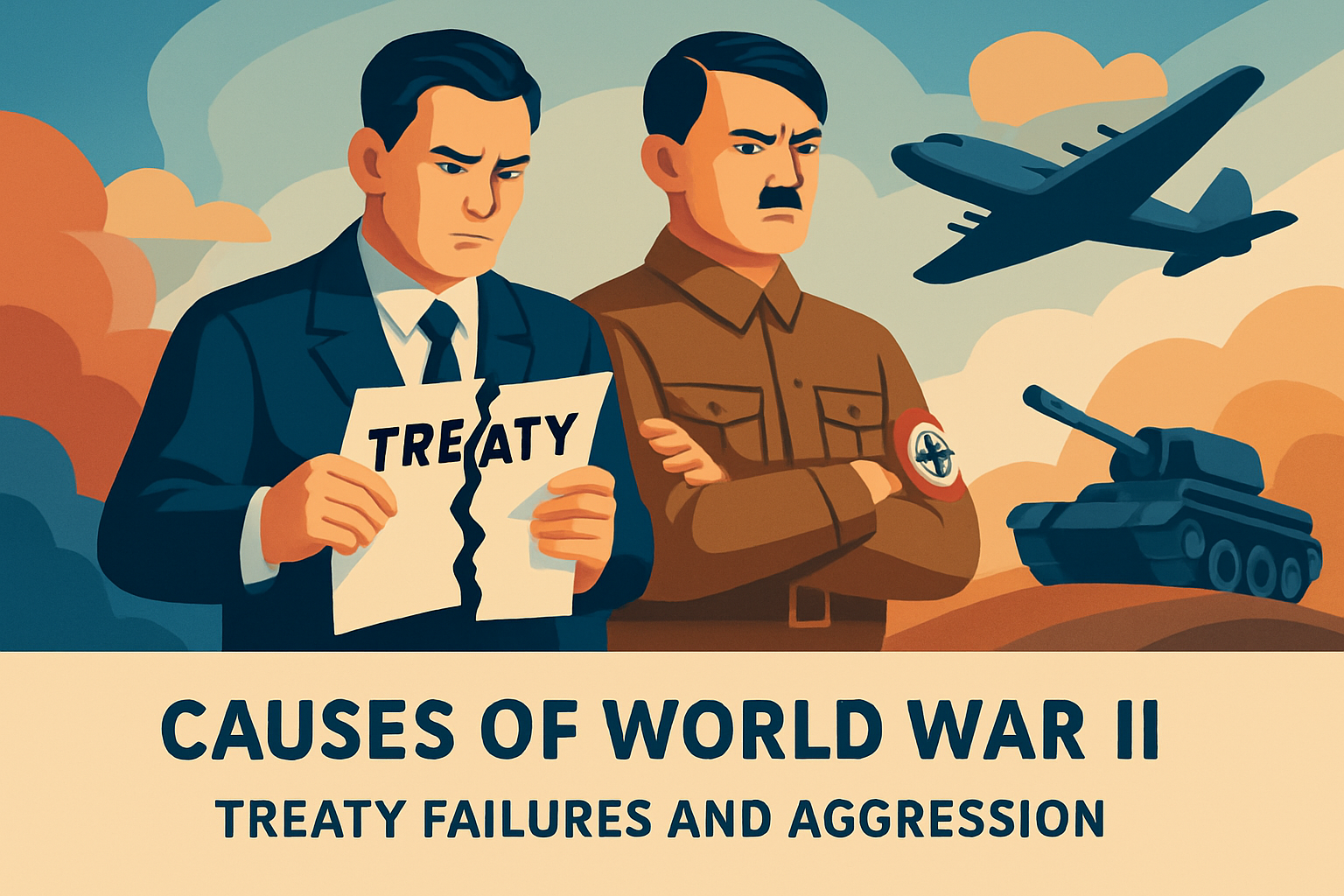
Introduction to World War II Causes
World War II, a massive global conflict from 1939 to 1945, reshaped the international landscape and had profound repercussions worldwide. The war drew in the majority of the world’s nations, including all of the great powers, eventually forming two opposing military alliances: the Allies and the Axis. This war resulted not only in significant loss of life and devastation but also played a critical role in shaping the modern political and economic systems. Understanding the causes of World War II is essential to grasp how such a catastrophic event unfolded, allowing us to learn from history to prevent future conflicts of similar magnitude.
Key terms such as “treaty failures” and “aggression” are central to understanding the factors that contributed to World War II. Treaty failures refer to the inability of international agreements, most notably the Treaty of Versailles, to maintain peace and address underlying geopolitical tensions post-World War I. Meanwhile, aggression involves hostile actions by countries seeking to expand their power and territory, often at the expense of neighboring states. This article explores these causes, elucidating their interconnectedness and significance. The exploration begins with a detailed understanding of treaty failures and the atmosphere they cultivated, leading into the aggressive actions that ultimately sparked World War II.
Treaty Failures: The Root of Discontent
One of the notable causes of World War II was the failures of treaties established after World War I, particularly the Treaty of Versailles. Established in 1919, the Treaty was meant to ensure peace by imposing strict penalties on Germany, the main aggressor of the Great War. These penalties included significant territorial losses, disarmament provisions, and substantial reparations. However, instead of ensuring peace, the Treaty fostered resentment and economic hardship in Germany, creating fertile ground for nationalism and militarism to thrive.
Germany felt humiliated and economically crippled by these terms, leading to social and political unrest that facilitated the rise of Adolf Hitler and the Nazi Party. Hitler explicitly exploited the widespread discontent with the Treaty of Versailles, promising to overturn its terms and restore Germany’s former glory. This promise resonated deeply with the German populace, and Hitler’s aggressive foreign policies aimed at revising territorial losses laid the groundwork for what became World War II.
Similarly, treaties involving other European powers also struggled to maintain peace. The lack of effective enforcement mechanisms and the desire for revisionism among other countries further compromised post-war stability. For instance, Italy and Japan, although on the victor’s side in World War I, felt marginalized in the post-war arrangements, motivating their own aggressive expansions.
Economic Distress and Global Depression
The economic instability that plagued the interwar period was another catalyst for World War II. The Great Depression of the 1930s had a disastrous impact on global economies, exacerbating political instability and extremism. Countries around the world faced massive unemployment, bank failures, and severe economic contraction. Governments struggled to address these challenges, often resorting to protectionist policies that worsened international relations.
This economic turmoil was particularly pronounced in Germany, which faced insurmountable reparations while simultaneously dealing with the impacts of the global economic downturn. The economic distress provided a fertile breeding ground for radical ideologies, as desperate populations sought answers from authoritarian leaders who promised recovery and renewed national strength.
Notably, the United States’ economic policies, such as isolationism and focus on domestic recovery, inadvertently contributed to global tensions. By 1933, as the U.S. grappled with its own economic challenges, it lacked the willingness to engage actively in international peace efforts, thus allowing more aggressive states like Germany, Italy, and Japan to pursue expansionist policies unchallenged.
Rise of Aggressive Nationalist Regimes
The interwar period saw the rise of aggressive nationalist regimes in Germany, Italy, and Japan, each driven by desires for expansion and power. In Germany, Adolf Hitler led the Nazi Party in a campaign to reverse the Treaty of Versailles and achieve Lebensraum (living space) for the German people through territorial expansion. Hitler’s agenda involved rearming Germany, annexing neighboring territories, and spreading the ideology of racial superiority.
Italy, under Benito Mussolini, pursued a vision of revitalizing a grand Roman Empire. Mussolini’s aggressive foreign policy focused on expansion in Africa and the Balkans. Japan, on the other hand, sought to dominate East Asia, starting with the invasion of Manchuria in 1931 and extending further throughout the Pacific region by the late 1930s. These actions by the Axis powers exemplified a broader trend of aggressive nationalism, characterized by expansion and military buildup in pursuit of regional and global hegemony.
These regimes shared a common disdain for the existing international order, which they perceived as unjust and humiliating. Their aggressive actions, combined with ideological fervor and military ambition, created a volatile geopolitical environment that ultimately led to the outbreak of World War II. Additionally, the League of Nations, tasked to ensure collective security, faltered due to its inability to prevent aggressive actions by these regimes, partly because key powers like the United States were not involved, and there was no enforcement power.
Policy of Appeasement
One of the critical diplomatic failures preceding World War II was the policy of appeasement pursued by Britain and France. This policy involved making concessions to aggressive powers in hopes of avoiding conflict. The most infamous example of appeasement occurred during the Munich Agreement of 1938, where Britain and France agreed to let Germany annex the Sudetenland, an ethnic German region of Czechoslovakia, without consulting the Czechs.
Rather than preventing war, the appeasement strategy emboldened Hitler’s expansionist aims, reinforcing his belief that the Allies would not intervene militarily to stop further German expansion. This perception of Allied weakness encouraged further breaches of treaties and eventually led to the invasion of Poland in 1939, prompting Britain and France to declare war on Germany.
The policy of appeasement is often criticized for misunderstanding Hitler’s ambitions and underestimating the threat posed by Nazi Germany. By allowing early acts of aggression to go unchecked, the Allies inadvertently encouraged further violations of international agreements, paving the way for the global conflict that followed.
Visual Representation of Key Events
| Year | Key Event | Significance |
|---|---|---|
| 1919 | Treaty of Versailles | Imposed reparations and territorial losses on Germany, leading to economic hardship and resentment. |
| 1931 | Japanese Invasion of Manchuria | Marked the beginning of Japanese expansionist policies in Asia. |
| 1933 | Hitler becomes Chancellor of Germany | Nazi rise to power marks start of Germany’s aggressive foreign policy. |
| 1938 | Munich Agreement | Policy of appeasement allows German annexation of Sudetenland, encouraging further aggression. |
| 1939 | Invasion of Poland | Triggers World War II as Britain and France declare war on Germany. |
Summarizing Key Takeaways
World War II was precipitated by a complex interplay of factors, primarily revolving around treaty failures and aggressive actions by nationalist regimes. The Treaty of Versailles, intended to secure lasting peace, inadvertently sowed the seeds for further conflict by fostering resentment and economic instability in Germany. This facilitated the rise of aggressive leaders who exploited national grievances, leading to militarization and territorial expansion.
The global economic distress and the failure of the international community to effectively check rising nationalism and militarism contributed significantly to the war’s outbreak. The policy of appeasement, which aimed to prevent conflict by conceding to the demands of aggressive states, only served to embolden those who sought military and territorial expansion.
By understanding these causes, we gain crucial insights into the dynamics that can lead to war, reinforcing the importance of balanced treaties, vigilant diplomacy, and robust international institutions in maintaining peace. It is essential to continue learning from history to prevent similar scenarios from arising in the future. As a next step, readers are encouraged to explore further readings and discussions on modern international relations and conflict prevention strategies.
Frequently Asked Questions
1. What were the main treaty failures that contributed to the outbreak of World War II?
The Treaty of Versailles, imposed primarily by the Allies on Germany at the end of World War I, is often cited as a pivotal treaty failure that contributed to the outbreak of World War II. It severely punished Germany with heavy reparations, territorial losses, military restrictions, and an admission of guilt for the war. This treaty sowed seeds of deep-seated resentment, economic hardship, and national humiliation in Germany, which exacerbated political instability and economic depression. The punitive measures were perceived by many Germans as unjust and overly harsh, leading to widespread discontentment that fueled the rise of extreme nationalist movements, notably the Nazi Party led by Adolf Hitler, who rode the wave of dissatisfaction and promised to restore Germany’s former glory and reverse the humiliations imposed by the treaty.
Moreover, the failure to establish an effective international peacekeeping organization contributed significantly to the outbreak of the second global conflict. The League of Nations, established to maintain peace and prevent future wars, proved ineffective due to its inability to enforce its resolutions and its lack of participation by key global powers like the United States. The League’s failure to act decisively against acts of aggression, such as Japan’s invasion of Manchuria in 1931 and Italy’s attack on Abyssinia in 1935, further undermined its credibility and emboldened aggressive expansionist policies by authoritarian regimes.
2. How did nationalist ambitions and military aggression play a role in leading to World War II?
Nationalist ambitions and military aggression were central to the lead-up to World War II as they laid the groundwork for expansionist policies and conflict. Hitler’s Germany epitomized this trend. Driven by a belief in Aryan racial superiority and a desire for Lebensraum or ‘living space’, the Nazi regime pursued aggressive territorial expansion to create a Greater German Empire. This ambition began with re-militarization of the Rhineland in 1936, contrary to Treaty of Versailles stipulations, and continued with the annexation of Austria in the Anschluss of 1938, followed by the occupation of Czechoslovakia’s Sudetenland, and eventually the entire country.
Similarly, Italy under Mussolini sought to revive the Roman Empire’s glory through military conquests, invading Ethiopia in 1935. Japan too pursued expansionist policies in Asia-Pacific, driven by militarism and a need for resources, leading to the occupation of Manchuria and later parts of China. These actions highlighted the aggressive territorial ambitions of major Axis powers, each exploiting the weaknesses of the European political landscape and the ineffectiveness of the League of Nations to pursue their goals without facing significant resistance, thereby setting the stage for a larger conflict.
3. How did economic factors, including the Great Depression, influence the political climate leading to World War II?
The global economic downturn caused by the Great Depression (1929) played a significant role in destabilizing nations, fostering political radicalization, and paving the way for World War II. As economies suffered, unemployment soared and living conditions deteriorated, leading to widespread social unrest and dissatisfaction with traditional political leaderships. This tumultuous environment was fertile ground for extremist parties that promised economic revival, national rejuvenation, and scapegoating of certain groups for society’s ills.
In Germany, the Weimar Republic struggled with hyperinflation and unemployment, which catalyzed support for Adolf Hitler’s National Socialist Party. Hitler’s economic promises, including job creation through rearmament and infrastructure projects, appealed to a desperate populace, helping him secure power. Meanwhile, countries like Italy and Japan viewed military expansion as a means to escape economic woes by accessing new resources and markets, further intensifying aggressive nationalist policies. The economic hardships of the era thus significantly eroded faith in democratic institutions and propelled authoritarian regimes into power, each contributing to the evolving climate of conflict that would engulf the world.
4. Why did the policy of appeasement fail to prevent the outbreak of World War II?
The policy of appeasement, notably adopted by Britain and France in the 1930s, was intended to maintain peace by conceding to some of the territorial demands of aggressive powers, thereby avoiding conflict through diplomatic negotiation and compromise. However, this strategy dramatically failed to curb the ambitions of Hitler and the Axis powers, as it was often perceived as a sign of weakness rather than a gesture of goodwill.
The most glaring example of appeasement’s failure was the Munich Agreement of 1938, where Britain and France allowed Germany to annex the Sudetenland from Czechoslovakia without a fight, hoping it would satisfy Hitler’s expansionist appetite. Instead, this concession only emboldened him, undermining Czechoslovakia’s defense and paving the way for further territorial incursions. Hitler viewed the Western powers’ reluctance for war as an opportunity to expand without immediate consequence, leading to the eventual invasion of Poland on September 1, 1939, which directly triggered World War II.
Appeasement failed because it underestimated the insatiable nature of totalitarian regimes’ ambitions and ignored the strategic imperative to balance power through deterrence. Rather than preventing conflict, it merely delayed the inevitable, giving Axis powers more time to strengthen militarily and diplomatically erode alliances opposing their interests. This failure highlighted the crucial need for a firm multinational front against aggression, a lesson harshly learned as World War II erupted shortly thereafter.
5. How did the lack of a unified response from major powers contribute to the escalation towards World War II?
The lack of a unified and decisive response from major world powers played a critical role in allowing aggressive actions to go unchecked, setting the stage for World War II. Following World War I, the collective security aims of the League of Nations faltered due to the absence of key nations like the United States, and the unwillingness of existing members to commit to military enforcement of its mandates.
Furthermore, divisions among the major European powers, particularly between France and Britain, regarding how to deal with German aggression, weakened their collective stance. While France favoured a stricter enforcement of the Treaty of Versailles, Britain was more inclined towards appeasement to avoid conflict, reflecting a broader European hesitance to engage in another war.
Additionally, the economic turmoil of the Great Depression shifted focus within countries towards domestic issues, reducing their inclination to involve in foreign conflicts. This, coupled with a general underestimation of the Axis threat, led to a diplomatic paralysis that emboldened the Axis powers. The lack of firm, coordinated diplomatic and military opposition allowed for the unchecked militarization and annexations by Germany, Italy, and Japan, steadily escalating tensions until they reached a boiling point with the invasion of Poland, marking the beginning of World War II.