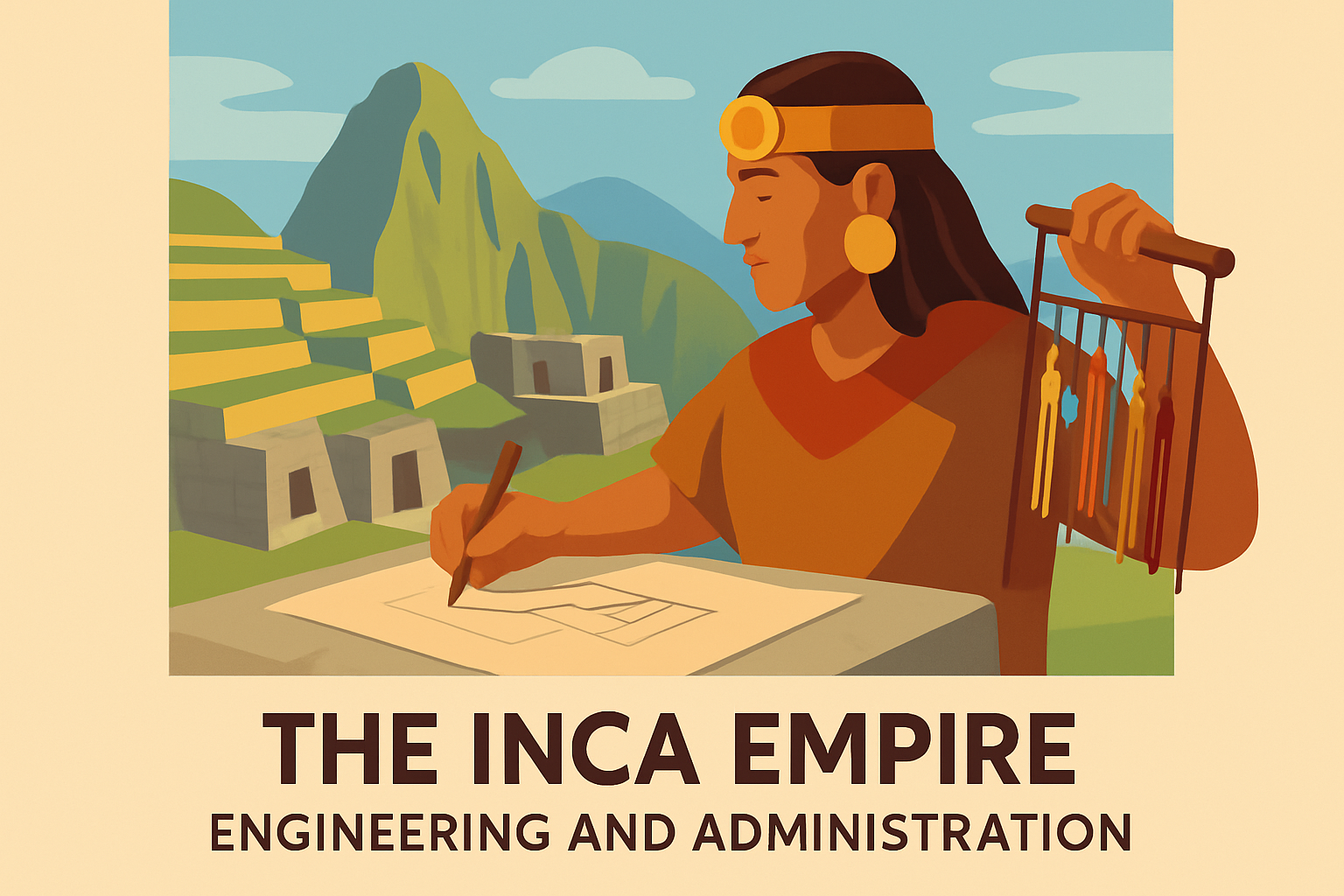
The Inca Empire, also known as Tawantinsuyu, was a vast and sophisticated civilization that thrived in South America from the 13th to the 16th century. This ancient empire, the largest in pre-Columbian America, extended through modern-day Peru, Ecuador, Bolivia, Argentina, Chile, and Colombia. The Inca civilization was renowned for its unique advancements in engineering and administration, two pillars that supported the empire’s success and longevity. Understanding these achievements provides contemporary society with insights into ingenious problem-solving and effective governance without the reliance on modern technologies. Despite lacking the wheel, a written language, and sophisticated tools, the Inca achieved impressive feats in engineering and administration that continue to intrigue archaeologists, historians, and engineers today. This article will explore how the Inca managed to create and maintain such a robust and expansive empire against the backdrop of the challenging Andean terrain, focusing on their exceptional engineering and administrative skills. By examining these historical marvels, we can appreciate the ingenuity required to unify diverse cultures and landscapes into a cohesive empire.
Inca Engineering: Building an Empire from Stone
Inca engineering marvels can be seen in their construction techniques and infrastructure, which facilitated the empire’s expansion and integration. Perhaps the most iconic example is the city of Machu Picchu, a testament to the Inca’s architectural prowess. Perched high in the Andes, this UNESCO World Heritage Site is a combination of masonry, terraces, and sophisticated water management systems. The Incas employed a technique known as ashlar masonry, where stones were precisely cut to fit together without mortar. The precision and durability of this technique ensured that the structures could withstand earthquakes, a frequent occurrence in the region.
The Inca road system, or Qhapaq Ñan, further exemplifies their engineering success. Spanning over 40,000 kilometers, this network connected the diverse regions of the empire, facilitating movement, communication, and trade. Despite the challenging topography, with its steep mountains and deep valleys, the Inca constructed a system that included bridges, tunnels, and stairways. The roads were not only a testament to their engineering skills but also crucial for administrative efficiency and military mobility within the empire.
The Mastery of Water Management
Water management was another critical component of Inca engineering, reflecting their ability to manipulate natural resources to meet their needs. The Inca developed advanced irrigation systems to support agriculture in the Andean highlands, one of the most challenging environments on Earth. Terracing was commonly employed, whereby hillsides were transformed into stepped plots of arable land. This technique conserved soil and water, allowing for the cultivation of crops such as potatoes, maize, and quinoa.
The city of Tipón, located near Cusco, provides a remarkable example of Inca water management. It features a network of aqueducts, canals, and fountains that channel water seamlessly across the site. This hydraulic system not only served agricultural needs but also provided water for domestic use and religious ceremonies. The ability to control water resources was pivotal to sustaining the large population centers and was a key factor in the empire’s stability and productivity.
Administrative Structure of the Inca Empire
The administrative prowess of the Inca was instrumental in maintaining order and unity across their expansive territory. The empire’s administrative framework was built upon a hierarchy of authority and reciprocal obligations, allowing for efficient governance without the need for written records. At the top of this organization stood the Sapa Inca, the emperor, who was regarded as a divine ruler with absolute authority over the empire’s affairs.
The administration was divided into four suyus, or regions: Chinchaysuyu, Antisuyu, Qullasuyu, and Kuntisuyu, each managed by a governor known as an apu. These regions were further subdivided into smaller units called wamani, administered by lower-ranking officials. This hierarchical structure helped streamline decision-making processes and facilitated the flow of information and resources.
The Role of Mit’a and Ayllu in Social Organization
The system of mit’a was central to fulfilling the empire’s labor needs without the use of currency. Under the mit’a system, each household contributed labor to state projects such as road construction, agriculture, or military service for a certain number of days each year. In return, the state provided necessities like land, food, and protection, reinforcing loyalty and service.
The social unit of the ayllu also played a vital role in the administration. The ayllu was a kinship group that cooperated in communal tasks and resource sharing. It’s through these micro-communities that the Inca managed to integrate various ethnic groups, ensuring loyalty and stability within the empire. The ayllu system enabled the redistribution of resources based on need and productivity, maintaining social cohesion despite the empire’s vastness and diversity.
Efficient Communication and Record Keeping with Quipus
Despite being non-literate in the conventional sense, the Inca developed an intricate method of record-keeping and communication using quipus. These devices comprised colored threads knotted in various ways to encode information. Skilled officials known as quipucamayocs interpreted these knots, allowing them to record statistical information like census data, agricultural yields, and labor service obligations.
Quipus were vital administrative tools that facilitated governance and communication over expansive and difficult terrains. They were employed not only for bureaucratic purposes but also to store data about the empire’s population, resources, and taxation. The quipu system highlights the Inca’s adaptability and innovation in overcoming the limitations of a non-written language civilization.
Lessons from the Inca Engineering and Administration
The Inca Empire’s engineering and administration serve as a masterclass in resourcefulness and resilience. Despite geographical challenges and limited technology, they implemented solutions that thrive to this day. The Inca’s feats remind us of the immense potential in utilizing local resources thoughtfully and organizing societies effectively, lessons that remain relevant in contemporary urban planning and management.
To further appreciate the complexities of Inca administration and engineering, consider the following breakdown:
| Aspect | Description |
|---|---|
| Engineering Techniques | Masonry, terracing, road construction |
| Water Management | Aqueducts, canals, terraced agriculture |
| Administrative Structure | Hierarchy of authority, regions, and local units |
| Labor System | Mit’a system and ayllu cooperation |
| Communication | Quipus for record-keeping and statistics |
Conclusion: The Legacy of the Inca Empire
In conclusion, the Inca Empire’s remarkable achievements in engineering and administration were foundational to its success and enduring legacy. These innovations allowed the Incas to conquer and hold sway over a vast, geographically diverse empire for centuries. By examining these historical accomplishments, modern societies can draw valuable insights into sustainable engineering practices and efficient governance without relying heavily on modern technology.
Understanding the Inca Empire offers more than just a glimpse into the past; it provides inspiration for addressing present and future challenges. The empire’s ability to harmonize its infrastructure with the natural environment while managing a multifaceted administrative framework exemplifies the potential in combining tradition with practicality. Engaging with and learning from the Inca’s wisdom calls upon us to seek adaptive solutions and reinforce cooperation, ensuring resilience and prosperity. For readers interested in exploring more, visiting archaeological sites such as Machu Picchu or consulting academic materials can further deepen the appreciation and application of these ancient techniques.
Frequently Asked Questions
1. How did the Inca Empire manage to achieve such impressive feats of engineering?
The Inca Empire, known as Tawantinsuyu, exhibited exceptional engineering skills, which were vital to its enormous infrastructure and growth. The Incas demonstrated extensive knowledge of topography and materials, enabling them to design and build magnificent projects amidst challenging Andean terrains. They recognized the natural contours of the land, allowing them to develop structures like roads, bridges, and agricultural terraces. These features not only functioned efficiently but also contributed to the empire’s architectural beauty.
The Inca road system, known as Qhapaq Ñan, stretched over 25,000 miles, seamlessly connecting the vast empire. It was a meticulously planned network, economically benefiting from suspension bridges over ravines and carefully crafted tunnels through mountains. Stone paving and drainage systems ensured durability, while waystations provided rest for travelers and relay communication across great distances.
In agriculture, the Incas ingeniously adapted terracing, maximizing arable land and preventing erosion. They employed complex irrigation techniques, redirecting mountain streams to their fields. Entire cities like Machu Picchu have examples of these practices, highlighting their ability to harmonize construction with the natural environment. Mastery of stonework, without the use of iron or wheel, showcased their precise masonry skills, fitting stones so accurately that they required no mortar.
2. What role did administration play in the success of the Inca Empire?
The administration of the Inca Empire was integral to its stability and expansion, establishing it as an advanced civilization. The Incas crafted an elaborate and organized administrative framework that allowed them to govern an expansive and diverse territory effectively. At the empire’s core was the Sapa Inca, the divine ruler considered a descendant of the sun god Inti, whose authority was absolute.
To manage the empire’s vastness, the Incas divided their territory into four regions, each governed by a provincial administrator or governor, known as an “Apu.” These Apu oversaw local affairs following a hierarchy under the central government, ensuring a feathered dissemination of the Sapa Inca’s directives. They were knowledgeable about the regions they controlled, making them adept in managing agriculture, production, and the people within their domains.
The Incas employed a labor tax system, known as the “mit’a,” conscripting men for public service in exchange for state-controlled resources like food and clothing. This system enabled the Incas to amass manpower for construction, military campaigns, and government projects, cementing loyalty and fortifying the economy. The administration’s efficiency thrived due to an absence of a monetary economy, relying instead on a barter system that promoted cooperation.
Record-keeping was another striking aspect of Inca administration. They used quipus, a series of knotted ropes, to store data about agricultural yields, populations, and statistics crucial for governance. Specialists, or “quipucamayocs,” deciphered these intricate knots and strings, summarizing the empire’s essential details for rollouts and planning.
3. What are some specific examples of Inca engineering accomplishments?
The Inca Empire’s engineering prowess is evident in several iconic structures that endure to this day. Machu Picchu is perhaps the most renowned, showcasing the Incas’ architectural ingenuity and stonework. Situated 7,970 feet above sea level, this city was intricately woven into the mountain landscape, featuring terraced steps and ceremonial spaces.
Another significant achievement is the Sacsayhuamán fortress above Cusco, the Inca Empire’s capital. This fortification displays the Incas’ architectural genius, using massive blocks weighing hundreds of tons, precisely chiseled to fit without mortar. The zigzag walls not only served military and protective purposes but also demonstrated their expertise in geometry and load distribution.
The Ollantaytambo site further illustrates their engineering skills. This functioning fortress and civic precinct presented formidable defenses, terraces for agriculture, and a source for irrigation. Its strategic location exhibited thoughtful city planning and complex hydraulic systems that safeguarded against natural elements.
Beyond individual sites, the sophisticated Inca road systems connecting the Andean region represent an engineering masterpiece. These roads enhanced militaristic and trade capabilities, vital for controlling a geographically diverse empire. From the Pacific Coast to the Amazon Basin, the infrastructure facilitated efficient transit and communication over 25,000 miles, uniting disparate cultures under a single network.
4. How did the Incas manage agriculture in difficult terrains?
The Incas showed remarkable adaptability in managing agriculture across challenging Andean landscapes, pioneering innovative methods that revolutionized food production. They ingeniously utilized terracing, carving the mountainside into level agricultural plots, thereby enhancing arable land and reducing soil erosion. These terraces improved irrigation efficiency and enabled the cultivation of crops in an otherwise hostile environment.
Understanding the complexities of climates and microclimates, the Incas developed a wide variety of crops, adapting each to specific elevation levels. Quinoa, potatoes, and maize dominated their agriculture, with composite variations suited for different altitudes. Agricultural experimentation abounded at sites like Moray, where tiered circular plantations allowed climate exposure research crucial for diverse crop production.
Irrigation systems underline another critical advancement. Canals, aqueducts, and cisterns harnessed mountain streams, diverting water to valleys and terraced fields. These hydraulic systems required precise calculations and engineering acumen to control water flow, sustaining agriculture year-round. The Incas even integrated water management into urban planning; systems like the fountains and pools of Machu Picchu exemplified this synthesis.
The expertise they put into agriculture extended beyond technique to communal organization. The ayllu, or traditional communal structure, supported agricultural operations through cooperative labor. This structure solidified social unity, ensuring distribution of resources and knowledge, enabling resilience in times of scarcity, and fostering continuity of agricultural excellence.
5. What impact did the Spanish conquest have on Inca engineering and administration?
The Spanish conquest of the 16th century marked a pivotal disruption in Inca engineering and administration, signifying the fall of a sophisticated empire. With the overthrow of the Sapa Inca, the centralized governmental structure crumbled, making way for Spanish colonial systems that reshaped land ownership and societal organization.
Engineering feats like the Inca road system fell into misuse or decay as Spanish priorities diverged. The imposition of European architectural practices saw many original structures dismantled or repurposed for colonial edifices. Colonial roads broke from the grand unifying network, changing Inca infrastructural coherence and leading to fragmentation.
Agricultural practices also faced evolution under Spanish rule. The forced labor and encomienda system reoriented land use and production for colonial benefits, focusing on European preferred commodities like wheat and livestock instead of the diversified Inca crops. Traditional irrigation and terracing systems suffered deterioration without the upkeep of skilled labor and systematic governance.
The Spanish intrusion did begin syncretism with existing Inca methods, but many facets of their engineering ingenuity remained overlooked, leading to gradual decline. However, their enduring works and knowledge form a cultural legacy, intrinsically woven into contemporary South American society, honoring ancient wisdom and technological prowess for posterity.