
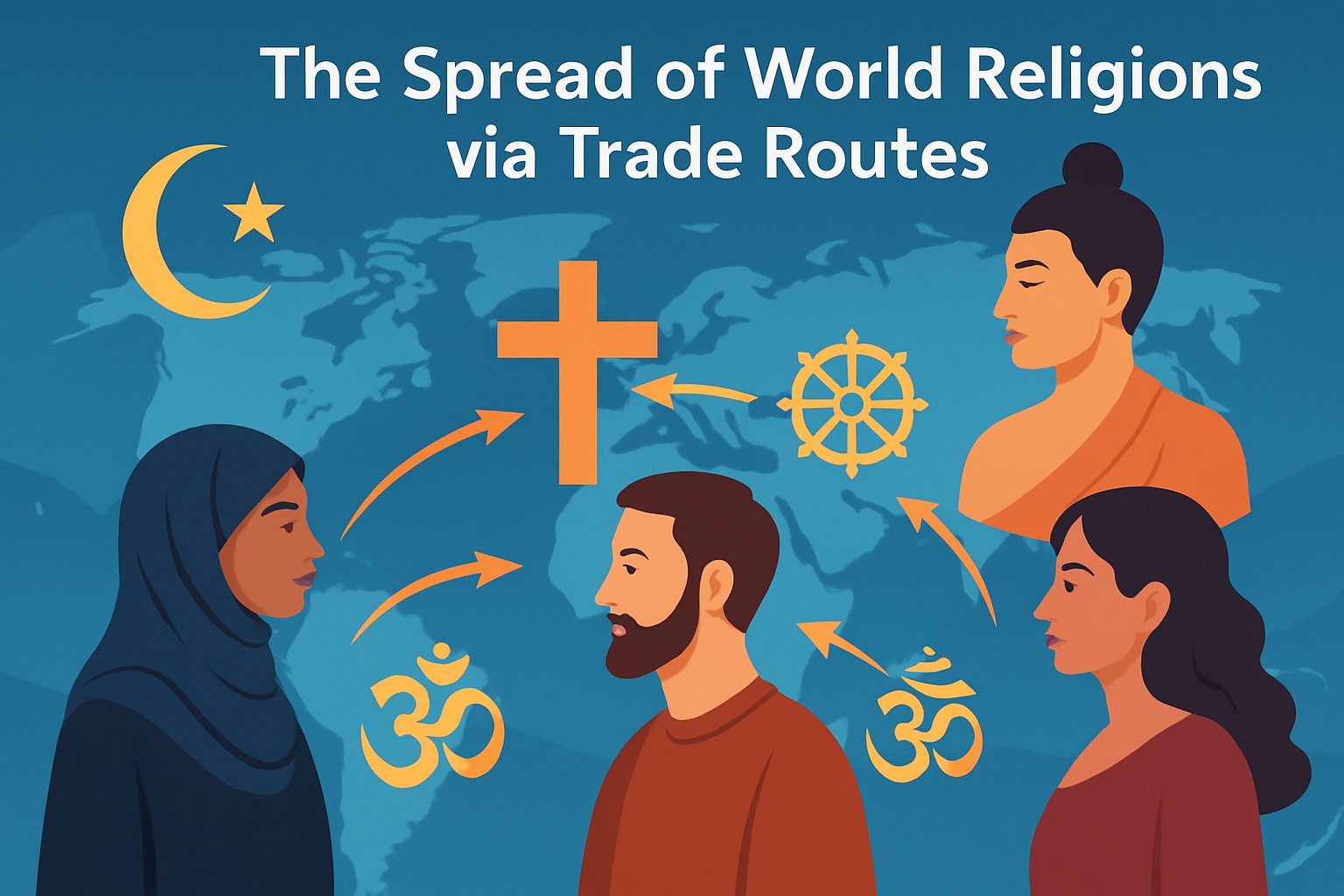
Introduction to Trade Routes and the Spread of Religion
In the annals of history, trade routes have not merely facilitated the exchange of goods like silk, spices, and precious metals; they have also been instrumental in the dissemination of ideas, cultures, and religions. Trade routes such as the Silk Road, the Trans-Saharan caravan trails, and the Indian Ocean maritime paths were conduits for much more than physical commodities. They carried stories, philosophies, and beliefs across vast geographies and varied civilizations. Understanding the relationship between trade and the spread of world religions is crucial because it highlights an integral aspect of cultural exchange which significantly shaped the societies we live in today. By examining this dynamic, we can appreciate the profound interconnectedness of the ancient world and its lasting impact on contemporary religious landscapes.
The word ‘religion’ refers to organized systems of beliefs, practices, and moral codes that often delineate what is sacred and divine to its adherents. These religious ideas, when carried over trade routes, frequently led to cultural syncretism, where customs and ideas fused, creating unique local variants that reverberate to this day. This significance adds layers to our understanding of how religions evolved and adapted, impacting local traditions and societies along the way.
The Silk Road: A Highway for Buddhism
The Silk Road was perhaps the most famous trade network, spanning thousands of miles across Asia, linking the East and West from China to Europe. It was not merely a single path but a network of interconnected trade routes. Alongside the traded silk, ceramics, and spices, Buddhism traveled to China from India. Initially spread by merchants and missionaries, Buddhism was uniquely adaptive. As traders moved goods from city to city, they also introduced Buddhist concepts and practices. These ideas were especially attractive to those in urban centers where the hustle and anxiety of trade life found solace in Buddhism’s teachings of peace and detachment from material possessions.
- Buddhism entered China around the first century AD.
- Caravans often included Buddhist monks who spread the teachings.
- Buddhist art and texts accompanied traders, influencing Chinese art and literature.
A tangible example of Buddhism’s spread via the Silk Road is the Dunhuang manuscripts, discovered in the early 20th century. These texts, found in China, showcase a wide array of Buddhist thought, indicating how comprehensive and influential the religion had become in areas far from its Indian birthplace.
Christianity along the Roman Roads and Beyond
Christianity, which germinated in the Middle East, found its footing in the Roman Empire, largely thanks to the empire’s extensive network of roads. These roads, initially built for military and administrative purposes, were pivotal for traders and also for disseminating Christian doctrine. As the Roman Empire stood at the crossroads between Europe, Asia, and Africa, it allowed Christianity to infiltrate different regions efficiently.
One story that encapsulates this spread is that of the Apostle Paul, who traveled extensively through the Roman Empire, preaching Christian teachings along these roads. This not only spread the religion but also set the stage for its eventual acceptance as the state religion.
| Region | Era | Mode of Spread |
|---|---|---|
| Eastern Mediterranean | 1st Century AD | By missionaries (e.g., Apostle Paul) |
| Europe | 4th Century AD | Edict of Milan, state endorsement |
| North Africa | 3rd Century AD | Trade and local converts |
The Roman acceptance and eventual sanction of Christianity as a state religion by Constantine the Great in the early 4th century were pivotal moments, allowing the religion to spread further into Europe and beyond. Along with trade, Roman infrastructure facilitated this major religious shift, underscoring how trade routes (and related paths) can be arteries for ideological transformation.
The Indian Ocean Routes and the Spread of Islam
While the Silk Road often dominates narratives concerning trade’s role in spreading religion, the Indian Ocean trade network was equally significant in disseminating Islam. Stretching from the Arabian Peninsula to Southeast Asia, these maritime paths witnessed not only the exchange of gold, textiles, and spices but also the spread of Islam to a vast range of regions and cultures.
Islamic traders, who were often from the Arabian Peninsula, played dual roles as both merchants and cultural ambassadors. They introduced Islamic principles and practices as they did business, which proved advantageous in building trust and forging lasting relationships with local populations.
Key examples of Islamic spread via these routes include the Islamic Sultanates that emerged in Southeast Asia, such as those in modern-day Indonesia and Malaysia. Towns like Malacca became melting pots of commerce and faith, where Islamic scholarship flourished alongside trade.
The Trans-Saharan Routes: Islam in Africa
Turning our gaze to Africa, the Trans-Saharan caravan routes were instrumental in spreading Islam across the continent. These trade routes linked North Africa with sub-Saharan regions, facilitating not just the movement of goods like gold, salt, and ivory but also Islamic teachings. Islam had a profound impact on the cultures and societies it touched, leading to the rise of Islamic empires such as Mali and Songhai.
One notable figure in this regard was Mansa Musa of Mali, whose famed pilgrimage to Mecca in the 14th century underscored the deep penetration of Islamic tradition into West Africa, facilitated by trade. Islamic scholars and clerics traveled these routes, setting up centers of learning and mosques, which became focal points of Islamic worship and education.
The legacy of these routes is evident today, with Islam being a dominant religion across much of North and West Africa. The cultural and religious landscapes of these regions have been richly informed by Islamic principles that arrived via ancient trade paths.
The Impact and Legacy of Religious Dissemination via Trade
From the sprawling landscapes of Asia to the old kingdoms of Africa, trade routes were among the most significant veins through which religions traversed the globe, leaving indelible marks on societies. This historical process not only altered religious demographics but also catalyzed a broader exchange of cultural and intellectual ideas. As paths facilitated dialogues between diverse cultures, they encouraged religious adaptations and syncretism, leading to enriched thought and coexistence despite disparate origins.
The impact of trade routes on religious spread exemplifies an ancient globalism that predated modern globalization, showing us that interconnectedness has long been a pivotal force in human history. Understanding these dynamics enhances our appreciation for the complexity of religious and cultural identities today, reminding us of a shared human experience shaped through centuries of encounters and exchanges.
Conclusion and Call to Action
The historical interplay between trade routes and the spread of world religions underscores the remarkable journey of ideas across borders and through time. This journey nurtured the cultural plurality that characterizes our global society today. Recognizing the routes that religions traveled helps understand the spiritual and cultural affinities shared across far-flung regions. It instills in us an appreciation and respect for the common threads that weave the fabric of human civilization.
For the modern reader, this understanding can inform a deeper appreciation for cultural diversity and religious tolerance, offering insights into how we may address contemporary challenges of coexistence. As we reflect upon the past, let us be inspired to honor and learn from the cultural exchanges that enriched our shared human history. Take a moment to ponder the trade routes of today—the digital, the social, the global logistics—and consider the ideas we might exchange for a more harmonious future.
Frequently Asked Questions
1. How did trade routes contribute to the spread of religions?
Trade routes have been pivotal in human history, not just for their economic significance but also for their role as conduits of cultural and religious exchange. When traders traveled along these routes like the Silk Road or the Trans-Saharan trails, they interacted with a diverse range of peoples and shared more than just goods. They exchanged ideas, beliefs, and stories. For instance, Buddhism spread from India to Central Asia, China, and beyond thanks to the Silk Road. As traders and pilgrims moved along these paths, they established monasteries and cultural exchange centers, embedding their religious beliefs into new regions. Similarly, Islam spread across Africa via the Trans-Saharan and Arabian trade routes, largely facilitated through the interactions between traders and local communities, often resulting in the integration of Islamic practices with local traditions.
2. What role did the Silk Road play in the dissemination of Buddhism?
The Silk Road was a network of trade routes connecting the East and West and was instrumental in the spread of Buddhism. Originating in India, Buddhism traveled outwards primarily through the dedicated efforts of missionaries and monks like those sent by Emperor Ashoka during the 3rd century BCE. These religious missionaries traveled along the Silk Road, establishing monasteries and converting local populations as they went. They often carried scriptures, relics, and sacred texts, which were translated into local languages, making the teachings more accessible. Over time, variations of Buddhism emerged in China, such as Mahayana Buddhism, which was influenced heavily by local customs and philosophies, demonstrating the adaptability and integration of Buddhism along this trade network.
3. In what ways did the Indian Ocean trade routes facilitate the spread of Islam?
The Indian Ocean trade routes were bustling highways of commerce that not only carried goods but also facilitated the spread of Islam. Due to the strategic position of the Arabian Peninsula along these routes, Muslim traders, seafarers, and missionaries brought Islamic teachings to the coastal regions of Africa, South Asia, and Southeast Asia. Cities such as Malacca and Aceh in present-day Indonesia became important Islamic cultural and learning centers. The intermingling of traders at these ports encouraged the exchange of religious beliefs, with conversions often occurring as part of social and economic exchanges. Additionally, the concept of Islamic brotherhood and the support among Muslim traders fostered a sense of communal identity that helped establish strong Muslim communities across these regions.
4. How did the Trans-Saharan trade routes influence the spread of Christianity in Africa?
The Trans-Saharan trade routes had a considerable albeit less direct role in the spread of Christianity in Africa compared to Islam. These routes connected Sub-Saharan Africa to North Africa and beyond, facilitating not only the trade of gold, ivory, and salt but also the exchange of cultural and religious ideas. Christianity had already taken root in North Africa by the early centuries of the Common Era, with centers such as Alexandria becoming major hubs of Christian theology. As traders from these regions moved southwards, they occasionally carried Christian practices along with them. However, it wasn’t until later, with the aid of European exploration and colonization, that Christian missions extensively penetrated Sub-Saharan Africa, often utilizing these established trade routes.
5. Can you provide examples of how cultural exchanges along ancient trade routes fostered religious syncretism?
Religious syncretism is the blending of different religious beliefs into a new, hybrid religion, and ancient trade routes were fertile ground for such exchanges. For example, along the Silk Road, Buddhism intertwined with local Chinese beliefs, leading to uniquely Chinese forms of Buddhism that incorporated elements of Daoism and Confucianism. In Africa, the contact between Islamic traders and local African spiritual systems led to the development of Sufi traditions, which often incorporated indigenous spiritual practices. This blending made Islam more palatable to native populations and facilitated its spread. The fusion of Hindu and Buddhist beliefs was also seen in Southeast Asia, where trade brought Indian cultural influences, resulting in a rich tapestry of religious practices that were neither purely Hindu nor Buddhist but a combination of both, as seen in the Angkor Wat temple complex in Cambodia.