
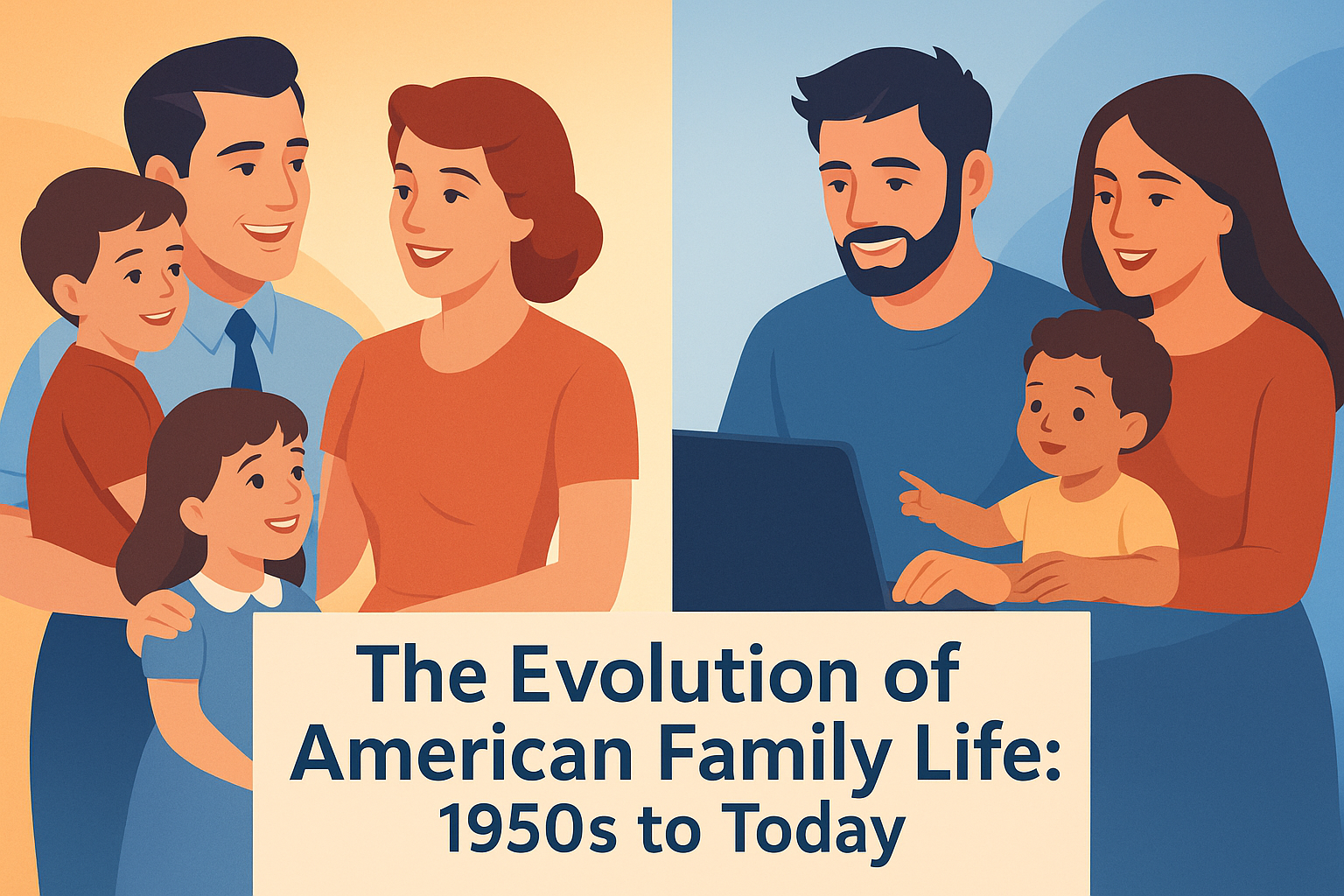
The concept of the family—a fundamental societal building block—has shaped and been shaped by profound changes in the American landscape. Post-World War II America saw the emergence of the idealized nuclear family during the 1950s. Fast forward to the present day, and the American family reflects a diverse and complex tapestry shaped by economic, technological, and cultural shifts. Understanding this evolution sheds light on societal trends and offers invaluable insights into our social fabric. By examining the trajectory from the past to the current dynamics, one can better appreciate the role families play in today’s world and how they might continue to evolve. This exploration is paramount as it impacts social policies, education systems, and our collective wellbeing.
The 1950s: The Golden Age of the Nuclear Family
In the 1950s, the American family was epitomized by the nuclear model, comprising a breadwinning father, a homemaker mother, and their children. This family structure was not only idolized but also widely disseminated through the media, becoming synonymous with the American Dream. Economic prosperity following World War II facilitated this ideal. Men returned to stable jobs, while women, having contributed massively to the wartime workforce, were encouraged to resume domestic roles. The popular TV show “Leave It to Beaver” is an illustrative example, depicting an idealized suburban family experiencing life’s trials and joys.
The seeming stability and prosperity of the time masked significant undercurrents. The era’s family model reinforced strict gender roles, marginalized non-conformity, and often disregarded minorities’ realities. While many celebrated the stability the nuclear family symbolized, others found themselves forced into molds that didn’t fit.
The 1960s and 1970s: Social Change and Redefinition
The 1960s and 1970s were decades marked by significant social upheaval. Civil rights movements, second-wave feminism, and shifts in societal values contributed to redefining the American family structure. Women increasingly pursued higher education and entered the workforce, challenging traditional gender roles. Concurrently, changing laws and social attitudes increased acceptance of divorce, leading to higher divorce rates and the rise of single-parent households.
- The Civil Rights Act of 1964 provided greater opportunities for minorities and women.
- No-fault divorce laws, first enacted in California in 1969, began spreading across the state, reshaping family dynamics.
- The counterculture movement fostered individuality and questioned traditional norms.
The TV show “The Brady Bunch,” airing in the late 1960s, serves as an example of society’s shifting perceptions. It portrayed a blended family, with two divorced parents remarrying and combining their previous families, reflecting the growing diversification in family structures.
The 1980s and 1990s: Technological Advancements and Economic Shifts
The 1980s and 1990s introduced significant technological advancements that began to reshape family life. The emergence of personal computers, video games, and, later, the internet, changed the way families interacted both internally and with the outside world. At the same time, economic pressures necessitated the dual-income household, with both parents often working full time. This period also saw a rise in daycare facilities and after-school programs, partially filling roles previously held by stay-at-home parents.
The show “Roseanne” that aired during this time portrayed a working-class family dealing with everyday issues, capturing the balance families sought between work and family life amidst tightening economic conditions. This era also introduced significant shifts in family composition. Rising acceptance of diverse family forms, including interracial and same-sex couples, began to reflect in societal attitudes and laws, paving the way for further change.
The 2000s: Legal Progress and Increasing Diversity
As the new millennium unfolded, legislative changes and societal acceptance further reshaped family structures. Key legal milestones such as the legalization of same-sex marriage in 2015 highlighted the growing acceptance of diverse familial models. Technological advances continued to evolve, altering communication modes and access to information, directly impacting family dynamics.
| Year | Key Developments |
|---|---|
| 2004 | Massachusetts legalizes same-sex marriage, a landmark decision. |
| 2015 | Obergefell v. Hodges legalizes same-sex marriage nationwide. |
During this time, TV shows like “Modern Family,” which premiered in 2009, depicted a wide-ranging picture of modern familial structures, including stepfamilies, same-sex partnerships, and interracial adoptions, reflecting society’s increasing diversity and acceptance.
2010s to today: Further Diversification and Technological Integration
The rise of digital technology has further integrated into everyday family life. Social media, streaming services, and smartphones have dramatically altered communication patterns within families and across generations. Families today are more connected externally via technology, yet this sometimes distances internal familial interactions. Furthermore, the pandemic accelerated the shift towards remote working, presenting both opportunities and challenges in balancing work-family life.
Current family structures are increasingly varied, with more children living in single-parent households or raised by extended family members. Modern legislation addressing family concerns, including parental leave policies and childcare support, is becoming increasingly important. Shows like “This Is Us” offer an insightful portrayal of present-day family complexities, addressing issues such as adoption, mental health, and socioeconomic disparities.
Summarizing the Key Takeaways
The evolution of the American family from the 1950s to today is a testament to societal resilience and adaptability. This narrative captures significant shifts—from the leave-it-to-beaver nuclear family to the diversified and technologically integrated families of today. Understanding this progression not only informs us about past and present societal norms but also guides future policy making and family support systems, ensuring they address the evolving needs of families.
The overarching lesson is that families, irrespective of form or structure, remain central to societal well-being. As we move forward, it is crucial to continue embracing these changes, supporting legislative frameworks that accommodate diverse family models, and fostering a society where every family form is recognized and valued.
In conclusion, as individuals and communities, we must engage actively in this journey. Reflect upon your familial experiences, advocate for inclusive policies, and cherish the diversity that defines our society today. Let’s continue to shape a future where every family, in whatever form, thrives.
Frequently Asked Questions
1. What characterizes the idealized nuclear family of the 1950s, and why was it so prevalent?
The idealized nuclear family of the 1950s, often epitomized by the wholesome image portrayed in popular television shows of the time, consisted of a breadwinning father, a homemaking mother, and their children. This family structure was prominent because it represented stability in a post-war era where the economy was booming, and societal norms encouraged conformity and traditional gender roles. The suburban lifestyle became ideal, with families seeking the American Dream through home ownership, steady employment, and a comfortable middle-class existence. The 1950s nuclear family was also supported by a societal infrastructure that promoted these values, through policies like the GI Bill, which made homeownership more accessible for returning veterans.
2. How did the counterculture movement of the 1960s and 1970s impact American family structures?
The counterculture movement of the 1960s and 1970s profoundly challenged and transformed American family structures. As society began to question traditional roles and norms, there was a significant shift towards individualism and personal freedom. This period saw a rise in divorce rates, an increase in single-parent households, and the acceptance of cohabitation without marriage. Women’s liberation played a crucial role, empowering women to pursue education and careers, leading to a more equitable sharing of family responsibilities. The counterculture also embraced diverse family forms, including communal living and same-sex partnerships, paving the way for the acceptance of various family dynamics we see today. These shifts reflected larger societal movements towards gender equality and civil rights, forever altering the landscape of family life in America.
3. In what ways has technology influenced the evolution of family life from the 1980s to today?
Technology has been a game changer in the evolution of family life from the 1980s to today. The advent of the Internet and later, smartphones, revolutionized communication, allowing family members to stay connected regardless of geographical distances. However, it also introduced new challenges, such as the blurring of work-life boundaries and the rise of screen time replacing face-to-face interactions. The digital age has seen an increase in telecommuting, providing parents more flexibility with work and child-rearing responsibilities. Social media has become a platform for sharing family milestones but also a source of unrealistic expectations and comparative anxiety. Access to information has empowered families, offering educational resources and parenting support at their fingertips. Technology’s impact on family life is profound, driving both the way we connect with each other and how we structure our daily routines.
4. How have economic changes since the mid-20th century affected American families?
The economic changes since the mid-20th century have had a significant impact on American families. The decline of manufacturing jobs in the 1970s and 1980s led to economic instability and a shift to a service-based economy. This change meant that many families needed dual incomes to maintain their standard of living, increasing the number of working mothers significantly. Economic recessions have driven families to adapt through multigenerational living arrangements or by relying more on community networks for childcare and support. Housing booms and their subsequent busts have affected homeownership rates, influencing where and how families live. Income inequality has also grown, leading to disparities in education, health care, and opportunities for children from different socio-economic backgrounds. Together, these economic shifts have influenced family formations, dynamics, and priorities, embedding adaptability and resilience into the fabric of modern American family life.
5. What are some of the most significant cultural changes regarding family life in the 21st century?
The 21st century has witnessed some of the most dramatic cultural changes regarding family life. Firstly, there is an increased recognition and acceptance of diverse family structures, including same-sex marriages and families, single-parent households, and child-free couples. Cultural expectations around marriage have shifted, with more couples marrying later or choosing not to marry at all. Similarly, the age of first-time parents has increased, reflecting broader societal changes in career prioritization and personal development. Ethnic and cultural diversity has enriched the American cultural tapestry, introducing varied customs, traditions, and family dynamics. Furthermore, the conversation around mental health and well-being is reshaping how families communicate and support each other, breaking down stigmas attached to seeking help and fostering open dialogues. These cultural shifts reflect an ongoing evolution toward inclusivity, individual choice, and holistic well-being in family life.