
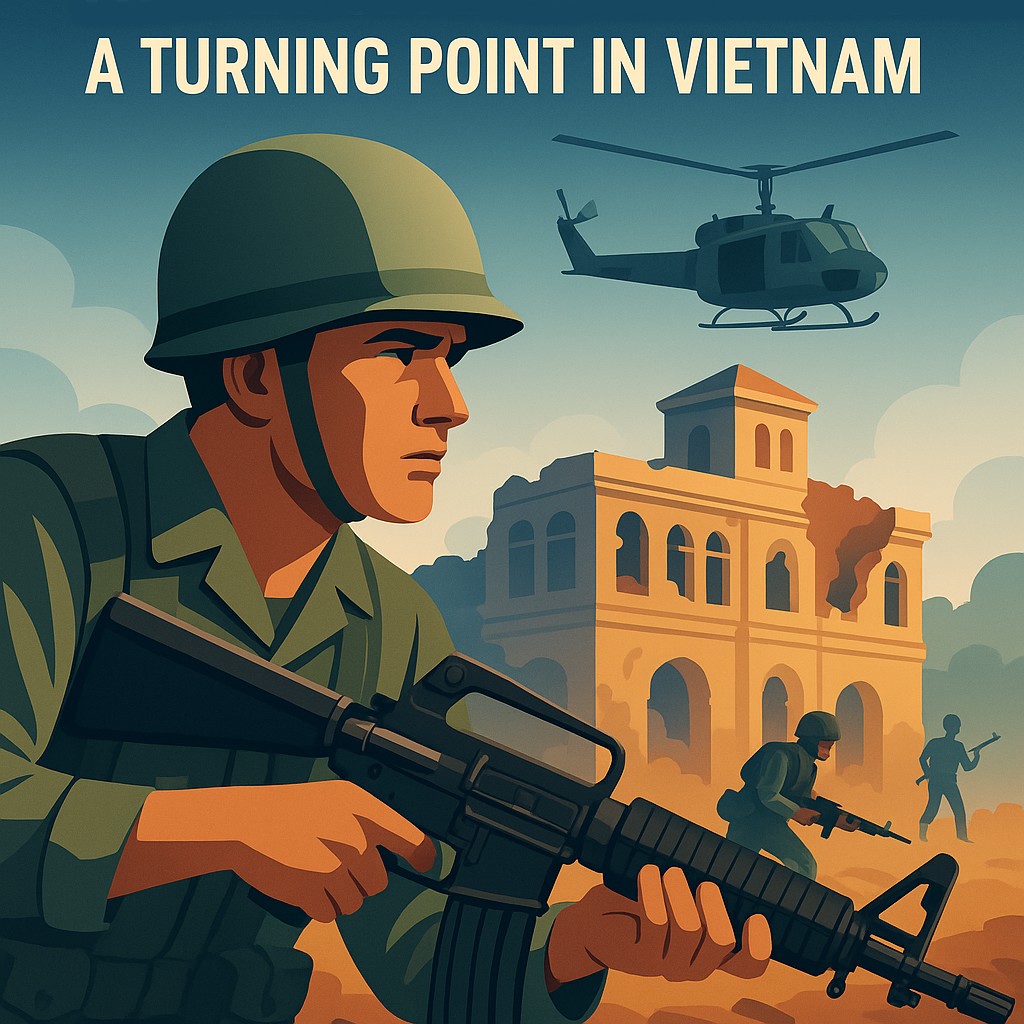
The Vietnam War, an intense conflict that occurred from 1955 to 1975, is marked by numerous significant events, but perhaps none as crucial as the Tet Offensive of 1968. This was a series of coordinated attacks by the North Vietnamese forces and the Viet Cong on South Vietnamese cities and military establishments. The offensive, named after the Tet holiday—Vietnam’s Lunar New Year—aimed to shatter the morale of the South Vietnamese and American forces and inspire revolts within South Vietnam. This article seeks to explore why the Tet Offensive was pivotal, what transpired during this period, and how it ultimately transformed both military strategy and public perception of the war.
The term “Tet Offensive” ignites imagery of sudden and unexpected attacks, and rightly so. During a time when there was an informal truce, the North Vietnamese and Viet Cong forces launched surprise assaults across over a hundred cities in South Vietnam. The offensive played a crucial role by altering the course of the war, showing that even more than a mere military confrontation, it became a psychological battle. For policy-makers and historians, it matters significantly as it underscored the unpredictability of warfare and the importance of psychological tactics over sheer military might. Despite their ultimately military failure, the North Vietnamese forces succeeded in a broader political and psychological sense.
The Battle Begins: A Sudden Onslaught
On January 30, 1968, North Vietnamese forces and the Viet Cong unleashed the Tet Offensive. This was meticulously planned to coincide with the Tet holiday, when both sides typically held a ceasefire. The suddenness of the attack took the U.S and South Vietnamese forces by surprise. The assaults were widespread, indicating a significant shift in the strategy of the North Vietnamese, who previously preferred guerrilla tactics. Cities such as Saigon, Hue, and Khe Sanh became focal points of intense street battles.
Hue, a city rich in history and cultural significance, witnessed one of the longest and bloodiest battles of the offensive. The fight to regain control of Hue lasted for almost a month. The historical prominence of Hue added to the gravity of the situation, amplifying concerns back in the United States where the battle was extensively covered by media, bringing the savagery of the war to American living rooms.
Impact on U.S. and South Vietnamese Forces
The Tet Offensive marked a turning point for American forces. Despite inflicting heavy casualties on the attackers, the psychological impact on U.S. troops and their families was profound. The realization that the enemy could strike with such coordination and scale was alarming. While militarily the U.S. repelled the attacks, the event further complicated military operations and prompted reassessment of strategies against an enemy willing to sustain high casualties for symbolic victories.
The offensive highlighted severe intelligence failures as well. American and South Vietnamese forces were caught largely off-guard despite significant U.S. military presence in Vietnam. This led to heavier scrutiny and eventual changes in military intelligence operations.
Effect on American Public Opinion
The Tet Offensive played a significant role in shaping American public opinion on the Vietnam War. The relentless media coverage of the offensive, particularly images and reports from the Battle of Hue and Saigon, magnified the perception of a distant war that seemed unwinnable. Chronically worsening public morale saw growing anti-war sentiment and intensifying protests across the United States.
Significantly, the perception of an impending victory that had been maintained by the U.S government was shattered. President Lyndon B. Johnson’s administration faced unprecedented criticism, leading to larger political repercussions. Public pressure mounted for a reassessment of U.S intervention in Vietnam, thus marking a shift in American policy and approach.
Political Ramifications and Policy Revisions
Politically, the Tet Offensive was something of a double-edged sword. While it was a disaster in immediate military terms for the North Vietnamese, strategically it worked in their favor by prompting policy revisions in the U.S. Within months, President Johnson announced his decision not to seek re-election, partly due to growing discontent fueled by the events of Tet.
Moreover, the offensive led to an acceleration of peace talks and opened the way for the policy of Vietnamization under President Richard Nixon. The shift aimed more at transferring combat roles to South Vietnamese troops while progressively reducing American involvement, thereby achieving a face-saving exit.
Legacy of the Tet Offensive
The legacy of the Tet Offensive extends beyond military history into broader cultural and social subtexts. It marked a change in how wars were perceived by the public, with more scrutiny on government motives and accountability. Thus, it exerted an indelible influence on subsequent foreign policy endeavors.
The offensive underscored the complexity of integrating military success with political objectives within the realm of international conflict. One could argue that it began to change how global conflicts were managed, with emphasis shifting toward negotiation, psychological strategies, and public opinion management.
- Widespread Media Coverage
- Heightened Public Scrutiny
- Psychological Warfare
- Military and Political Strategy Overhaul
Conclusion: Lessons Learned from the Tet Offensive
The Tet Offensive was more than just a series of military attacks; it was a critical turning point in the Vietnam War that changed the trajectory of American involvement in Southeast Asia. Its immediate impacts were measured in terms of lives lost and cities damaged, but its longer-lasting effects were seen in the psyche of the American public, military strategy, and foreign policy realignment. For students of history, military strategy, and political science, the Tet Offensive is a vital case study on how underestimating an opponent’s resolve can lead to profound consequences.
Understanding the events and implications of the Tet Offensive leads to more informed perspectives on how military operations and policies are evaluated. It compels policymakers to balance military engagements with psychological and political strategies. For the everyday observer, it offers a historical testament to the power of adaptability, the necessity of understanding broader contexts alongside immediate actions, and the undeniable impact of media on warfare and public opinion.
The legacy of the Tet Offensive demands that we question military actions and policies today with greater scrutiny and, perhaps more importantly, engage in conversations around policy effectiveness both on and off the battlefield. With these lessons in hand, let us advocate for a balanced approach in diplomacy and conflict resolution. Know your history. Question your present. Shape your future.
Frequently Asked Questions
1. What was the Tet Offensive of 1968, and why is it considered a turning point in the Vietnam War?
The Tet Offensive of 1968 was a major escalation and one of the largest military campaigns during the Vietnam War. It was conducted by the forces of the Viet Cong and North Vietnamese People’s Army. Named after the Vietnamese New Year ‘Tet,’ the campaign was well-coordinated, involving surprise attacks against key cities, towns, and military targets across South Vietnam. For many, it marked a major psychological turning point in the conflict. Before this, there was a common belief among U.S. leaders and the American public that North Vietnam was weak and incapable of decisive action. The scale, audacity, and initial successes of the attacks contradicted these perceptions and exposed vulnerabilities, leading to increased skepticism about the United States’ ability to win the war. Though militarily, it was a harsh defeat for the communist troops resulting in massive casualties, politically and psychologically, it weakened public support for the war effort, influencing the media’s portrayal and public opinion back home.
2. How did the Tet Offensive impact American public opinion on the Vietnam War?
The impact of the Tet Offensive on American public opinion was profound. Prior to the offensive, the U.S. government consistently assured the public that progress was being made and that victory was imminent. Nevertheless, as the attacks unfolded, the stark contrast between official reports and the images broadcasted by U.S. media stunned many Americans. The vivid portrayal of Viet Cong forces penetrating the U.S. Embassy compound in Saigon and other widespread attacks helped shatter the existing narrative, causing shock and disbelief. As such, public confidence in the government waned significantly. The ‘credibility gap’ widened, and protests against the war intensified. The media emphasized the brutality and futility of the Vietnam conflict, contributing to a growing anti-war sentiment. This shift played a crucial role in President Lyndon B. Johnson’s decision not to seek re-election and in the eventual direction of U.S. foreign policy towards Vietnam.
3. What were the military objectives and outcomes of the Tet Offensive for the North Vietnamese?
The North Vietnamese aimed to achieve several military and political objectives through the Tet Offensive. Militarily, they sought to decimate U.S. and South Vietnamese forces, capture key cities and bases, and build momentum for a general uprising in South Vietnam that would topple the Saigon government. Politically, they aimed to weaken the U.S. resolve and push them towards negotiation by exposing the vulnerabilities and amount of resources required to sustain American operations. While the offensive was a military failure in terms of strategic gains, as they suffered high casualties and were unable to retain the positions captured, the political outcomes were more significant. It demonstrated the tenacity and determination of the communist forces, and it drastically altered the American and international perspectives of the war, pushing the U.S. toward de-escalation and eventually leading to peace talks in Paris.
4. What were the strategic mistakes or successes made by the United States during the Tet Offensive?
One major strategic misstep by the United States was underestimating the capabilities and resilience of the North Vietnamese and Viet Cong. American military leaders and policymakers were caught off guard despite some intelligence warnings, particularly because they believed the enemy was on the brink of defeat. The United States’ reliance on traditional military metrics like body counts and territory held did not accurately gauge the morale and fight within the North Vietnamese forces. Conversely, the swift and well-coordinated American counterattacks eventually repulsed the Tet Offensive, demonstrating the tactical superiority of U.S. forces. However, the success in repelling the offensive was overshadowed by the inability to translate military victories into strategic successes, as it amplified anti-war sentiment at home and did not bring them closer to the war’s end.
5. What were the long-term effects of the Tet Offensive on the Vietnam War and global politics?
The Tet Offensive had lasting impacts both on the Vietnam War and globally. In the immediate aftermath, it led to increasing demands for de-escalation and withdrawal from Vietnam. Long-term, it eroded the perception of American invincibility and reshaped U.S. foreign policy to embrace a more cautious approach in international conflicts, reflecting deeper skepticism and moral questioning regarding involvement in distant wars. In Vietnam, although short-lived in its immediate outcomes, Tet ultimately pressured both sides towards negotiations culminating in the Paris Peace Accords of 1973 and the eventual withdrawal of U.S. forces. Globally, it influenced superpower strategies during the Cold War, prompting them to reconsider prolonged military engagements. Additionally, the offensive laid the groundwork for détente, especially as the world observed the limits of conventional military power against unconventional guerrilla warfare, prompting a reconsideration of military doctrines and engagement rules.