
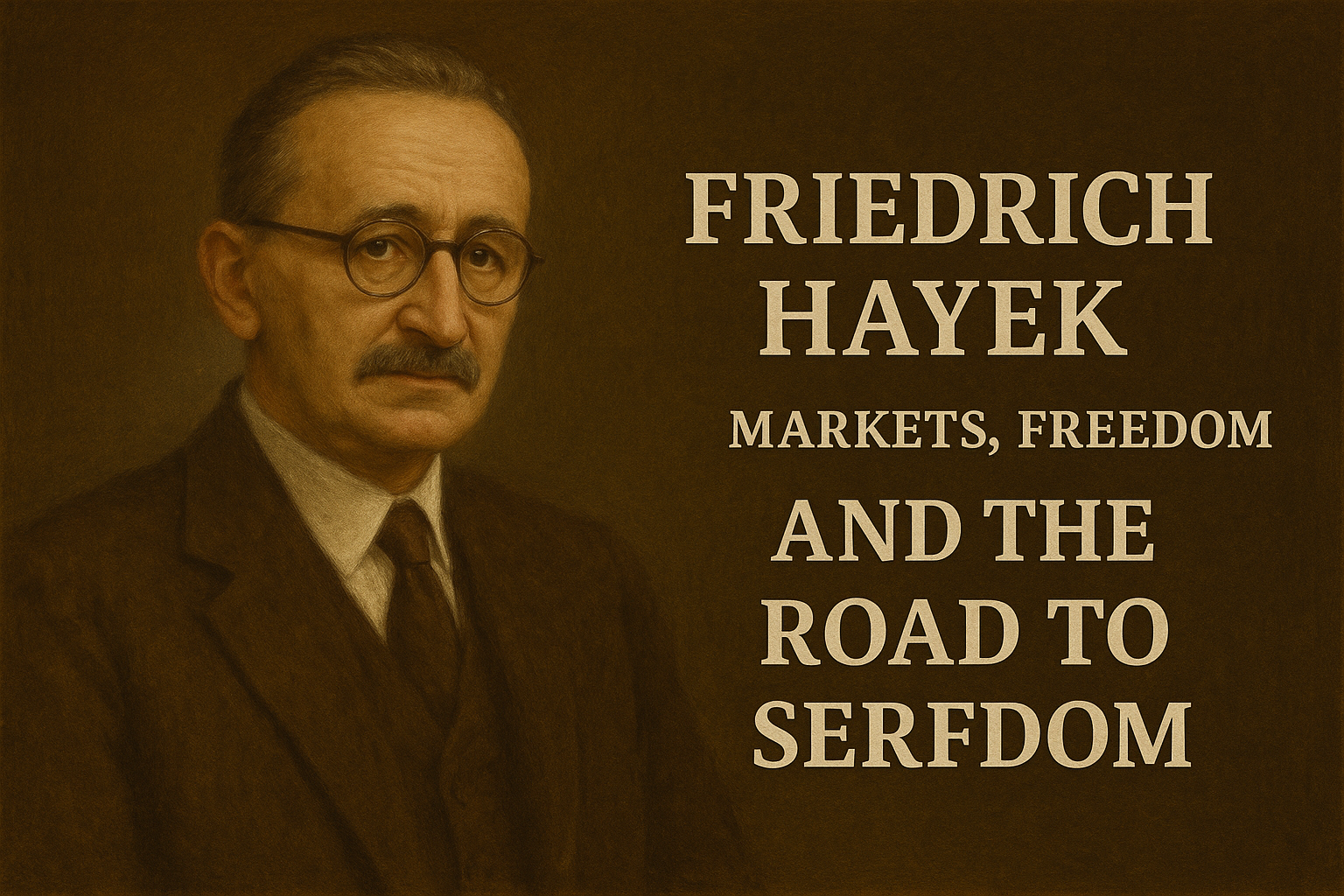
Introduction to Friedrich Hayek: Markets, Freedom, and the Road to Serfdom
Friedrich August von Hayek, an influential economist and philosopher, left an indelible mark on how we understand markets, freedom, and human society. Born in 1899 in Vienna, Hayek rose to prominence in the mid-20th century as a leading proponent of classical liberalism. His profound criticisms of central planning and socialism, alongside his robust defense of free-market capitalism, have had a lasting impact on economic thought and policy. Hayek’s most famous work, “The Road to Serfdom,” published in 1944, challenged prevailing economic theories and highlighted the dangers of governmental overreach and centralized control. This book remains a seminal text in economics, political science, and philosophy, illuminating the complex relationship between liberty and economic systems. In this article, we will explore Hayek’s perspectives on markets, freedom, and the intellectual journey that led him to write “The Road to Serfdom.” By examining his ideas, we will gain insight into the perennial debates on government intervention and individual rights that continue to shape modern society.
Hayek’s Intellectual Journey and Influences
Friedrich Hayek’s intellectual journey was defined by a variety of influences and experiences that shaped his worldview. Growing up in post-World War I Austria, he witnessed firsthand the economic turmoil and instability that followed the collapse of the Austro-Hungarian Empire. This tumultuous backdrop sparked his interest in economic theory and policy. Hayek was initially drawn to the Austrian School of Economics, founded by Carl Menger and later developed by Eugen von Böhm-Bawerk and Ludwig von Mises. Of these figures, Mises had the most profound impact on Hayek, shaping his belief in free-market capitalism and skepticism towards socialism. Mises’ emphasis on the importance of price mechanisms and economic calculation strongly influenced Hayek, driving him to refine and expand upon these ideas in his own work.
Hayek’s education at the University of Vienna coincided with the rise of new economic theories and debates, particularly those surrounding socialism and central planning. He became involved in these debates, engaging with contemporaries such as Oskar R. Lange and John Maynard Keynes. Despite the intellectual challenges posed by these engagements, Hayek remained steadfast in his defense of free markets, contending that central planning would ultimately undermine individual freedom and economic efficiency. His interactions with these scholars enriched his understanding, prompting him to explore the limitations of government intervention and the vital role of market signals in allocating resources effectively.
In 1931, Hayek was appointed to the London School of Economics, where he continued to develop his ideas. His debates with Keynes regarding macroeconomic management and intervention further solidified his belief in the superiority of decentralized market systems. The Great Depression and World War II heightened his concerns about the expansion of government control over economic affairs, motivating him to articulate these concerns in “The Road to Serfdom.” Through his academic journey, Hayek synthesized his insights into a coherent framework that underscored the importance of individual liberty and spontaneous order in fostering economic prosperity and societal progress.
The Central Thesis of “The Road to Serfdom”
“The Road to Serfdom” stands as a pivotal work in Hayek’s oeuvre and political economy. The book’s central thesis revolves around the idea that central planning and extensive government control are incompatible with individual freedom and democracy. Hayek argued that government attempts to control or direct economic life often lead down a slippery slope towards authoritarian control. He posited that even well-intentioned policies could gradually erode personal liberties, as state intervention required coercion and control incompatible with the principles of a free society.
Hayek’s critique was aimed not only at socialism but also at evolving forms of interventionism that had become popular in Western democracies. He was deeply concerned about the allure of central planning, especially as it became more appealing in the face of economic crises. In “The Road to Serfdom,” he laid out a potent argument against the notion that state planners could replicate the efficiencies and benefits of competitive markets, emphasizing that the complexity of economic problems far exceeded the capacity of any central authority to manage effectively. The book articulated a clear warning: the path from well-meaning interventions to a loss of freedom was not always evident or immediate, but it was inevitable if unchecked.
This work invoked historical examples and rhetorical arguments to explore the risks that unchecked governmental power posed to democratic institutions. He underscored that planners, once granted power, would prioritize their goals over individual rights, potentially leading to tyranny. This analysis served as both a cautionary tale and a call to defend the principles of classical liberalism, paving the way for a renaissance of free-market ideas during the latter half of the 20th century.
Hayek’s Contributions to Economic Theory
Beyond “The Road to Serfdom,” Hayek made significant contributions to economic theory that have shaped understanding of markets and competition. His work on the dynamics of price signals in the market process is particularly noteworthy. Hayek argued that prices are not mere indicators of value but effective instruments for communicating information throughout the economy. Prices help individuals coordinate their activities without centralized directives, enabling efficient allocation of resources in a complex society. This notion of the “price system as a communication mechanism” brought new insights into the role of market mechanisms in fostering spontaneous order.
Moreover, Hayek’s analysis of the knowledge problem highlighted a fundamental limitation of central planning. He argued that information is dispersed and localized—every individual possesses unique knowledge about their circumstances, preferences, and constraints, which cannot be aggregated or replicated by central authorities. Thus, decentralized markets inherently outperform centralized planning by leveraging localized knowledge through voluntary exchange. These insights contributed significantly to the theory of market processes and expanded upon the Austrian tradition, solidifying Hayek’s reputation as a leading thinker in economic theory.
Freedom as an End in Itself
For Hayek, freedom was not merely a means to achieve economic prosperity but an end in itself, essential for human dignity and development. He championed the principle of individual autonomy, asserting that personal freedom allows individuals to pursue their goals and aspirations within a framework of rules and norms that protect mutual rights. In his view, a society that curtails individual freedom reduces the potential for creativity, innovation, and human flourishing.
Hayek was also influential in advocating for the rule of law as a fundamental safeguard of freedom. He believed that laws should be general, abstract, and equally applicable to all society members, creating a predictable legal environment. This rule-bound framework was essential for preserving individual liberty and curbing arbitrary state power. Hayek’s emphasis on the interplay between freedom and the legal order continues to resonate with scholars and policymakers, reinforcing the importance of maintaining institutions that promote accountability and limit government overreach.
The Enduring Legacy of Hayek’s Ideas
Friedrich Hayek’s ideas have had a profound and lasting impact on political and economic discourse, inspiring a new generation of scholars, policymakers, and leaders. His economic theories and political philosophy have laid the groundwork for the resurgence of liberalism and the embrace of market-oriented policies in the latter half of the 20th century. The intellectual movement that grew from his work, commonly referred to as the “neoliberal” resurgence, played a pivotal role in shaping the policies of conservative governments, including those of Margaret Thatcher in the UK and Ronald Reagan in the USA.
Hayek’s critique of interventionism and advocacy for free markets profoundly influenced the way societies approached issues of economic management, social welfare, and state power. The debates he engaged in over the role of government intervention in economy and society have remained relevant in contemporary discussions on globalization, regulation, and the welfare state. His insistence on the limitations of scientific knowledge to predict and control societal evolution has pushed back against overconfident policies that promise more control than they can deliver. Hayek’s insights into the spontaneous orders created by markets have found applications in legal theory, political science, and beyond, underscoring their broad relevance.
Conclusion: Hayek’s Relevance in Today’s World
In today’s world, Friedrich Hayek’s exploration of markets, freedom, and the dangers of centralized control remain as relevant as ever. The challenges of modern economies—technological advancements, globalization, social inequality, and environmental sustainability—require careful consideration of government roles and individual freedoms. Hayek’s arguments remind us of the power and limitations of both market solutions and state interventions.
Amid contemporary debates on the balance of state and market forces, Hayek’s insights continue to offer cautionary tales about the complexities and unintended consequences of central planning. They encourage vigilance in safeguarding personal freedoms and democratic institutions amid political, social, and technological change. His enduring legacy lies in encouraging a continued commitment to dialogue and critical thinking about the fundamental relationships between governance, economy, and liberty.
Understanding and applying Hayek’s principles requires nuanced analysis and open debate, cultivating a society that values both individual liberty and collective well-being. As we reflect on Hayek’s contributions, the central questions remain: How do we balance freedom and control? How far should governmental interventions go before they risk the freedoms they aim to protect? In exploring these questions, Hayek’s work continues to serve as a touchpoint for those striving to navigate the complexities of human civilization in pursuit of a free and prosperous society.
“`htmlFrequently Asked Questions
1. Who was Friedrich Hayek and why is he important?
Friedrich August von Hayek was a pioneering economist and philosopher born in Vienna in 1899. He became one of the leading figures in the development and promotion of classical liberalism, particularly known for his influential critiques of central planning and socialism. Hayek’s work highlighted the dangers of government overreach and the inefficiencies of planned economies. His thoughts have deeply influenced economic policy and free-market advocacy worldwide. He is perhaps best known for his classic work “The Road to Serfdom,” which argues that extensive government control of economic activity can lead to totalitarianism, effectively stifling individual freedoms. Hayek’s concerns about personal liberty, economic efficiency, and market dynamics remain crucial considerations in the discourse surrounding modern economies today.
2. What is the central thesis of “The Road to Serfdom”?
“The Road to Serfdom,” published in 1944, is Hayek’s seminal work warning that any move toward socialism, or excessive state control, can endanger personal freedom. Hayek theorizes that when the state controls economic decision-making, it eventually leads to a concentration of power in a centralized authority. This arrangement often erodes individual freedoms and can spiral into authoritarian regimes. Instead, Hayek advocates for a system where the free market leads to more efficient economic decisions, encouraging individual freedoms, prosperity, and innovation. He makes a compelling case that liberty thrives when individuals make their own economic choices rather than those choices being prescribed by overarching government control. Hayek’s insights remain influential among economists and policymakers who advocate for limited government intervention in economic affairs.
3. How did Hayek view the role of markets in society?
Friedrich Hayek held a deeply rooted belief in the efficacy and importance of free markets in society. He argued that markets are dynamic, complex systems that utilize dispersed information far beyond the capabilities of any single entity or central authority. For Hayek, markets represent a self-regulating mechanism where prices signal information, guiding individuals and businesses in making economic decisions. This system not only efficiently allocates resources but also respects individual autonomy and empowerment, facilitating opportunities for creativity and innovation. By fostering competition and allowing for freedom of choice, markets, in Hayek’s view, are indispensable in protecting personal freedom and enhancing societal welfare. His appreciation of markets comes from observing how they naturally coordinate individual efforts in ways that centralized decision-making simply cannot replicate.
4. Why did Hayek oppose socialism and central planning?
Hayek’s opposition to socialism and central planning stems from his belief in the limitations of centralized intelligence and its inherent risk to personal freedoms. He argued that socialism’s demand for comprehensive control over the economy leads to inefficiencies and unintended consequences because no central planner can gather and process information as effectively as the open, competitive interactions facilitated by a free market. This hubris, according to Hayek, risks manipulating and constraining the freedoms of individuals by placing immense power in the hands of a few planners. Additionally, Hayek warned that this concentration of control would pave the way toward a totalitarian state, where the government enforces its will over individuals, sacrificing liberty for the sake of a misguided attempt at economic equity and social justice. Hayek’s analyses signal profound ethical and practical concerns regarding the balance of power, warning against the dangers of sacrificing personal freedoms for supposed economic efficiency.
5. How have Hayek’s ideas influenced modern economic thought?
Hayek’s ideas have had a considerable and enduring impact on modern economic thought, particularly within the realms of macroeconomic policy and political philosophy. His work laid the foundation for what became known as the Austrian School of economics, which emphasizes the decentralized nature of economic knowledge and the superiority of spontaneous order that arises in a free market. Hayek’s commitment to liberty and markets influenced the neoliberal turn in economic policy during the late 20th century, impacting political leaders and policymakers worldwide. Figures like Ronald Reagan in the United States and Margaret Thatcher in the United Kingdom publicly cited Hayek’s work as influential in their moves towards deregulation, privatization, and tax reforms. Additionally, Hayek’s intellectual legacy persists in contemporary debates about the role of government in economic life and the continuous value of free markets in thriving democracies. His ideas challenge scholars and policymakers to rethink the scope of government authority and champion market-driven solutions to complex societal problems.
“`